Lecture 14 - Eukaryotic Microbiology: Protists, Cell Biology, and Pathogens
 Call Kai
 Learn
 Practice Test
 Spaced Repetition
 Match
 Flashcards
 Knowt Play
1/98

There's no tags or description
Looks like no tags are added yet.
99 Terms
What are the two groups of eukaryotic microorganisms?
Protists and fungi.
What are the common features of eukaryotic cells?
Membrane-bound nucleus, plasma membrane, membrane-enclosed organelles, and sexual and/or asexual reproduction.
What are the two types of cell division in eukaryotes?
Mitosis and meiosis.
What is the function of ribosomes?
Protein synthesis.
What is the function of the Golgi apparatus?
Chemical modification, packaging, and secretion.
What are the functions of mitochondria?
ATP production through electron transport and oxidative phosphorylation; site of the TCA cycle.
What domain do protists belong to?
Domain Eukarya.
How many different protist life forms are estimated to exist?
More than 60,000.
What are the general characteristics of protists?
Mostly unicellular; include algae, slime molds, and protozoa, terrestrial and aquatic, some parasitic, in animals, and plants, motile: cilia, flagella or pseudopodia, Reproduction: Sexual and/or Asexual
Where are protists commonly found?
Terrestrial and aquatic environments.
Why are protists important in ecosystems?
They are important links in food chains, especially as aquatic plankton.
What are three examples of protists with mineral-based walls?
Radiolarians, diatoms, and foraminiferans.
What materials make up the walls of some protists?
Silica and calcium carbonate.
How do protists contribute to geological formations?
They contribute to reef formation, beach sand, and limestone.
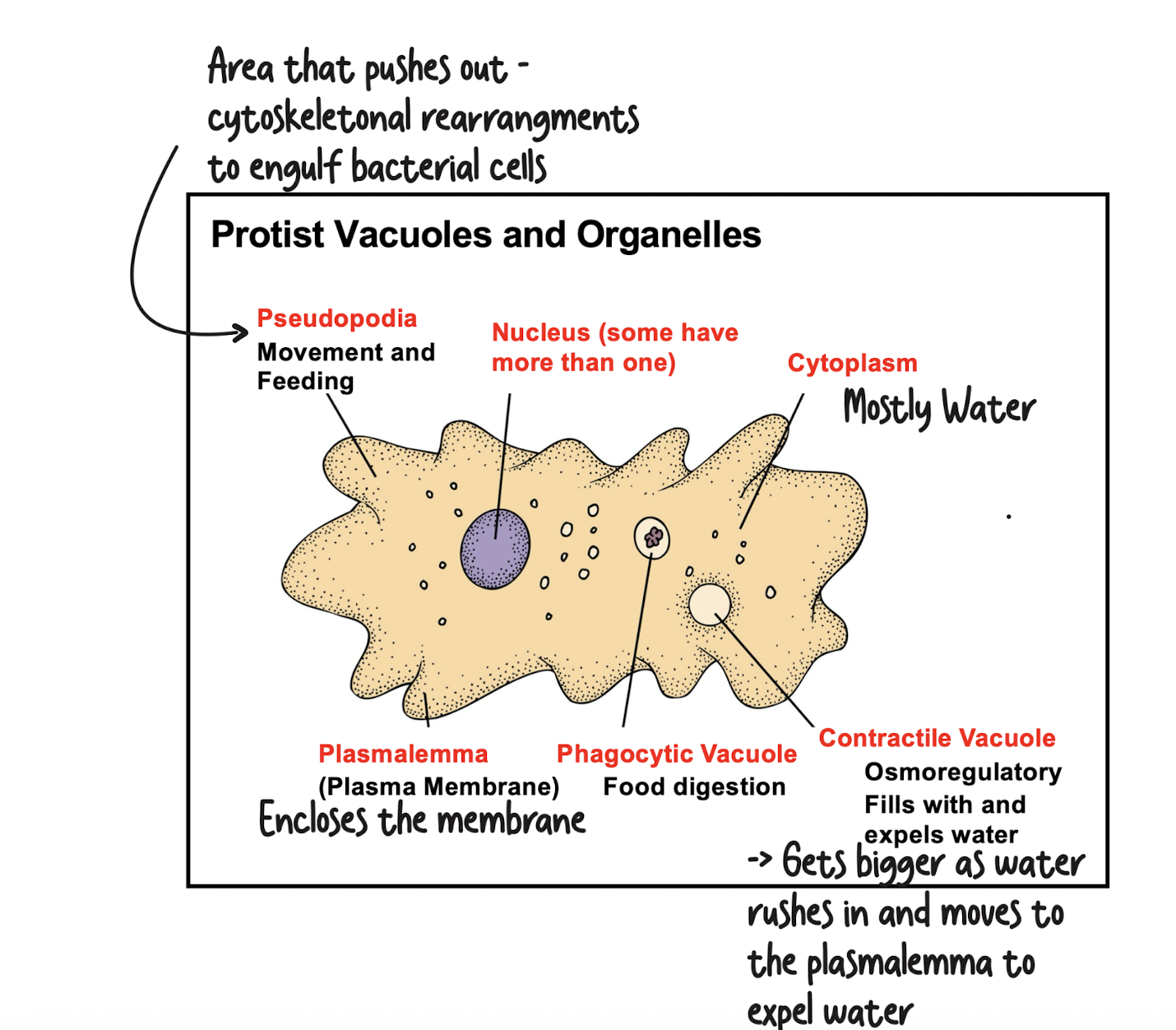
What are pseudopodia?
Extensions of the plasma membrane used for movement and engulfing prey.

How do protists move?
Using cilia, flagella, or pseudopodia.
How do protists reproduce?
Sexually and/or asexually.
What are the two major forms of protist nutrition?
Photosynthesis and chemoorganoheterotrophy.
How do protists obtain solid nutrients?
Phagocytosis.
How do protists obtain soluble nutrients?
Facilitated diffusion and active transport, including ABC transport.
What is the function of the plasma membrane in protists?
Encloses the cell.

What is the function of a phagocytic vacuole?
Digestion of engulfed food.

What is the function of a contractile vacuole?
Osmoregulation; collects and expels excess water.

Whats the function of Pseudopodia
Movement and Feeding

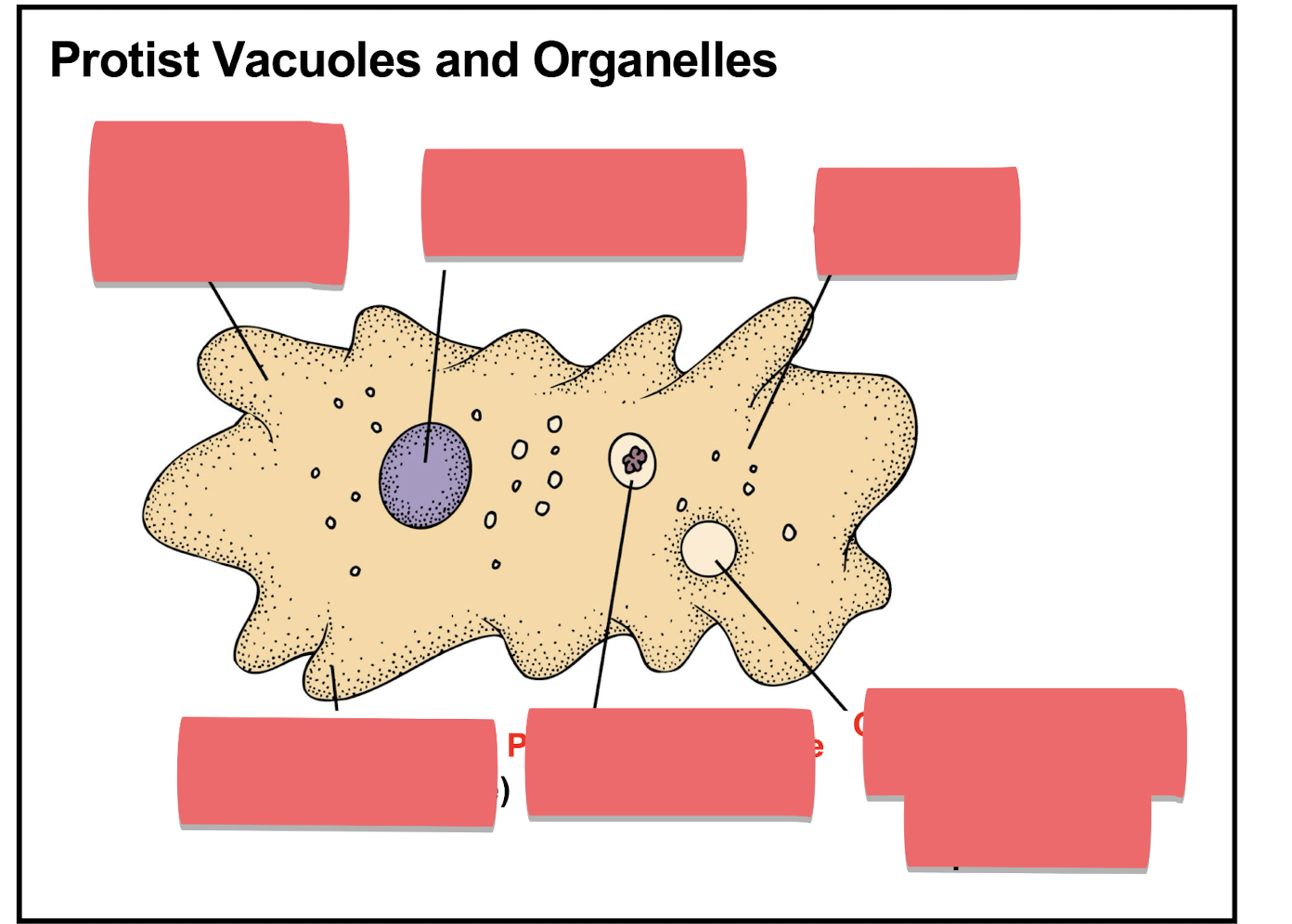
Label all parts of the protist
What happens during encystment?
A protist develops into a dormant cyst for protection and transmission.
What happens during excystment?
The cyst releases a metabolically active, motile trophozoite.
What is a trophozoite?
The metabolically active, motile form of a protist.
What is a cyst?
A dormant, protective stage of a protist.
What is Chlamydomonas?
A unicellular green alga protist that performs oxygenic photosynthesis.

What are the characteristics of Chlamydomonas?
Cellulose cell wall, two flagella, and an eyespot called a stigma.
Based off of these characteristics name the genus: Cellulose cell wall, two flagella, and an eyespot called a stigma.
Chlamydomonas
What is the function of the Chlamydomonas stigma?
Phototaxis; helps the organism respond to light.
What are photoreceptors?
Structures that detect light.
What causes watermelon snow?
Strains of Chlamydomonas containing chlorophyll and carotenoid pigments.
How can watermelon snow contribute to glacial melting?
Pigments darken the snow and contribute to increased absorption of sunlight.
What is Dictyostelium?
A cellular slime mold.

Based off these characteristics name the genus under the protists: A cellular slime mold.
Dictyostelium
How does Dictyostelium obtain nutrients?
Phagocytosis of bacteria.
What happens during the Dictyostelium life cycle?
Free-living amoeboid cells aggregate into a motile slug and form a fruiting body with spores.
Label the lifecycle of Dictyostelium


What signal helps Dictyostelium cells aggregate?
cAMP (cyclic AMP).
What is the function of spores in Dictyostelium?
They are released and germinate into free-living amoeboid cells.
What is Giardia?
A protozoan parasite and human pathogen.
Based off of these characteristics name the genus: A protozoan parasite and human pathogen that causes Giardiasis
Giardia
What disease does Giardia cause?
Giardiasis.
How is Giardia transmitted?
Ingestion of cysts, often through contaminated water.
What happens after Giardia cysts are ingested?
They become trophozoites that attach to the intestine.
How do Giardia trophozoites attach to the intestine?
Using a sucking disc.
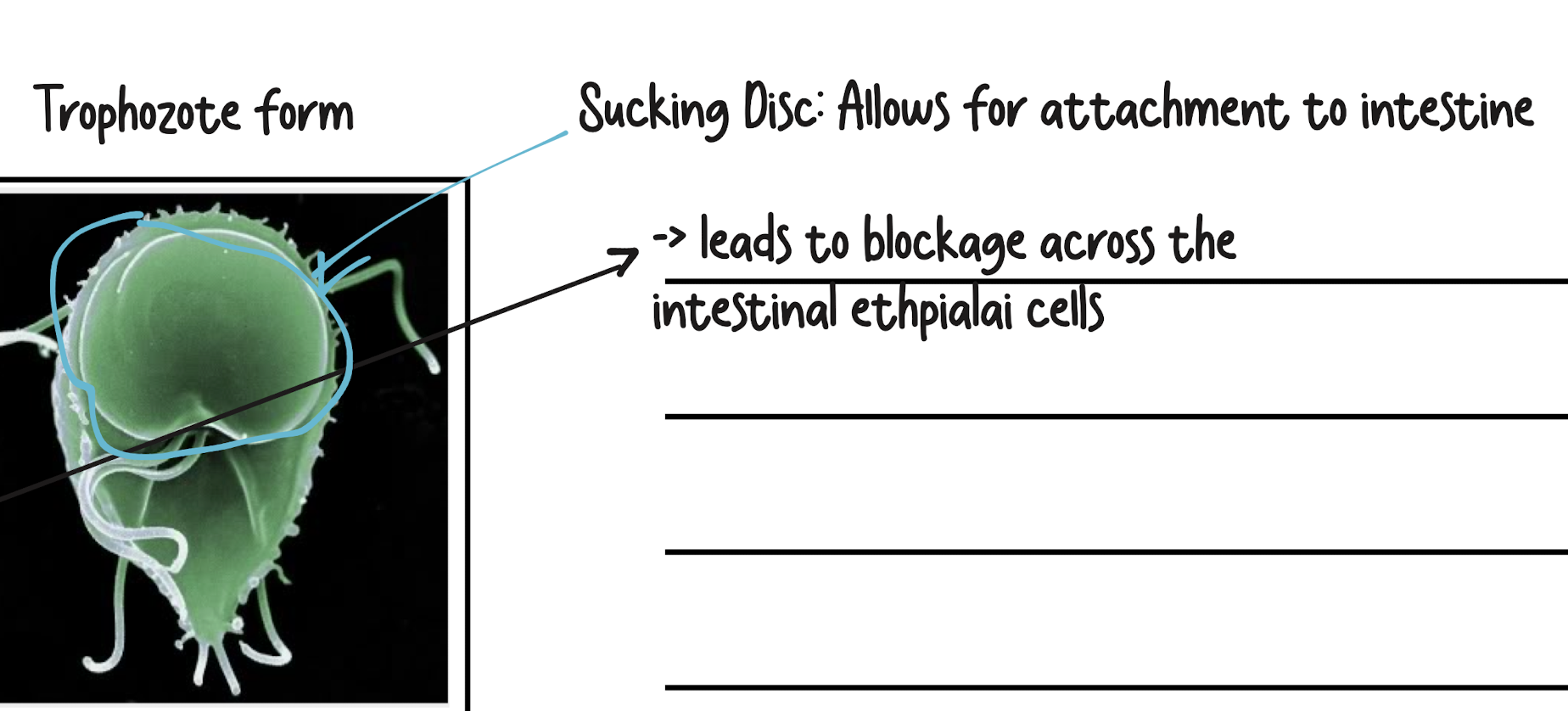
How does Giardia cause disease?
Attachment disrupts nutrient and water flow, causing severe diarrhea and fluid loss.
What should backpackers consider when filtering water for Giardia?
The filter must remove the cyst form.
What is Naegleria fowleri?
A free-living aquatic amoeba and thermophile.
Where does Naegleria fowleri live?
Warm, nutrient-rich freshwater.
What is the infectious form of Naegleria fowleri?
The trophozoite.
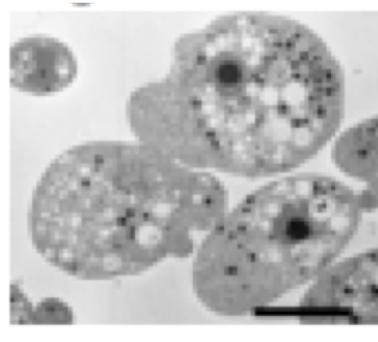
How does Naegleria fowleri enter the human body?
Through the nose.
What disease does Naegleria fowleri cause?
Primary amebic meningoencephalitis (PAM).
Name the genus and species based off of these characteristics: A free-living aquatic amoeba, lives in warm, nutrient-rich freshwater and causes Primary amebic meningoencephalitis (PAM).
Naegleria fowleri
What is the Alveolata?
A large group of protists that includes dinoflagellates, ciliates, and apicomplexans.
What are the characteristics of dinoflagellates?
Two flagella located in longitudinal and transverse grooves.
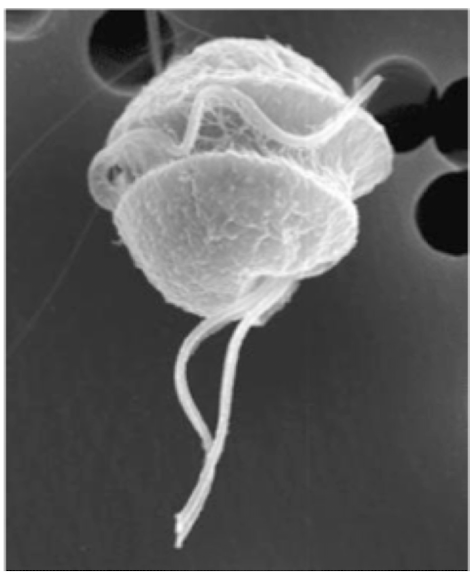
What environmental phenomenon can toxic dinoflagellates cause?
Red tides.

What are the characteristics of ciliates?
Use cilia for movement and contain two types of nuclei.
What are the two types of nuclei in ciliates?
Micronucleus and macronucleus.
What is the micronucleus?
The true nucleus of a ciliate.
What are characteristics of the ciliate macronucleus?
Contains thousands of short, linear chromosomes and genes for growth and feeding.
What are apicomplexans?
Protists with an apical complex used to penetrate host cells.
What is the function of the apical complex?
Releases proteins and enzymes that help the parasite penetrate host cells.
Name three diseases caused by apicomplexans.
Cryptosporidiosis, toxoplasmosis, and malaria.
Which organism causes cryptosporidiosis?
Cryptosporidium.
Which organism causes toxoplasmosis?
Toxoplasma.
Which organism causes malaria?
Plasmodium.
What is the dormant form of Cryptosporidium?
Oocysts.
How is Cryptosporidium commonly transmitted?
Through ingestion of oocysts in contaminated water.
What major Cryptosporidium outbreak occurred in 1993?
Milwaukee outbreak, with over 400,000 cases.
How many Cryptosporidium oocysts can cause infection?
Approximately 8-10.
Why are Cryptosporidium oocysts difficult to eliminate?
They are small, chlorine-resistant, and stable for months.
What happens after Cryptosporidium oocysts are ingested?
They undergo excystment and become trophozoites in the intestine.
How is Toxoplasma transmitted?
Through oocysts in raw or undercooked meat and cat feces.
What animal is a natural reservoir for Toxoplasma?
Mice.
Which animals are necessary to complete the sexual cycle of Toxoplasma?
Cats.
What do Toxoplasma oocysts develop into after ingestion?
Tachyzoites.
Where do Toxoplasma tachyzoites localize?
Neural and muscle tissue.
What can Toxoplasma tachyzoites cross?
The blood-brain barrier and placenta.
What precaution does the lecture recommend regarding cat litter during pregnancy?
Avoid changing cat litter during pregnancy.
What organism causes malaria?
Plasmodium.
How many Plasmodium species cause malaria according to the lecture?
Four species.
How is malaria transmitted?
By the bite of an infected female Anopheles mosquito.
What form of Plasmodium enters the human bloodstream?
Sporozoites.
Where do Plasmodium sporozoites travel first in humans?
The liver.
What do Plasmodium sporozoites become in liver cells?
Merozoites.
Where do merozoites travel after being released from liver cells?
Red blood cells.
What happens when Plasmodium merozoites infect red blood cells?
They reproduce cyclically and continue infecting red blood cells.
What causes periodic fever spikes in malaria?
The cyclic nature of parasite infection and red blood cell disruption.
What causes anemia in malaria?
Destruction of red blood cells.
How does Plasmodium affect blood vessels?
Parasite proteins form knobs on red blood cells, causing them to stick to blood vessel walls.
What can happen when infected red blood cells stick to blood vessel walls?
Disrupted blood flow.
What are clinical symptoms of malaria?
Periodic chills, fever, anemia, and enlarged liver.
What are methods of malaria prevention and control?
Mosquito control through wetland drainage, insecticides, and netting.
What drug is mentioned for malaria treatment?
Chloroquine.
How does Malarone work according to the lecture?
It blocks electron transport and oxidative processes.