Mechanics 4th | 1st term
 Call Kai
 Learn
 Practice Test
 Spaced Repetition
 Match
 Flashcards
 Knowt Play
1/28

Earn XP
Description and Tags
يارب الأول زي كل سنة
29 Terms
Scalar quantity
Is determined by a magnitude only such as: mas , volume , length , time.
Vector quantity
Is determined by a magnitude and a direction like velocity , force , displacement weight.
The Directed Line Segment (Vector)
Is a line segment which has:
a starting point,
an ending point and a
direction from the start to the end.

Two directed line segments are said to be equivalent if:
They have the same norm (length).
They have the same direction.
Norm equals to
sqrt(X² + Y²)
Position Vector to a given point with respect to the origin:
Is the directed line segment which its starting point is the origin point and the given point is its ending point.
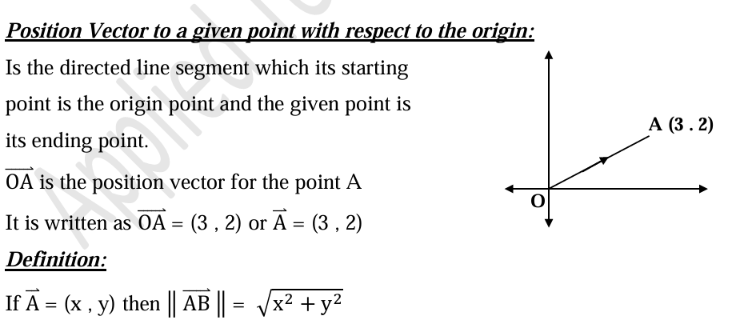
The Polar form of the position Vector:
The vector OA makes an angle 𝜃 with the positive direction of X-axis its polar form is (‖ AB ‖ , 𝜃).

To convert from the polar form to the Cartesian coordenate form:
If the polar form of the vectors A is: (‖ AB ‖, 𝜃)
Then the coordinates of the vectors A is: (‖AB‖ cos𝜃 , ‖ AB ‖ sin 𝜃)
Some Properties of vectors:

Expressing the vector in terms of the fundamental unit vectors:
A = xi + yj
where i and j are unit vectors

Parallel and Perpendicular of two vectors:

Parallel formula
X_1 Y_2 - X_2 Y_1
A = k B
then A and B are Parallel vectors
Perpendicular formula
X_1 X_2 + Y_1 Y_2
Expressing 𝑨𝑩 in terms of the position vectors of its ends:
If A (X_1, Y_2), B (X_2, Y_2)
Then AB = B - A
Effectiveness of the force depends on
Magnitude
Direction
Point of action
Kgf (Kg.wt) =
9.8 Newton
Newton =
105 Dyne
Units of Magnitude of the force
Kg.wt
Newton
Gm.wt
Dyne
Smallest measuring unit of force is
Dyne
1 N = 10^5 Dyne
F1 and F2 are two forces meeting at a point and the measure of the angle between them is α and the magnitude of their resultant “R” makes an angle ɵ with F1 , then
R = Sqrt [ (F1)2 + (F2)2 +2F1F2 * Cos(𝛂) ]
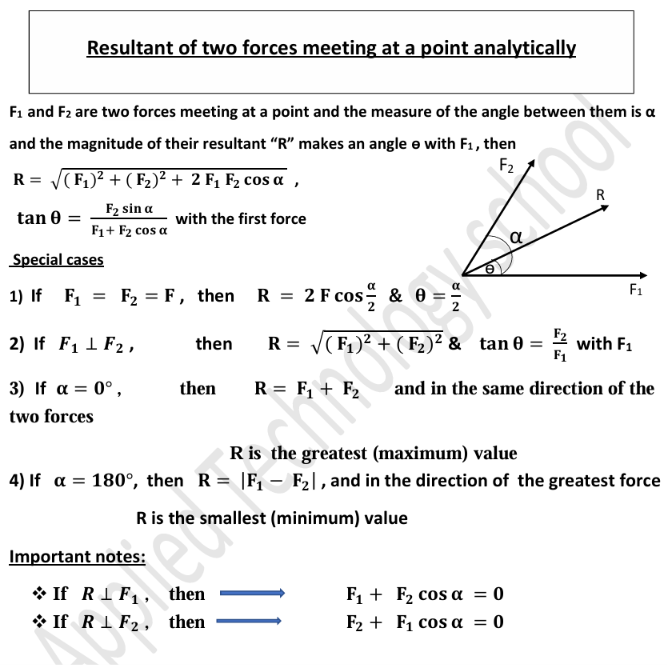
If R is perpendicular on F1
F1 + F2 cos a = 0

if 𝛂 = 0
R is Maximum
if 𝛂 = 180
R is Minimum
F1 =
F1 = R Cos(𝜽𝟏)

F2 =
F2 = R Cos(𝜽2)

If the system of forces is in equilibrium, then
X = 0
Y = 0
R = 0
The body is in equilibrium under the action of two forces if the forces are:
equal in magnitude
opposite in direction
their lines of actions are on the same straight line
If three forces meeting at a point and acting up on a particle equilibrium, then the magnitude of each force is proportional to the sine of the angle between the two other forces.
Lami’s Rule

The triangle of forces rule
If three forces acting at a point are in equilibrium and a triangle is drawn whose sides are parallel to the lines of action of the forces and taken in the same cyclic order, then the lengths of the sides of the triangle are proportional to the magnitudes of the corresponding forces
