Microbiology - Exam 2
 Call Kai
 Learn
 Practice Test
 Spaced Repetition
 Match
 Flashcards
 Knowt Play
1/138

There's no tags or description
Looks like no tags are added yet.
Name | Mastery | Learn | Test | Matching | Spaced | Call with Kai | Chat |
|---|
No analytics yet
Send a link to your students to track their progress
139 Terms
Sepsis
Indicates bacterial contamination
Asepsis
Indicates absence of significant contamination
Antimicrobial agents that end in -cidal
Kills microorganisms
Antimicrobial agents that end in -static
Inhibit microbial growth
Sterilize
Destroying all microbes even endospores but not infectious prions (autoclave)
Disinfectant
Kills microbes but not endospores, at least not all (bleach)
Sanitize
Reduce microbial numbers, usually food/drink utensils, but not sterilize (industrialized dish washers)
Antiseptic
Kills/inhibits microbial growth but it’s nontoxic enough to be applied to living tissues (hydrogen peroxide/hand sanitizer - inhibits more than kills)
Degermation
The physical removal of microbes by primarily mechanical means (injection sites)
Heat steriization
Most common technique to control microbial growth
Moist heat works better than dry heat (humidity tends to help penetrate cells)
Thermal death time (TDH)
A test used for heat sterilization to measure the amount of time it takes to kill all cells at a given temperature
Determined by decimal reduction time = the amount time it takes to kill 90% of microbe population
(Exponent + 1) x DRT = TDT
Autoclave
A sealed device that used steam under pressure
The pressure prevents liquids/water from evaporating, enabling it to reach temperatures above 100°C and their boiling point to kill endospores/thermophiles
The temperature is what’s actually killing the microbes, not the pressure
Pasteurization
A process that uses precisely controlled heat to reduce (not kill) microbial growth/load in a sensitive liquid
Radiation
Used for sterilization
High energy light targets specific spots
Damages DNA
UV
A form of radiation that decontaminates surfaces, but it needs direct contact (ex-can’t go through glass)
Works by causing formation of thymine dimers, bonds in between thymine nucleotides that stop DNA/RNA polymerase = no translation/transcription
Darker skin tones have more pigment that gives them protection
Filters
HEPA filters
Membrane filters
Collect microbes that are larger than the pore size of the filter
HEPA = filter microbes >300nm (for viruses, not as effective)
Membrane filters = filters liquids
Minimum inhibitory concentration (MIC)
The smallest amount of agent/antibody needed to inhibit growth of microbe
Bigger zone = more susceptible bacteria = generally lower MIC = less antibiotic needed to inhibit growth
Culture medias
Nutrient solutions for laboratory growth (typically sterilized in autoclave)
Chemical constituents in culture medias
Defined media: exact chemical composition known
Complex: digests of microbial, animal, or plant products (yeast/meat extracts), where the exact amount of individual components are unknown (there’s a large excess of multiple components)
Physical nature of culture medias
Solid agar: provides a large surface area for growth
Semi-solid agar: has less agar and is useful for identifying motility
Liquid medium: no agar that supports suspended growth
Types of functions for culture medias
Enriched medias: complex mediums plus highly nutritious material = everything grows
Selective medias: inhibit some microbes while allowing others to grow
Differential medias: contain a dye that changes color with a particular metabolic reaction
Fastidious
Bacteria that need a lot of nutrients to grow
Mannitol salt agar
Shows selective (via salt) and differential effects (via color)
How do bacteria reproduce?
Binary fission
Generation/doubling time is the time for cell replication
Bacterial growth curve
LAG = getting used to/adapting to environment
LOG = rapidly growing in a short amount of time; ↑nutrients to support replication (replicating faster than dying)
Stationary = ↑wastes, ↓nutrients; endospores can form in this phase (dying and replicating at same rate)
Death = ↑wastes, no nutrients; endospores can form in this phase (dying faster than replicating)
Psychro
Cold
Meso
Intermediate
Thermo
Heat/hot
Hyper
High/excess
Hypo
Low/under
Halo
Salt
Phile
Loving
Osmo
Push
Xero
Dry
Macro
Large
Micro
Small
Obligate
Must
Faculative
Optional
Aero
Air
A/an
Not
How does temperature affect microbes/enzymes?
Lower temperatures slow transport and enzymes (typical range = <40°C)
Psychrophiles
Low, found in cold environments (<15°C)
What are some cold adaptations?
Enzymes that work optimally at lower temperatures
Mesophiles
Midrange, most likely to grown on humans (20-45°C)
Thermophiles
High, found in hot environments (45-80°C)
What are some heat adaptations?
Cytoplasmic/cellular membrane modifications for heat stability
Hyperthermophiles
Found in extremely hot environments like hot springs or deep see hydrothermal vents (>80°C)
How does pH affect microbes/enzymes?
pH changes can disrupt membranes and alter transport protiens/enzymes
Neutrophile
Neutral environments
ph = 7
Acidophile
Acidic environment
pH = ↓7
Alkaliphile
Basic environments
pH = ↑7
How does osmolarity affect microbes/enzymes?
Solute concentration (salt/sugar) in water
High solute concentrations inhibit microbial growth (explains salt as preservative)
Non-halophiles
Hate salt
Halotolerant
Tolerate added solutes but usually grow best without it (skin)
Halophiles
Love salt (sea-water)
Extreme halophiles
Love extremely salty environments
Osmophiles
Loves sugar
Xerophiles
Hate water
Love dry environments
Catalyse
An enzyme that breaks down toxins released by O2
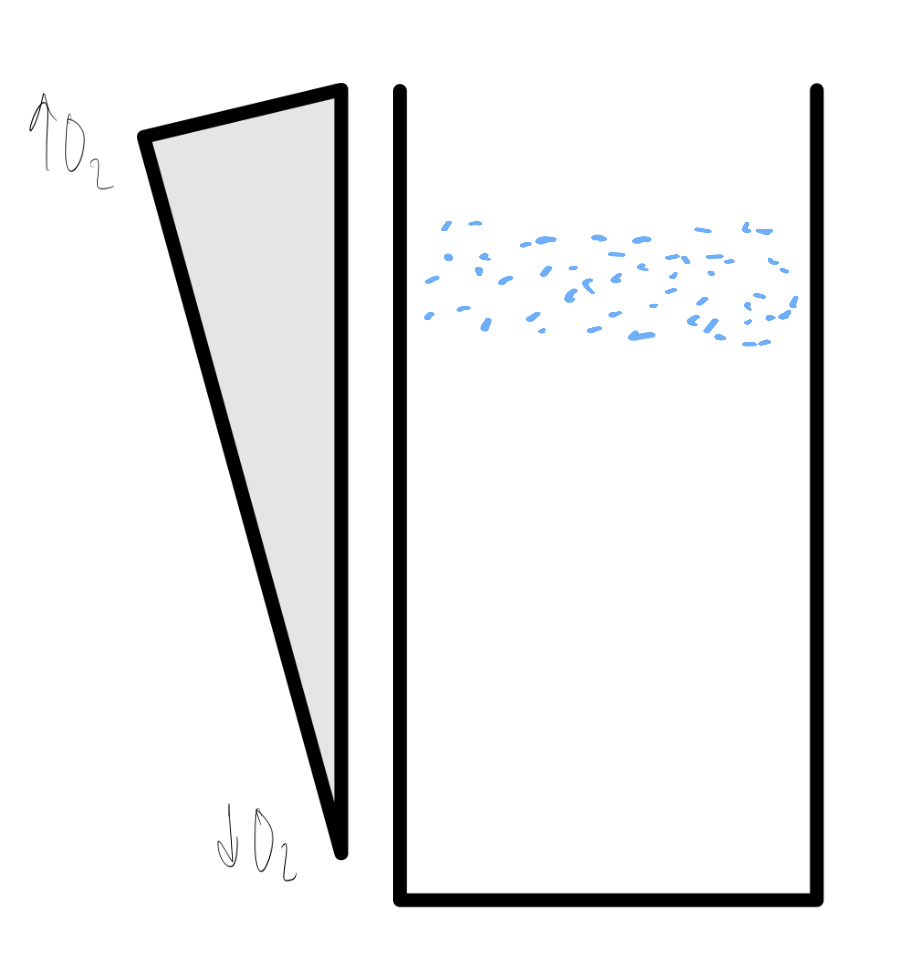
What type is this bacterias O2 preference?
Microaerophile (ocean)
Catalyse

What type is this bacterias O2 preference?
Obligate anaerobe (gut)
Respiration: anaerobic
ECT: Fe/etc.
No catalyse because no O2

What type is this bacterias O2 preference?
Aerotolerant (strep)
Fermentation
Catalyse
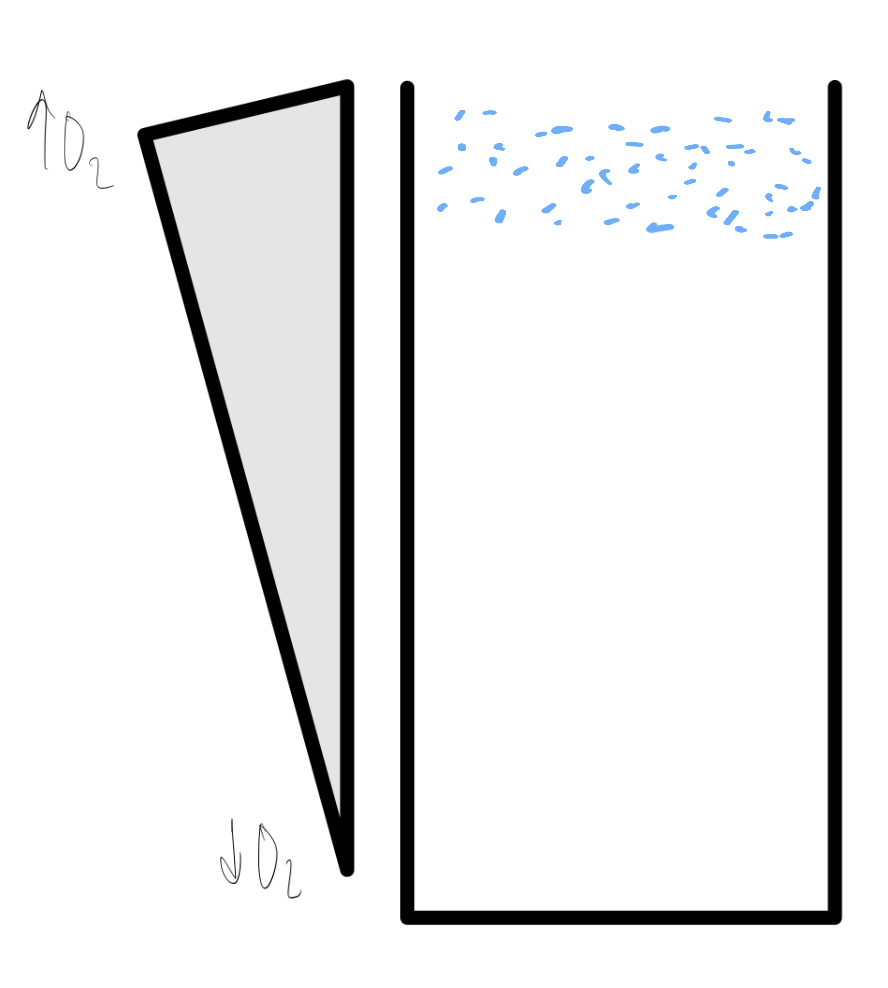
What type is this bacterias O2 preference?
Obligate aerobe (skin)
Respiration: aerobic
ECT: O2
Catalyse

What type is this bacterias O2 preference?
Facultative anaerobe (gut)
Respiration: anaerobic or aerobic
More energy/ATP = more O2
Catalyse
Biofilms
Collections of microorganisms that attach to inert/living surfaces
Surround by a sugar glycocalyx
Planktonic growth
Suspended in liquid (swimming/moving around)
Sessile growth
Attached to a solid surface (stuck)
How do biofilms form?
Planktonic cells move towards surfaces via flagella and attach via fimbriae to produce a glycocalyx
More baceria join using pili to move onto the surface
Cells can detach into liquid and start a new biofilm
What are some advantages of biofilms?
Their sugary glycocalyx provides protection
Resists phagocytosis
Collects nutrients
Resists penetration of toxic molecules (antibiotics)
What are the steps in microbial evolution?
Mutation (rapid)
Transformation (environmental DNA)
Transduction (virus carries DNA)
Conjugation (direct contact0
Mutation
During replication, DNA polymerase makes mistakes while copying parental DNA
Transformation
Microbes take DNA from the environment/free floating DNA from dead bacteria and makes it a part of its own chromosome
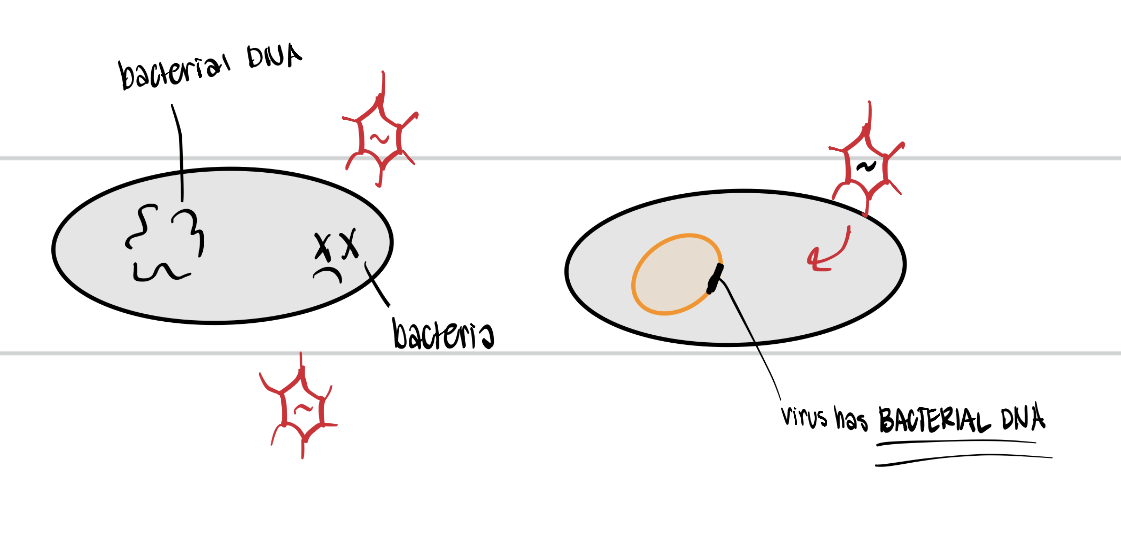
Transduction (lysogenic cycle)
A virus takes specific bacterial DNA near where it was attached and carries it to another bacterium

Transduction (lytic cycle)
A virus accidentally picks up random bacterial DNA and carries it to another bacterium
Essentially, a virus packages a dead bacteria’s DNA instead of viral DNA
Conjugation
Transfer of DNA from one bacterium to another requiring cell-to-cell contact (via pili) and F-factor
F-
No F-factor
F+
F-factor located in a plasmid
HFR
F-factor located in the actual chromosome
What happens when F+ —→ F-
Pili grab, fuse, replicate, and split
Plasmid with F-factor is copied by DNA polymerase and can go infect another F- cell
START: F+/F-
END: F+/F+
What happens when HFR ——> F-
Pili grab, fuse, replicate, and split
START: HFR/F-
END: HFR, F- with ½ of F-Factor
Builds a level of resistance/overall beneficial function
Trp
Required for living
Builds tryptophan
Lac
Not required for living
Breaks down lactose
Where does RNA polymerase bind?
Promoter
Where does a repressor bind?
Operator to inhibit transcription
Inducible operon
Metabolite binds to repressor to keep it from binding to the operator
—LAC—
When Lac levels are high, Lac binds to repressor so transcription/translation can occur to break down lactose
Repressible operon
Metabolite binds to the repressor so it binds to the operator
—-TRP—
When Trp levels are high, Trp binds to the repressor so transcription/translation are STOPPED = lowering Trp levels
↑Trp
Trp bound to repressor = repressor on operator = blocked transcription/translation

↓Trp
No Trp to bind to repressor = repressor doesn’t bind to operator = transcription/translation occur

↑Lac
Lac bound to repressor = repressor isn’t bound to operator = transcription/translation occur

↓Lac
No Lac to bind to repressor = repressor binds to operator = blocked transcription/translation

Describe what happens with ↓Lac ↓Glucose
cAMP binds to the cap site on a Lac operon and increases RNA polymerase binding causing low levels of transcription/translation

What’s involved in DNA replication?
Helicase: unzips DNA
Topoisomerase: binds at region ahead of helicase to prevent supercoiling
DNA polymerase: adds complementary nucleotides
DNA ligase: seals any gaps between DNA fragments
What’s transcription and what’s involved?
Transcription: creates a single stranded mRNA copy of DNA for protein production
RNA polymerase: used to make RNA out of DNA
What’s the difference between DNA polymerase and RNA polymerase
DNA polymerase uses DNA to make DNA
RNA polymerase uses DNA to make RNA
How does RNA polymerase work?
Binds to the promotor and opens up the double stranded DNA
Makes complementary RNA copy of one DNA strand (nucleotides)
Stops at the terminator which then releases the mRNA
What’s translation and what’s involved?
Translation: uses mRNA to make protein at a ribosome
Ribosomes: site of protein synthesis
mRNA: carries instructions out of nucleus into ribosomes
tRNA: has anticodons with amino acids attached
rRNA: provides structural and catalytic components
What’s the sequence of translation?
Initiation: ribosomes scans mRNA dor AUG start sequence
Elongation: ribosomes read codons the tRNAs attached to amino acids bind forming a chain of amino acids
Termination: stop codon is reached and the protein is released
Semiconservative replication
One original DNA strand from the parent and one that was newly generated
Polyribosomes
Multiple ribosomes attached to one mRNA
Can transcription and translation occur at the same time in bacteria?
Yes, it allows for rapid protein production