Protozoan Groups -Chapter 11
 Call Kai
 Learn
Learn Practice Test
 Spaced Repetition
 Match
Match Flashcards
 Knowt Play
1/53

There's no tags or description
Looks like no tags are added yet.
54 Terms
Protozoan Characteristics
They are found wherever life exits
They are highly adaptable
Easily moved from place to place
The required moisture
They may be sessile or free living
They form a large part of the suspended plankton
They have to perform every function that they need to survive
Unicellular but many are colonial meaning they live close together
All symmetries found within the group
All feeding modes found in the group
What is the term denoting structures found within a cell?
Organelles-have specific functions
Aquatic Habitat
-Most are free-living
-Algae are the base of the food web and primary producers exposed to sunlight.
Parasitic protists
Complex life cycles with multiple habitats including multiple hosts.
Not free living.
Autotrophs like algae
Photosynthesizers-make their own energy through photosythesis
They also need- minerals/nutrients, water. CO2
Protozoa are heterotrophs
They consume other beings to get their nutrients and organic materials.
Phagocytosis
Ingest whole prey by engulfing them
Parasitic Protists nutrition
Consume resourses taken from their hosts
Unicellular Forms and Small Colonies
Comprise phytoplankton communities in oceans and lakes
Colonial Algae
Sometimes they can form large colonies for example, seaweed
Protozoan Vs Plants
Protozoans do not have roots and leaves and are composed of single cell organisms. They also can’t transport water and food.
Two Kinds of Asexual Reproduction for Protozoans
Binary Fission and Schizogany
Binary Fission
Asexual
A form of mitotic division
A simple form of reproduction where one cell splits into two identical cells
Schizogany
Asexual
repeated nuclear divisions followed by simultaneous cytokinesis
one cell divides many times to produce many new cells at once.
Two Kinds of Sexual Reproduction that occur in Protozoans
Syngamy and Conjugation
Syngamy
Sexual
Fertilization of one haploid gamete by another they join together to form one cell
conjugation
Sexual
mutual exchange of genetic material
Two cells join together exchange genetic material and become more genetically diverse, then break apart
Cilia
small, hairlike structures, usually very numerous
Flagella
long, whip-like, few in number
pseudopodia
locomotion (false feet)
lobopodia
Blunt and temporary-Amoeba
Axopodia
long, thin, with rigid rod (Prey)
reticulopodia
are branching, net-like (prey)
How does gas exchange occur in protozoans?
-simple diffusion from high to low concentration
-no special organelles or system-limits size
-diffusion occurs across the cell membrane this limits how large protozoans --can be because the surface-area-to-volume ratio decreases as they get bigger
-This is why very small/flat/skinny organisms don’t need specialized gas-exchange structures.
How does excretion occur in protozoans?
Simple diffusion from high to low concentration (because of high surface-area-to-volume ratio)
What is the major end product of protein metabolism in protozoans?
ammonia
What is osmoregulation?
Maintaining the appropriate solute/water balance (this is part of homeostasis)
What is the osmoregulatory challenge for freshwater protozoa
Water tries to push from the more concentrated area outside of the cell and the cell is saltier so water wants to go to the cell.
What is osmosis?
Movement of water form more higher concentration to lower concentration
what if the solute can’t move through a barrier (like a cell membrane)?
The water moves
What is exocytosis?
Contractile vacuoles gather and eject excess water
How do Contractile Vacuoles work?
“proton pumps” actively transport H+ and HCO3- ions, drawing water across lipid membrane of vacuole
How do marine protists cope with osmotic pressures?
-Most or all species are probably “osmoconformers”, not “osmoregulators”.
-This means their internal solute concentration matches seawater. Cope with it
-If they DO lose some water through osmosis, they can “drink” more in by forming vacuoles to take in water – this is called “pinocytosis” (and then they have to force the excess salts out).
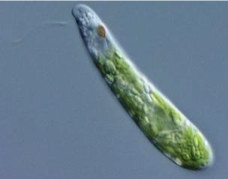
Phylum Euglenozoa
-Single Cell
-A thick outer membrane called a pellicle
-Flagellum locomotion
-have chlorophyll and red eyespot
-They are saprozoic (absorb nutrients) and many are autotrophic (photosynthesizers).
Trypanosoma
-A parasitic Euglenozoan
-causes African Sleeping Sickness in humans.
-Single cell parasites and rely on blood sucking vectors (Tsetse fly)
-sickle-shape cell with an undulating membrane driven by a flagellum
Phylum Viridiplantae
-“plant-like” protists
-unicellular or colonial, autotrophic, very diverse; land plants arose from this group of algae
Volvox
Type of Viridiplantae
-displays the most primitive form of cell specialization, or division of labor:
-most cells have two flagella to propel the colony
-some have larger stigmata to detect light
-some form gametes, for sexual reproduction
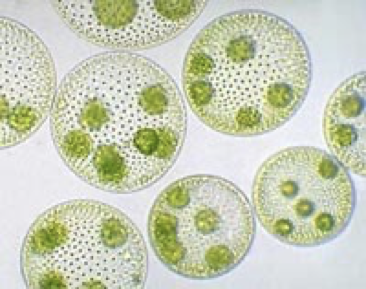
Volvox reproduction
Volvox reproduces asexually in spring and summer, but sexually in the fall
To produce thick wall zygotes to survive harsh weather. They stay dormant until they can survive and better conditions.
Ameba
are not a monophyletic* group, so they are no longer in a single phylum.
-some are ”testate” (a “test” is a rigid outer structure)
-constantly changing shape
-locomotion on a substrate using lobopodia
-feeding via phagocytosis
Amoeba proteus
NON-testate ameba are characterized by the very common species
Entamoeba hystolitica
-A parasitic non-testate Ameba
-amoebic dysentery in humans
-transmitted via untreated drinking water.
-most prevalent in tropical regions and poorer regions without treated water
Testate Ameba
has a shell
Radiolaria
-Testate Ameba
-very abundant heterotrophs in the marine plankton worldwide
-They have skeleton-like tests made of silica
-They are divided inner and outer
-They significantly contribute to the composition of the ocean bed-form rocks
Foraminifera
-are also very abundant heterotrophs in marine plankton. Primarily marine.
-Limestone is ancient deposits of these tests.
-One-third of the seabed made up of test of single genus
-Cells are covered with locomotory cilia.
-Feeding is by ingestion (phagocytosis).
-Paramecium has two star-shaped Contractile vacuoles.
-Food enters through cytostome in the oral groove.
Conjugation vs Syngamy
conjucation-an exchange rather than a transfer of genetic information
Dinoflagellates
-They have an outer test and two distinctive flagella – one circling the cell and the other trailing from it (e.g., Fig 11.27).
-Toxins secreted by certain members of this group can build up and be toxic to fish and other marine life; what is this phenomenon called?
A:”red tide”
zooxanthellae
-live in a mutualistic association in the tissues of stony corals and other invertebrates
-only corals with (“) can build coral reefs because
(“) are photosynthesizers, providing sugars to the coral polyps
Giardia
-Phylum Retortamonada
-can occur in drinking water contaminated by fecal material and can cause severe diarrhea.
Phylum Apicomplexa
-includes parasitic protozoans with complex life cycles – many are pathogenic
Plasmodium
causes the most widespread infectious disease in the world
Malaria
Definitive Host
Where sexual maturity occurs and reproduce
Intermediate Host
an organism that harbors a parasite during its immature or larval stage
Plasmodium
