Hearing Science Quiz 10
 Call Kai
 Learn
 Practice Test
 Spaced Repetition
 Match
 Flashcards
 Knowt Play
1/49

There's no tags or description
Looks like no tags are added yet.
50 Terms
Given that the speed of sound is 1100 feet per second and using the equation f = v / λ, what is the frequency of a sound with a wavelength of 2 feet?
550 Hz
What is a spectral envelope?
The overall outline of a spectrum
The separation between the N distribution and the S+N distribution is called the _____.
Discriminability index
Harmonics are _____.
Frequency components that are whole-number multiples of the fundamental frequency
The probability that a person with a negative (normal) test result is truly free of the disorder is known as _____.
Negative predictive value
What is the level, in dB SPL, of a sound with a pressure level of 200,000 μPa?
80 dB SPL
Which of the following is a function of the inferior colliculus?
Coordinates auditory and visual systems in localizing and identifying the source of any sound
The three dimensions of sound source localization are _____.
Azimuth, elevation, and distance
What is accuracy?
The percentage of total results that are correct
What is the mode of operation for the inner ear?
Mechanical, hydrodynamic, and electrochemical

What is the frequency of the sound depicted in the waveform above?
5000 Hz
What is a “hit”?
True positive
What is the subjective perception of intensity?
Loudness
Given that the speed of sound is 340 meters per second and using the equation λ = v / f, what is the wavelength of a 1500 Hz sound?
0.227 meters
The probability that a patient with a positive (abnormal) test result actually has the disorder is known as _____.
Positive predictive power
If one sound amplitude is 1000 times greater than another sound amplitude, what is the difference between the two sounds on the dB scale?
60 dB
An internal judgment of how often and at what level is required for an individual to respond during a task is known as _____.
Response bias
What is the loudness of a sound in phons?
The level in dB SPL of an equally loud 1000-Hz pure tone
When a signal is absent and a response of “signal absent” or no response is provided, this is a _____.
Correct rejection
What is the loudness in phons of a 1000-Hz tone presented at 80 dB SPL?
80
What is Weber’s law?
Law stating that a stimulus must be changed by a constant proportion of itself to be judged as different
If one sound amplitude is 10,000 times greater than another sound amplitude, what is the difference between the two sounds on the dB scale?
80 dB
A range of frequencies surrounding a given stimulus frequency that contributes to the masking of that frequency is known as a _____.
Critical band
What is the mode of operation for the outer ear?
Air vibration
Which of the following is a function of the Eustachian tube?
Provide a supply of fresh air needed for metabolism of the middle ear’s mucosal lining
What is the frequency of a pure tone with a period of 2 msec?
500 Hz
What is the mode of operation for the central auditory nervous system?
Electrochemical only
The correct rejection rate of a test/screening is known as its _____.
Specificity
A false negative is also known as a _____.
Miss
What is sensitivity?
Measure describing the abilities of a test or screening to detect a condition when it is present (true positives)
Which dB scale measures amplitude in pascals and uses a reference of 20 μPa?
SPL
A response that occurs when the stimulus is absent is called a _____.
False alarm

What would the miss rate be if the false alarm rate is 0.5 and d’ is equal to 1?
About 0.2

What would the hit rate be if the false alarm rate is 0.75 and d’ is equal to 2?
1
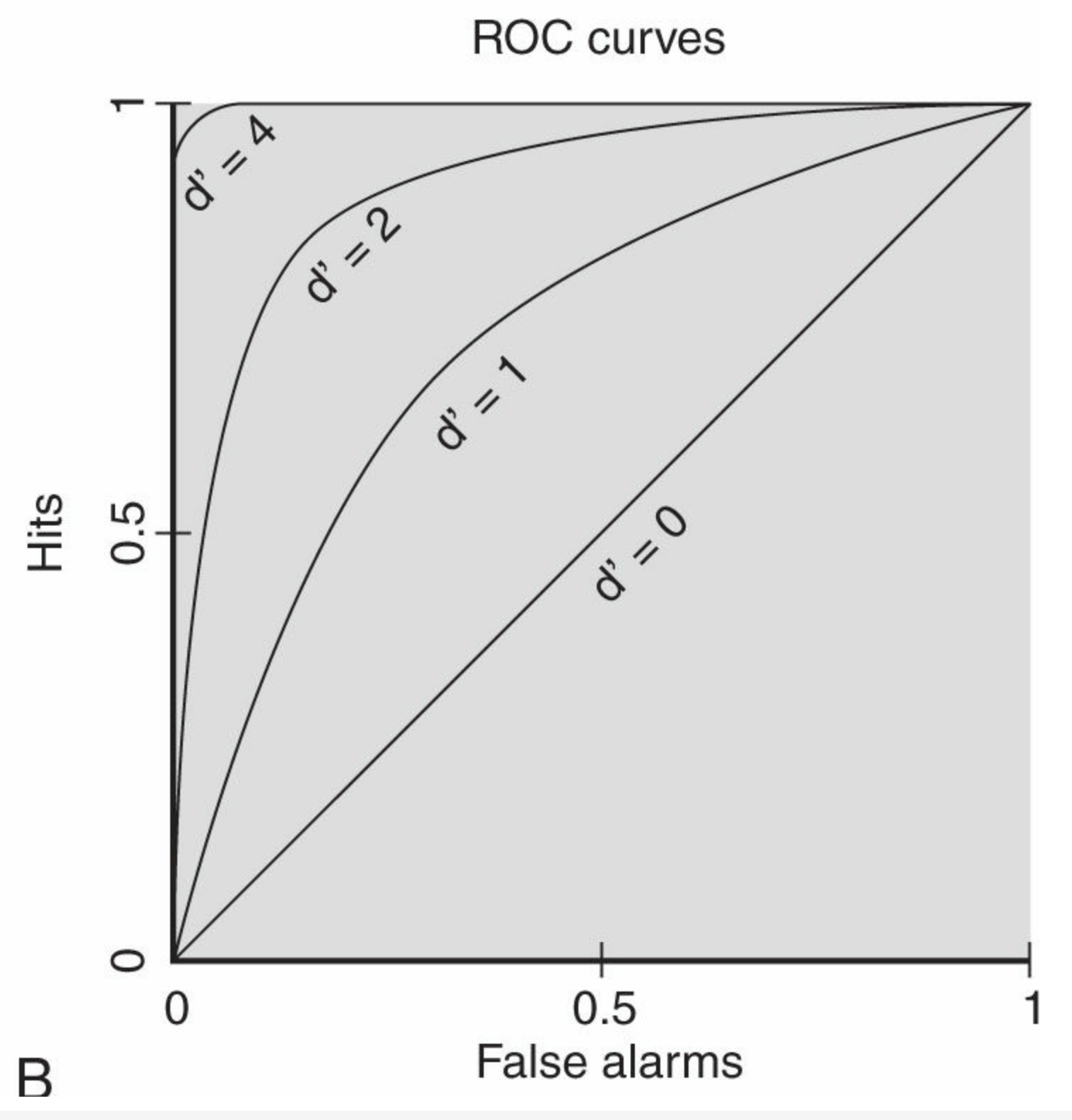
If d’ is equal to 2, and the false alarm rate is 0.25, what is the probability of a hit?
Approximately 0.88

If d’ is equal to 0 and the probability of a hit is 0.5, what is the probability of a false alarm?
0.5

In which scenario will the observer have the highest false alarm rate?
B

In which scenario does the observer have the least discriminability?
E

In which scenario will the observer have the highest miss rate?
C
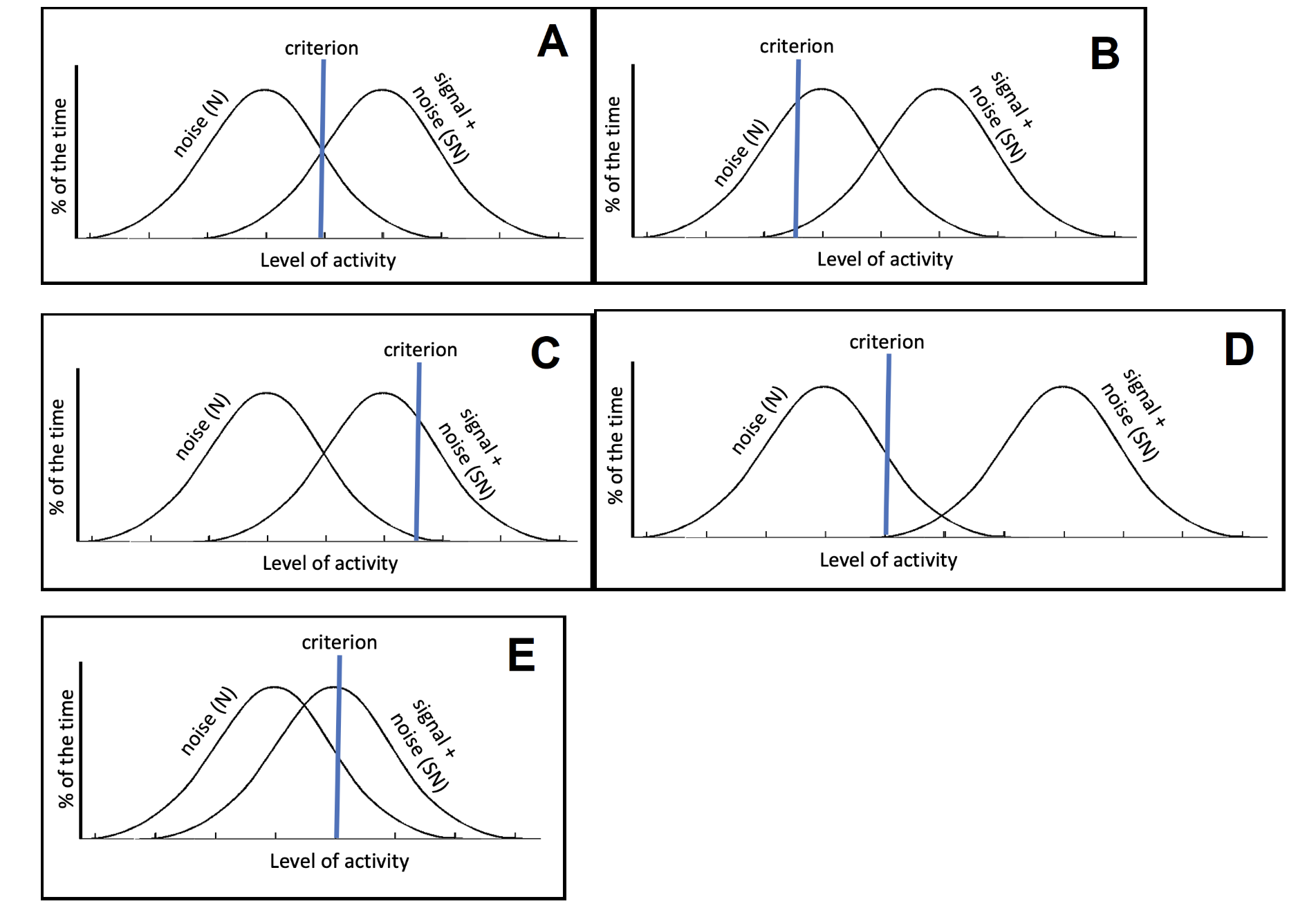
In which scenario does the observer have the greatest discriminability?
D

In which scenario will the observer have the lowest correct rejection rate?
B

Given the above distributions of neural activity and observers’ response criteria, which of these observers will have the highest false alarm rate?
Observer A

Given the above distributions of neural activity and observers’ response criteria, which of these observers will have the lowest correct rejection rate?
Observer A

Given the above distributions of neural activity and observers’ response criteria, which of these observers will have the highest miss rate?
Observer C

Which observer will have the second-highest miss rate?
Observer B

Which observer has the lowest discriminability?
They all have the same discriminability

Which of the following is the most likely explanation for Observer A’s response bias?
Observer A is motivated to show as little hearing loss as possible

Which clinical test has the higher sensitivity?
Clinical Test 1 (9/10=90% vs. 8/10=80%)
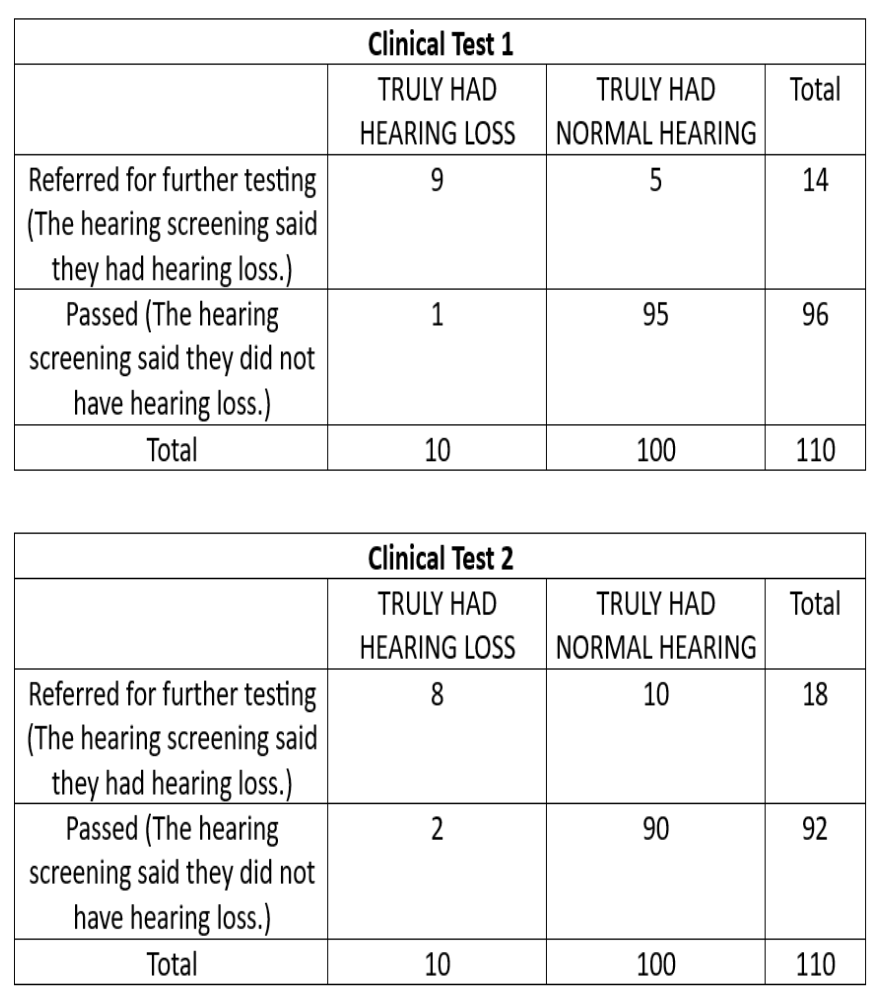
Which clinical test had better discriminability?
Clinical Test 1
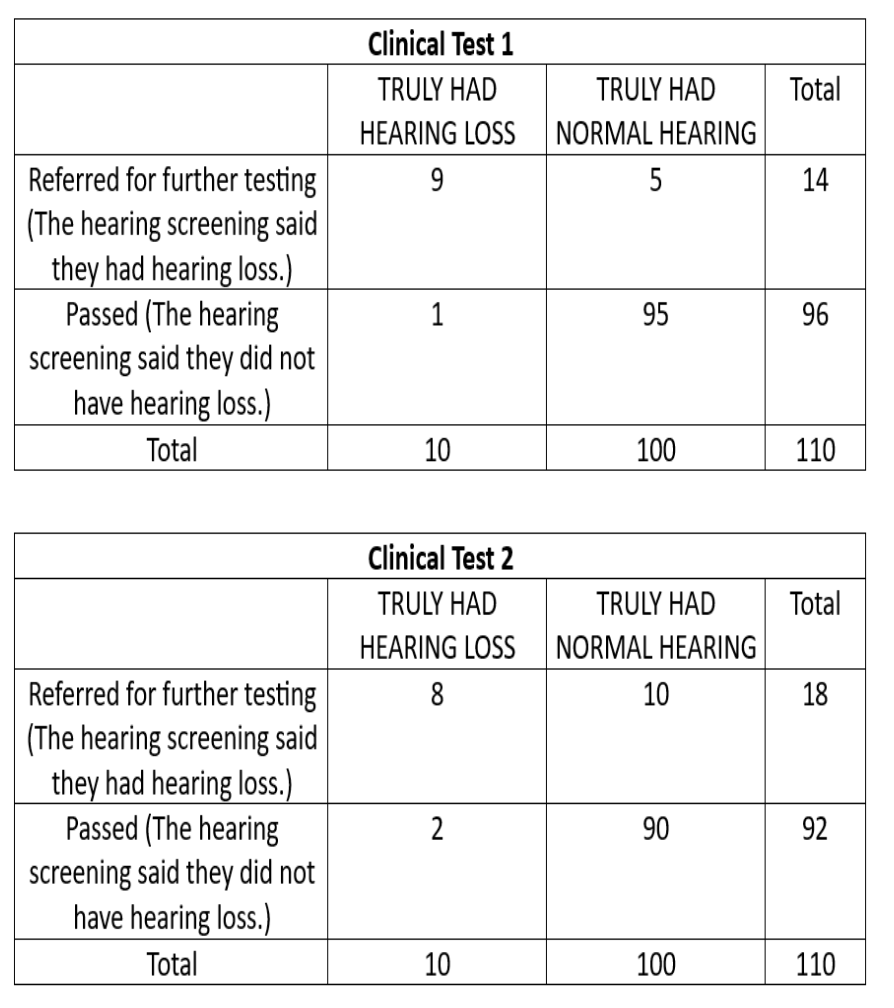
Which clinical test had the lower specificity?
Clinical Test 2 (90/100= 90% vs. 95/100= 95%)