ECN 202 L3 - Closed economy one-period model
 Call Kai
 Learn
 Practice Test
 Spaced Repetition
 Match
 Flashcards
 Knowt Play
1/10

There's no tags or description
Looks like no tags are added yet.
11 Terms
What is a basic structure of a model?
An exogenous variable (explained outside the model e.g. government spending) acts as a driver in the model which explains dynamics of endogenous variables
Properties of a competitive equilibrium
G = T
Y = C +G
Y = zF(K,N)
What is a ppf?
A model displaying the bundles between 2 goods (e.g. consumption and leisure)
What is the competitive equilibrium point?
Slope of the indifference curve = slope of PPF: MRS = MRT where:
MRS (Marginal Rate of Substitution)
How much consumption someone is willing to give up for an extra unit of leisure.
MRT (Marginal Rate of Transformation)
How much consumption the economy must give up to provide an extra unit of leisure.
The slopes are equal at J.
What is the pareto optimum?
The allocation that is chosen by a fictitious social planner to make the representative consumer as well off as possible
What are the conditions for Pareto optimality?
MRS = MTR = MPN = w
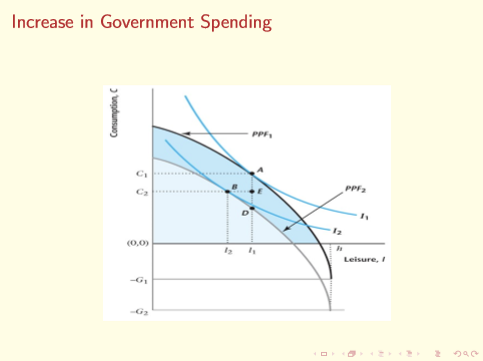
How does an increase in government spending impact the closed economy one-period model?
PPF shifts inwards as taxes rise (G=T), consumption and leisure both fall - pure negative income effect
How does an increase in TFP impact the closed economy one-period model?
Increase in TFP increases marginal productivity of labour and wage. Substitution effect: leisure is more expensive so people work more. Income effect: households are better off so work less. This shifts the PPF upwards at consumption.

Household budget constraint with a proportional labour tax
C=w(1−t)(h−l)+π When competitive profits π=0π=0, this simplifies to C=w(1−t)(h−l)C=w(1−t)(h−l).
Determination of dividend income (ππ) in the competitive linear model
π=0, because competitive firms hire labour until productivity equals the market wage (w=zw=z), yielding zero economic profit: π=Y−wN=(z−w)N=0π=Y−wN=(z−w)N=0.
PPF equation in the linear production model
C=z(h−l)−G Derived from Y=z(h−l)Y=z(h−l) and the resource constraint C+G=YC+G=Y.