PSYC1002 - mental health
 Call Kai
 Learn
 Practice Test
 Spaced Repetition
 Match
 Flashcards
 Knowt Play
1/144

There's no tags or description
Looks like no tags are added yet.
145 Terms
define mental health conditons
disorders that can impact a person’s thinking, mood, behaviour or perception
what are the three D’s and is any one sufficient for diagnosis?
deviant, distressing and dysfunctional
deviant 偏离社会常态:behaviour that is rare or inconsitent with social norms.
distressing 引起痛苦:a psychological state that causes distress to the individual 指某种心理状态使本人产生明显的心理痛苦。但有两个重要例外:
Distress may be situationally appropriate:某些情境中的痛苦完全正常。例如失去亲人后感到悲伤。
Psychopathology can occur without distress:某些心理障碍可能不伴随当事人主观感受到的明显痛苦。
dysfunctional 功能受损:impairment the ability to function in everyday life 指一个人的日常生活功能受到损害。
例如,一个人因为强烈恐惧,持续无法上学、工作或完成日常活动。
Some conditions do not interfere with goals.
Dysfunction can occur without a mental health condition.
None of the 3 D's on their own is sufficient to merit a diagnosis!
What is the biopsychosocial model of mental health?
An integrative model explaining mental health through interacting biological, psychological and social factors.
Give examples of biological, psychological and social influences on mental health.
Biological: genes, hormones. Psychological: thoughts, coping. Social: family, relationships, SES.
why do psychologists classify mental health condition?
improve research and clinical consistency, understand symptons and identify effective tratments
How does the DSM-5-TR cateforise mental health conditions?
into diagnnostic categories based on symptoms, aetiology and developmental trajectory
Symptoms(症状)
Aetiology(病因)
Developmental trajectory(发展过程)
Why do DSM diagnoses change across editions?
New scientific evidence, improved understanding of disorders and changing diagnostic concepts lead to revisions.
Reliability & Validity in mental health
Concept | 在 Mental Health Diagnosis 中的意思 |
|---|---|
Reliability | 不同专业人员在相同情况下,是否能够作出一致诊断 |
Validity | 某个诊断类别是否准确地描述或识别了目标心理障碍 |
例如:
Low Reliability: 两名专业人员面对同样的资料,却得出不同的诊断。
Low Validity: 一个诊断类别可能将具有不同病理机制的人归为同一类,不能充分反映真正的心理问题
What is the mental health continuum?
Psychological symptoms vary in degree, with no always-clear boundary between normal and abnormal.
What are major challenges in diagnosing mental health conditions?
Cultural variability, reliability and validity problems, changing norms and overlapping diagnoses.
Why do shared risk factors and different causes challenge diagnostic classification?
Different disorders may share risk factors, while the same diagnosis may arise from different causes.
Alarm
Alarm(警觉)
Definition: An attentional reaction to a possible threat.
例如,你突然看到远处有一个不明物体,觉得可能有危险,于是转头注意它。
这是 Orienting towards potentially threatening stimuli(将注意转向潜在威胁刺激)。
Fear
Fear(恐惧)
Definition: A cognitive and emotional reaction to a clear and specific threat.
当你发现那个物体真的是自己害怕的东西时,产生明确的恐惧,并想要逃离。
核心区别:Fear 针对明确存在的威胁。
Stress
Stress(应激反应)
老师在这里强调的是身体的 Fight-or-flight response(战斗或逃跑反应)。
例如:
Heart rate increases(心率增加)
Physiological arousal(生理唤醒)
Preparing for escape or defence(准备逃跑或防御)
Anxiety
Anxiety(焦虑)
Definition: A cognitive and emotional reaction to situations where a threat may appear.
焦虑不需要危险现在就出现。
例如,你知道明天可能需要经过一个有很多小丑的地方,今天就开始担心。
这种反应可能表现为 Caution(谨慎)或 Hypervigilance(过度警觉)。
Chronic Stress
Chronic Stress(慢性压力)
Definition: The physiological impact of prolonged or uncontrollable exposure to stressors.
即长期、持续或难以控制的压力,对身体造成的生理影响。
可能导致:
Burnout(耗竭)
Learned helplessness(习得性无助)
Health deterioration(健康状况恶化)
How do alarm, fear, stress, anxiety and chronic stress differ?
Alarm: possible threat; fear: clear threat; stress: physiological response; anxiety: anticipated threat; chronic stress: prolonged stress exposure.
SAM Axis - stress response system
Sympathetic-Adreno-Medullar Axis(交感-肾上腺髓质系统)
PPT p.11
SAM 是身体面对突然危险时的快速生理反应。
Threat → Sympathetic Nervous System → Adrenal Medulla肾上腺髓质 → Epinephrine / Norepinephrine 肾上腺素/去甲肾上腺素
Immediate Fight-or-Flight Response
例如,突然有一条狗朝你冲过来。
你可能立刻心跳加快、呼吸变快,身体准备逃跑或防御。
这种反应通常持续 Seconds to minutes(数秒至数分钟)。
HPA Axis - stress response system
Hypothalamic-Pituitary-Adrenal Axis(下丘脑-垂体-肾上腺轴)
HPA 主要提供 Sustained stress response(持续性的应激反应)。
它的任务不仅是让人立即逃跑,还要帮助身体维持能量及生理调整,以应对较长时间的压力。
PPT 指出,HPA 反应的峰值大约出现在应激源结束后 20 分钟。理解它比 SAM 慢即可,不需要背精确分钟数。
How do the SAM and HPA stress response systems differ?
SAM: fast sympathetic response via adrenal medulla and catecholamines. HPA: slower hormonal response via adrenal cortex and glucocorticoids.
What is the complete hormonal pathway of the HPA axis?
PVN → CRH/CRF → anterior pituitary → ACTH → adrenal cortex → glucocorticoids (cortisol in humans).
Step 1 — Hypothalamus(下丘脑)
Hypothalamus 是 Diencephalon(间脑)的一部分,负责调节 Autonomic nervous system(自主神经系统),并协调身体对威胁的反应。
在 HPA axis 中,我们特别关注:
PVN — Paraventricular Nucleus(室旁核)
PVN 释放 CRH,也称 CRF。
注意:CRH 与 CRF 在这节课的 HPA 流程中指同一个释放信号
Step 2 — Anterior Pituitary(垂体前叶)
CRH/CRF 刺激垂体前叶释放:
ACTH — Adrenocorticotropic Hormone(促肾上腺皮质激素)。
ACTH 随血液到达肾上腺皮质。
Step 3 — Adrenal Cortex(肾上腺皮质)
ACTH 刺激 Adrenal cortex 释放:
Glucocorticoids(糖皮质激素)
人类主要是 Cortisol(皮质醇)。

What are the main functions of glucocorticoids during stress?
Mobilise energy, support brain function, suppress non-essential functions, and prepare for tissue repair.
Function | 中文解释 |
|---|---|
Energy mobilisation / Enhanced brain function | 调动能量,支持应对压力时的注意力和脑功能 |
Suppress non-essential functions | 暂时抑制当前不必要的功能,如消化活动 |
Prepare for tissue repair | 帮助身体为组织修复作准备 |
hippocampus regulate the HPA axis through negative feedback?
Cortisol binds to hippocampal receptors, allowing the hippocampus to inhibit the PVN and reduce HPA activity.
遇到危险时,HPA axis 被激活。
身体释放 Cortisol,帮助应对压力。
Cortisol 与 Hippocampus 的受体结合。
Hippocampus 抑制 PVN,减少 HPA 的活动。
身体逐渐恢复 Baseline(基线状态)。

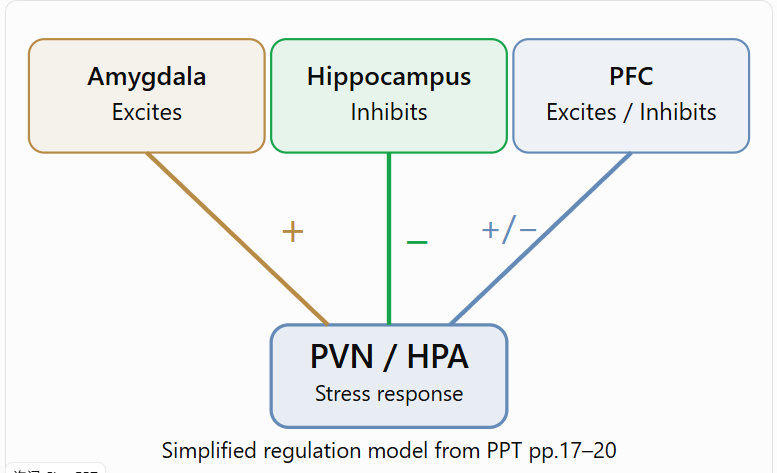
Amygdala regulating HPA
Amygdala(杏仁核)
主要功能:Threat detection & Fear learning(威胁检测与恐惧学习)。
Amygdala activation can drive the HPA response by exciting the PVN.
也就是说,Amygdala 可以通过兴奋 PVN 来促进 HPA 的活动。
例如,你发现眼前有危险,Amygdala 参与对威胁的识别,促进身体启动应激反应。
可以把它理解成 Alarm system(警报系统)。
Prefrontal Cortex (PFC) - regulating HPA
Prefrontal Cortex (PFC)(前额叶皮层)
主要功能:
Higher-order cognition(高级认知)
Threat assessment(威胁评估)
Decision-making(决策)
PFC 很重要,因为它可以评估你遇到的事情是否真的危险。
例如,你看到远处有一个看起来像蛇的东西,但仔细观察后发现只是一根绳子。
PFC 参与这种分析判断,并可以调节压力反应。
特别注意:PFC 可以 Excite 或 Inhibit HPA activity。
不能简单地把 PFC 记成只负责关闭 HPA。它对 HPA 的作用取决于具体的调节回路和情境。
Negative Feedback
Definition: A regulatory mechanism in which the response inhibits the process that produced it.
即系统产生的结果会反过来抑制最初启动该过程的活动。
Why is the PFC important for regulating stress?
It supports higher-order cognition, threat assessment and decision-making, with excitatory or inhibitory effects on HPA activity.
How do the amygdala, hippocampus and PFC regulate HPA activity?
Amygdala excites the PVN; hippocampus inhibits it via feedback; PFC can excite or inhibit HPA activity.
Brain region | 主要作用 | HPA regulation |
|---|---|---|
Amygdala | Threat detection, fear learning | Excites PVN |
Hippocampus | Memory, stress regulation | Inhibits PVN through negative feedback |
PFC | Threat assessment, decision-making | Can excite or inhibit HPA |
What Is Emotional Dysregulation?
Emotional dysregulation(情绪调节失常)
Definition: Difficulty regulating emotional responses appropriately.
即难以适当地控制和调节情绪反应。
例如,一种原本只需要轻微警惕的刺激,可能引发过度强烈或持续的恐惧与压力反应。
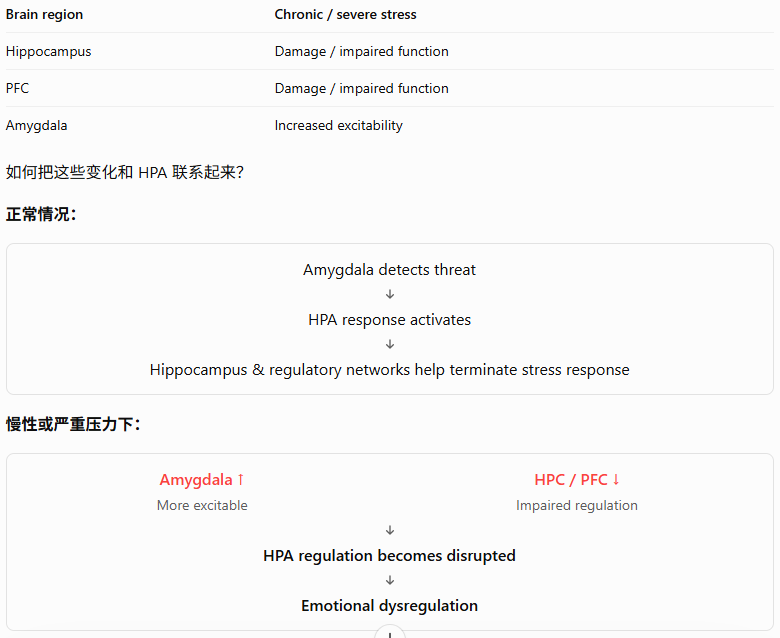
How can chronic stress cause HPA dysfunction and emotional dysregulation?
It may impair hippocampal/PFC regulation and increase amygdala excitability, disrupting stress feedback and emotional control.
define chronic stress and acute stress A
Acute stress(急性压力) 可以帮助我们应对短期危险。
Chronic stress(慢性压力) 则可能因为长期或不可控的压力暴露,对身体产生负担。
effect of chronic stress on body and brain
Effects on the Brain
Effect | 中文 | 为什么重要 |
|---|---|---|
Hippocampal damage | 海马体损伤 | 可能影响记忆及压力调节 |
PFC damage | 前额叶损伤 | 可能影响高级认知及决策 |
Increased amygdala excitability | 杏仁核兴奋性增加 | 可能加强威胁反应 |
Impaired cognitive function | 认知功能受损 | 影响思考与信息处理 |
Effects on the Body
Effect | 中文 |
|---|---|
Cardiovascular issues | 心血管问题 |
Weakened immune system | 免疫系统功能减弱 |
Health deterioration | 健康状况恶化 |
why is chronic stress causing prolems?
7.3 为什么慢性压力会产生这么多问题?
理解这个比单纯背结果更重要。
当身体短时间处于危险之中时,调动能量、提高警觉、暂时降低某些日常功能是有益的。
但如果这种应激状态不断重复或持续存在,身体就无法正常恢复。
因此,原本用于短期生存的压力反应,可能成为长期生理负担。
这并不表示压力必然造成永久脑损伤,也不表示经历慢性压力的人一定会患心理障碍。 PPT 描述的是慢性或严重压力可能产生的不良影响。
Flashcard 9
What Influences Stress Responsivity? - biological factors
生物因素主要涉及:
Amygdala、Hippocampus、PFC 的活动及调节。
HPA axis 的激素反应。
Negative feedback 是否有效。
例如,两个人遇到相似的威胁,但如果其中一个人的 Amygdala 更容易兴奋,或者 Hippocampal negative feedback 较弱,那么其压力反应可能与另一个人不同
What Influences Stress Responsivity? - psychological factors
理因素主要包括:
Cognitive interpretation of threats(对威胁的认知解释)
Emotional responses to triggers(对触发刺激的情绪反应)
Attentional bias(注意偏向)
Attentional bias: A tendency to direct attention preferentially towards certain stimuli.
例如,一个人可能对以前曾经带来威胁的刺激特别敏感,即使现在没有明确危险,也更容易注意到那些刺激。
因此,对同一种情境的不同心理解释,可能导致不同的压力反应。
What Influences Stress Responsivity? - social factors
社会环境可能影响一个人接触到的压力源,以及他能否获得足够支持。
老师特别提到:
External threats(外部威胁)
Social support(社会支持)
Policy changes(政策改变)
例如,一个人长期承受不稳定的工作环境和经济压力,仅仅要求他改变想法,可能无法消除其压力来源。
改善社会环境本身也很重要。
How do biological, psychological and social factors influence stress responsivity?
Biological: brain/HPA regulation. Psychological: threat interpretation and attention. Social: external stressors and support.
How may pharmacological approaches modify stress responses?
Benzodiazepines reduce neural arousal; beta blockers reduce physical symptoms; SSRIs/ketamine may support neuroplasticity and regulation.
Treatment / drug | PPT 中提到的作用 |
|---|---|
Benzodiazepines(苯二氮䓬类) | 降低神经活动,使 PFC 和 Amygdala 的活动趋于平静;老师提醒不适合长期使用 |
Beta Blockers(β受体阻滞剂) | 降低心率及焦虑的身体症状 |
MDMA | PPT 将增加 Oxytocin(催产素)活动、抑制 CRF 列为一种可能机制 |
SSRIs(选择性血清素再摄取抑制剂) | PPT 将其与提高 Neuroplasticity(神经可塑性)及改善调节联系起来 |
Ketamine(氯胺酮) | PPT 也将其与 Neuroplasticity、Hippocampus 及 Negative feedback 联系起来 |
需要理解的区别:
Benzodiazepines 和 Beta Blockers 主要在这页被用于说明减轻神经唤醒或身体应激表现的方式。
SSRIs 和 Ketamine 则被老师用来说明可能通过 Neuroplasticity 改变压力调节的途径。
How can psychological and social approaches reduce stress responsivity?
Psychological: change threat appraisal, emotional responses and attention. Social: reduce external stressors and improve support.
Psychological Approach
Method | 中文 | 核心目的 |
|---|---|---|
Cognitive Behavioural Therapy (CBT) | 认知行为疗法 | 改变对威胁的认知解释 |
Exposure Therapy | 暴露疗法 | 减少对威胁线索的过强情绪反应 |
Attentional Bias Retraining | 注意偏向再训练 | 减少对以前具有威胁性的刺激的注意偏向 |
Environmental Changes | 环境改变 | 改善可能引发压力的情境 |
CBT: 帮助他重新评估“所有狗都会攻击我”这种威胁解释。
Exposure Therapy: 在适当且安全的治疗环境下,逐渐接触与恐惧有关的刺激,减少过度的恐惧反应。
Strengthen negative feedback(强化负反馈)作为可能的改善方向。
Depressive Disorders(抑郁障碍)
Sad, empty, or irritable mood, accompanied by changes that significantly affect functioning.
即悲伤、空虚或易怒的心境,并伴有显著影响日常功能的其他变化。
不同类型的 Depressive disorders 主要通过以下方面加以区分:
Term | 中文 |
|---|---|
Duration | 持续时间 |
Timing | 症状出现的时机 |
Presumed aetiology | 推测的病因 |
Depressive Disorders 的主要类型
Disorder | 中文 |
|---|---|
Major Depressive Disorder (MDD) | 重性抑郁障碍 |
Persistent Depressive Disorder | 持续性抑郁障碍 |
Disruptive Mood Dysregulation Disorder | 破坏性心境失调障碍 |
Premenstrual Dysphoric Disorder | 经前烦躁障碍 |
Substance/Medication-Induced Depressive Disorder | 物质/药物诱发的抑郁障碍 |
The Nine Symptoms of MDD
No. | DSM symptom | 中文解释 |
|---|---|---|
1 | Depressed mood | 持续情绪低落 |
2 | Anhedonia | 失去兴趣或体验快乐的能力 |
3 | Weight/appetite loss or gain | 体重或食欲明显减少或增加 |
4 | Insomnia / Hypersomnia | 失眠/睡眠过多 |
5 | Psychomotor agitation or retardation | 精神运动性激越或迟缓 |
6 | Fatigue or loss of energy | 疲劳或精力不足 |
7 | Feelings of worthlessness or guilt | 无价值感或过度内疚 |
8 | Lack of focus/concentration, indecisiveness | 注意力、集中力下降,犹豫不决 |
9 | Thoughts of death, suicidal ideation, or suicidal behaviour | 死亡想法、自杀意念或相关行为 |
A patient reports insomnia, fatigue, appetite loss, poor concentration, and psychomotor agitation, but neither depressed mood nor anhedonia.
Does the patient meet the symptom requirement highlighted in the lecture?
No, because neither core symptom is present
What is the key symptom requirement for Major Depressive Disorder?
Five or more symptoms, including depressed mood or anhedonia.
What are the nine main symptoms of MDD?
Depressed mood, anhedonia, appetite/weight change, sleep change, psychomotor change, fatigue, guilt/worthlessness, poor concentration, and death/suicidal thoughts.
Psychotherapy
Psychotherapy(心理治疗) Psychological treatments that aim to improve mental health through structured therapeutic approaches.
即通过系统性的心理干预,帮助改善情绪、思维和行为。
Treatment | 中文 | 基本作用 |
|---|---|---|
Cognitive Behavioural Therapy (CBT) | 认知行为疗法 | 改变不适应的思维及行为模式 |
Psychodynamic Therapy | 心理动力治疗 | 探索心理冲突及经历 |
Behavioural Activation Therapy | 行为激活疗法 | 增加有意义或有积极强化作用的活动 |
Problem-Solving Therapy | 问题解决疗法 | 提高处理现实困难的能力 |
Interpersonal Psychotherapy | 人际心理治疗 | 处理人际关系相关问题 |
Life-Review Therapy | 生命回顾疗法 | 回顾和整合生活经历 |
Third-wave psychotherapies | 第三波心理治疗 | 例如 Mindfulness(正念) |
Non-directive supportive counselling | 非指导性支持咨询 | 提供支持性治疗关系 |
What does research show about psychotherapy for depression?
Psychotherapies outperform wait-list/usual care, but response and remission vary across patients.
Psychotherapy is effective for depression, but not every patient responds or achieves remission.
为什么结果能支持治疗有效?
因为接受心理治疗的群体总体上比对照条件表现更好。
但仍有不少患者没有获得充分改善,说明治疗效果存在个体差异。
Response vs Remission
Term | 含义 |
|---|---|
Treatment response | 症状得到有意义的改善 |
Remission | 症状减轻至不再达到相关临床发作阈值 |
Remission 不等于保证以后永不复发。PPT 使用了较简化的措辞,这里理解为症状缓解即可。
具体百分比不必背,记住治疗有效但不是所有患者都会改善。
SSRIs Selective Serotonin Reuptake Inhibitors
增加突触间 Serotonin(血清素)的可用性
SNRIs Serotonin and Norepinephrine Reuptake Inhibitors
增加 Serotonin 和 Norepinephrine 的可用性
MAOIs Monoamine Oxidase Inhibitors
抑制单胺类神经递质的分解
Mechanism of Action

What is the difference between acute and long-term antidepressant effects?
Acute effects vs Long-term effects
药物可以较快改变突触间神经递质的可用性,但其长期治疗作用还涉及较慢发生的结构和适应性变化。
这里与之前学过的 Neuroplasticity(神经可塑性)有关。
What does research suggest about combined treatment for depression?
Combining psychotherapy and medication may offer advantages, especially in severe cases, but results vary.对于 Severe cases(严重病例),联合药物和心理治疗可能是更合适的选择。
HPA axis HPA 激素流程
PVN → CRF → Anterior pituitary → ACTH → Adrenal cortex → Cortisol
How does HPA function change in MDD?
MDD is associated with increased baseline cortisol and impaired HPA negative feedback.
What Is Dexamethasone?
Dexamethasone (DEX) 是一种具有 Glucocorticoid-like effects(糖皮质激素样作用)的药物。
它能够模拟 Cortisol 的作用,并与 Glucocorticoid receptors(糖皮质激素受体)结合。
What does the Dexamethasone Suppression Test reveal about MDD?
Healthy controls suppress cortisol after DEX; depressed patients may show impaired suppression, indicating weak negative feedback.
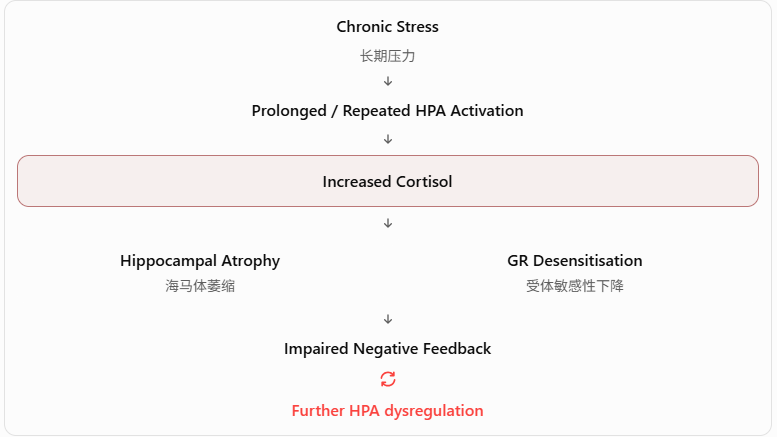
The Vicious Cycle
长期压力导致 HPA axis 持续被激活,Cortisol 长期升高。
高水平 Cortisol 与海马体变化、GR 敏感性下降相关。
结果是原本应该帮助关闭 HPA 的机制受损。
HPA 更难恢复正常,又可能使 Cortisol 调节进一步异常。
这就是一个 Vicious cycle(恶性循环)。
GR
Glucocorticoid Receptor 糖皮质激素受体
How can chronic stress and hippocampal changes create a vicious HPA cycle in depression?
Chronic stress raises cortisol, contributing to hippocampal atrophy and GR desensitisation, weakening negative feedback.
How does the yoked shock design test stress controllability?
ES mice can terminate shocks; yoked IS mice receive matched shocks without control. NS mice receive no shocks.
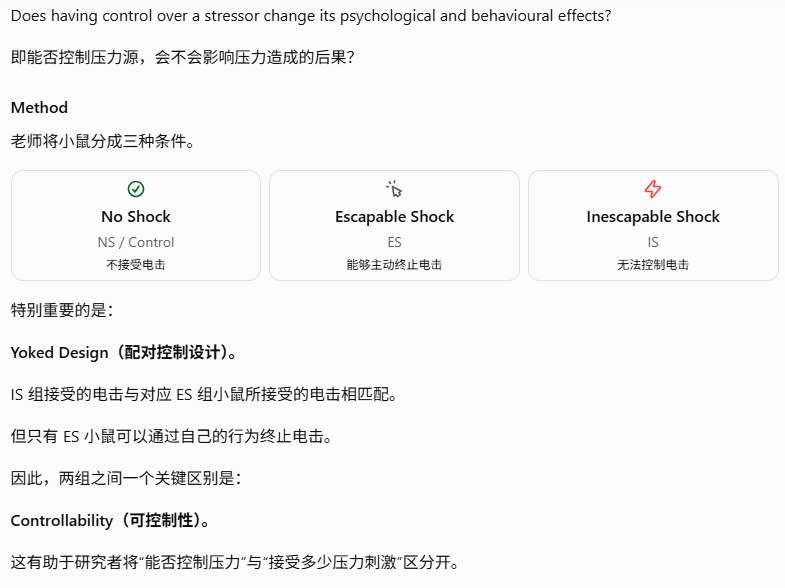
What did Baratta et al. find about controllable vs uncontrollable shock?
IS mice showed more freezing than ES and controls; ES mice showed less freezing than no-shock controls.
What does increased immobility in the Forced Swim Test suggest?
Greater depressive-like behaviour in the lecture's model, associated with uncontrollable stress and learned helplessness. |
limitations in animal experience
动物无法通过语言报告 Depressed mood、Guilt 或 Suicidal thoughts。
所以动物实验测量的是 Depressive-like behaviours(抑郁样行为),而不是直接诊断动物患有和人类完全相同的 MDD。
此外,Immobility 也可能受到其他应对策略和行为因素影响,不能单靠这个指标证明动物具有主观绝望感。
这也是为什么动物模型有价值,但不能完整代表人类抑郁症。
What are the effects of chronic corticosterone exposure in animal models?
Increased immobility, reduced hippocampal branching and PFC spines, and increased amygdala spines.
Chronic Corticosterone Exposure
Research QuestionCan prolonged exposure to glucocorticoids produce depressive-like behaviours and changes in the brain?
Method
研究者通过 Drinking water(饮用水)让小鼠长期接受 Corticosterone。随后设置一段 Washout period(停用期),再进行 Forced Swim Test。
为什么使用 Corticosterone?
Humans:Cortisol
Rodents:Corticosterone
二者都是相关的 Glucocorticoids。
Results 1 — Behaviour 长期 Corticosterone 处理的小鼠,在 Forced Swim Test 中表现出更高的 Immobility time(不动时间)。
Results 2 — Hippocampus, Dendritic Branching(树突分支)
Control 较多树突分支
Corticosterone 较少树突分支
Dendrites(树突) 是神经元接收和整合信息的重要结构。
老师的研究结果:Chronic corticosterone reduces dendritic branching in the hippocampus.
长期 Corticosterone 暴露与 Hippocampus 树突分支减少有关。这支持慢性压力相关激素可能影响海马体结构的观点。
Results 3 — PFC & Amygdala Dendritic spines(树突棘)的变化。
Brain region | Effect of chronic Corticosterone |
|---|---|
Prefrontal Cortex | Decreased dendritic spines |
Amygdala | Increased dendritic spines |
Dendritic spines 是树突上的小型突起,许多兴奋性突触位于树突棘上。
PFC ↓ / Amygdala ↑
Hippocampus:调节功能可能受到影响。
PFC:结构与功能可能受到损害。
Amygdala:兴奋性或威胁相关反应可能增强。
注意,树突棘数量的改变不等于可以直接、精确地计算某个脑区的整体活动强度。这些是支持压力相关神经结构改变的实验发现。
Conclusion
Chronic glucocorticoid exposure can produce depressive-like behaviour and alter brain structures involved in stress regulation.
这个研究很重要,因为它不仅观察到压力和抑郁之间的相关性,还通过实验操纵 Corticosterone 暴露,进一步研究这种激素对于行为与神经结构的影响。
anxiety disorder
焦虑障碍主要表现为过度或不成比例的 Fear(恐惧)、Anxiety(焦虑)及 Avoidance(回避)。
Disorder | 中文 |
|---|---|
Specific Phobia | 特定恐惧症 |
Social Anxiety Disorder | 社交焦虑障碍 |
Panic Disorder | 惊恐障碍 |
Agoraphobia | 广场恐惧症 |
Generalised Anxiety Disorder | 广泛性焦虑障碍 |
Separation Anxiety Disorder | 分离焦虑障碍 |
Selective Mutism | 选择性缄默症 |
Trauma- and Stressor-Related Disorders
创伤及应激相关障碍: 这类障碍的共同分类特点是与特定的 Trauma(创伤)或 Stressor(应激源)有关。
PTSD、Acute Stress Disorder、Adjustment Disorder、Prolonged Grief Disorder,以及两种依恋相关障碍。
Anxiety Disorders | Trauma-/Stressor-Related Disorders | |
|---|---|---|
核心特征 | Excessive fear or anxiety | Symptoms associated with trauma or stressors |
是否必须有创伤事件 | 不一定 | 诊断涉及特定的创伤或应激背景 |
本节代表 | Specific Phobia, Social Anxiety | PTSD |
例如,一个人极度害怕蜘蛛,可能符合 Specific Phobia,并不要求他以前被蜘蛛咬过。
How do anxiety disorders differ from trauma- and stressor-related disorders?
Anxiety disorders involve excessive fear/anxiety; trauma- and stressor-related disorders involve symptoms associated with traumatic events or stressors.
Specific Phobia
特定恐惧症: Marked, persistent and disproportionate fear or anxiety about a specific object or situation.即对某个具体物体或情境产生明显、持续且不成比例的恐惧或焦虑。
Diagnostic Features
Feature | 中文理解 |
|---|---|
Marked fear/anxiety | 对特定对象有明显恐惧 |
Immediate fear response | 接触恐惧对象几乎总会立即引发反应 |
Avoidance | 主动回避,或在极强恐惧下忍受 |
Disproportionate fear | 恐惧程度与真实危险不成比例 |
Persistence | 通常持续至少 6 个月 |
Distress or impairment | 造成临床显著痛苦或功能损害 |
例如,一个人不喜欢蜘蛛,但生活完全不受影响,不能仅因此判断为 Specific Phobia。
如果他因为看到蜘蛛而持续避免进入某些正常生活环境,且造成明显功能损害,才更符合障碍的特点。
Aversion can be based in fear and/or disgust.
Term | 中文 | Example |
|---|---|---|
Fear | 恐惧 | 担心蜘蛛会咬自己 |
Disgust | 厌恶 | 看到蜘蛛感到恶心 |
因此,Specific Phobia 不一定完全由 Fear 驱动,也可能涉及 Disgust(厌恶)。
What are the main diagnostic features of Specific Phobia?
Persistent, disproportionate fear of a specific object/situation, immediate anxiety, avoidance, and significant distress or impairment (typically ≥6 months).
Social Anxiety Disorder (SAD)
Social Anxiety Disorder: Marked fear or anxiety about social situations involving possible negative evaluation by others.即在可能受到别人评价的社交情境中,产生明显的恐惧或焦虑。
最关键的词:Negative evaluation(负面评价)。例如,一个人害怕公开演讲,并不是因为演讲台本身危险,而是担心其他人认为自己愚蠢、尴尬或能力不足。
Feature | 中文 |
|---|---|
Fear of social situations | 害怕社交情境 |
Fear of negative judgement | 害怕他人的负面评价 |
Almost always provokes anxiety | 这些情境几乎总会引发焦虑 |
Avoidance or intense endurance | 回避或在强烈焦虑下忍受 |
Disproportionate fear | 与实际威胁不成比例 |
Persistent (>6 months) | 持续超过约六个月 |
Distress and dysfunction | 造成显著痛苦或功能损害 |
What distinguishes Social Anxiety Disorder from Specific Phobia?
SAD centres on fear of negative evaluation in social situations; Specific Phobia centres on a particular object or situation.
What do studies show about HPA and neural fear responses in SAD?
HPA findings are inconsistent (blunted or elevated cortisol); amygdala and insular activity are often increased during emotional processing.
Posttraumatic Stress Disorder (PTSD)
Posttraumatic Stress Disorder(创伤后应激障碍)PTSD 是一种与 Traumatic event exposure(创伤事件暴露)有关的心理障碍,涉及创伤记忆反复出现、回避、情绪及认知变化,以及持续的警觉或应激反应。
Feature | 中文 | Example |
|---|---|---|
1. Trauma exposure | 经历或接触创伤事件 | 经历严重交通事故 |
2. Intrusions | 侵入性症状 | 不由自主地想起事故、噩梦或 Flashbacks |
3. Avoidance | 回避 | 避免接触与事故有关的地点和刺激 |
4. Negative alterations in cognitions and mood | 认知及情绪的负面变化 | 与创伤有关的持续负面信念或情绪 |
5. Alterations in arousal and reactivity | 唤醒及反应性变化 | Hypervigilance、Exaggerated startle、Emotional outbursts |
What are the five key diagnostic features of PTSD?
Trauma exposure, intrusions, avoidance, negative changes in cognition/mood, and altered arousal/reactivity.
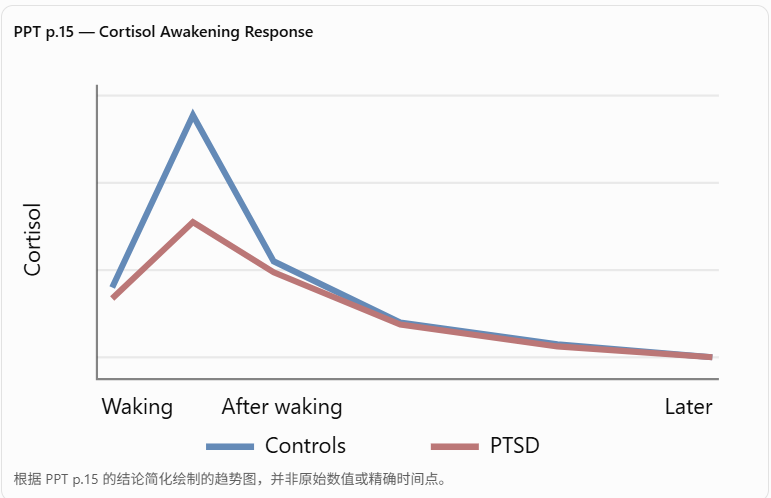
Cortisol in PTSD
Research Question
How does the Cortisol Awakening Response differ in PTSD?
Method
研究者在起床后不同时间测量 Salivary cortisol(唾液皮质醇),比较 PTSD 患者与健康对照。
Results
Cortisol Awakening Response is blunted in PTSD.
即 PTSD 患者的醒后皮质醇反应较弱,Cortisol 水平低于对照组。
Conclusion
PTSD is associated with a reduced cortisol awakening response.
这与 MDD 中较高 Baseline cortisol 的发现形成对比。
Dexamethasone Suppression Test (DST)
Dexamethasone 模拟 Glucocorticoid 的作用,正常情况下会启动 Negative feedback,从而降低 Cortisol。
Research Question
Is negative feedback impaired in PTSD, as it can be in depression?
Method
比较 PTSD 患者与没有 PTSD 的对照者接受 Dexamethasone 后的 Cortisol 抑制反应。
Results
No deficits in DST test for PTSD vs controls.
也就是说,与 MDD 的结果不同,这项 PTSD 研究没有发现明显的 DST 抑制缺陷。
图上两组在服用 Dexamethasone 后,Cortisol 都出现下降。
How do HPA biomarkers differ between MDD and PTSD?
MDD: high cortisol, impaired DEX suppression, low GR sensitivity. PTSD: low cortisol, intact suppression, increased GR sensitivity.
Biomarker | Depression (MDD) | PTSD |
|---|---|---|
Baseline cortisol | Increased ↑ | Decreased ↓ |
DEX suppression | Impaired | Intact |
Hippocampal volume | Smaller; likely consequence in PPT model | Smaller; risk factor in twin study |
GR sensitivity | Decreased | Increased |
Negative feedback | Impaired | Potentially exaggerated |
GR = Glucocorticoid receptors(糖皮质激素受体)。
What does the Dexamethasone Suppression Test show in PTSD compared with MDD?
PTSD shows relatively intact cortisol suppression; MDD often shows impaired suppression, indicating weaker negative feedback.
Fear-Potentiated Startle
What Is Fear-Potentiated Startle?
Definition: An increased startle response in the presence of a fear-related stimulus.
即当某个人处于恐惧相关情境时,他对突然刺激的惊跳反应比平时更强。
例如,一个经历创伤的人,在感受到危险线索时,听到突然的响声会出现异常强烈的惊跳反应。
这不等于普通的 Startle reflex(惊跳反射)。
Fear-potentiated startle 强调的是恐惧情境对惊跳反应的增强作用。
What is fear-potentiated startle, and how is it altered in PTSD?
An increased startle response in fearful contexts; it is exaggerated in PTSD.
What did Gilbertson et al.'s twin study suggest about hippocampal volume and PTSD?
Smaller hippocampal volume is a pre-existing risk factor for PTSD, rather than merely an effect of trauma.
Exposure Therapy
暴露疗法 Definition: A treatment involving gradual exposure to feared stimuli or memories to reduce fear responses. 即让患者在安全、有计划的治疗环境中,逐步接触害怕的刺激或创伤相关记忆,以减少过强的恐惧反应。
Condition | Exposure target |
|---|---|
Specific Phobia | Feared object or situation |
PTSD | Trauma-related memories or cues |
例如:
Specific Phobia 患者害怕蜘蛛,治疗中可以逐步接触蜘蛛相关刺激。
PTSD 患者则可能在治疗中逐渐、安全地处理创伤记忆及相关线索。
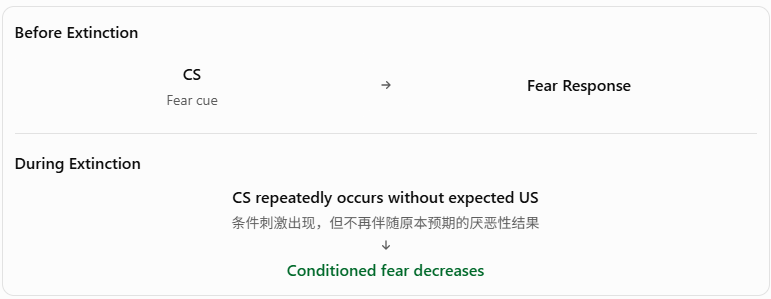
Extinction Learning
消退学习 A reduction in conditioned responding when the conditioned stimulus is repeatedly presented without the expected aversive outcome.
即过去会预测危险的条件刺激,在反复出现但不再伴随预期危险结果时,逐渐引发较弱的条件反应。
How does exposure therapy use extinction learning to treat phobias and PTSD?
Gradual exposure to feared stimuli or trauma memories without expected harm promotes extinction learning and reduces conditioned fear.
How might cognitive enhancers support exposure therapy?
They may strengthen learning during exposure therapy, potentially improving extinction.
What is the benzodiazepine paradox in exposure therapy?
Benzodiazepines reduce anxiety but, when given before extinction, may impair extinction retention and treatment efficacy.
What Is Substance Use Disorder?
Definition: A problematic pattern of substance use involving impaired control and continued use despite harmful consequences.
物质使用障碍主要指一个人难以控制某种物质的使用,即使它已经造成负面后果,仍然继续使用。
Main criterion | 中文解释 |
|---|---|
Excessive use | 使用量超过原本计划 |
Unsuccessful efforts to control use | 想减少或停止,但反复失败 |
Excessive time devoted to drug-seeking | 花费大量时间寻找、获取或使用物质 |
Strong cravings | 强烈渴求 |
Dysfunction | 工作、学习、家庭或社交功能受影响 |
Use in hazardous situations | 在危险情境下使用,例如驾驶时 |
Use despite aversive outcomes | 尽管出现负面后果仍继续使用 |
Tolerance | 耐受性 |
Withdrawal symptoms | 戒断症状 |
Tolerance vs Withdrawal
Tolerance | Withdrawal | |
|---|---|---|
中文 | 耐受性 | 戒断 |
Definition | Reduced response to a substance after repeated use | Symptoms occurring when substance use is reduced or stopped |
Example | 原来少量即可产生效果,后来需要更多 | 停止使用后出现不适或其他戒断表现 |
Tolerance: 重复使用后,同样的量可能产生更弱的效果,因此可能需要更多物质才能获得原本的效果。
Withdrawal: 身体适应长期使用后,当使用减少或停止时可能出现不适症状。
How does the DSM-5 classify substance vs behavioural addictions?
It includes substance-use disorders and Gambling Disorder; other proposed behavioural addictions lack sufficient evidence for formal inclusion.
What are the three stages in the Habit Theory of Addiction
Voluntary use → Habitual use → Compulsive use.

How do habitual and goal-directed behaviours differ?
Habits are inflexible S-R responses; goal-directed actions depend on the expected outcome value.
Relapse
Relapse(复发): A return to problematic substance use after improvement or abstinence.
即使一个人已经成功停止使用,之前建立的 Drug-related cues(药物相关线索)仍然可能引发 Craving(渴求)。
原因可能是过去建立的 S-R associations 仍然存在。
Why can habitual drug use increase relapse risk?
Drug-related cues can trigger automatic seeking and craving even after abstinence.
Increasing cognitive flexibility and disrupting habitual behaviour may reduce relapse.
Cognitive flexibility(认知灵活性)帮助人根据当前目标和后果调整行为,而不是自动重复旧习惯。
How does dopamine signalling change after CS–US learning?
Before learning, dopamine spikes at reward delivery; afterwards, it spikes at the reward-predicting CS.
How does repeated alcohol exposure affect dopamine responses in rats?
Alcohol-naïve rats show increased dopamine release; experienced drinkers show a blunted response.Repeated alcohol exposure can alter reward-related dopamine responses.
这为后面的 Koob model 提供了背景:长期使用后,奖励系统的反应可能发生改变,使用动机也可能逐渐转变。
Positive vs Negative Reinforcement
Positive Reinforcement | Negative Reinforcement | |
|---|---|---|
中文 | 正强化 | 负强化 |
Meaning | 增加令人愉快的结果 | 移除令人不愉快的状态 |
Addiction | 使用物质获得奖励 | 使用物质减轻戒断痛苦 |
Negative reinforcement 不是 Punishment。
两种 Reinforcement 都会提高行为发生的可能性,只是强化行为的方式不同。
How do dopamine and CRF differ in Koob's addiction model?
Early use: dopamine and positive reinforcement (feel happy).
Dependence: CRF and negative reinforcement (feel normal).
What did Chu et al. find when CRF was blocked
CRF blockade reduced withdrawal-induced ethanol-seeking, supporting CRF's role in negative reinforcement.
CRF-related stress signalling contributes to withdrawal-induced drug seeking.
为什么这个实验支持 Koob?
因为 Koob 认为依赖后的物质使用越来越受到戒断压力及 Negative reinforcement 的驱动。
如果阻断 CRF 能够减少戒断引起的寻求行为,就说明 CRF 相关压力系统参与这一过程。
但这并不证明 CRF antagonists 已经是有效的人类成瘾治疗方法。