Psych: Test 3 Textbooks
 Call Kai
 Learn
 Practice Test
 Spaced Repetition
 Match
 Flashcards
 Knowt Play
1/96

There's no tags or description
Looks like no tags are added yet.
97 Terms
Chapter 5: Figure 1
Prefrontal cortex: front part of frontal hemisphere
- significant development during middle and late childhood
Myelination
axons are insulated by fatty white matter called myelin that increases speed of signals
Chapter 5: figure 2
characteristics that enhance young children's safety
- individual, family/home, school/peers, community
Preoperational stage
Piaget's 2nd stage (2-7 years old)
- symbols: words, drawings, images
- mental reasoning and egocentrism
Operations
Piaget: internalized reversible sets of actions
- being able to mentally visualize an action instead of actually do it
ex) basic math/algebra problems
symbolic function substage
Piaget's 1st substage of preoperational thought (age 2-4)
- mentally represent an object that is not present
egocentrism
inability to distinguish between one's own perspective and someone else's
Chapter 5: figure 3
The three mountain task
- child cannot picture the perspective of someone other than themselves when looking at a display from different angles
animism
belief that inanimate objects have lifelike qualities and are capable of action
intuitive thought substage
Piaget's 2nd substage of preoperational thought (age 4-7)
- children suddenly want to know all the answers to all sorts of questions (primitive reasoning)
centration
focusing of attention on one characteristic to the exclusion of all others
conservation
Piaget: awareness that changing an objects appearance does not change its basic properties
Chapter 5: Figure 4
Piaget's conservation task
- pouring water from a short/fat glass into and tall/skinny
- does it change the amount of water?
Chapter 5: figure 5
Dimensions of conservation: number, matter, length
social constructivist approach
emphasizes the social contexts of learning and that knowledge is mutually built and constructed
Zone of proximal development (ZPD)
Vygotsky's term
- tasks that are too difficult for children to master alone but can be mastered with assistance
Chapter 5: figure 6
Vygotsky's zone of proximal development
- lower limit and upper limit
Chapter 5: figure 7
Comparison of Vygotsky and Piaget theories

executive attention
- planning actions
- forwarding attention to goals
- detecting/compensation for errors
- monitoring progress on tasks
- dealing with difficult circumstances
Sustained attention
Vigilance
- focused and extended engagement with an object, task, event
executive function
higher-level cognitive processes linked to development of prefrontal cortex
- managing one's thoughts to engage in goal-directed behavior and to use self-control
Theory of mind
the awareness of one's own mental processes and the mental processes of others
phonology
sound system of a language, that includes the sounds used and how they may be combined
morphology
units of meaning involved in word formation
syntax
the ways words are combined to form acceptable phrases and sentances
semantics
the meaning of words and sentences
Chapter 5: figure 10
stimuli in Berko's study of young children's understanding of morphological rules
- wug -> wugs
fast mapping
process that helps explain how young children learn the connection between a word and its reference so quickly
pragmatics
the appropriate use of language in different contexts
project head start
gov funded program that is designed to provide children from low-income families the opportunity to acquire the skills and experiences important for school success
Self understanding
child's cognitive representation of self, the substance and content of the child's self-conceptions
Moral development
development that involves thoughts, feelings, and actions
- regarding rules and conventions about what people should do in their interactions with others
heteronomous morality
Piaget's 1st stage of moral development (4-7 years old)
- justice and rules are conceived of as unchangeable properties of the world, beyond what people can control
autonomous morality
Piaget's 2nd stage of moral development (10 and older)
- children become aware that rules and laws are created by people and that in judging an action, one should consider the actor's intentions as well as the consequences
immanent justice
the expectations that, if a rule is broken, punishment will be met out immediately
gender identity
the sense of being male or female, which most children acquire by the time they are 3 years old
gender roles
sets of expectations that prescribe how females or males should think, act, and feel
social role theory
gender differences result from the contrasting roles of men and women
psychoanalytic theory of gender
Frued's view
- preschool children develop a sexual attraction to the opposite sex parent, then later rejects these feelings and becomes more attached to same sex parent
social cognitive theory of gender
children's gender development occurs through observation and imitation of gender behavior and through the rewards and punishments children experience for gender-appropriate/inappropriate behavior
Chapter 6: figure 1
developmental changes in percentage of time spent in same-sex and mixed-sex groups
- 4.5 years: equal between both groups
- 6.5 years: more same groups than mixed groups
gender schema theory
gender typing emerges as children gradually develop gender schemas of what is gender appropriate/inappropriate in their culture
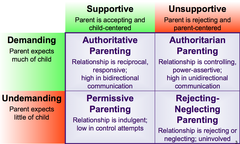
Authoritarian parenting
High control, low warmth
- children's social incompetence
Authoritative parenting
High control, High warmth
- children's social competence
neglectful parenting
low control, low warmth
- children's social incompetence and less self-control
Indulgent parenting
low control, high warmth
- children's social incompetence and lack of self-control
Chapter 6: figure 2
Classification of parenting styles
Chapter 6: figure 3
Corporal punishment in different countries
- south korea/US: higher remembering/in favor of corporal punishment
- spain/sweden: less remembering/in favor of corporal punishment
Chapter 6: figure 4
Single parent families in different countries
- US highest
- Japan lowest
Chapter 6: figure 5
Divorce and children's emotional problems
- 25% of children with divorced parents showed serious emotional problems while 75% didn't
Sensorimotor play
behavior engaged in by infants to derive pleasure from exercising their existing sensorimotor schemes
practice play
involves repetition of behavior when new skills are being learned or when physical/mental mastery and coordination of skills are required for games/sports
pretense/symbolic play
play in which child transforms the physical environment into a symbol
social play
play that involves social interactions with peers
constructive play
combines sensorimotor and repetitive activity with symbolic representation of ideas
- self regulated creation or construction of a product or a problem solution
games
activities engaged in for pleasure that include rules and often involve competition
Chapter 7: figure 2
brain scans and learning disabilities
- using MRI to study children with learning disabilities such as dyslexia
Learning disability
difficulty understanding or using spoken or written language or doing math.
ADHD
disability in which children consistently show one or more characteristics of inattention, hyperactivity, and impulsivity
Chapter 7: figure 3
Regions of the brain in which child with ADHD has a delayed peak in the thickness of the cerebral cortex
- greatest delays occurred in prefrontal cortex
Autism spectrum disorder
characterized by problems in social interactions, verbal and nonverbal communication, and repetitive behaviors
individualized education plan (IED)
written statement that spells out a program tailored to a child with a disability
least restrictive environment (LRE)
child with disability should be educated in a setting that is as similar as possible to the one in which children who do not have disabilities are educated
Chapter 7: figure
classification: an important ability in concrete operational thought
- classifying different members on family tree
inclusion
educating a child who requires special education full-time in regular classroom
seriation
concrete operation that involves ordering stimuli along a quantitative dimension
transivity
the ability to logically combine relations to understanding certain conclusions
working memory
mental work bench where individuals manipulate and assemble information when making decisions/solving problems/comprehending written and spoken language
long term memory
relatively permanent type of memory that holds huge amounts of information for a long period of time
metacognition
thinking about thinking, or knowing about knowing
Chapter 7: figure 5
normal curve and Stanford-Binet IQ scores
- IQ= mental age / chronological age x 100
intelligence
problem-solving skills and the ability to learn from and adapt to the experiences of everyday life
mental age (MA)
Binet's measure of an individual's level of mental development compared with that of others
IQ
mental age divided by chronological age and multiplied by 100
Chapter 7: figure 6
sample subscales of the Wechsler intelligence scale for children-fifth edition (WISC-V)
- similarities, comprehension, block design
triarchic theory of intelligence
Sternberg's theory
- intelligence consists of analytical intelligence creative intelligence and practical intelligence
Chapter 7: figure 7
correlation between intelligence and test scores and twins' status
- identical twins are more than fraternal twins
Chapter 7: figure 8
the increase in IQ scores from 1932-1997
- bell curve has shifted right significantly so that more people are considered superior intelligence
stereotype threat
anxiety that one's behavior might confirm a negative stereotype about one's group
culture-fair tests
tests of intelligence that are designed to be free of cultural bias
intellectual disability
a condition of limited mental ability, indicated by an intelligence score of 70 or below and difficulty in adapting to the demands of life; varies from mild to profound
organic intellectual disability
intellectual disability that involves some physical damage and is caused by a genetic disorder or brain damage
cultural-familial intellectual disability
intellectual disability in which there is no evidence of organic brain damage, but the individual's IQ generally is between 50 and 70
gifted
Having above-average intelligence (an IQ of 130 or higher) and/or superior talent for something.
metalinguistic awareness
knowledge about language, such as knowing what a preposition is or being able to discuss the sounds of a language
Flynn effect
worldwide increase in IQ scores over short times frame (James Flynn)
perspective taking
the social cognitive process involved in assuming the perspective of others and understanding their thoughts and feelings
self-esteem
The global evaluative dimension of the self.
- self-worth or self-image.
self-concept
domain-specific evaluations of the self
Self-efficacy
the belief that one can master a situation and produce favorable outcomes
gender stereotypes
broad categories that reflect society's impressions and beliefs about females and males
popular children
children who are frequently nominated as a best friend and are rarely disliked by their peers
average children
children who receive an average number of both positive and negative nominations from their peers
nelgected children
children who are infrequently nominated as a best friend and are actively disliked by their peers
controversial children
children who are frequently nominated both as someone's best friend and as being disliked
Chapter 8: figure 1
bullying behaviors among US youth
- about religion or race
- about looks or speech
- hit, slapped, pushed
- subject of rumors
- sexual comments or gestures
Chapter 8: figure 2
mother's beliefs about the factors responsible for children's math achievement in three countries
- effort vs ability