A & P II exam 3
 Call Kai
 Learn
Learn Practice Test
 Spaced Repetition
 Match
Match Flashcards
 Knowt Play
1/45

There's no tags or description
Looks like no tags are added yet.
Name | Mastery | Learn | Test | Matching | Spaced | Call with Kai | Chat |
|---|
No analytics yet
Send a link to your students to track their progress
46 Terms
What is the function of the lymphatic sysytem?
Filters germs & makes white blood cells for immune defenses
Drains extra liquid and returns blood volume for fluid balance

What organ is this? What are the dark circles vs the pink surrounding them?
Spleen
White pulp circles, red pulp surrounding
What cels are found in the white pulp of the spleen?
Lymphatic cells (B and T cells)
What cells are found within the red pulp of the spleen?
Red blood cells

What organ is this?
Lymph node
Left long arrow → follicle, inside is germinal center
Left short arrow → capsule
Bottom arrow → medulla


What organ is this?
Bone marrow
Pink→ trabeculae
Purple → marrow
What’s cells are found in the germinal centers of lymph nodes?
B lymphocytes
What is the function of a lymph node?
Act as filters to remove potential pathogens
What does the red bone marrow produce?
Red blood cells, and lymphocytes
What is the function of the thymus?
To produce mature and train t lymphocytes to protect the body from germs/disease. To identify the “self”
What is the difference between innate immune responses and adaptive immune responses?
Innate is fast and immediate, present from birth, non specific (macrophages, neutrophils)
Adaptive is slower but highly specific target exact germ and contains a memory bank (T cells, B cells, antibodies)
What is the job of a B lymphocyte?
B cells spot foreign germs in blood or lymph fluid and release antibodies to tag/neutralize bacteria & viruses
What is the job of a T lymphocytes?
They mature in the thymus gland and identify antigens to directly fight or signal other immune cells to destroy pathogens
What are the surface barriers to immune responses?
Skin, flushin (tears/snot/sweat), mucus (nose/throat)
What are the 4 steps in an indirect ELISA?
Antigen on well wall
Primary antibody on antigen
Secondary antibody on PA
Substrate on SA
What was the goal of the ELISA for this lab?
Testing giant pandas for infection with canine distemper virus (CDV)
What was different between this labs ELISA and the previous labs ELISA?
This lab, we were testing to see if the primary antibody was present. Previously we were using an Antigen

Cell and function
Monocyte
Macrophages, active phagocytosis

Cell and function
Lymphocytes
Principle cells of immune response (both t & B cells)

Cell and function
Basophil
Allergic reactions

Cell and function
Eosinophil
Phagocytosis of parasites and allergies

Cell & function
Neutrophils
Phagocytosis of bacteria, most abundant WBC
What are the 2 classes of leukocytes?
Granulocyte → has granules
A granulocyte → lacks granules

What organ is this
Esophagus

what organ is this
Stomach

What organ is this ?
Duodenum of small intestine

Jejunum of small intestine

Ileum of small intestine
How can the 3 sections of small intestine be told apart?
Duodenum → submucosa filled with duodenal glands
Jejunum → submucosa empty, lack of structure
Ileum → submucosa contains Peter’s patches
How is the mucosa of the esophagus different from other parts of the GI tract?
Begins as stratified squamous but transitions to simple columnar
What are the 4 layers of the gi tract?
Innner
Mucosa → epithelial tissue
Submucosa → connective tissue
Muscularis externa → smooth muscle
Serosa → dense irregular connective tissue
Outer

large intestine (colon)

Pancreas
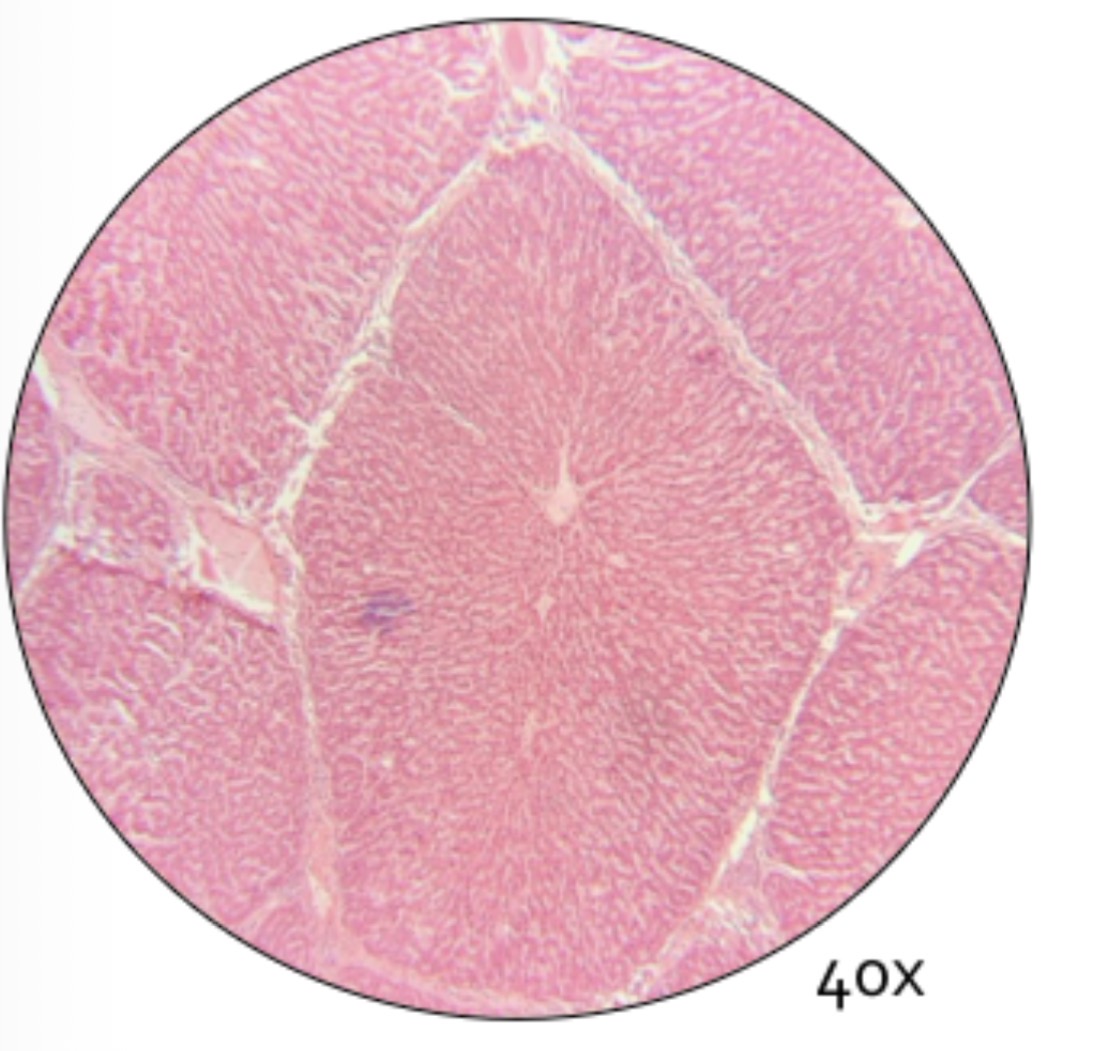
Liver
What cells make up the pancreas?
Acinar cells
What cells make up the liver?
Hepatocytes
What is a hepatic (portal) triad?
Connection point between liver lobules where a venule, bile duct, and arteriole meet
What enzyme breaks down starch?
Amylase
Into reducing sugars like glucose
What is Lugols Iodine test?
Tests for starch, black color means positive, starch present, no breakdown occurred, negative means enzyme activity
What is Benedict’s test?
Tests for the presence of reducing sugars, positive means orange/red and enzyme worked, green/yellow means negative and enzyme did not break down starch
What enzyme digests proteins?
Pepsin
Into amino acids
What is Biruet reagent test?
Indicates peptide bonds that make proteins, positive means vivid purple and enzyme did not break down protiens, negative means blue and enzyme did work to break the peptide bonds
What enzyme breaks down fat?
Lipase
Into fatty acids
How does bile act on food stuff? (Fat)
As an emulsifier, lowers surface tension and physically breaks them into smaller droplets allowing the digestion easier
What does phenol red test do?
Tests for acidity, if fats are broken down → more fatty acids → more acidity. Red/orange means acidic means lipase broke down fat. Pink means not acidic means lipase didn’t break down fat
What is the role of acinar cells of the pancreas?
Makes hydrolitic enzymes (pancreatic juice) that helps to neutralize the acidity of the stomach in the small intestine