Week 5 - Normal/Altered Osseous Form
 Call Kai
 Learn
 Practice Test
 Spaced Repetition
 Match
 Flashcards
 Knowt Play
1/34

There's no tags or description
Looks like no tags are added yet.
35 Terms
What are the 3 features of normal osseous form?
Thin bony margins, vertical grooving, positive architecture
What are the features of altered osseous form?
Thick bony margins, dehiscence, fenestration, reverse architecture, osseous defects
What is a dehiscence?
Cleft-like absence of alveolar cortical plate resulting in a denuded root surface

How common are dehiscences?
Approximately 20% of teeth
Where are dehiscences most common?
Facial bone, anterior teeth
T/F: Dehiscences are frequently bilateral.
True
What is a fenestration?
Circumscribed absence of cortical bone over facial or lingual root surface

What is a 3 wall osseous defect?
Defect surrounded by 3 osseous walls
Interproximal, facial, lingual remain
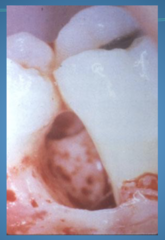
What is the most common early intrabony defect?
Crater
What is a crater defect?
2 wall defect with facial and lingual walls remaining
What walls remain in a 2-wall defect?
Facial and lingual, or facial/lingual and proximal

What is a 1-wall defect?
Defect with only 1 remaining osseous wall

What is a hemiseptum?
1-wall defect with a remaining proximal wall
How are osseous defects diagnosed?
Probing, sounding, radiographic evaluation
What is furcation involvement?
Invasion of the bifurcation or trifurcation of multirooted teeth by periodontal disease
Which teeth most commonly have furcation involvement?
Mandibular molars
Class I furcation involvement:
Incipient involvement
Class II furcation involvement:
Definite involvement, not through and through
Class III furcation involvement:
Total bone loss with through and through opening
Class IV furcation involvement:
Through and through involvement visible due to gingival recession
What is ledging?
Buttressing bone formation

What is the most common pattern of bone destruction?
Horizontal bone loss
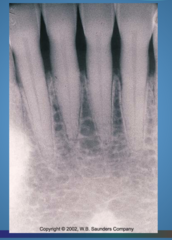
What is vertical/angular bone loss?
Oblique bone destruction forming a trough alongside the root
What is reverse osseous architecture?
Facial and lingual bone levels more coronal than interproximal bone
What is positive osseous architecture?
Interproximal bone more coronal than facial/lingual bone
What is the goal of positive osseous architecture?
Restore a physiologic bony contour that supports maintainable gingival form
What is osseous resective surgery?
Reshaping alveolar bone to restore form at or slightly apical to existing bone level
What is the most predictable pocket reduction technique?
Osseous resective surgery
What are the indications for osseous resective surgery?
Acceptable oral hygiene, persistent inflammation, osseous lesions, biologic width violation
Osteoplasty =
Bone reshaping without removing supporting bone
Ostectomy =
Bone reshaping that removes supporting bone
What is the sequence of osseous resection?
Facial/lingual thinning and grooving
Intrabony defect correction
Positive architecture
Final refinement
What is primary intention healing?
Mucosal wound edges approximated together to minimize scarring
Ex: Periodontal flap surgery
What is secondary intention healing?
Epithelial migration to close an open wound
Ex: Gingivectomy
What are contraindications to osseous surgery?
Inadequate Phase I therapy, medical history, esthetics, root sensitivity/caries, extensive bone loss, patient preference