offender profiling
 Call Kai
 Learn
 Practice Test
 Spaced Repetition
 Match
 Flashcards
 Knowt Play
1/19

There's no tags or description
Looks like no tags are added yet.
20 Terms
Offender Profiling
Offender profiling refers to a set of investigative techniques used by the police to try to identify perpetrators of serious crime. There are two main approaches to offender profiling: the Typology Approach & the Data Driven approach
Typology
The top-down approach to offender profiling is sometimes called the American approach because it was developed by the FBI in the 1970s. Investigators begin by analysing evidence from the crime scene and details of the offence. These details are compared with patterns identified from previous cases and interviews with convicted offenders, particularly serial murderers. The FBI used this information to develop offender typologies, most notably the organised and disorganised offender categories. The profiler then works from these broad categories to infer the likely characteristics of the offender. This approach is mainly used for serious crimes such as murder, rape and other offences involving significant interaction between the offender and victim.
Typology Steps – Flowchart:

what was the original FBI typology based on?
The original FBI typology was based mainly on interviews with 36 sexually motivated serial killers, conducted by FBI agents such as Douglas and Hazelwood.
Hazelwood & Douglas (Top-Down Approach) 1970’s
Aim: To identify patterns in the behaviour of serious offenders and determine whether different types of offender could be distinguished from crime scene evidence.
Participants: 36 convicted sexually motivated serial killers from American prisons.
Method: Unstructured interviews were conducted with the offenders, and information about their crimes and crime scenes was analysed.
Results: Two distinct patterns emerged. Some crimes appeared planned, controlled and methodical (organised), whereas others appeared spontaneous, chaotic and impulsive (disorganised).Conclusion: Characteristics of the crime scene can be used to infer characteristics of the offender.
Organised Crime Scene Classification
✓ Crime is planned in advance
✓ Leaves few clues or forensic traces
✓ Victim is selected and targeted in advance
Organised Offender Profile Generation
✓ Above average IQ
✓ Socially and sexually competent
✓ Married or co-habiting
✓ Skilled occupation
Disorganised Crime Scene Classification
✓ Little planning or preparation
✓ Makes little attempt to hide evidence
✓ Victim chosen at random
Disorganised Offender Profile Generation
✓ Lives alone
✓ Sexually and socially inadequate
✓ Unskilled occupation or unemployed
✓ Physically or sexually abused in childhood
Evaluation of the Typology Method:
A weakness of the top-down approach is that the organised/disorganised typology may lack validity. Canter (2004) analysed 100 murders and compared them with 39 characteristics associated with organised and disorganised offenders. He found evidence for organised characteristics but little evidence for a distinct disorganised category.
The typology method may oversimplify criminal behaviour by assuming offenders can be classified into one of only two categories. Bundy appeared to be organised for a lot of his crimes. He would bring a mask, rope, weapon, and he would stalk his victims prior to the attack. However, during one of his planned attacks, the woman managed to escaped. Ted then went on a killing spree and killed a number of women in a college dorm, this was not planned, but instead a retaliation of rage from his unsuccessful attack. The change in his MO suggests that there is an element of free will within his behaviour and the lack of consistency is due to choice rather than intellectual and social competency.
The research underpinning the typology method suffers from methodological weaknesses. Hazelwood and Douglas relied heavily on interviews and self-report data from convicted serial killers when developing the organised/disorganised classification. Self-report methods are vulnerable to dishonesty, exaggeration and memory distortions. Offenders may misrepresent their behaviour or motivations. This means the categories may be based on inaccurate information, reducing the validity of the typology method.
The typology method may be too rigid because it assumes that crime scene behaviour consistently reflects an offender’s personality. The organised/disorganised classification assumes that characteristics displayed at the crime scene are stable features of the offender. However, criminal behaviour can vary substantially depending on situational factors such as victim resistance, emotional state, pressure or opportunity.
There are alternative approaches that may provide more scientifically grounded offender profiles. The bottom-up approach, particularly investigative psychology, uses statistical analysis and databases of offender behaviour to identify patterns rather than assigning offenders to pre-existing categories. Unlike the typology method, bottom-up profiling builds profiles from evidence collected from many crimes and examines correlations between behaviour and offender characteristics.
The top-down approach was developed from detailed research with real offenders. Hazelwood and Douglas conducted lengthy unstructured interviews with 36 sexually motivated serial killers.
The Data Driven Approach
Canter (1990) is the UK’s foremost profiling expert. In the Data driven approach there are no initial assumptions made about the offender and the approach relies heavily on objective research. The bottom-up approach bases its ideology on the belief that the little details that are often overlooked, can be crucial to the success of a case. Unlike the Typology approach, which begins with pre-existing categories such as organised and disorganised offenders, the data-driven approach starts with evidence from the crime scene and builds a profile from the available information
what is this system of offender profiling based on?
This system of offender profiling is based on statistical data alongside psychological theory. Evidence from previous crimes and offenders is on the database, this is then used to identify patterns and trends about offender behaviour.
As new crimes are committed, they are also added to the database. An offender profile is generated by identifying statistically significant patterns in previous offences and applying principles from investigative psychology to the current case.
There are 2 types of Bottom-Up profiling that we will cover in the course:
Investigative Psychology
Geographical Profiling
Investigative Psychology:
Canter’s (2004) critique of the Typology approach was partially motivated by a desire to see offender profiles built on objective data rather than an “intuition” based approach, such as that used by Typology profilers. Canter (2004) proposed five key principles that can be used to infer characteristics of offenders from their crime scene behaviour. Canter’s work was developed over a period of several years and has been developed using psychological theory and objective data/research, he called this Investigative Psychology. Canter used a data driven approach by analysing 66 sexual assault cases using a computer-based programme. Analysis revealed patterns suggesting that offenders who treated victims impersonally during offences were also likely to display impersonal relationships in other areas of their lives.
Memory strategy – FIVES!
Forensic awareness – offenders who show an understanding of a police investigation are likely to have had previous encounters with the criminal justice system.
Interpersonal coherence – there is a consistency between the way offenders interact with their victims and with others in their everyday lives.
Villain’s characteristics – the offender’s characteristics, such as age, occupation, habits and lifestyle, may be inferred from crime scene evidence.
Early career – offenders often show consistency in their behaviour across different crimes. Patterns found in previous offenders can be used to predict the likely offending history and future behaviour of an unknown offender.
Space and time – the time and location of an offender’s crime will communicate something about their own place of residence/employment
The Data Driven Approach Flowchart:
Crime scene evidence collected
⬇
Compared with large databases of solved crimes
⬇
Statistical patterns and correlations identified
⬇
Likely characteristics of the offender inferred
⬇
Offender profile produced
Geographical Profiling
Canter and Youngs (2008) identified that the locations of linked crimes can provide valuable clues about an offender. Geographical profiling can be used alongside investigative psychology, but it is most useful when there are multiple offences committed by the same offender.
Geographical profiling uses information about the locations of linked crimes to make inferences about an offender’s likely home or operational base. This process is sometimes referred to as crime mapping. It can be used alongside psychological theory to generate hypotheses about how an offender thinks and operates.
The assumption is that serial offenders are more likely to commit crimes in areas they know well. Therefore, analysing the pattern of crime locations may help investigators identify where the offender is based. As the number of linked offences increases, geographical patterns become easier to identify. Canter’s circle theory proposes that many offenders operate within an area that forms a circle around their home base.
Investigators can also create a jeopardy surface, which is a probability map showing the areas most likely to contain the offender’s base of operations. Research by Canter found that in many cases an offender’s home base was located within the geographical area formed by the crimes. Geographical profiling may also allow investigators to make informed inferences about factors such as an offender’s likely mode of transport, mobility, and lifestyle.
Canter – John Duffy – The Railway Rapist.
Between 1975 and 1986 23 women were raped aged between 15 and 32 at railway stations in and around London. Canter became interested in the case after reading reports in the Evening Standard. In the early 1980’s two police officers were appointed to help him draw up an offender profile. It was already known that there was an accomplice involved in the crimes. Canter placed all the cases on a map and this allowed him to speculate about where the rapist might live. He developed a Circle theory, and proposed two models of offender behaviour – ‘marauders’ or ‘commuters’. Depending on whether they strike from within their home base ‘marauders’ or travel away from home ‘commuters’.
Canter called it the circle theory as most offenders (marauders) do operate in an area they are familiar with and their crimes form a circle around their usual residence. See below the locations of some of the murders committed by Jack the Ripper.
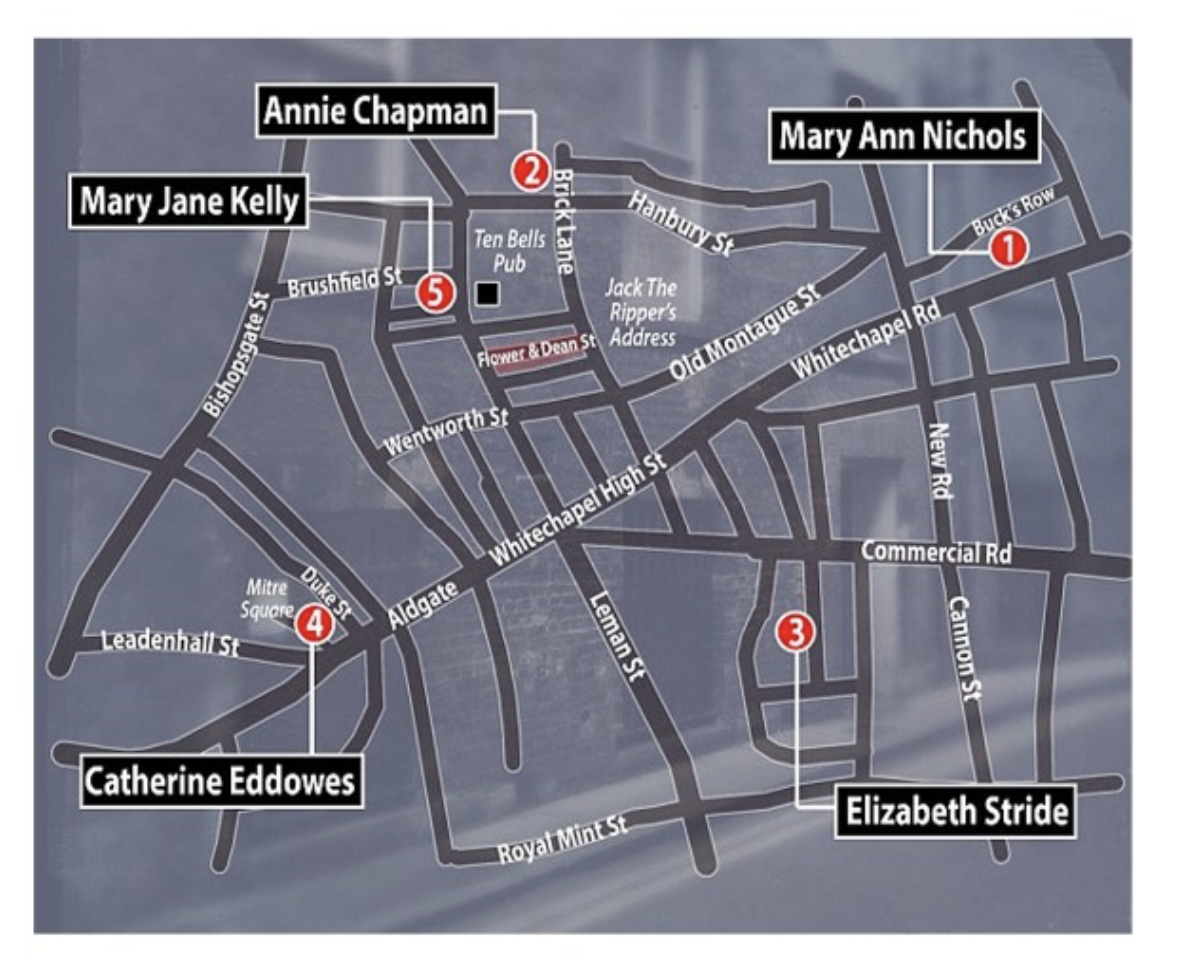
example of a commuter offender:
An example of a commuter offender relates to the disappearance and murder of 4 young girls from different and seemingly unrelated areas of Britain in the 1980’s. The bodies were dumped in laybys next to major A roads (including Twycross, just up the road). It was realised that his likely occupation was delivery driver, giving him access to a van/lorry for easy transportation and led to him ‘commuting’ all over the country, travelling along A roads.
Evaluation of the Data Driven Approach:
One strength of investigative psychology and geographical profiling is that they are highly scientific and objective approaches to offender profiling. Investigative psychology uses statistical analysis of large databases of solved crimes to identify patterns in offender behaviour, while geographical profiling uses computerised mapping of offence locations. This means that profiles are based on measurable data rather than the intuition or personal judgement of investigators. As a result, conclusions are likely to be more reliable because they are derived from patterns identified across many offences.
A strength of geographical profiling is that there is research evidence supporting its usefulness. Canter’s analysis of murder cases found that many serial offenders operate from a central base and commit crimes within a geographical area surrounding that location.
A strength of data driven approach is that it provides a more flexible approach to offender profiling than the typology approach. Rather than placing offenders into rigid categories such as organised or disorganised, investigative psychology examines several dimensions of behaviour, including interpersonal coherence and criminal career patterns.
A strength of investigative psychology is that there is empirical evidence supporting its assumptions. Canter and Heritage analysed 66 sexual assault cases and identified consistent patterns linking behaviour during offences with aspects of offenders’ everyday interpersonal behaviour.
A strength of the data driven approach is that it can be applied to a wide range of crimes. Unlike the typology approach, which was developed primarily from research into serial sexually motivated crimes, geographical profiling can be applied to offences such as burglary, robbery, arson, rape and murder.
A problem with the data driven approach is that it is reliant on data. This means that unreported crime is not considered when creating profiles. This limits the accuracy of the profiles generated, because it does not have access to all crime data.
The data driven approach also relies upon having a large amount of data to identify patterns of criminality. Some crimes and criminals are very unique, and therefore it may be difficult for the data driven approach profile and identify these types of offenders.