KNES 486 - Midterm II Review
 Call Kai
 Learn
 Practice Test
 Spaced Repetition
 Match
 Flashcards
 Knowt Play
1/56

There's no tags or description
Looks like no tags are added yet.
57 Terms
What is mild cognitive impairment (MCI)?
a clinical state, can be transient
diagnosis made by clinician, associated with increased risk of dementia
can be intermediate stage between normal cognitive function and AD, but not everyone with MCI will progress to AD
Criteria:
subjective memory complaints
objective cognitive impairment in some domain(s) — measurable + worse than expected for age + education level
no significant functional impairment (activities of daily living intact)
no dementia
Why is MCI a critical window for intervention?
MCI can revert back to normal cognition ~25%
MCI can be stable for years
MCI can progress/convert to dementia

What are the sex differences in MCI?
amnestic MCI (memory impairments) — males higher
non-amnestic MCI (executive functions) — females higher
How does self-reported physical activity influence risk for MCI?
higher PA linked to lower risk for MCI
self-reported can increase bias
What are the different subtypes of dementia? How do they differ?
Alzheimer’s, vascular, Lewy bodies, frontotemporal
differ in cognitive domains affected, pathology in the brain + cause of impairment
What drives the statistics behind more females living with dementia than males?
Alzheimer’s cases
females are more likely to have AD than males
Watch video slide 10 up to 4:34 min.
Done
Study the dementia continuum. What type of neuropathology occurs first?
amyloid plaques (A-beta) occur first and lead to neurofibrillary tangles (tau)
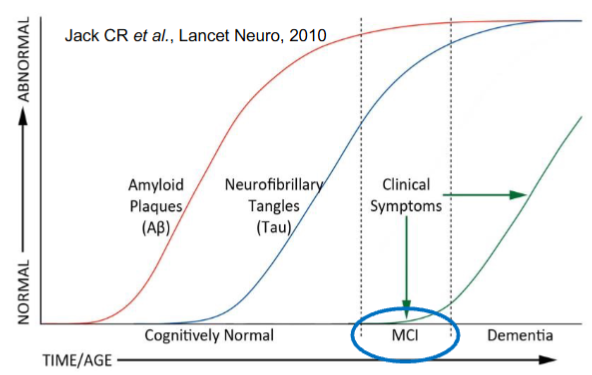
How are amyloid beta and tau measured? Which of these are the gold standards?
post-mortem brains (gold standard)
in vivo brains with PET (gold standard)
cerebrospinal fluid
blood (plasma/serum)
Females show greater yearly decline in _____________ in the presence of greater _______ in the brain compared to males (AD pathology).
hippocampal volume, tau
What is the pathology for vascular dementia?
vascular lesions
large infarcts (areas of cellular or tissue death)
white matter lesions
lacunes (small holes or cavities in the brain)
hemorrhages
What are the types of major vascular dementia?
post-stroke dementia
SIVCI
multi-infarct dementia
mixed dementia
What is post-stroke dementia?
immediate and/or delayed cognitive decline within 6 months after stroke and does not reverse
What is SIVCI?
sub-cortical ischemic vascular cognitive impairment —> lesions in subcortical white matter due to small vessel disease
small vessel disease can lead to this
What is multi-infarct dementia?
multiple large cortical infarcts contributing to the dementia
What are the sex differences in vascular dementia/VCI?
males have higher risk than females
What are microglia?
innate immune cells of the brain → have a role in the brain’s defense + repair mechanisms
Compare the hallmark pathologies between vascular dementia and AD.
Vascular dementia:
infarcts (micro/macro)
white matter lesions/hyperintensities
neuroinflammation (microglia)
AD:
amyloidosis
tauopathy
neuroinflammation (microglia)
Microglia release _____________ and _____________ signaling factors.
pro-inflammatory, anti-inflammatory
What are the two phenotypes of microglia?
M1 → pro-inflammatory (pathogen elimination, tissue damage, neuroinflammation)
M2 → anti-inflammatory (resolution of inflammation, restoring of homeostasis, promote nerve repair, regeneration, tissue maintenance)
Both M1 and M2 ___________ and the ___________ signals determine phenotype.
eat debris, local environment
In dementia, there is _______ overactivation and _______ inhibition.
M1, M2
In AD, the _________________ activate microglia. There is an increase in _______ and reduced _______, which leads too greater _______________ and _______________.
amyloid-beta plaques, M1, M2, neuroinflammation, AD-pathology
What are some of the modifiable risk factors for AD?
physical inactivity
smoking
excessive alcohol consumption
air pollution
head injury
infrequent social contact
less education
obesity
hypertension
diabetes
depression
hearing impairment
high LDL cholesterol
vision loss
Physical inactivity is a _______________ risk factor for dementia in females than in males.
stronger
Erickson et al. (2010) found that walking more than or equal to ______ per day maintains ___________ volume over 9 years. It also reduces the risk of ____________ over 13 years.
1 km, grey matter, MCI
Larson et al. (2006) found that people were more likely to be dementia free with increasing age if they walked _____ or more times per week.
3
What is the difference in physical activity design between cohort studies and randomized controlled trials?
cohort → no prescribed treatment/intervention
physical activity level is measured subjectively w/ questionnaires or objectively w/ accelerometers
randomized controlled trials
treatments/interventions are randomly prescribed (purposeful exercise)
The Rush Memory and Aging Project was a prospective observational cohort study that _____________ measured physical activity and dementia risk, brain pathology + synaptic proteins. What results did they find?
objectively
higher late life PA associated with better global cognitive trajectories (reduced incidence of dementia)
higher or late-life PA associated with LESS neuronal loss and macroinfarcts
ISSUE → limited pathologies looked at (no tau, amyloid plaques or white matter insensitivities)
higher PA associated with more synaptic proteins
Increased PA is associated with _____________ amyloid beta in cerebrospinal fluid. Why is this?
increased, because there is higher clearance of amyloid beta from the brain (good)
What are the sex differences between PA levels and amyloid beta and cortical perfusion?
higher PA in females is linked to increased cortical perfusion
higher PA in males is linked to decreased amyloid beta burden
What were the sex differences in the relationship between PA and blood levels of tau in a study by Nel et al. (2026)?
high PA was associated with lower tau levels in females but not in males
What is the relationship between white matter lesions and PA?
higher PA + fitness associated significantly with reduced white matter lesion volume
What is reverse causation?
occurs when the presumed “effect” or outcome actually causes or drives changes in the presumed “cause”
instead of X causing Y, Y causes X
example of Whitehall II cohort study → no association between PA + cognitive decline, but PA in people with dementia declined up to nine years before diagnosis
previous findings showing a lower risk of dementia in physically active people may be attributable to reverse causation — due to a decline in PA levels in the preclinical phase of dementia
How does self-reported PA influence the risk for MCI? How does self-reported PA relate to the risk of all-cause dementia, Alzheimer’s disease and vascular dementia, and different dementia pathologies?
MCI → higher self-reported PA reduces the risk for MCI
others → higher self-reported PA reduces the risk for all-cause dementia and others
What did Latenschlager et al. (2008), who did a 6 month, 150 min/week exercise intervention (home-based)?
exercise intervention was beneficial for those with MCI, with benefits lasting a year
exercise group got better scores on the ADAS-cog test (AD assessment scale-cognitive subscale) (lower scores are better)
What were the findings of a meta-analysis of RCTs of supervised, moderate-intensity aerobic training interventions?
aerobic training improved mini-mental state exam scores
aerobic training improved Montreal cognitive assessment scores
both assessments measure global cognitive functioning
What were the findings of supervised, high-intensity aerobic training intervention in people with MCI?
aerobic training improved executive functions (in women only)
What were the findings of the SMART (study of mental and resistance training) trial?
progressive resistance training:
improved global cognition on ADAS-Cog
increased gray matter in posterior cingulate
reduced progression of white matter lesions
What were the main findings of the meta-analysis by Balbim et al. (2022)?
investigated the effects of exercise training on cognitive function in older adults living with all-cause dementia
does dementia type matter
found a small significant effect of exercise training (regardless of type) on cognitive function in all-cause dementia compared to control
only adherence to the exercise intervention moderated the effect of exercise on cognition (greater adherence associated with greater effect on cognition)
main findings:
seems like aerobic training might have the greatest effect on cognition
greatest cognitive effects might only be in Alzheimer’s disease
maybe exercise more beneficial in males with all-cause dementia for overall cognition
in all-cause dementia, greater effect of exercise maybe for global cognition
What were the main findings of the PRoMOTE study in terms of cognition, the brain and BDNF?
improved set-shifting in females only
exercise increased functional aerobic capacity in males only
exercise increased BDNF in females only
What are white matter lesions and how does exercise influence them?
areas of tissue change or injury in the brain’s white matter, resistance training 2x per week reduces progression of white matter lesions, some studies say aerobic exercise decreases white matter, others say it increases it (some say there is a sex difference, white matter in females increases and decreases in men)
How do you determine the age of newborn neurons?
check other flashcards
Is type of exercise a moderator of exercise efficacy? What is the evidence supporting this?
ExCEL study → resistance training improves executive functioning, AT improved memory + maintained hippocampal volume in MCI, both improved visual spatial memory
so → type may be an important moderator
Is APOE4 genotype a moderator of exercise efficacy? What is the evidence supporting this?
APOE → supports lipid transport and injury repair in the brain (clearance of amyloid beta)
main genetic risk for Alzheimer’s disease is APOE polymorphic alleles
APOE4 → increases risk for AD
in a meta-analysis, increased PA was associated with increased brain activation, only seen in APOE4 carriers
AT improved set shifting in APOE4+ females
Why are animal models of dementia necessary?
valuable to understand the pathophysiology of dementia
development of new therapeutics (preclinical trials)
What are the 2 main classes of AD?
1. FAD (familial Alzheimer’s disease)
rare, associated with mutations in several genes
pathology + cognitive impairment onset is between 50-60 years of age (early onset)
plaques, tangles + cognitive dysfunction
2. SAD (sporadic AD)
highly prevalent, linked to over 20 genes
APOE4 gene has the greatest influence
later onset of pathology + cognitive impairment than FAD
plaques, tangles + cognitive dysfunction
How can the 2 main classes be modelled in rodents?
transgenic rodents that overexpress human genes associated with FAD
most common transgene used is for the amyloid precursor protein (APP)
only the 3xTg-AD mouse expresses all 3 pathologies (amyloid beta plaques, amyloid beta in the vasculature, tau tangles)
Explain the neuropathology, cognitive impairment and reduced neurogenesis associated with the 2 major rodent models of AD (3xTg-AD, 5xFAD).
3xTg-AD
mutations in the human MAPT gene related to the formation of tau tangles
neuropathology:
plaques in cortex + hippocampus
vascular amyloid beta
tau tangles
death of mature neurons
increase in # of microglia
cognitive impairments:
decline in Morris water maze spatial reference learning + memory, decline in spatial working learning + memory, decline in contextual fear conditioning
5xFAD
neuropathology:
plaques in the cortex and subiculum, later in the hippocampus + thalamus
NO tau tangles or vascular amyloid
death of mature neurons
increase in # of microglia
cognitive impairments:
decline in Morris water maze spatial reference learning + memory, decline in spatial working memory in the Y-maze, decline in contextual fear conditioning
In AD, what are the areas of the brain to first show neuronal loss?
subiculum, entorhinal cortex, hippocampus
Outline 2 potential mechanisms through which Alzheimer’s influences adult hippocampal neurogenesis.
1) amyloid beta + tau tangles
2) neuroinflammation
What are the limitations associated with rodent AD models?
most AD clinical trials in humans conducted with SAD, not FAD which most rodent models rely on
heavy reliance on amyloid beta-related gene mutations
cognitive impairments seen in mouse models usually occur either at or before neuropathology development
rodents don’t have AD (only certain aspects of the disease are modelled)
different rodent models for different aspects
currently no perfect model
What are the major rodent models of vascular dementia?
surgical models:
bilateral common carotid artery occlusion (BCAO) → leads to rapid/acute, almost complete reduction of cerebral blood flow, induces hypoxia with white matter damage
bilateral carotid artery stenosis (BCAS) → uses coils, sutures or constrictors to produce slower development of changes than BCAO
genetic model:
spontaneously hypertensive/stroke prone (SHR/SP) → models one of the main risk factors for SIVCI (uncontrolled hypertension), results in damage to white matter + cortex + hippocampus
What are the pros + cons of the surgical models? The genetic models?
surgical:
pros: can use in other rodent models, pathology for vascular dementia (WML, etc.)
cons: gradual return of cerebral BF, damage to the optic tracts which are fed by branches of occluded arteries (loss of sight affects Morris water maze)
genetic:
pros: models main risk factor
cons: don’t live very long, progression is very fast
What is the role of aerobic training in vascular dementia (when is it most effective)?
seems to be more effective as an intervention in early AD for:
spatial reference learning memory
synaptic plasticity
forced more effective than voluntary
Outline 2 possible mechanisms through which aerobic training could be influencing adult hippocampal neurogenesis?
reduction of amyloid plaques via decreased cleavage of APP into amyloid beta
creating a microenvironment conducive to promotion of adult hippocampal neurogenesis
Understand the relationship between irisin + AD and the role of AT.
irisin levels are reduced in AD brains
boosting irisin (with exercise, especially aerobic exercise) improves memory in AD