business law exam 2
 Call Kai
 Learn
 Practice Test
 Spaced Repetition
 Match
 Flashcards
 Knowt Play
1/176

There's no tags or description
Looks like no tags are added yet.
177 Terms
Civil Rights Act — Title 7 (what is it? —> what is included? —> what is the threshold?)
Civil rights act title 7 *
→ private companies (and govt agencies) can’t discriminate against employees → 15 employees and impacts foreign/interstate commerce
Atlanta motel case (title 2 of CRA – no denying service to business) → commerce clause is constitutional backing
Can’t deny employment at a business or negative employment action because race color religion sex or national origin →now includes sexual orientation
Can’t promote someone over another bc of race or fire someone else over gender
Negative employment treatment against someone
Title 7 → employment discrimination
NOT TESTING ON (what are we takling about here slide)-->
Applies to private companies or business that have 15+ employees and are engaged in interstate commerce
15 person threshold? → compromise
for exam: know that this is bc of commerce clause and
bostock, Ames v ohio (what happened? — what is the background circumstances requirement? — what was the ruling? — what was the impact? — what was the justification of the ruling)
Ames — eliminated background circumstances requirement —> was a judicial doctrine in employment discrimination law that required plaintiffs from historically advantaged or majority groups—such as white, male, or heterosexual employees—to meet a higher evidentiary burden when filing "reverse discrimination"
SCOTUS → 5 to 4 decision → in favor of the plaintiffs and ruled that taking a negative employment action against somebody bc of their sexual orientation/identiy is a violation of CRA 7
5 to 4 conservative majority (6 to 3 majority now)
Justice – Gorsuch → sided with four liberals and ruled in favor of the plaintiffs → surprising!
2 different plaintiffs w/ different cases that were merged →
Man transitioned to woman → fired after transition
Gay man came out and was fired
SCOTUS ruled in favor of plaintiffs →
Gorsuch wrote majority opinion – very conservative judge
Gorsuch legal rationale → textualist and associated with orginialism
Textualist: When you're faced with ambiguity → look at the text
Document holds u can’t discriminate based on SEX
Four liberal judges → proud textualists in that moment (usually living, breathing document supporters)
Real originalist belief→ in the 1960s prob not to protect gays or trans people
BFOQ & Ministerial exception (what is BFOQ?)
Religious organizations → can in fact sometimes discriminate based on religion
Protects employer w/ discriminating → because of an essential element of the job
very limited and very rare exceptions
Cannot be race or color
stereotypes do not establish the excpeiton
Only hiring women as a nurse – ok if narrowly tailored
or only hiring women in an undergarment section
or female nurse only for the delivery unit of a hospital is okay
or male attendant only in bathroom
Nothing against attractiveness
NFL,NBA – not men only
Wnba – female only organization
hooters — uses this argument as a part of their business model — no clear cut definition saying hooters can use this — all lawsuits have settled out of court
EEOC (what is the EEOC? — EEOC practices)
EXCEPTION: Cannot sue someone in court for title 7
Have to file EEOC
EEOC
Not prior to 1964 → very practical → agency to help w/ backlog to investigate with claims
Someone is assigned to be eeoc investigator
After EEOC makes a ruling → either person can appeal
investigates claima of workplace discrmination and harassment — can’t go directly to the court
disparate treatment (what is disparate treatment — how would one go about filing a disparate treatment claim— what must you prove/show — what must the employer show? )
intentional discrimination
only need to show race/gender/etc was a substantial contributing factor — or can show circumstantial evidence
must show adverse employment decision was discriminatory and must be proved beyond POTE
P must prove prima facie case — all elements necessary
if prima facie case proven, burden shifts to employer’s rebuttal, plausible evidence of a nondiscriminatory reason
pretext — excuse for discrimination
show circumstantial evidence — like number of employees of a certain group
disparate impact (what is it? — is it still in use? — what does neutral on its face mean? — what is the defense? )
“neutral on its face” —> , a policy or practice that is neutral on its face means that the rule appears fair, equal, and non-discriminatory when you read the words on the page.
for disparate impact, a plaintiff must show that a neutral on its face policy has disproportionately adverse impact
disproportionately affects one or more groups
Civic test to be janitor → neutral test but disproportionately impacts black students for example
April 2025 → EEOC is not investigating these claims anymore
Trump says its a woke policy and we shouldnt be doing it anymore
EEOC says they are no longer investigating disparate impact claim
Amazon → If theree was a rule that you have to lift 200+ lbs → this may disproportionately impact women – but is lowk necessary
→ was this policy necessary in order to successfully fulfill duties of the role ??
Not necessary → then do away with policy
Not being enforced → trump sent executive order → said woke policy
Frankly, did give an opportunity to easily claim that its disrportionately impacting a certain group → and not necessary
Supreme court used to agree year after year → but trump admin said no longer enforcing
prima facie case (what does it mean — why is this a thing?)
the establishment of a legally required rebuttable presumption
On its face – he can check the boxes to move forward
If you file EEOC claim you will need to at least have interacted/interviewed with employer to make the prima facie case – on its face need to check the boxes
All this means is that you can move forward once prim facie is laid out – maybe something is going on → now its employers turn after – employer has opportunity to respond to claims
Often people file frivolous cases on discrimination → for money
prima facie case is a cause of action or defense that is sufficiently establish by a party’s evidence to justify a verdict in their favor, provided such evidence is not rebutted by the other party
sexual harassment (two types — who is liable?— why are they liable?)
intentional discrimination aka disparate treatment (not an accident)
two types
1. quid pro quo — an eye for an eye
sexual favors for positive job reaction
illegal based on position of power
2. hostile environment
verbally or physically sexually harass
employer liability
If a perosn has been harassed at work (sexually harassed) – the business or employer is strictly liable for damages to the victim
If a supervisor is harassing a subordinate or if a coworker is harassing another coworker and if supervisor knew aobut it or SHOULD have known about it → company is strictly liable
Why we have this qualification?
—> Supervisor would act like they wouldnt know about it w/o this qualification
strictly liable if supervisor/coworker — liable if supervisor knows or should have known and did not take immediate action
special defense for sexual harassment
no tangible job detriment
company policy with clear procedures
employee did not use procedures
all 3 are elements!!! - usually hard to check the first box
When the Defense Does NOT Apply
Tangible Employment Action: If the hostile environment culminates in a tangible adverse employment action (e.g., being fired or demoted for rejecting a supervisor's advances), the employer is strictly liable and no affirmative defense is available
Okoli v. City of Baltimore (what happened — what were the rulings — constructive discharge)
District court level → allowed summary judgment – appeal → reversed district courts ruling
Says she was fired bc of too many typos but her PR have been good so far
Summary judgement → bc not severe enough
Appeal – very clearly sexual harassment
—> constructive discharge - happens when an employee resigns because their employer made working conditions so intolerable that no reasonable person could stay —> wrongful termination claim
employment practices liability insurance
specialized form of liability coverage protecting businesses against employee lawsuits alleging wrongful employment acts
They would hire lawyers for you and follow you through – for your business owner – insurance that would protect you from liaiblity coverage for employment acts
For owners who are very risk adverse –
Business owners that operate business for a much high rlikelihood that would imagine a much higher likelihood of sexual harassment or racial discrimination
Strip clubs for ex
businesses against claims made by employees, former employees, or job candidates who allege that their legal rights have been violated —>
wrongful termination
harassment
discrimination
ADEA
Discrimination based on 40+
Cant fire someone simply because youre old
age only needs to be a motivating factor
Exceptions
Pilots 65 and younger
americans with disabilities act
Disability - physical or mental impairment
With regards to employment discrimination “reasonable accomodations”
Like one little tool but maybe not something super expensive
This codifies that you are not discriminate from society or work just because your not able bodied
lily ledbetter act (what happened? — what did this codify? )
Worked for goodyear tires – became a manager – only female manager – somebody told her she was being paid less than all her colleagues – if true, against equal pay act
She finds out – files a lawsuit – goodyear tires says she wasnt being paid as much bc shes not as good – goodyear says if even if this is true – she should be barre from bringing this bc of statue of limitations – SOL was 2 years and she waited too long – she says i didnt know
Case goes to SCOTUS and 5-4 ruling – rules in favor of good year tires – she lost – obama – first bill he signed – lily ledbetter act
LLA – amended equal pay act – every new instance of discrimination starts SOL over —> every new paycheck
workers compensation (what is it? — what state doesn’t have it? what is the trade off?)
Workers' compensation is a state-regulated insurance program that provides medical care and wage replacement to employees who suffer a work-related injury or illness
Employees injured on the job will rcve payment – from seperate insurance polcy – if there is an on the job accident
Minimum threshold of workers comp – for every state except texas
Business friendly – pro employer – risk on the backs of the employees – but if you do get injured →
Trade off – worker could get injured on the job – you have to pay him out of pocket
Higher salary trade off with not having to pay these insurances
General liability insurance will not pay if its your own employee – wont pay for an on the job employee injury
OSHA — occupational safety and health admin (what is it? — what does it do? — who does it protect? — what are the consequences?)
regulates workplace standards
general duty clause — place of employment free from recognized hazards of death or serious harm
imposes citations nd fines
Ensuring workplace safety for employees
More in blue collar jobs – required to have hard hat/vest – will shut down if violations/costing owners a lot of money
Protections for blue collar workers – consequence is that its less efficient, more costly, slows down business
fair labor standards act
Overtime – from unions – child labor – from unions
The Fair Labor Standards Act (FLSA) is a United States federal law enacted in 1938 that establishes basic labor rights, including the federal minimum wage, overtime pay, recordkeeping rules, and child labor standards
no child labor
40 hour work week and overtime
minimum wage
at will employment
Employees can be fired for any reason and only after specific procedures have been followed
Can fire for any reason except for race, religion, sexual orientation
No law against jerks firing people for no good reason
On the flip side, the employee can quit at any time
employment contracts
most dont have
not at will – only can be fired for cause (tom from desperate housewives)
Most people wont work under contract, usually at will
U can also only quit under certain stipulations
tenure debate (why does tenure exist — what are the pros and cons?(
In higher education, there are two faculty paths – professional tenure
Professional – u only teach and no other requirements or expectations
Tenure – obligation to publish/research – have to have PhD - assistant-associate-full – if you make full, you have job protection for life and you can only be fired for cause
Pros
Cons
Criticism is that they may not actually try with teaching and they are making a lot
Problem – politicized, people make it polarized – or they say all tenured professors are too liberal `
Why do we have this policy → because of academic freedom – do not get worried about doing research/teaching (abt outside influences) – important to ask uncomfortable questions and producing high level research
wagenseller v scottsdale memorial hopsital
at-will employee cannot be fired for refusing to break the law, establishing a major "public policy" exception to employment-at-will
Nurse was a good nurse – one night her unit goes on a company retreat – staying up late and started mooning each other – except wagenseller – 2 days later she was fired – she files a wrongful termination claim – hospital says shes an at will employee excetp for statutory exceptions (
Goes up to the arizona supreme court – agrees with hospital, no law they can point too
Judge-made law – makes new law – as of now - it is against arizona public policy – wrongful termination if you fire someone for refusing to break a law – creating this new rule — she ends up winning on appeal
Going forward – public policy exception
Family Medical Leave act
—> point is that you know you have your job after something happens
a federal law providing eligible U.S. workers with up to 12 weeks of unpaid, job-protected leave for specified family and medical reasons, or up to 26 weeks for military caregiver leave
what is a tort?
any wrong excluding breaches of contract and crimes
When someone harms you
Many ways – someone punches you, steals something, breaks your computer,
Excludes crimes though → wrong against someone outside of breach of contract or a criminal charge, – aarnav has a tort claim against joe – but DA can also say that was assault - criminal charges
intentional tort
plaintiff argues that defendant cause harm INTENTIONALLY
assault and battery
No intent!!!! → cannot be an intentional tort***
Negligence approximately = accidents (accident)
Not an intentional tort – negligence
— not an intentional tort → wRecklessness – in betwen category – Prof Q not book – not doing it intentionally but acting a fool
Driving over the speed limit – negligence (5mph over)
Hits someones car at 100mph – gross negligence or recklessness
compensatory damages v punitive damages
Compensate you for what you damaged – intentionally or unintentionally
Punitive – punishment – usually only intentional torts or recklessness
employer liability
Business are responsible for actions so long employees are doing their job!!!
Company will have to pay out and if your employee did an accident/doing a job → employers are resoponsible
3 requirements for assault and battery and defenses
affirmative conduct — actively and voulunatrily
intent
injury
defenses:
consent — if you voluntarily agreed
self — self defense
assault (definition — what does imminent mean?)
any act that creates a reasonable apprehension of an imminent battery
has to be imminent!
“Im going to kick your ass wehn i see you”
Not imminent
Imminent definition – has to be right now or incoming right now – seeing it coming
Putting someone in imminent fear of bodily harm
—> going. up to someone and cocking your fist back getting ready to punch
Reason for assault as a claim – pyschological harm (assault as a tort)
the actual process or happening of you about to hurt someone and that pyschological harm against somoene
transferred intent
hitting someone else by accident
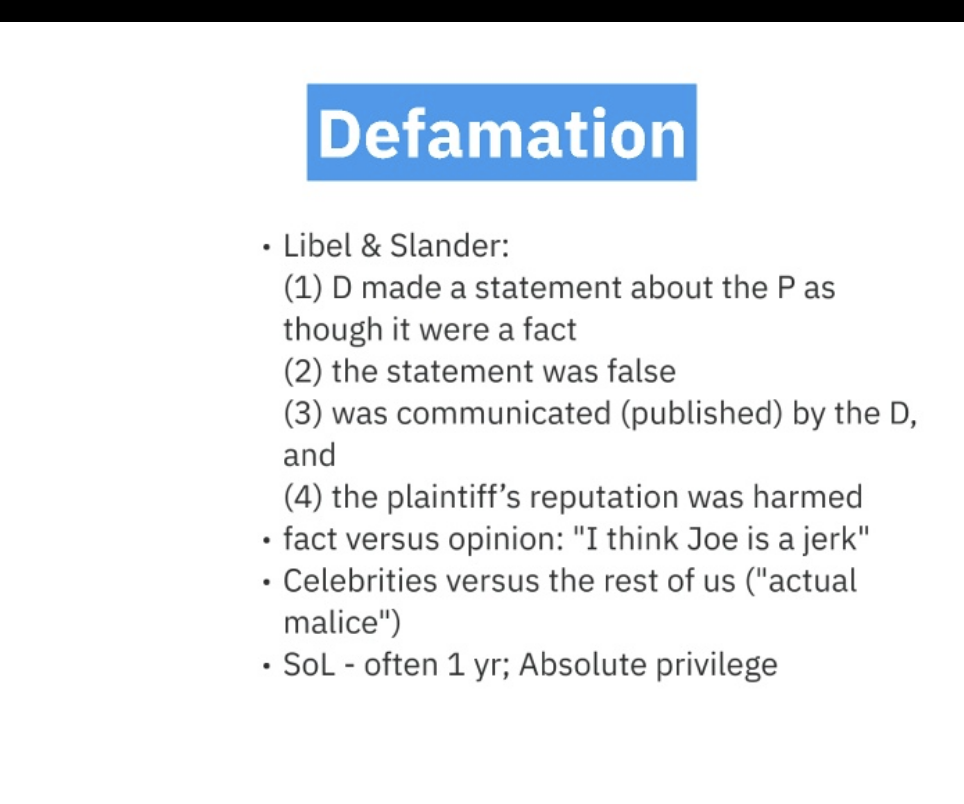
defamation
Defamation
Requires that you are lying about someone intentionally to harm their reputation
Was it true?
Not defamation if you thought it was actually true
Donald trump —-> name calling not defamatory
emotional distress elements
elements:
Extreme and outrageous conduct
Intent to cause or disregard of a substantial probability of causing severe emotional distress
That the conduct did in fact cause sever emotional distress
Often brought up seldom successful
false imprisonment
intentionally confined or restairned plaintiff
without the plaintiffs consent
without lawful authority or in an unreasonable manner
injured the plaintiff
Walmart case
Unreasonable – went too far
Can happen in a field too
tortious interference with a contract
contract between plaintiff and third party — that defendant knew about
defendant imporperly induced third party to breach contract or made performance of contract impossible
injury to plaintif
false advertisement
false or misleading fact statements about products or those of a competitor
statements were material an dlikley to influence purchasing decisions
defendants used statemetns in commercial advertising or promotion
statements created likelihood of harm
negligence (definition and requirements)
accidents — usually no punitive damages
requirements:
duty
breach of duty
direct causation
damages
(Duty – owed you a duty
Breach of duty – breach of duty
Causation – cause your damages
Damages)
Duty
A lot of it has to do with proximity
I shouldn’t hurt someone, even accidentally – you owe everyone a duty
Otis Engineering Corp v Clark
Drunk on work - asked if can drive home safely - bob says yes - maanger sends hin home early - drives home and kills two people
- did bob owe those women a duty? → definitely yes
Did manager owe them a duty? → yes
How likely that someone might be injured
Moral blame attached to actions
**policy of preventing future harm → sets precedent that you can’t send drunk employees home as a business (like with sexual harassment) if we dont hold otis at least partially responsible – that would be bad for society
**the reason this company was liable was because they weren’t acting reasonable – unreasonable action
Is there a duty? (requirement for negligence)(what is the general rule)
we owe a duty to every person who we can reasonably foresee might be injured by our carelessness
dram shop laws
are legal rules that hold commercial alcohol-serving businesses—such as bars, restaurants, taverns, and liquor stores—financially and legally responsible for harm caused by intoxicated or underage patrons whom they overserve.
Bartender liable, so is company if you overserve and they get in trouble
Whole business is liable in part for selling alcohol as well – business and employees
types of people on your property and definitions (and what can they sue for?)
Invitees
Someone u invited over
May sue under ordinary rules of negligence
Licensee
Right to be on ur property but didnt invite you there
Salesman or neighbor
May sue for hidden dangers they should have been warned
Responsibility bar lowered
Trespasser
Katko v. Briney (important caveats — and what this means for texas)
Important caveats if homeowner is liable:
Self defense – legally within rights to shoot that person and protect yourself – if threat is imminent
Unreasonable – murder if not a threat
He is not protecting himself – he has the right to protect himself if he was a lethal threat → then not okay in this situation since he is not protecting himself cannot shoot someone
Man is protecting only property → that designation makes different
You have the right to protect property but you dont have to shoot him (you could have done other things like put a different rap)
Human life more valuable than property
Little kids trespassing – doesn't deserve to get shot
No lethal traps to protect property → but different if you are protecting yourself and your kids
Held liable for injuries minus from breaking in
DEADLY FORCE NOT ALLOWED IN THESE SITUATIONS!!
for simple trespassing
non threatening presence
reasonable, non deadly force
different with forceful entering (castle doctrine)

dogs and negligence and trespassing (Caveats, best practice, when okay — when not okay)
If dog is protecting family → ok if true intruder
If dog attacks normal person (invitees) – negligence applies
But there is nuance when it comes to a chihuahua vs a big dog – where you should be more careful with a big dog
If a big dog attacks an intruder who breaks into your home while you are gone and the dog is safely kept inside the home
You will not be held liable
One could reasonably expect to safely ekep their dog inside
If you keep your dog outside while you leave the home and it mauls a kid, you will be liable – one could reasonably expect this may happen — if the kid is crossing the fence to pick up a lost ball
If dog is protecting only property and is outside and dog attacks or kills someone → then you will be liable
If you are gonna be out of town – keep the dog inside
Beware of dog signs – may help you but u are still liable
Doesnt matter if you kill someone, you willl still be held mostly liable
Potentially lethal weapon as a pet
breach of duty
If you owe someone a duty and then you breach it
did they meet the reasonable person standard of care?
reasonable forseeability, legislatively imposed standards (negligence per se) , circumstances of the case
negligence per se
is a legal doctrine in tort law meaning "negligence in itself". It applies when a person violates a law or safety statute, and that violation causes an injury. Instead of proving that a defendant acted unreasonably under a general "reasonable person" standard, the court automatically treats the statutory violation as a breach of duty.
speeding
two requirements for causation ( and definitions)
factual causation → (but for) the defendants act the injuries would not have happened (if i did not fill up the soda machine)
legal causation → (proximate cause) reasonable forseeability of the resulting harm
palsgraf v long island
landmark American tort law case that established the legal concept of the foreseeable plaintiff and the scope of a defendant's duty of care in negligence.
Palsgraf sued the railroad company for negligence. A jury found in her favor, and the Appellate Division affirmed it; the railroad appealed to the New York Court of Appeals.
not foreseeable the old lady would have been injured
damages
take your victims as you find them
if you hit a $250k car — you pay $250k
punitive damages generally not applicable for regular negligence
plaintiff must prove injury to person or property
is a legal term that refers to monetary compensation awarded by a court to an individual or business as a remedy for a loss, injury, or breach caused by another party's wrongful act. [1, 2, 3]
what can you put in a contract and what is negotiable in a contract?
Virtually Anything → can’t be illegal
Can’t have a contract for something illegal
Can make it for just about anything as long as its not harmful
Agreement
Even if you paid for food and then forgot ot give you you drink that you purchased – by law they have to give you the food/drink if you paid for it
Important!! – need ot understand that contracts are negotiable
Rule: everything negotiable except take it or leave it contracts
Get comfortable negotiating – dont pay sticker price
definition of a contract
an agreement that the court will enforce
Legally enforceable agreement!
If she refuses to do her end of the bargain, you have to do it or at least pay her the damages to do it
An agreement that the court will enforce
He said she said – whoever has a more believable story
valid contract (4 elements)
offer
no contract if there are no offers
acceptance
consideration
I am giving something up in exchange that they give something up to me
no consideration, no contract
meeting of the minds
two people have to have legal capacity (adults) whom know what they’re doing and doing it willingly
bilateral vs unilateral contracts
Most contracts are bilateral
Offer a promise for a promise
unilateral contract
Promise for an act upon completion/promise in exchange for doing an act
Give her 500 if she checks the box – if she finds my dog
Lost dog
express vs implied contracts
Express - where parties are communicating what they want – written or spoken – communicating that this is something that I want
Implied – understood that you will pay a reasonable sum for the service (haircuttery — UNLESS THEY ASK AT THE BEGINNING IF $30 IS OKAY AND U SAY YES THEN IT IS EXPRESS)
quasi contracts
“only in exceptional circumstances where a court feels compelled to impose an obligation upon one person regardless of whether he or she had any intention of making a contract”
Doctor saves unconscious person found on the ground and he later bills someone → you do have to pay them
Technically not a contract since you didnt agree
But doctor can do this
Same as doctors being able to work on you if your are unconscious – and the doctor can bill you
In this scenario only for doctors
common law and UCC
older contract law is guided by common law
Business (merchant) involved in selling tangible goods – if you are selling tangible goods — if you have a merchant and contract dispute – UCC will kick in to tell us what to do
Business can count on the fact that things will remain consistent – adopted by every state except louisiana
valid, void, voidable contracts (when are they unenforceable as well?
Valid contract
Valid
Meets all requirements
Voidable contract
One person has the potential to make it void
Can follow through but don’t have to
Void
Never took place
When one party has been declared legally insane
Bankruptcy or statute of limitations expired
statute of fraud
to guard against fraud
Do not need to be in writing to be enforceable
Oral is fine
In order to guard against fraud these things have to be in writing
Property
Contracts made in contemplation of marriage – prenup → no oral prenups!
Contracts that cant be performed in one year – if longer than one year has to be in writing
land
debt
over 500$ - UCC
adhesion contracts
formed when one party, usually having greatly superior bargaining power over the other — prepares the terms of a proposed contract and presents it to the other party on a take it or leave it basis
ex: apartment leases
agent
a person employed to act on behalf of another
principal
employer of an agent
fiduciary relationship
principals and agent relationship — A fiduciary relationship is a legal connection where one party (the fiduciary) must act primarily in the best interests of another party (the beneficiary), placing the beneficiary's needs above their own
express authority
directly granted by the principal to the agent
implied authority
serves to fill in gaps where the principal has not spoken specifically on a subject
apparent authority
agent acts outside the scope of express or implied authority → principal normally not responsible for the transaction
however if principal - by his or her own conduct - has led third parties to believe agent has authority, principle may be responsible — agent has apparent authority
when can a superior be sued for an agent’s negligence? (3 reasons)
if the superior directs the subordinate to commit the tort
if the superior carelessly allows the subordinate to operate potentially dangerous equipment — knowing agent is unqualified/incapable
or the agent is just doing their job
employment at will
companies can fire workers at any time for any reason, unless the company would violate a specific law in doing so
Civil Rights Act
what does reasonable accomodations mean in regards to CRA
are not reasonable only if an employer can demonstrate it will impose undue hardship upon employer
what is business necessity and what needs to be shown? (disparate impact)
must show
challenged employment practice was necessary to achieve an important business objective
the practice actually achieves this objective
pretext (CRA)
excuse for intentional discrimination
ADEA - what must you prove
40+ and over
must prove employees age was a motivating factor in an adverse employment decision
if employers age is at least one significant reason for firing or demotion — even if there are other reasons
no minimum worker
battery
requires physical contact
harmful or offensive bodily contact
what does injury mean in an assault and battery case?
assault — fear or apprehension must be imminent harmful or offensive contact → not in the future, imminent, and only if they are aware
battery —> only needs to show that they received a harmful or offensive bodily contat
libel
defamation that is written or in some fixed form like a video
traditionally, libel is considered more damaging than slander because it is more permanent
slander
spoken defamation
requires proof of special damages
economic loss or damage to reputation
two types of defamation
libel
slander
slander per se
spoken false statements that are so naturally and obviously damaging to a person's reputation that the law presumes harm, meaning the plaintiff does not have to prove specific financial or economic loss
categories: lies about serious crimes, contagious diseases, professional incompetence
key elements of defamation
statement is untrue
not an opinion, can be proved untrue
statement is published
must be published or communicated by the defendant — overheard or read by a third party
d made a statement about p as though it was fact
plaintiff’s reputation was harmed
unconscionable contracts
adhesion contracts will uphold unless — shocking to the conscious
court doesn’t care if you got yourself into a shitty deal unless it is UNCONSCIONABLE
false imprisonment KEY ELEMENTS
intentional confinement
without consent
without lawful authority
injury — deprivation of freedom is injury ; doesn’t matter if it was brief imprisonment — injury is pyschological in nature
will not offucr if plaintiff is unaware of the confinement
elements required for intentional infliction of mental distress
defendant must act intentionally or recklessly
conduct must be extreme and dangerous
plaintiff’s emotional distress must be severe
voidable contract
one of the parties has the legal right to withdraw from it at a later time without liability
maybe enforced by court
void contracts
never existed at all
if someone has alzheimers or court deems is adjudicated insane — they cant walk away from the contract so it wouldnt be void
NEVER ENFORCED
unenforceable contract
valid at time it was made but later rendered unenforceable because of the application of some special rule or law
time lapse
A voidable contract is an agreement that is legally valid and binding unless the injured or disadvantaged party chooses to cancel (rescind) it, whereas an unenforceable contract is a valid agreement in substance that a court will simply not enforce due to a technical, procedural, or legal defect (such as missing a required written form)
express contract
parties have fully and specifically stated the terms of the deal
can be written/oral
—> haircuttery ex. it will be express if both sides are clearly laying out the terms
implied contract
may not have communicated but may have gestured and agreed
candy bar — ten dollars situation
executory contract
once a contract is formed — executory until both parties have performed their obligations
executed contract
when both sides have completed their part of hte bargain
negotiated contracts
terms of many contracts are agreed upon only after a certain amount of bargaining takes place between the parties
offer (definition and 3 basic requirements)
proposal made in such a way it creates first formal step towards creating a contract
manifestation of an intent to contract
reasonably definite indication of what the two sides are to do
a communciation of the proposal to the intended offeree
manifestation of intent: are there any required words to make an offer?
No — all that is required is amnifestation of intent
what would a reasonable listener think?
objective v subjective intent
objective intent — important
subjective intent — not important
why? — because people lie
courts dont care what you “thought” in your head
preliminary negotiations
dickering/fishing
NOT AN OFFER
tentative or exploratory language
reasonably definiteness
a requirement of the offer
definite enough so that a court can determine whether both parties lived up to their promises in the event that a question of breach of contract arises
if too indefinite — court is unable to do this — will determien that hte proposal does not count as an offer
agreement on major points
advertisements (contract law)
preliminary negotiations rather than offers to sell —> invitations to come to the store or invitations to purchase
not binding — stores cannot control and predict stock/inventory; stores can choose not to sell to u
exception:
first come first serve rewards
bad faith (bait and switch)
bait and switch advertsiing
liability upon advertisers who lure readers into the store by offering deals
deceptive trade practices
auctions - with reserve and without reserve
with reserve — act of putting a particular item up for auction indicates only a willingness to consider offers for purchase
a bit is treated as an offer which may be accepted
without reserve
auctions presumed to be with reserve unelss they are explicitly represented as being without reserve
definite offer
first bid creates a contract binding on the seller unless a higher bid is made
two options once an offer has been made
acceptance or termination
requirements of an acceptance
demonstrate a definite present intent to accept the offer
must be unconditional and not add any terms that are additional or different from those of the offer
must be legally communicated to the offerer
3 ways of termination of an offer
revoked
rejected
lapse
**TERMINATION BY OPERATION OF LAW
revocation
withdrawal of the offer by the offeror
can take the offer whenever you like so as long as you communicate your revocation to the offeree before an acceptanc ehas occured
notable exception: option contract
option contract
offeree gives money or something else of value in exchange for the offerors promise than an offer will be kept open for a set length of time