Digestion and Absorption
 Call Kai
 Learn
 Practice Test
 Spaced Repetition
 Match
 Flashcards
 Knowt Play
1/26

There's no tags or description
Looks like no tags are added yet.
27 Terms
What is bile composed of?
Bile salts and cholesterol
Describe where bile is produced and where it acts
Made in liver, stored in gall bladder, released in small intestine
What is emulsification?
Turning a large fat globule into smaller droplets of fat, emulsion is small droplets of fat in water
What are the 3 functions of bile?
emulsification
micelle
neutralise - HCl makes molecules acidic
What is a micelle?
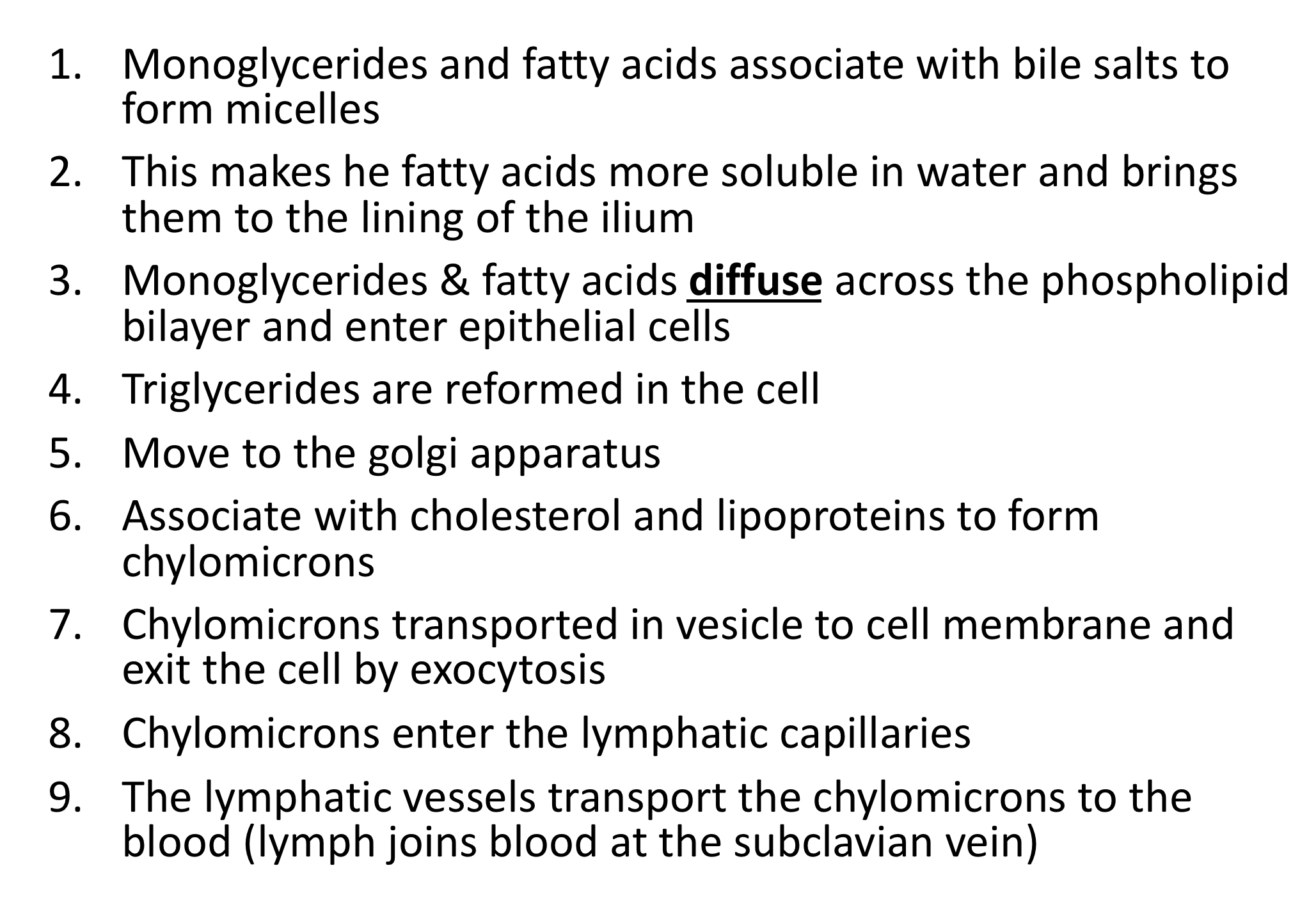
Micelles are bile salts surrounding fatty acids which were produced from the hydrolysis of triglycerides
bile salts form the micelles to make the fatty acids soluble in water
The micelle then carries the fatty acids to the ileum lining
Micelle- an aggregate of lipid molecules within an aqueous solution
What is digestion?
The process by which large molecules are hydrolysed by enzymes to produce smaller molecules that can be absorbed across cell membranes
What is absorption?
The transferring of small soluble molecules from the lumen of the small intestine and into the blood
What are all the components of the digestive system?
Mouth, salivary glands, Oesophagus, stomach, gallbladder, pancreas, small intestine, large intestine
What enzyme(s) is present in the mouth and salivary glands?
Amylase
What enzyme(s) is present in the stomach?
Endopeptidase- pepsin
What enzyme(s) is present in the pancreas?
Exopeptidase, amylase, lipase
What enzyme(s) is present in the small intestine?
exopeptidases, dipeptidases,
amylase, Maltese, sucrose, lactase,
Lipase
Where are carbohydrates hydrolysed in the digestive system?
salivary glands- amylase
Pancreas secretes amylase/dissacharides
Membrane-bound dissacharides + amylase (in the small intestine on epithelial cells)
What needs to happen to lipids before they can be digested?
They must be emulsified by bile salts produced by the liver.
This breaks down large fat molecules into smaller, soluble molecules called micelles, increasing surface area.
Where are lipids hydrolysed in the digestive system?
pancreas secretes lipases into the small intestine
Membrane bound lipases (in the small intestine on the epithelial cells)
Where are proteins hydrolysed in the digestive system?
stomach endopeptidases
Pancreas releases exopeptidases
Membrane-bound exopeptidases and dipeptidases on the small intestine epithelial cells
What do endopeptidases (eg pepsin do) to begin digestion in the stomach?
Hydrolysed peptide bonds in the middle of a polypeptide chain to produce shorter polypeptides/increase the number of chains
Endopeptidases are secreted in stomach where pH is 2 due to HCl - optimum pH for endopeptidases, tertiary structure of enzyme can cope with a very low pH
Later in the small intestine, how do exopeptidases continue digestion?
they hydrolysed peptide bonds at the end of polypeptide chains/ at terminal amino acid producing amino acids/dipeptides
Endopeptidases make lots of ends so exopeptidases can break the peptide bonds between terminal amino acids
Also in the small intestine, there are dipeptides, what do they do?
Hydrolyse the peptide bond in a diet peptide and produced single amino acids
These enzymes can be membrane bound, why is this advantageous?
Stay stuck in epithelial cells- not wasted
Closer to food molecules- more efficient absorption
What do we do if the concentration of glucose is higher in the blood than the small intestine?
Na+/K+ pump removes 3 sodium ions from the epithelial cell of small intestine and into the blood
So there is a lower concentration of Na+ ions in the epithelial cell compared to the lumen of the small intestine
A Na+ ion binds to synport protein and diffuses into epithelial cell down its concentration gradient
Glucose also binds to the synport protein and diffuses into the epithelial cell against its C.G.
Glucose diffuses from the epithelial cell and into the capillaries using a carrier protein down the concentration gradient
Why do fatty acids and monoglycerides not require co-transport?
They are non-polar molecules, meaning they can easily diffuse across the membrane of the epithelial cells
How are these epithelial cells adapted for absorption of the products of starch and protein digestion?
Describe how monosaccharides are absorbed by the cells lining the ileum
Sodium-potassium ion pump actively transports 3 sodium ions out of the epithelial cell into the blood
• This reduces the concentration of sodium ions in the cell.
• So sodium ions and glucose move into the epithelial cell from the lumen through a symport protein by facilitated diffusion (This is cotransport).
• Sodium ions move down their concentration gradient, glucose moves against its concentration gradient.
• The concentration of glucose increases in the epithelial cell
• So glucose moves into the blood from the epithelial cell by facilitated diffusion down the diffusion gradient
Describe how amino acids are absorbed by the cells lining the ileum?
Sodium-potassium ion pump actively transports 3 sodium ions out of the epithelial cell into the blood
• This reduces the concentration of sodium ions in the cell.
• So sodium ions and amino acids move into the epithelial cell from the lumen through a symport protein by facilitated diffusion (This is cotransport).
• Sodium ions move down their concentration gradient, amino acids moves against its concentration gradient.
• The concentration of amino acids increases in the epithelial cell
• So amino acids moves into the blood from the epithelial cell by facilitated diffusion down the diffusion gradient
What is bile’s role in lipid hydrolysis?
bile emulsifies lipids
bile neutralises HCl in the stomach
bile forms micelles
Describe the role of micelles in the absorption of lipids.
(HELPFUL HINT: use the diagram as you read through the steps)