Plants Bio 130
 Call Kai
 Learn
 Practice Test
 Spaced Repetition
 Match
 Flashcards
 Knowt Play
1/29

There's no tags or description
Looks like no tags are added yet.
30 Terms
plants are…
alive, they feel and respond to their enviroment
photosythetic(autotrophs), link beteween the sun energy and chemical energy
sessile, don’t move
have cell walls
autotrophs
make food out of sun energy and other nutrients, beling to kingdom plantae (eukaryotes)
intermediate growth
continue to grow throughout their lives
phenotypic plasticity allows for stalling growth
4 main groups/phylla
bryophytes (nonvascular, moss, etc.)
seedless vasculars (ferns)
gymnosperms (conifers)
angiosperms (flowering/fruit-bearing)

big evolutionary steps
multicelluarity
vascular system
seeds and pollen
flowers and fruits
4 main resources needed for growth
light
water
nutrients
space
what are the shoots and their functions
Usually aboveground.
Includes stems, leaves, flowers, and fruits.
Supports the plant.
Performs photosynthesis and reproduction
what are roots and their functions
Usually underground.
Absorbs water and minerals.
Anchors the plant.
Stores nutrients
surface area to volume ratio
high surface area is good for light exposure, absorbtion
- bad for water loss and storage
high volume is good for storage and less dehydration
surface area on shoots
increased sun exposure (big fat leaves)
increased water loss (more stomata to lose water)
more danger from freezing, think of tree types in autumn
surface area on roots
increase absorbtion
decreased strength (pulling up grass v. pulling up a shrub)
decreased storage
key functions of root system
anchors the plants
abrobs ions and water
conducter water and ions
stores molecules
tap roots
more volume than surface area
strength and storage
vertical

lateral roots
more surface areathan volume
for absorbtion
not very strong

what is root style determined by
natural selection- minimize competition for resources
modified roots
anchor roots- anchor stems to walls
prop roots- stabilize stems
pneumatophores- allows for gas exchange
storage- store sugars for later
shoot system
stems
leaves
buds
stem structure
contains main part of vascular system
nodes- where leaf is attached
internodes- between nodes
what are leaves
the photosynthetic areas hat contain part of the vascular system
what are buds
they show future growth
lateral buds- leaf attachment
terminal bud- tip of the branch
modified stems
water storage - cactus
stolons- produce new indivisuals above ground
rhizomes - storage
tubers- carbohydrates storage
throns - defense
leaf modification
bulbs- food storage
succulent leaves- water storage
tendrils- aid climbing
floral mimics- not real flowers (colorful leaves)
traps- pitcher plants
plant tissue
merismatic tissue - growth
dermal tissue- outside surface
vascular tissue- transport
ground tissue- the rest

primary growth
inreases length
extends roots and shoots
secondary growth
increases thickness
adds layers (like trees)
makes wood and bark related tissues
meristimatic tissue
growth tissue
grow from the tip (primary) and/or add layers (secondary/lateral)
at the tips of stems under the surface of the plants
layers laid down immedietly under ht esurface of the plant
angiosperms
can be classified based on secondary v. primary growth - determines the arrangement of vascular bundles
includes monocots and eudicots
monocot
scattered vascular bundles
not lateral growth, only herbacous
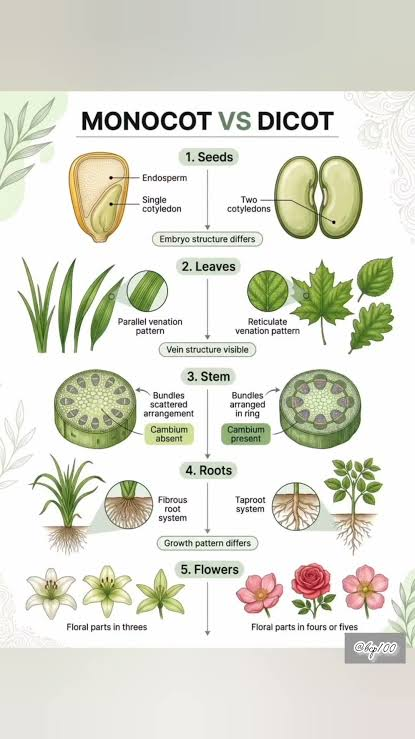
eudicot
vascular bundles are in a ring
lateral growth and woody vegetation
