Modalities Chap 10
 Call Kai
 Learn
 Practice Test
 Spaced Repetition
 Match
 Flashcards
 Knowt Play
1/49

There's no tags or description
Looks like no tags are added yet.
50 Terms
What should you do if heat is too high on ultrasound? (Mensinger rule)
Turn the heat down and turn the time up
Energy exchange types for superficial heat
Conduction
Convection
Radiation
Conversion
Conduction
Transfer of energy via direct contact (hot pack)
Convection
Energy transfer via air or liquid movement (fluidotherapy, whirlpool)
Radiation
Energy transfer emitted from electromagnetic energy and absorbed by body (diathermy)
Conversion
Energy changes to another form. Ultrasound converts acoustic sound into thermal heat depending on how the tissue reflects or absorbs energy.
Depth of penetration for superficial heat treatment
2cm
Contraindications of heat
Older patients
Sensory issues (Can’t perceive burning from heat pack)
Poor circulation
Medically unstable
Coronary heart disease
Open wounds (Specifically for whirlpool and paraffin bath)
Arndt-Shultz Principle
Describes an optimal amount of energy for tissues
Law of Grotthuss-Draper
Energy absorbed in superficial layers can’t be transferred to deeper layers
How much does tissue temperature need to increase to change viscoelastic properties of it?
4 degrees celsius above baseline temp
Parameters for superficial heat
Temperature
Whirlpool rule: the more body submerged, the lower the temperature
Wrist/hand up to 112 deg
Generally never above 115 deg
Duration
20 mins
Frequency
Can be every day, active exercise is better for warmup (bike, treadmill)
Types of superficial heat
Moist hot pack
Warm water immersion
Paraffin bath
Fluidotherapy
Therapeutic ultrasound is ___ energy, but similar to ____ energy. Behaviors of this energy include:
Sound, light
Reflection: Light bounces off of smooth surface
Refraction: Light bends when passing through medium
Absorption: Light is taken by the material and converts to another form of energy (i.e. heat)
Contraindications of therapeutic ultrasound
Pregnancy
Cancer
Active infection
DVT
Pacemaker
Joint replacements
Applied over eyes/genatalia
Caution with peripheral vascular disease (PVD), sensory loss, and using over the spine
Ultrasound energy is created by the…
Reverse piezoelectric effect; electricity is moves through a crystal
Effective radiating area (ERA)
The actual area of the soundhead that is producing energy.
Treatment area should never exceed 2-3x the ERA (basically the size of the soundhead)
If needed just do multiple treatments

Beam nonuniformity area (BNR)
Ratio between peak output and average output intensity.
*Crystals tend to not be perfect and may have more intensity in more areas of the soundhead. Lower ratio (left) is better than higher ratios (right) to avoid hotspots

Continuous vs. Pulsed ultrasound
Continuous: Significant temp increase
Pulsed: Non-temperature related effects
Parameters for ultrasound
Frequency: Depth of tissue penetration
Superficial: 3MHz, up to 2.5 cm
Deep: 1MHZ, 2-5 cm (uncommon irl)
Time: Relates to intensity, quantified with math
Intensity: How much energy is produced by transducer
Duty cycle: Percentage of energy being delivered during treatment (Continuous vs. pulsed;10-20-50%)
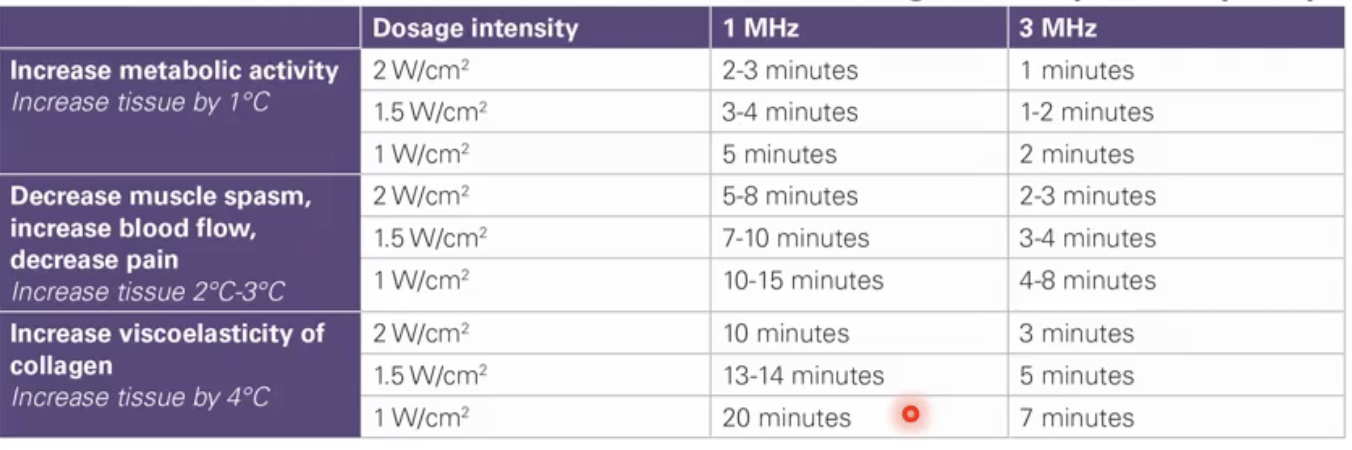
Goals for ultrasound duration from short to long duration
1 deg (celsius) increase = Increase metabolic activity
2-3 deg increase = Decrease muscle spasm and pain, increase blood flow
4 deg increase = Increase viscoelasticity of collagen
How does the math work for ultrasound duration for deep tissue and superficial tissue respectively? (Continuous)
1MHz (Deep tissue)
For every 1 W/cm², tissue temperature increases 0.2 degrees celsius per minute (So, it takes 5 minutes to reach 1 deg celsius)
For every 1.5 W/cm²; 0.3 deg celsius/min
For 2 W/cm²; 0.4 deg celsius/min (Best for keeping treatment time short)
3MHz (Superficial tissue)
For every 1 W/cm², 0.6 deg celsius/min (Now takes less time to reach 1 deg celsius, only a minute and some change)
For every 1.5 W/cm²; 0.9 deg celsius/min (Better option since ultrasound can heat up too quickly and creating hotspots)
2 W/cm²; 1.2 deg celsius/min
What does ultrasound require for effective sound transmission?
Coupling medium
Gel
Biofreeze
Water (Not effective just dont use it bro) (Only for underwater)
How to prevent discomfort and thermal damage
Proper movement
Proper parameter selection
Stretching window
Heat is dissipated 5-10 mins after ultrasound and effect is lost
How to take advantage of ultrasound treatment
Do ROM exercises immediately after application while tissue temperature is increased (within stretching window)
Nonthermal ultrasound
Pulsed ultrasound at 20/50% and low intensity. Mechanism of this is through acoustical streaming and cavitation
Proposed bone healing (-.5 2/cm², 20%, x5 minutes)
What is acoustical streaming?
Mechanism of nonthermal ultrasound where sound waves causes fast, one-way flow due to pressure changes in tissue
(One-way flow of tissue fluid)
Cavitation
Mechanism of nonthermal ultrasound that causes growth and collapse of microbubbles in the tissue, which the ultrasound oscillates and changes the pressure of. Theorized to;
Increase vascular and also cell membrane permeability
Increase protein and collagen synthesis via bloodflow
Improving tensile strength of connective tissue
Decreasing edema
Ultrasound effects
Increases tissue temperature
May improve blood flow
May reduce muscle spasms
Diathermy
Local heating via high-frequency electromagnetic waves that are typically..
Shortwave
Generate an alternating current at 27.12 MHz
Capacitance technique
Older form of diathermy that uses more of the electric of the electromagnetic field. Heating is caused by rapid rotation of the dipoles which cause
Inductance technique
Newer, more efficient, and more common form of diathermy that uses more of the magnetic of the electromagnetic field.
Greatest heating occurs in tissues with fewer _____. (And define the word)
Dipoles: Structures with positive and negative poles
Fewer dipoles (adipose tissue/fat)
Therefore least heating occurs in tissue with greater # of dipoles (skin and muscle)
Precautions and contraindications of diathermy
Precautions
Metal implants and jewelry
Heat sensitivity
Medications
Contrain.
Pacemakers
Impaired sensation
Infections
Acute inflammation (unless non-thermal treatment is used)
Large joint effusions
Diathermy parameters
Longwave, shortwave, and microwave
Frequency
Typically 4-8 mHZ set by the unit
Power
Example: 12-16 Watts = 1 degree increase
Pulse rate
Example: 400-800 pulses/sec = 1 degree increase (in conjunction with duration)
Pulse duration
Example: 100-200 microseconds = 1 degree increase (in conjunction with rate)
Non-thermal treatment
Same effect as non-thermal ultrasound
Diathermy temperature objectives
Subacute inflammation = 1 degree tissue temperature increase
Pain reduction, muscle spasm, chronic inflammation = 2-3 degrees
Vigorous stretching, increase viscoelasticity of tissue = 4 degrees
Diathermy duration and rate of 1 degree tissue temperature increase
Subacute inflammation
Duration: 100-200 microseconds
Rate: 400-800 pulses/sec
Diathermy duration and rate of 2-3 degree tissue temperature increase
Pain reduction, muscle spasm, chronic inflammation
Duration: 200-400 microsecond
Rate: 400-800 pulses/sec
Diathermy duration and rate of 4 degree tissue temperature increase
Vigorous stretching, increase viscoelasticity of tissue
Duration: 400 microseconds
Rate: 800 pulses/sec
Typically 20 min treatment (Like most diathermy treatments)
Diathermy effectiveness
Not proven to do much by itself, works better in conjunction with other treatments like stretching
May facilitate soft tissue stretching
Can heat large tissue volumes quickly (limited and controversial clinical studies on this)
Traction
Relieve radicular symptoms (pain, numbness, muscle weakness) caused by spinal nerve compression by decompressing/distracting the spine. Can be done mechanically (machine) or manually (hands).
Used for treatment for many issues
Manual traction
Using the hands to distract the cervical spine with ~15-25 lbs of force while patient is supine for 10 minutes. Neck positions change the outcome.
Neutral: upper cervical separation
Flexed ~30 deg: lower cervical
Side bending/rotation: radicular symptoms
Used before mechanical traction is considered
Duration of manual traction outcomes
Intermittent: 30 seconds on, 30 seconds off (Not completely releasing tension)
Disc issues: on time longer, off time shorter
Facet joint issue: on time shorter, off time longer
Continuous: Consistent force for the entire duration of treatment (less desirable, hard to quantify with hands)
Mechanical traction
Using a machine to distract the spine with patient supine and pads snug under the skull. Appropriate if manual traction relieves symptoms.
15-25 lbs of force
Intermittent traction (30s on/30s off) usually better tolerated than continuous
Time: 20-30 mins
Precautions and contraindications of traction
Contraindications:
Acute injury
Dens fracture (may not be painful but still catastrophic if traction is applied)
Instability
Connective tissue disorders (Down syndrome, marfan, ehlers-danlos, prader-willi, rheumatoid arthritis)
Vertebral cancer
Vertebral artery compromise (Indicated by dizziness, sharp pain, vertigo, and vascular risk factors)
How to screen for spinal stability and dens fracture
Alar Ligament Test: Palpate C2 vertebrae, make sure that it rotates with head and it is not fractured
Lumbar traction
Spinal distraction at lumbar spine that requires greater force. Can be done with a harness
Setup: Prone or supine depending on comfort
Upper body needs as little clothing as appropriate
Starting force; ~25% bodyweight, can progress up to 50%
Precautions and contraindications of lumbar traction
Contraindications
Pregnancy
Hiatal hernia
Advanced osteoporosis
Fractures
Cancer
Effectiveness of lumbar traction
Mixed; some benefits for patients with radicular pain and nerve root compression