Cardiac Cycle + Systole/Diastole
 Call Kai
 Learn
 Practice Test
 Spaced Repetition
 Match
 Flashcards
 Knowt Play
1/7

There's no tags or description
Looks like no tags are added yet.
8 Terms
Heartbeat
Cardiac muscle cells contract as a unit to produce one coordinated contraction
muscle cells are arranged in a spiral pattern, producing a “wringing” action in the heart when it contracts
Pressure changes caused by contractions drive blood flow through the heart, with valves preventing backflow
Left Ventricle Contraction
When the left ventricle contracts, its pressure rises above pressures in the left atrium and the aorta
the mitral valve is forced shut while the aortic valve is forced open and blood flows into the aorta

Left Ventricle Relaxation
When the left ventricle relaxes, its pressure falls below pressures in the left atrium and the aorta
The mitral valve is forced open and blood enters the ventricle and blood in the aorta closes the aortic valve

Diastole and Systole
Cardiac Cycle—Consists of one period of relaxation called Diastole and one period of contraction called Systole for each chamber of the heart
Atrial and ventricular diastoles and systoles occur at different times; however, both sides of the heart are working to pump blood into their circuits simultaneously
There are four main phases defined by the actions of the ventricles and the positions of the valves

Phases of Cardiac Cycle
(1) Ventricular filling phase – Ventricles fill with blood because they are in diastole
atrioventricular (AV) valves are open because atria are in systole
semilunar (SL) valves are closed
End Diastolic Volume is about 120 ml of blood
(2) Isovolumetric contraction phase – Ventricular systole begins which closes the AV valves when the pressure builds enough
atrial diastole begins
SL valves are still closed
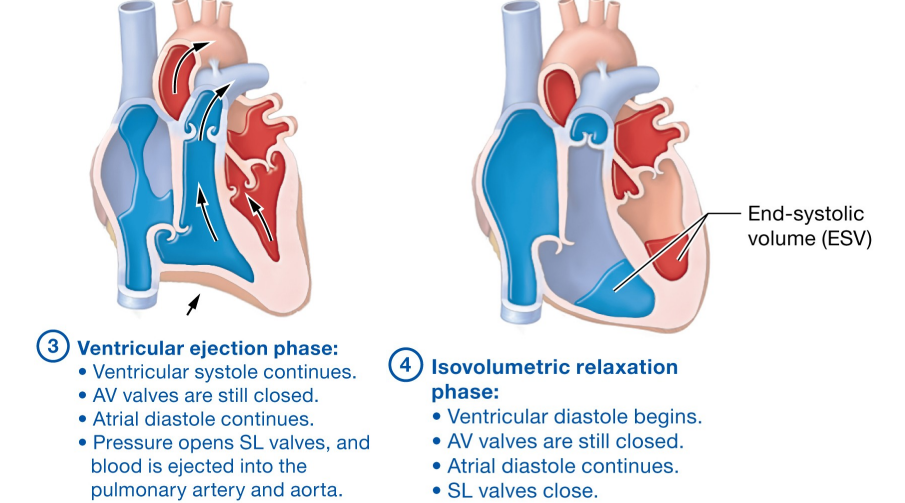
(3) Ventricular ejection phase – Ventricular systole continues and AV valves remain closed;
atrial diastole continues
pressure opens the SL valves and blood is ejected into the pulmonary artery and aorta;
End-Systolic Volume (ESV) is about 50 ml of blood
(4) Isovolumetric relaxation phase – Ventricular diastole begins and AV valves are still closed
atrial diastole continues and SL valves close
Ventricular Pressures
During the cardiac cycle, the right ventricle exhibits a maximum pressure of about 28 mm Hg, whereas that of the left ventricle is about 118 mm Hg
This is because the pressure in the pulmonary trunk varies between 10 and 28 mm Hg and the pressure in the aorta ranges from 80 to 118 mm Hg
The left ventricle has to squeeze significantly harder to generate the pressure needed to open the aortic valve and eject blood into the aorta
