Arthropodborne dz (third)
 Call Kai
 Learn
 Practice Test
 Spaced Repetition
 Match
 Flashcards
 Knowt Play
1/22

There's no tags or description
Looks like no tags are added yet.
23 Terms
What are the 3 main routes of disease transmission?
Contact
Vehicle
Vector: involves an arthropod vector
What are arthropods, and what is their role in disease?
Living, “insect-like” animals with segmented body parts and jointed appendages
They deliver the pathogen to the host
Give the kingdom, phylum, and 2 classes of arthropods, with the vectors from each class.
Kingdom Animalia, Phylum Arthropoda
Class Insecta: lice, fleas, mosquitoes
Class Arachnida: ticks
What 3 things interact in an arthropod borne disease?
Host/reservoir (human or animal)
Pathogen/parasite
Vector (arthropod)
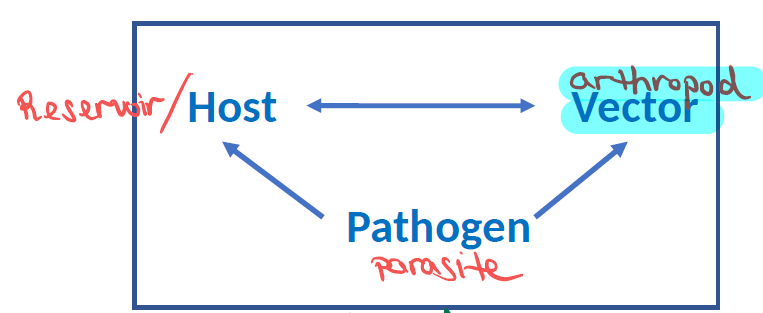
What is the “big picture” chain of an arthropod borne disease?
Animal reservoir (with a pathogen)→ arthropod vector→ host (human)
Using plague as the example, name the reservoir, vector and host in the chain.
Infected rat = animal reservoir
Infected rat → infects rat flea = arthropod vector
Infected rat flea → infects human = host
What is the goal of arthropod vector adaptation?
Enhanced survival of the arthropod vector (vectors are extremely adaptable)
What 3 factors make arthropod vectors adaptable?
Multiple developmental stages / complex life cycle (egg and nymph in water → adult on land)
Diverse habitats, e.g. water and land
Several types of vertebrate hosts, e.g. mice/rodents and humans
What are the 3 types of arthropod vector adaptations (for arthropod survival)?
Physiological
Behavioral
Structural
Give the 2 examples of physiological adaptations.
Kissing bug detects the host’s chemicals (CO₂) and bites around the mouth
Mosquito bites with its needle and releases chemicals before and after a blood meal
What 3 things does the chemical the mosquito releases do?
Numbs the area
Dissolves clots
Forms a clot
Give the example of a behavioral adaptation.
Mosquito bites the host at the right times, usually at night when the person is still
Q: What are the 4 structural adaptations of arthropod vectors?
Wings
Compound eyes
Needle (proboscis)
Sensory bristles
What are wings and the needle (proboscis) used for?
Wings: travel, to find a nutrient source and escape predators
Needle: to take a blood meal and deliver pathogens to the host
What do compound eyes and sensory bristles do?
Compound eyes: multiple lenses let it see 360° around and escape predators
Sensory bristles: detect vibrations to find nutrients, escape predators and attract mates
Which 4 arthropodborne diseases are bacterial?
Plague, Lyme Disease, Epidemic Typhus, Rocky Mountain Spotted Fever (RMSF)
What is the 1 parasitic arthropodborne disease, and what kingdom is it in?
Malaria (Kingdom Protista)
What are the 7 arboviral diseases?
West Nile Virus Encephalitis, St. Louis Encephalitis, Eastern Equine Encephalitis, Zika, Yellow Fever, Dengue, Ebola
Which disease on the arboviral list is NOT transmitted by arthropods?
Ebola Virus Disease. It’s a viral disease, but no arthropod vector is involved
What is an arbovirus
An arthropodborne virus: a virus transmitted by an infected arthropod vector. Arboviruses belong to several viral families
Who is the usual arthropod vector for arboviruses?
Usually the mosquito. They’re caused by mosquito-borne viruses
Which arboviral diseases are considered EIDs?
Ebola Virus Disease and Zika Virus Disease
What is the range of arboviral symptoms, and what are the 2 types of severe symptoms?
They range from subclinical (mild) to severe:
Neurological → Encephalitis
Vascular (blood vessel) damage → Hemorrhagic fevers