fah350 1
 Call Kai
 Learn
 Practice Test
 Spaced Repetition
 Match
 Flashcards
 Knowt Play
1/24

There's no tags or description
Looks like no tags are added yet.
25 Terms

Black Square
Minimalism did not emerge out of a vacuum, like ruptures, but had been brewing in previous avant-garde movements
Russian avant-garde, representing suprematism
displayed in the corner like a Russian religious icon that is traditionally reserved for Christian icons, new way of painting and an icon of the modern age
deeply spiritual, not nihilistic gesture, in the 60s minimalists adopted this purity of art as reduction but abandoned the whole spiritual thingy
connected to Ad Reinhardt’s Twelve Rules, the emphasis on non-representational forms, no movement, no texture, etc…
ABC art by Rose, staring into the abyss, mystical, tranquility and anonmity, passionless nirvana, what Eastern monks and yogis and Western mystics sought

Corner Counter-Relief
material culture or truth to materials, artist shouldn’t force a material than what it naturally is, rawness
assort of raw materials, zinc, wood, metal, and wire strung across the corner of the gallery, how it is held up is clear
served as a precedent for having no frame or pedestal, projects into the room with the viewer
The Creative Act by Marcel Duchamp, the spectator as a contributor to the piece itself, brings the work in contact with the external world by deciphering and interpreting it (esthetic osmosis)
ABC Art by Barbara Rose, the rejection of the personal, the subjective, tragic, contrast to traditional Western sculpture

In Advance of the Broken Arm
bought this from a commercial hardware store, brought it back to to the studio and hung it up, attached a label
no emotional response, decoupling of art with pleasure, precedent for minimalism
using mass-produced materials could remove the distracting artist hands and taste in the work
Minimal Art by Richard Wolheim stated that one of the principal reasons for those who do not accept minimal art is the manifestation of work, emphasis on the decision of the artist that the work has gone far enough, elevation of the conceptual
His concept of the tokens, many who have preceded it and will come after, removal of the respect for the original-copy
ABC art by Rose, renunciations of differentiation from other objects
humorous

Abstract Painting
series of 5×5 canvases called ‘black paintings’
subversion, humor
appears to be dark and featureless, desire for stimulation, but the longer you look at it, each grid square has a slightly different temperature
ABC art by Rose, there is a certain kind of repetition when the long duration of looking, like Yvonne Rainer’s dance where she repeated the same movements for 8 minutes
ABC Art by Rose also mentioned the removal of the individual, go into a semi-hypnotic state of blank consciousness + mentioned the apparent simplicity made through a series of informed decisions
Minimal art by R. Wolheim, is the complete destruction of the ‘pre-image’ and has been dismantled according to the artists’ needs
Twelve rules by Ad Reinhardt, smooth brushwork, absence of what created it

Die Fahne hoch!
logic of composition, width of the white lines are the same as the width of his brush
reductionist like Malevich’s Black square, though without the spiritualism
rejects Ad Reinhardt’s complete purity of art, as he stated there was to be no line or outline
name is a reference to the Nazi rally cry, abyss the world sunk after WWII
non-representational still
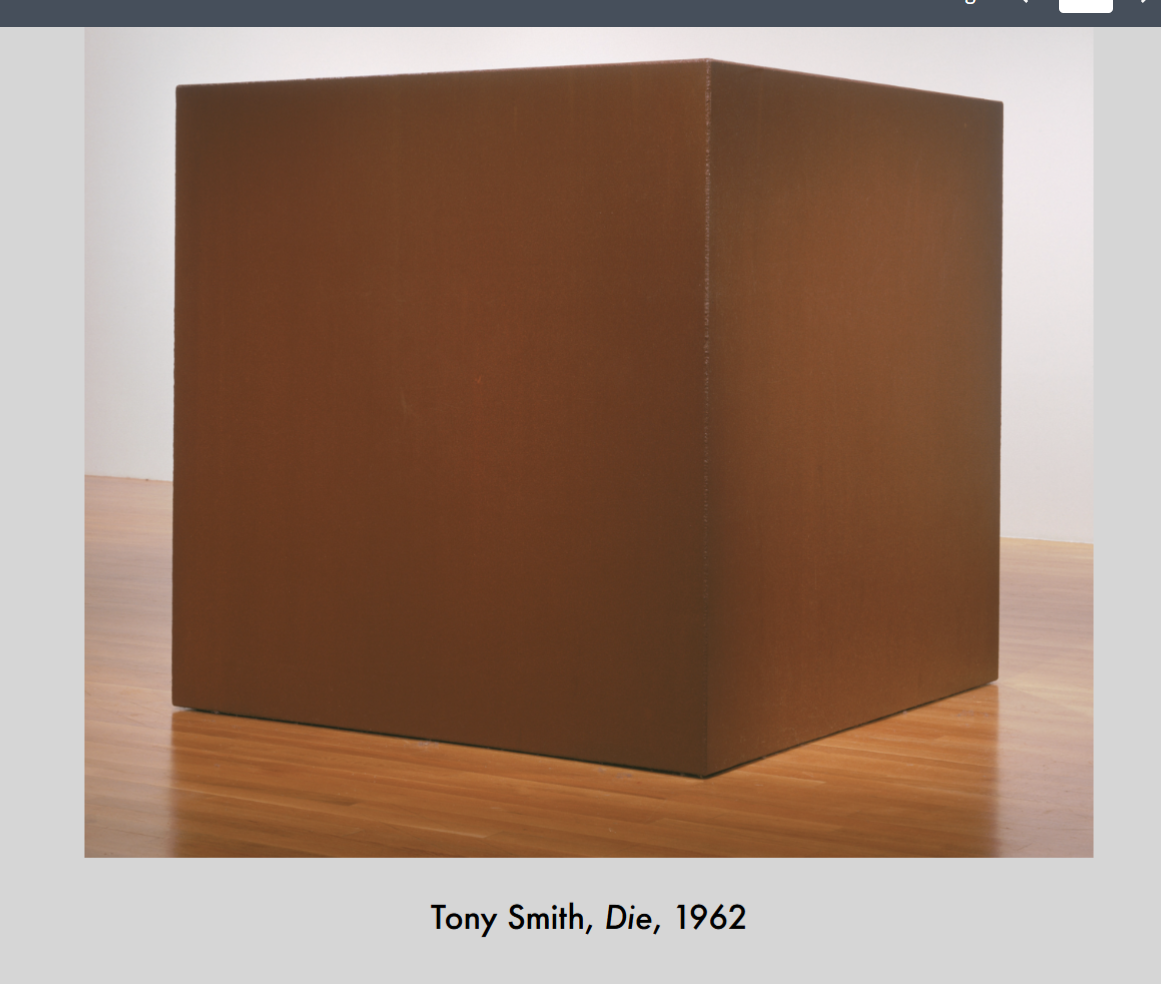
Die
6×6×6 cube, body-sized, was accused by critics of being anthropomorphic, viewer had to confront it, like by Michael Fried
The fact that the viewer was always aware of the body affecting the art; the experience is durational, aware of the time passing, and that it could not be taken in by a single glance like Anthony Caro’s Midday
Also mentioned by Rose in ABC Art, of the repetition in looking and extended duration like Yvonne Rainer’s dance
in The Creative Act by Marcel Duchamp, bringing in the spectator/forced to confront the object in a physical way rather than deciphering it mentally
Gestalt form as stated by Robert Morris
implicates the space since it changes the acoustics

Pink out of a corner
florescent light tubes bought and placed in corners, light radiating on the wall and gallery floor becomes part of the work, space is implicated and spatial experience for the viewer
ready-made lights
The Creative Act by Marcel Duchamp, the spectator as a contributor to the piece itself, brings the work in contact with the external world by deciphering and interpreting it (esthetic osmosis)
ABC Art by Barbara Rose, the rejection of the personal, the subjective, tragic, contrast to traditional Western sculpture
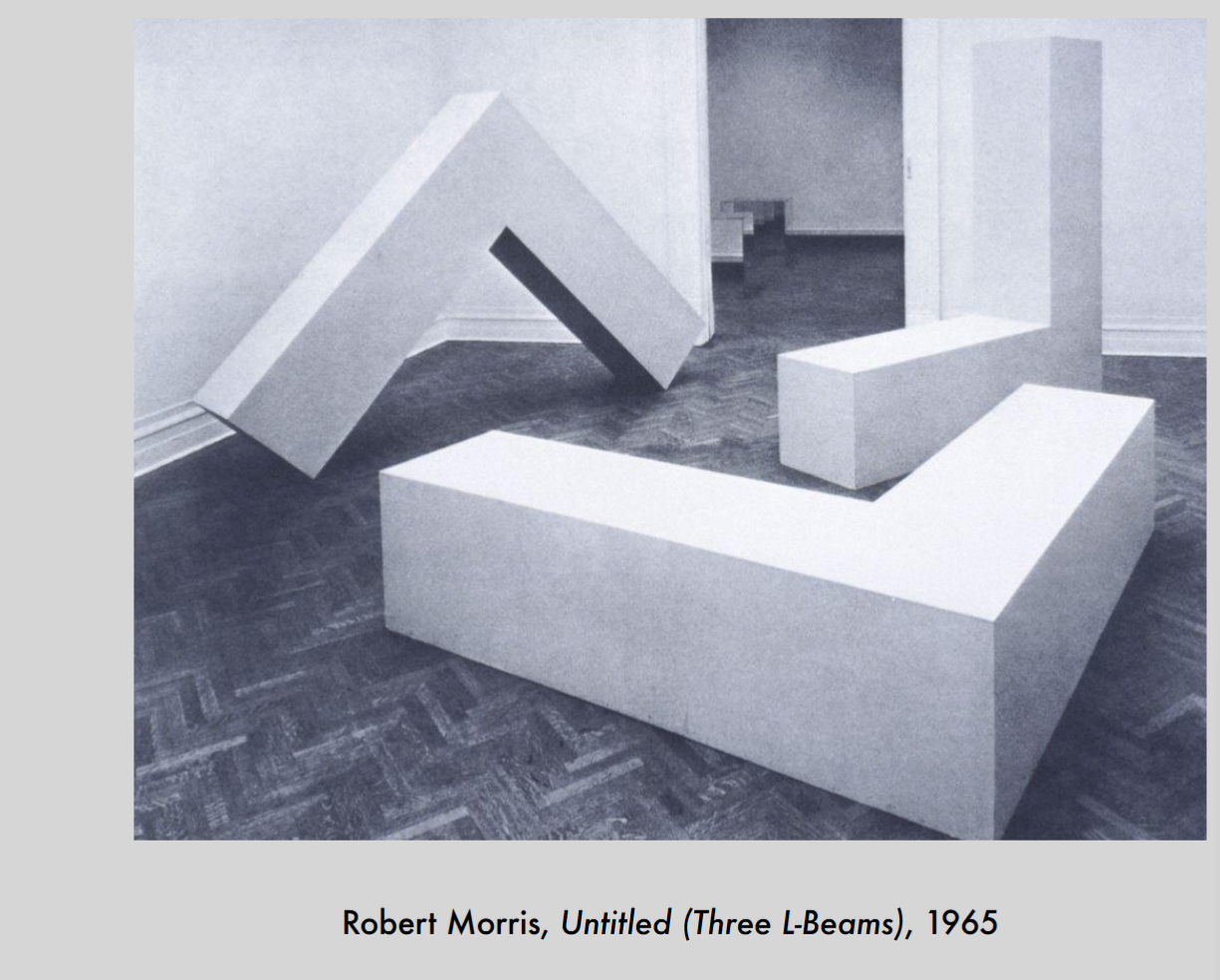
Three L-Beams, untitled
all the same, but in different orientation, read them differently, could be a bench of some sort for example
they take on meaning on their orientation and relation to each other and within the gallery space, body and form can generate their own form of grammar
decoupling with artistic value from craft
The Creative Act by Marcel Duchamp, the spectator as a contributor to the piece itself, brings the work in contact with the external world by deciphering and interpreting it (esthetic osmosis)
ABC Art, element of repetition since it’s the same shape, but it has variability despite it
could bring in Minimal Art by Richard Wolheim, conceptual agent of the artist and the decision to place them in a certain orientation for the spectator to deal with
The Creative Act, Marcel Duchamp, bringing in the viewer and their interpretation/contribution to how it is arranged
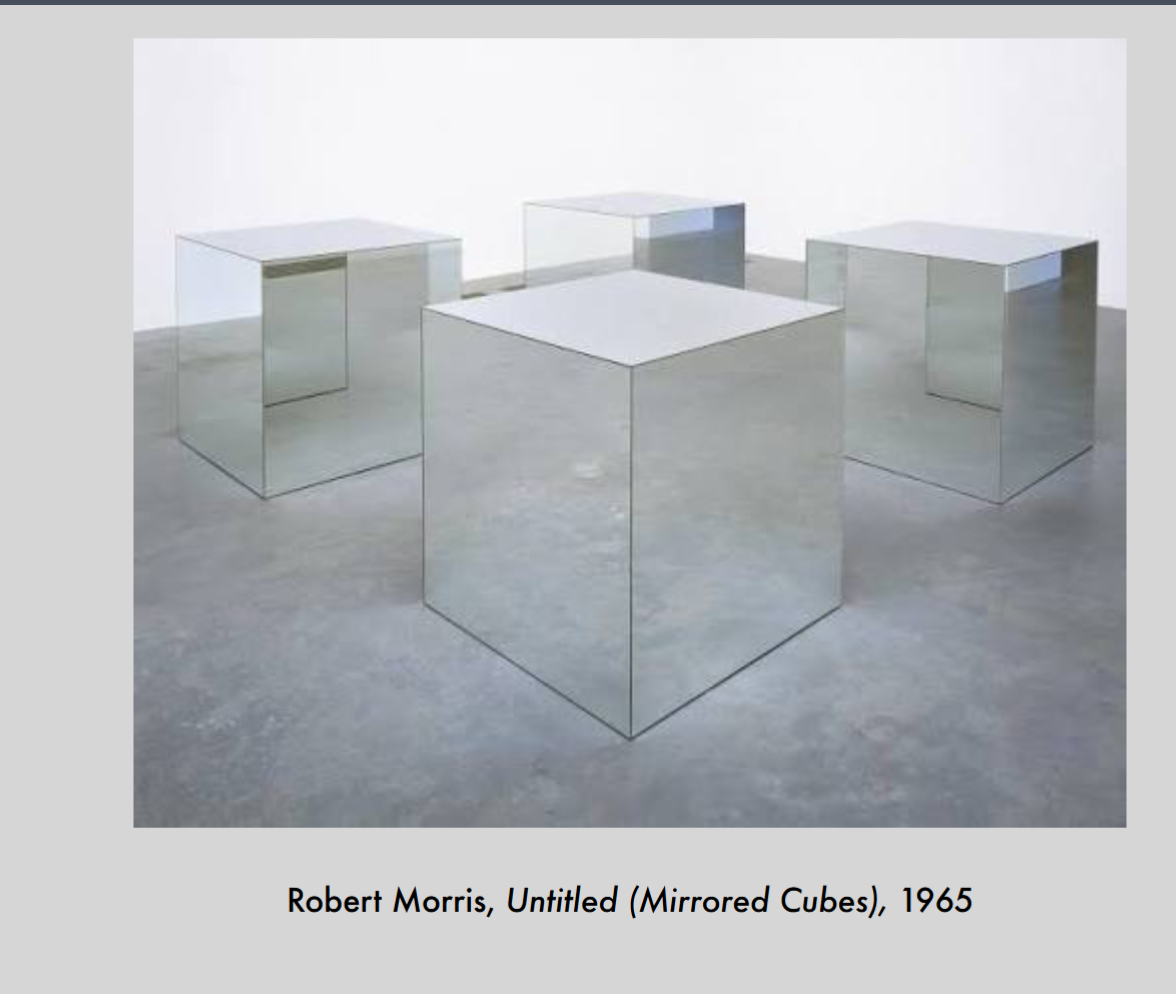
Mirrored Cubes, untitled
literal art tied to narration and time, changing all the time
dependent on the viewer, moving in front of it etc…
space is implicated(?)
ABC Art, element of repetition since it’s the same shape, but it has variability despite it
goes against Ad Reinhardt’s definition of fine art as timeless, since this art is literally dependent on/related to the viewer moving in front of it
Gestalt form by Robert Morris, Shape remains constant, visual information is in constant state of flux, cannot experience it as an autonomous work of absorption, designed to map the present movement to realize that perception is not detached but part of the bodily process that is bound to time and space of the room, ego is fragmented
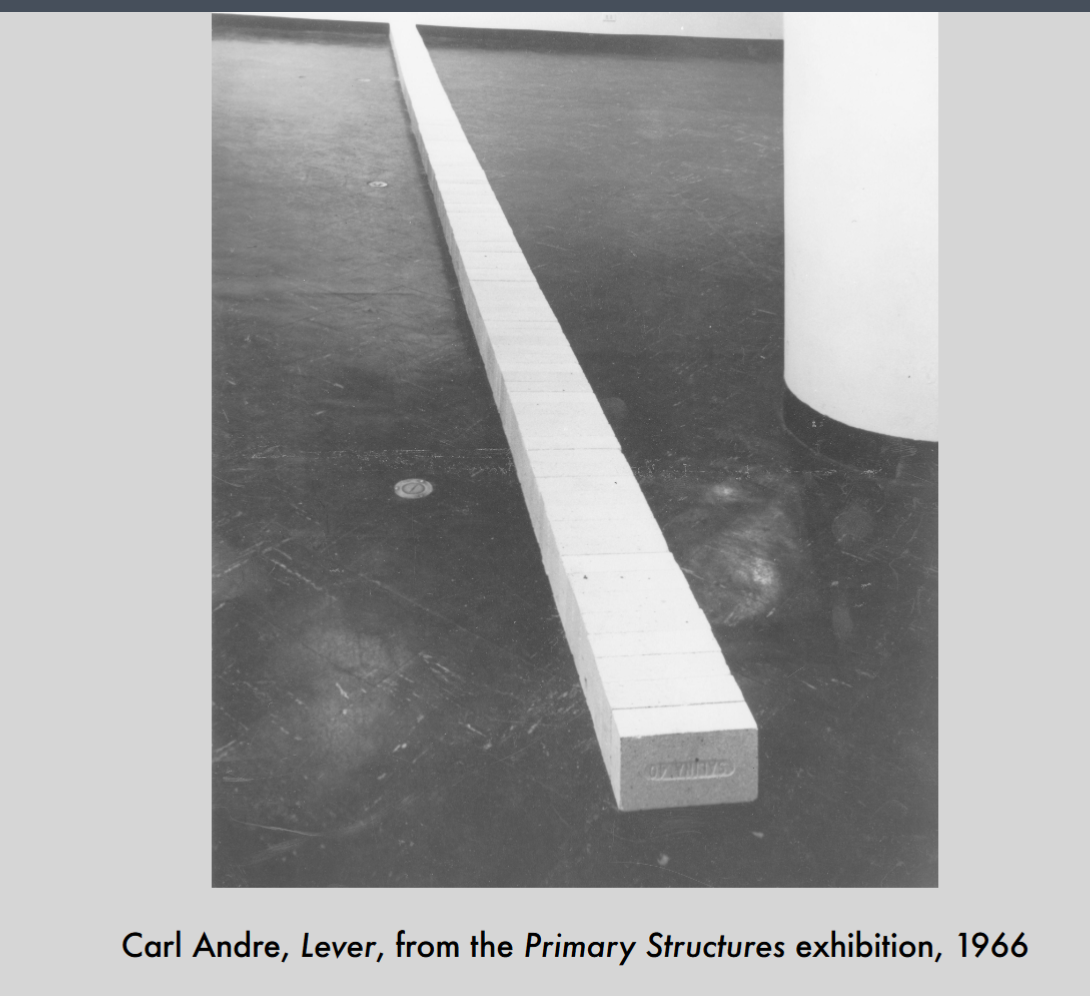
Lever
firebricks arranged in a single file line on the gallery floor
removes artist touch, purpose in the spatial arrangement and concept
viewer has to confront it, projecting into their space as an obstacle
forced awareness of your own scale and movement, rejected traditional pedestal
implication of space
ABC art, industrial repetition
The Creative Act by Marcel Duchamp, the spectator as a contributor to the piece itself, brings the work in contact with the external world by deciphering and interpreting it (esthetic osmosis)
Minimal art by Wolheim, physical demonstration of the reproducibility of the firebricks, undifferentiated and no temporal priority, stream of identical objects

Installations
appears to be stainless steel cubes that are the same, repeated on the walls and floors
dream of creating art through manufacturing and the rawness of materials
ABC art, industrial repetition
projecting into one’s space
Reinhardt’s Twelve Rules, completely reductionist except for the fact that it does not stay behind the picture frame, but this is intruding within the space

Untitled
Things are not rational, but one thing after another, literal
Identical stainless steel plexiglass box, distance between is the exact same
Addition and subtraction, could be adjusted according to the gallery space, logic of the space could be maintained + manufacturing
ABC art, industrial repetition, rhythmic beat + concreteness of art and their presence, not suggestive of anything else
adheres to Reinhardt’s 12 rules that it is reductionist of having no subject matter, symbols, or signs but implicates the space
Berenstein Brothers, gave them a sheet of engineering blueprints that would specify exact dimensions and angles of corners, what kind of screws he wanted to use, use heavy machinery for this, loved industrial materials, intrinsic to what it is
Sol Lewitt’s Paragraphs on Conceptual Art, the idea or concept is the most important part, the machine that makes the art, most ideas that are simple are extremely simple
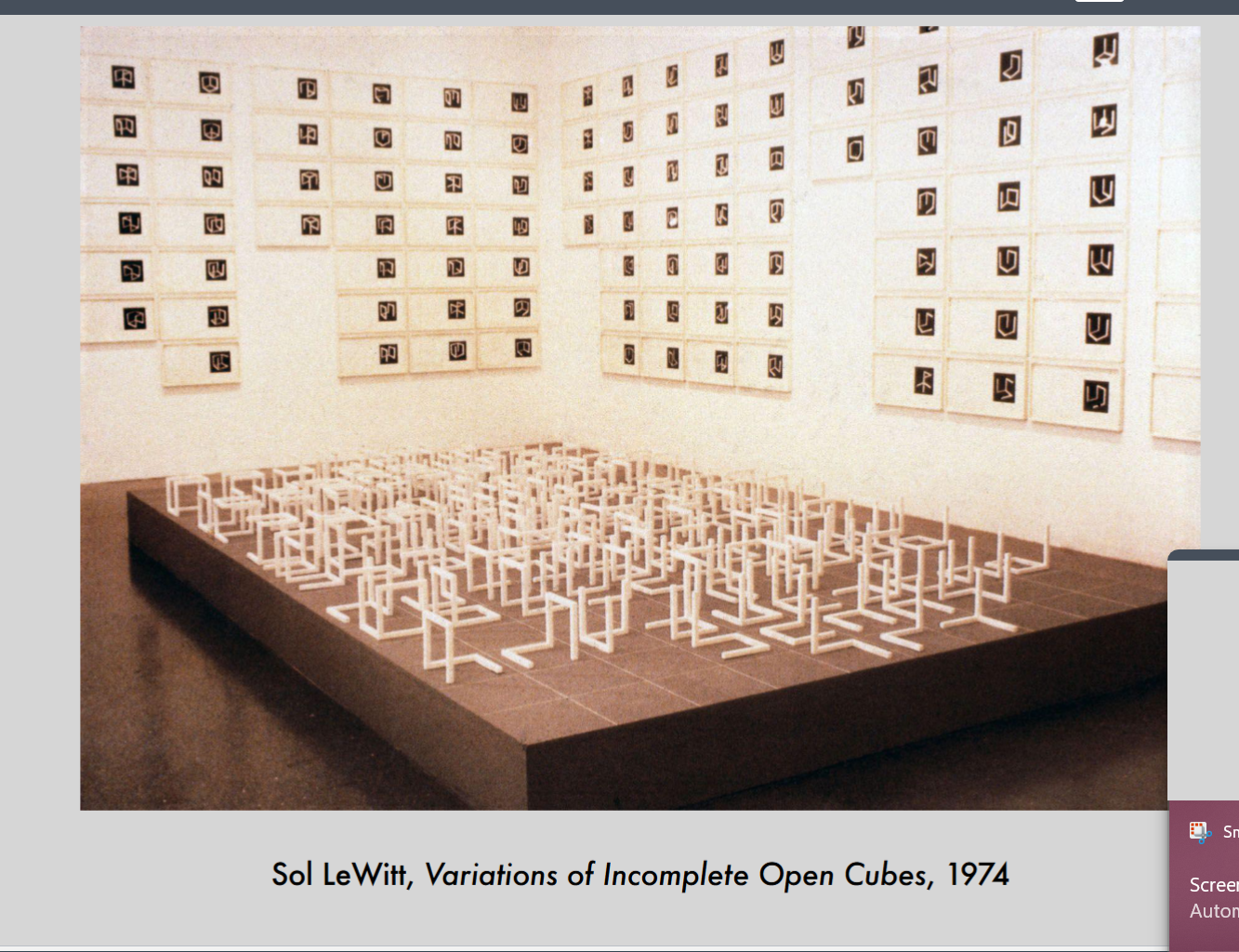
Variations of incomplete open cubes
9×9 grid, open 3d system that expands through space
occupied physical space, stood in galleries as independent objects and asserted their own presence
mapped out every possible cube that is missing one of its hedges, schematic drawings on the wall
rigorous execution
ABC art, industrial repetition, rhythmic beat + concreteness of art and their presence, not suggestive of anything else
work could be implied? Minimal art by Wolheim, follows traditional work, where he did all of this, but also incorporated the second phase in artistic productivity is the artist’s decision to stop, perhaps incorporating both phases rather than one being isolated?

Carl Andre’s Equivalent VIII 1966
made of 120 firebricks arranged in a two-layer, 6 × 10 rectangle on the gallery floor
In Michael Fried’s Art and Objecthood, it is criticized that literalist works are theatrical since they depend on the viewer’s presence to function, unlike modernist works, whose meanings are contained an transform the beholder as an audience
work is confronting the viewer since it’s literally in the way, almost as if its been waiting for them
goes against the modernist sensibility of having a specific character or specificity of the materials, as they are literally firebricks and that’s all they are, obdurate identity, is established at the outset, presenting an experience of endlessness and inexhaustibility, go on and on
ABC art by Barbara Rose, repetition of a single motif
Robert Morris’s Notes on Sculpture, Part 1, gestalt forms

Carl Andre 37th Piece of Work
lays flat, 36×36 feet, made up of almost 1300 individual unjointed square plates of metal of 1×1 foot, used 6 different elements from the periodic table, aluminum, copper, zinc, and others, equalizing the materials, there is no specificity
distributed them according to mathematical logic, arranged in a checkerboard style
In Michael Fried’s Art and Objecthood, it is criticized that literalist works are theatrical since they depend on the viewer’s presence to function, unlike modernist works, whose meanings are contained and transform the beholder as an audience
haptic experience or different sensations through one’s feet, importance of the spectator, The Creative Act by Marcel Duchamp, of transmutation or aesthetic osmosis, inert matter into a work of art
implicates the gallery in a way since it subverts traditional museum rules, form of resistance?

Donald Judd Untitled
horizontally oriented wall sculpture, projects off the wall into the room, unpainted matte finish beam of aluminium, L-shaped brackets at the bottom, precise sequence of solids, spaced out in a pre-determined, mathematical way
paint on those boxes are used for Harley Davidson motorcycles, contrast between the beam, play of light and interior space
ends are open, look through the sculpture at the sides, see the drywall of the gallery, no secrets
Sol Lewitt’s Paragraphs on Conceptual Art, the idea or concept is the most important part, the machine that makes the art, most ideas that are simple are extremely simple
Michael Fried’s Art and Objecthood, beholder is made aware beyond the object, apprehends the object from various positions and varying conditions of light and spatial context, glossiness of the work

Richard Serra’s One Ton Prop
made out of 4 identical square plates of lead, measuring 4×4 feet, weighs close to a ton, stacked like a house of cards, actively working right now to maintain the form and corners get dented over time, changes over time
embodied survival, body sees the heaviness of the object, understand that it topple over, made participant in the work
In Michael Fried’s Art and Objecthood, it is criticized that literalist works are theatrical since they depend on the viewer’s presence to function, unlike modernist works, whose meanings are contained and transform the beholder as an audience, confrontation, distance of a silent person
goes against Donald Judd’s Specific Objects, who disliked the relation and part-by-part arrangement, this sculpture depends on each other to work, not completely unified

Sol LeWitt’s Open Modular Cube
3d lattice structure, made of aluminum, painted matte white, Open on every side, Smaller, repeating cubes that make it up, uses white as neutral, minimize the material and intended to be unaccented as possible
ratio of the grid can be materialized, literal demonstration of the logic that governs it
Sol Lewitt’s Paragraphs on Conceptual Art, the idea or concept is the most important part, the machine that makes the art, most ideas that are simple are extremely simple
ABC art by Barbara Rose, repetition of a single motif
Goes against Robert Morris’s Notes on Sculpture, Part 1, the frame is a simple gestalt shape, but the fact that it can be perceptually separated

Sol LeWitt’s Wall Drawing 11
Piece of paper with written instructions, executed directly on gallery wall with graphic drawings, not done by him, have assistants or museum workers, take instructions execute them on the wall, when it is over painted over, Ceases to exist physically, yet the written instructions remain, apply them to a different wall, Model borrows from classical music
Industrial production, outsourcing to various laborers, but always different as it is applied by different people and on different walls
no artistic touch
Sol Lewitt’s Paragraphs on Conceptual Art, the idea or concept is the most important part, the machine that makes the art, most ideas that are simple are extremely simple

Agnes Martin, The Tree
6x6, relating to the human body, Surface covered with thin wash of white translucent oil paint, draws grids by hand using a ruler and pencil
Composed of repeating rectangular cells and organized into bands, Grid not explicitly mathematical, manual labor not mechanized, see little errors
Grid is not a cold, analytical thing, but a way to bring out a mediative, transcendent human experience, emotional state of looking at a tree
Sol Lewitt’s Paragraphs on Conceptual Art, the idea or concept is the most important part, the machine that makes the art, most ideas that are simple are extremely simple
ABC art by Rose, staring into the abyss, mystical, tranquility and anonmity, passionless nirvana, what Eastern monks and yogis and Western mystics sought

Dan Flavin, Monument for Tatlin
Specific configuration made up of 7 light fixtures, using cool-white bulbs, arrangement symmetrical and plain, quasi-architectural, middle single 8 foot tube, flanked by two 6 foot, two 4 foot, two 2 foot tubes, ziggurat tower, white is the same as those used in the office, very institutional
Flavin's monument made out of cheap glass, throw off heat and glare, will burn out, screwed directly into the gallery wall, light is primary and occupies the entire room and is the medium of the work
Robert Morris’s Notes on Sculpture, Part 1, very simple form, that the viewer is directed outward to its environment or light, body as the perceiving mechanism and how the work changes as the viewer moves
Michael Fried’s notion of the experience of endlessness and duration

Anthony Caro’s Midday
Made out of found industrial materials, I-beams and steel sheets, Has been welded and bolted together to make asymmetrical composition, Unified coat of bright yellow paint and sits on the floor, Steel elements begin to dance, prop each other, network of internal angles that lift your eye up
Michael Fried’s relational syntax, trace how one part is related to another, puts you in presentness and instanteousness, beyond objecthood, completely absorbed and is a sanctuary for the viewer from a world that has so many commodities
Goes against Donald Judd’s Specific objects, favored works that stood as a whole which are more intense and clear rather than being diluted by an inherited format, variations of a form, mild contrasts and connecting parts and areas

Mel Bochner’s Working Drawings
contributed working drawings, notes, diagrams, mathematical tables, and blueprints, invoices, gallery director refused to fund the exhibition
took them to a print shop, made copies and bound them into 4 black binders and on 4 white plints in the middle of gallery
office materials and a photocopy machine, severing the connection between the unique touch of the artist, becomes an office clerk
focus on langue rather than parole, shift to linguists, Saussure, abstract system of language that preexists the speaker, and parole as the individual act of speech
white columns, something doesn’t become art because its innateness but its specific placement in a structural institution

Joseph Kosuth’s One and Three Chairs
Physical wooden chair in the middle, photograph of the chair, dictionary definition of chair
Explicit breakdown of Saussure and his semiotic triad, confront gaps of language, representation, and reality
Material chair is the referent, photograph is the signified (iconic signified), and the dictionary is the signifier, linguistic definition of a chair, text provides the abstract rules that govern how we understand the concept, connects the signifier to the signified
Meaning is not in its wood, text, but generated within the viewer
Rule of the installation, whenever the piece moved, owner had to take a new photograph, art is always changing and meaning is generated through context

Lawrence Weiner’s book statements
surrender of the art object to language, artwork is the sentence itself, words are just as physical as iron but also very flexible
Langue is foregrounded, artwork reduced to a set of instructions, unique execution is optional
Enduring part of the work is the linguistic structure
Choice to build or not to build, rests on the receiver, artists is relinquishing control
Cannot be passively consumed, viewer has to be a coproducer of the work
relates to Roland Barthes’ The Death of an Author, his assertion that the author is completely unoriginal