Urogenital System Development
 Call Kai
 Learn
Learn Practice Test
 Spaced Repetition
 Match
Match Flashcards
 Knowt Play
1/29

There's no tags or description
Looks like no tags are added yet.
Name | Mastery | Learn | Test | Matching | Spaced | Call with Kai | Chat |
|---|
No analytics yet
Send a link to your students to track their progress
30 Terms
kidneys derived from
intermediate mesoderm + coelomic mesothelium = urogenital ridge
coelomic mesothelium - covering of embryonic body cavity
intermediates of kidney formation
pronephros
mesonephros
metanephros → becomes adult kidney
pronephros
consists of 7-8 tubules
nonfunctional
pronephric duct persists as mesonephric duct


mesonephros
functional → produces urine
consists of 70-80 tubules
tubules with glomerulus at one end, connected to the mesonephric duct at the other end
rapidly degenerates (cranial to caudal)
caudal tubules and duct remain to form testicular channels. epididymis, ductus deferens, and contributes to gonad development

metanephros
adult kidney
metanephric diverticulum (ureteric bud) → ureter, renal pelvis, calyxes, and collecting ducts
metanephrogenic mass (mesenchyme) → nephrons (functional unit → produces urine)
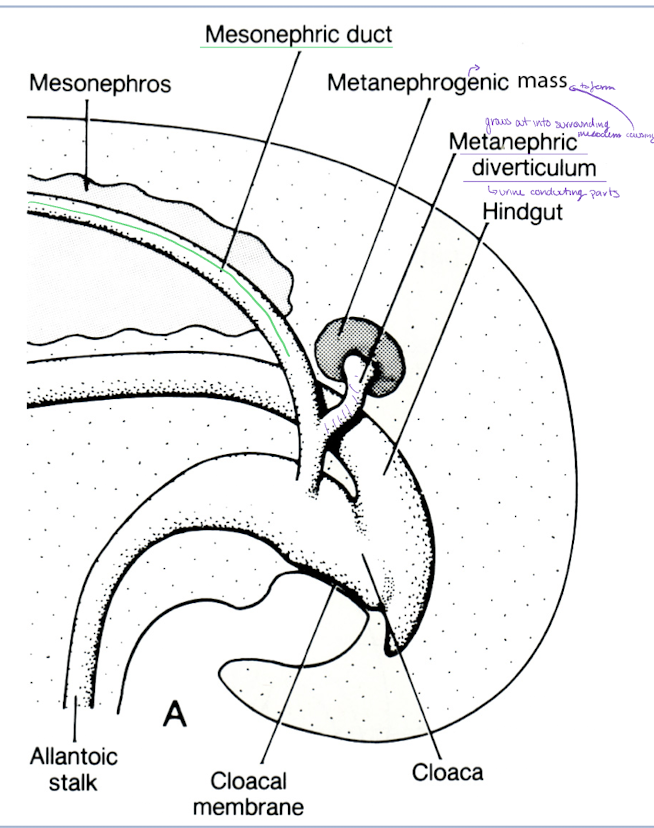
metanephric diverticulum grows out into surrounding mesoderm causing metanephrogenic mass to form
nephron formation
not unlimited, cannot produce any more once in adult state


urinary bladder and urethra
urinary bladder develops from an expansion of the urachus and cranial end of the urogenital sinus
urogenital sinus contibutions
male: pelvic urethra and penile urethra
female: pelvic urethra, vestibule and caudal vagina
formation of urinary bladder
mesonephric duct (dd) enters into urinary bladder, branching off mesonephric duct is the ureter
differential growth - ureter and dd have separate tubes
differential growth - ureter enters UB, dd enters urethra

renal malformation
agenesis - doesn’t form
dysplasia - abnormal
hypoplasia - underdeveloped
ectopic - differentiates in pelvic area and sometimes fails to ascend to sublumbar, typically non problematic, bad for pregnancy
ectopic ureter
ureter within urethra not UB, drippling urine
more common in female puppies
patent urachus
urachus not closed out at birth - medical management or surgical repair
early in development there is a membrane blocking urethra, normally degenerates to allow urine to flow out into amniotic cavity, urachus closes out once urine has an alternate route out
urachus connects to allantoic cavity, initial conductor for removing urine
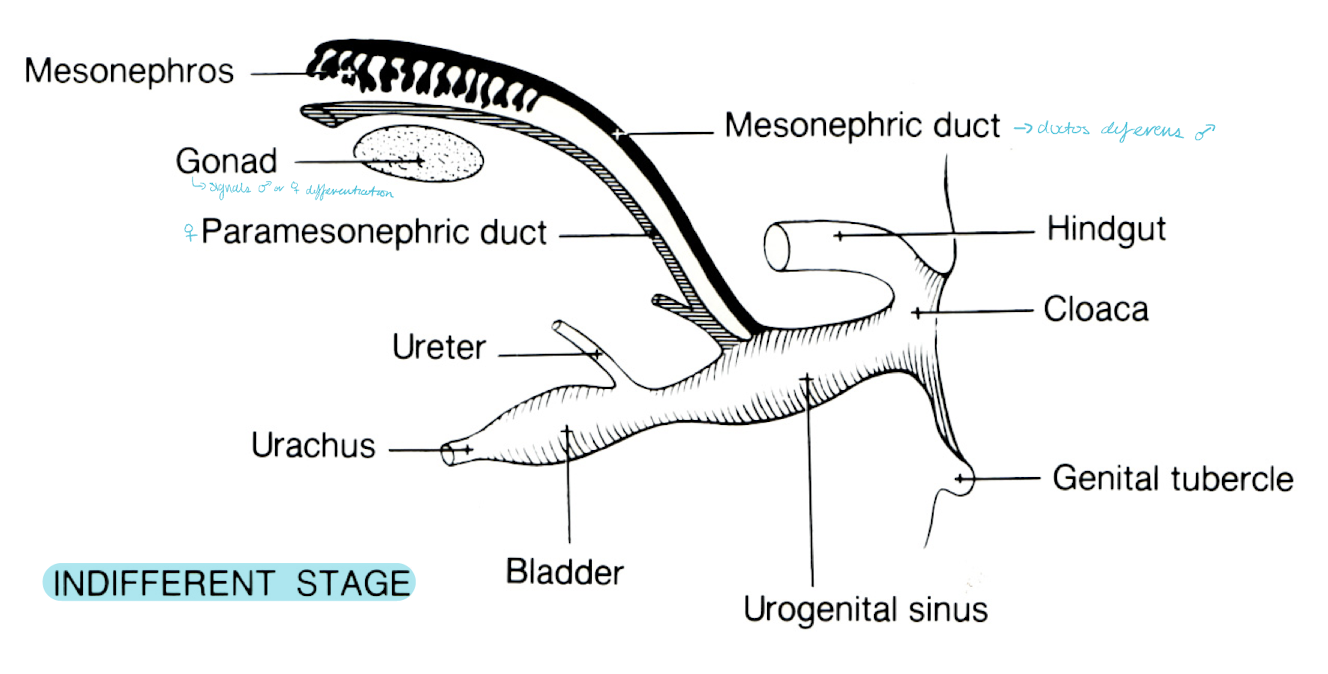
indifferent stage of reproductive system
gonad will eventually signal differentiation
paramesonephric duct - present, further develops in females
mesonephric duct - present, further develops in females
testis influence on differentiation
testosterone (Leydig cells)
mesonephric ducts stimulated → vas deferens, epididymis
dihydrotestosterone, external genitalia stimulated → growth of penis, scrotum, and prostate (accessory sex glands)
mullerian inhibiting substance (AMH)(Sertoli cells)
paramesonephric ducts suppressed (“Mullerian duct”)
ovary influence on differentiation
estrogens (maternal and placental)
paramesonephric ducts stimulated → uterine tube, uterus, cranial portion of vagina
external genitalia stimulated → labia, clitoris, caudal portion of vagina
mesonephric ducts degenerate in the absence of testosterone
germ cells
primordial germ cells replicate until 100-300 cells then migrate to the genital ridge (area of degenerating mesonephric kidney)

gonadal (genital) ridge
indifferent stage of gonadal development
gonadal cords formed by disintegrating mesonephric tubules
germ cells interact with degenerating mesonephric cords

testicular development
mesonephric duct → epididymis and ductus deferens
mesonephric → rete testis and efferent tubules
gonadal cords → seminiferous tubules
paramesonephric duct degenerates

testicular descent
gubernaculum
attaches to caudal pole of testis and scrotum
holds developing gonad in position
mesenchymal CT
mesenchymal cells release hyaluronic acid (inc. H2O) causing swelling and enlargement
dilates inguinal canal and scrotum
decreased [hyaluronic acid] → dec H2O → gubernaculum shrinks drawing testis into scrotum
remnants of the gubernaculum
ligament of the tail of the epidisymis
proper ligament of testis

ovarian development
degenerating mesonephric tubules → follicular cells
primordial germ cells in urogenital ridge → egg
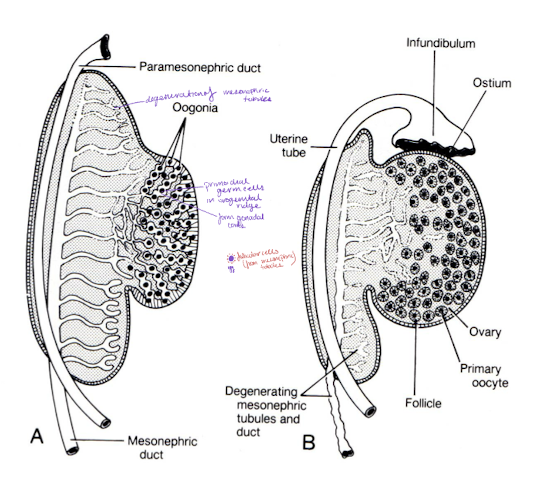
female reproductive tract development
paramesonephric duct → uterine tube, horns, body, cervix, and cranial 1/3 → ½ of vagina
urogenital sinus → caudal vagina, vestibule
mesonephric duct degenerates

uterine comparative anatomy
based on paramesonephric duct fusion
primates have a large amount of fusion → very large body

external genitalia - indifferent stage
genital tubercle
male - penis (glans penis, corpora cavernosa, corpus spongiosum
female - clitorus (glans clitoris, corpora cavernosa clitoris, bulb of vestibule)
urogenital folds
male - ventral aspect of penis
female - labia of the vulva
labioscrotal swellings
male - scrotum
female - does not/poorly develops in domestic sp.
development of external genitalia

genital tubercle
cloacal fold (blue) - chared opening with digestive and urogenital system
urogenital fold (red)
labioscrotal swelling (orange)
anus (purple)
hypoplasia (gonad)
few/no germ cells
migration issue or division of PGC issue
cryptorchidism
testis doesn’t descend
gubernaculum issue, only in male
stenosis of the ducts, abnormal fusion
issue with hormone release
hypospadia
open urethra in males
penile part of urethra doesn’t form caudally
penile urethra open to environment
intersex conditions
can be internal or external

XY, testicular feminization, testicles w vulva, increased urogenital distance, due to faulty T receptors on urogenital fold and/or genital tubercle
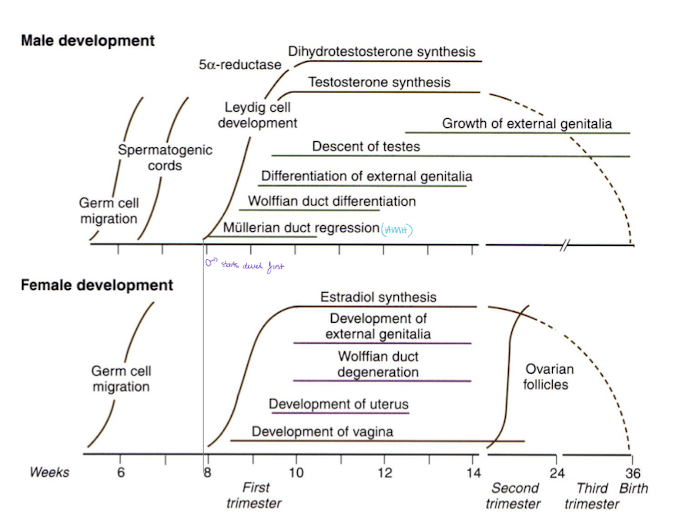
major events in sexual differentiation
males reproductive tracts start developing sooner than female
freemartin
female born twin to a male
typically twins placental BVs anastomose (join) together so hormones from each twin impacts each other
chimeras
male fertility - affected but less
female fertility - underdeveloped tract
AMH from male decreases development of paramesonephric duct components
normal urogenital sinus derivatives
increased anogenital distance because of increased [T]
