Chapter 16: Glycolysis and Gluconeogensis
 Call Kai
 Learn
 Practice Test
 Spaced Repetition
 Match
 Flashcards
 Knowt Play
1/42

Earn XP
Description and Tags
Exam 3
43 Terms
glycolysis
A sequence of 10 enzyme-catalyzed reactions that convert glucose into 2 pyruvate molecules
traits of glycolysis
sequence of reactions that metabolizes one molecule of glucose to two molecules of pyruvate with the concomitant net production of two molecules of ATP
anaerobic (does not require O2)
common to all cells (prokaryotic and eukaryotic)
2 pathways of glycolysis
anaerobic = glucose (glycolysis) —> pyruvate (fermentation) —> ethanol or lactate
aerobic = glucose (glycolysis) —> pyruvate (oxidation) —> CO2 + H2O (and much more ATP)

process of dietary sources of glucose
glucose being transported from the intestines, through the blood stream, and into the cytoplasm of cells
acquire most glucose from diet
digestion breaks down more complex carbohydrate sources (starch, glycogen, lactose, sucrose, etc.)
glucose uptake into intestinal endothelial cells via secondary active transport (symport with Na+)
facilitated diffusion into blood stream
facilitated diffusion into cells
GLUT
glucose transporters
GLUT 1 and 3
present in nearly all cell membranes
essentially transport glucose at a constant rate
GLUT 2
found in liver and beta pancreatic cells
very high Km for transport
requires high blood glucose concentration
GLUT 4
muscle and fat cells
number of GLUT 4 molecules increases w/high amounts of insulin
GLUT 5
primarily transports fructose
glycolysis overview (equation)
glucose + 2 Pi + 2 ADP + 2NAD+ —> 2 pyruvate + 2 ATP + 2 NADH + 2 H+ + 2 H2O
fermentation
metabolizing in the absence of O2
A redox neutral metabolic scheme for the production of ATP from an organic chemical source
3 reactions of pyruvate
ethanol
lactate
carbon dioxide

ethanol fermentation
decarboxylation of pyruvate
reduction of acetaldehyde
in yeast and some other microorganisms
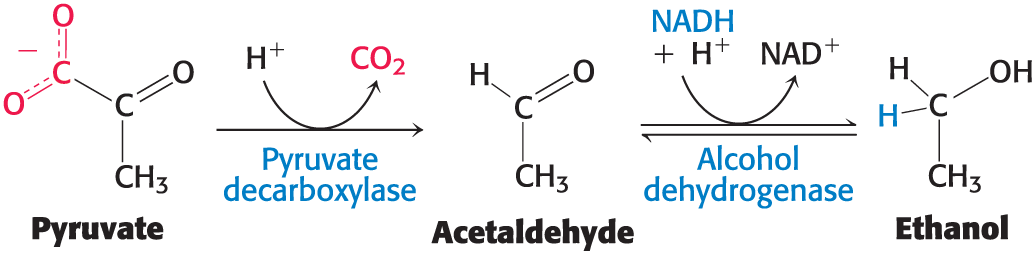
decarboxylation of pyruvate
pyruvate —> acetaldehyde
catalyzed by pyruvate decarboxylase
uses H+, releases CO2
coenzyme thiamine pyrophosphate that is derived from the vitamin thiamine ( B 1 )
reduction of acetaldehyde
acetaldehyde —> ethanol
catalyzed by alcohol dehydrogenase
uses NADH and H+, releases NAD+
ethanol fermentation overview
glucose + 2 Pi + 2 ADP + 2 H+ —> 2 ethanol + 2 CO2 + 2 ATP + 2 H2O
lactic acid fermentation
in animals and some microorganisms
The reduction of pyruvate by NADH to form lactate is catalyzed by lactate dehydrogenase

lactic acid fermentation net reaction
glucose + 2 Pi + 2 ADP —> 2 lactate + 2 ATP + 2 H2O
other carbohydrates can enter glycolysis
fructose
galactose
fructose in glycolysis
has one pathway in the liver and one pathway in other tissues
fructose liver pathway
enters via glyceraldehyde-3-phosphate
multi-enzyme steps
fructose adipose/muscle/etc. pathway
enters via fructose-6-phosphate
enzyme hexokinase catalyzes fructose —> fructose-6-phosphate
galactose in glycolysis
enters via glucose-6-phosphate
proceeds via multiple enzyme-catalyzed reactions
regulation of glycolysis in muscle vs liver
liver has more diverse biochemical functions than does muscle
liver maintains blood-glucose concentration
liver uses glucose to generate reducing power for biosynthesis and synthesize a host of biochemicals
muscle prioritizes immediate ATP for contraction
regulation of glycolysis in muscle
3 regulatory enzymes
hexokinase
phosphofructokinase-1
pyruvate kinase
hexokinase regulation in muscle
inhibited by its product glucose-6-phosphate
High concentrations of this molecule signal that the cell no longer requires glucose for energy or for the synthesis of glycogen
glucose is left in blood
phosphofructokinase-1 regulation in muscle
inhibited by ATP
high levels of ATP allosterically inhibit the enzyme
lowers the enzyme’s affinity for fructose 6-phosphate
activated by AMP
AMP reverses the inhibitory action of ATP
inhibited by low pH
augment the inhibitory effect of ATP
pyruvate kinase regulation in muscle
inhibited by ATP
ATP allosterically inhibits pyruvate kinase to slow glycolysis when the energy charge is high
activated by fructose-1,6-bisphosphate
committed step in glycolysis
regulation enzymes of glycolysis in liver
hexokinase
glucokinase
phosphofructokinase-1
pyruvate kinase
hexokinase regulation in liver
inhibited by product glucose-6-phosphate
same as muscle
glucokinase regulation in liver
not inhibited by product glucose-6-phosphate (like the muscle) —> used for synthesis of glycogen and formation of fatty acids
lower affinity for glucose compared to hexokinase
phosphofructokinase-1 regulation in liver
inhibited by ATP (not as frequent as muscle)
inhibited by low pH (not as frequent as muscle)
inhibited by citrate
used in TCA cycle
high level of citrate in the cytoplasm means that biosynthetic precursors are abundant, and so there is no need to degrade additional glucose for this purpose
activated by fructose-2,6-bisphosphate
the concentration of fructose 6-phosphate rises when blood-glucose concentration is high
pyruvate kinase regulation in liver
several isozymic forms of pyruvate kinase
liver enzyme behaves much like the muscle enzyme with regard to allosteric regulation
inhibited by ATP, activated by fructose-2,6-bisphosphate
inhibited by alanine
can be synthesized from pyruvate in one enzymatic step
controlled by covalent modification (reversible phosphorylation)
when phosphorylated, activity is inhibited
substrate channeling
The transfer of the product of one enzyme-catalyzed reaction directly to another enzyme for which the molecule is the substrate, without the release of the molecule to the bulk solvent
enzymes of glycolysis in eukaryotes are organized into complexes
gluconeogenesis
The synthesis of glucose from noncarbohydrate precursors, including lactate, glycerol, and amino acids
substrate-level phosphorylation
The formation of ATP from ADP in which the phosphate donor is a substrate with a higher phosphoryl-transfer potential than that of ATP.
fermentation
A redox neutral metabolic scheme for the production of ATP from an organic chemical source
obligate anaerobe
An organism that cannot survive in the presence of oxygen and thus is usually dependent on fermentation as a source of cellular energy.
facultative anaerobe
An organism that can both utilize molecular oxygen for aerobic metabolism as well as survive and grow in its absence through fermentation pathways
feedforward stimulation/activation
The activation of an allosteric enzyme in a later stage of a pathway by the product of a reaction that takes place earlier in the reaction pathway
bifunctional enzyme
An enzyme with two different, often opposing, catalytic activities on one polypeptide chain