CH 11: The Auditory and Vestibular System
 Call Kai
 Learn
 Practice Test
 Spaced Repetition
 Match
 Flashcards
 Knowt Play
1/33

Earn XP
Description and Tags
FNTB Exam 3
34 Terms
What is sound, what properties/variables does it have
Vibrational wave/pulse with frequency and amplitude
What are the broad sections of ear areas
Outer, middle, inner
What structures are in the outer ear, what are their functions
Pinna - external cartilage, convolutions can localize sound
Auditory canal - entrance to internal ear
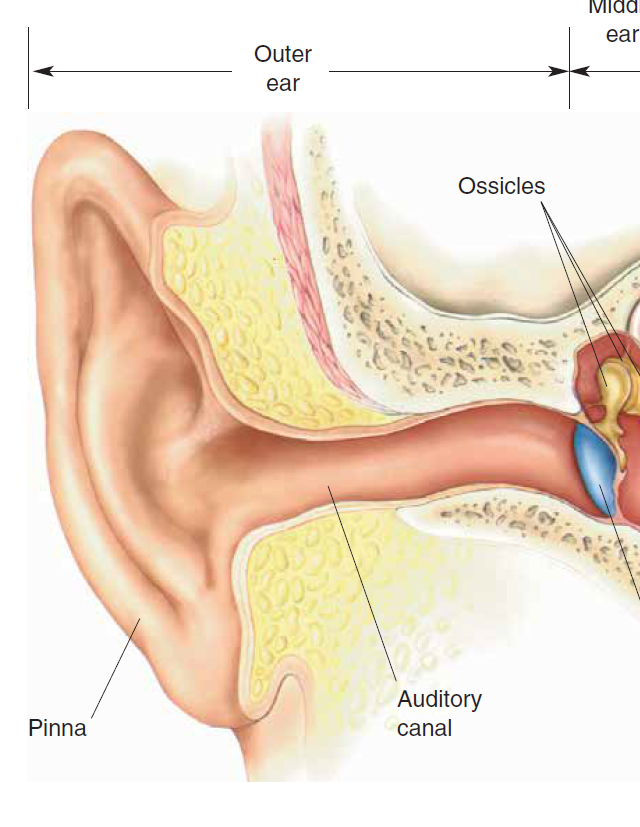
What structures are in the middle ear, what are their functions
Tympanic membrane/eardrum - sound waves interact with it to move the associated ossicles
Ossicles - little bones - transfer tympanic movements to oval window. Malleus, Incus, Stapes
Tensor tympani muscle / stapedius muscle - stiffens the middle ear during onset of loud noise ( acoustic reflex)
Eustachian tube

What structures are in the inner ear, what are their functions
Oval window - hole in the skull
Cochlea - behind oval window - transforms oval window movement into neuronal response
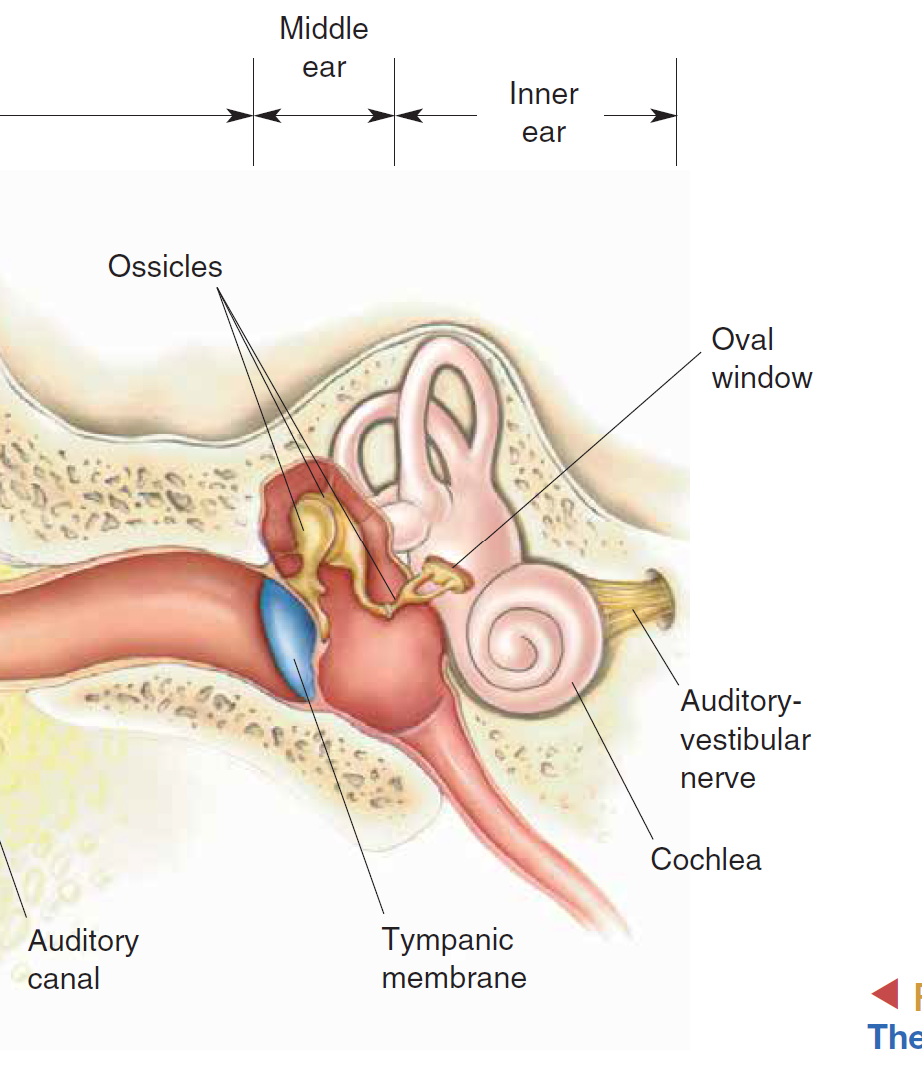
What are the 3 scalae of the cochlea
scalae vestibuli, media, tympani

How does the membrane potential of the endolymph compare to the perilymph
Endolymph is more positive from active transport to have a much higher K+ interior and lower Na+ then perilymph
Where are the auditory receptors located? What are they called and what type of cell are they?
Organ of Corti, on basilar membrane - hair cells (specialized)endothelial cells
How does the structure of the basilar membrane impact function
In unrolled cochlea, it has a narrow, stiff base, wide, thin apex

What are the steps of sound propagation within the cochlea
Stapes hits oval window membrane, sending movement into perilymph, making a wave travel along basilar membrane form base to apex

How do hair cells transduce sound from basolateral membrane - cilia
Baso membrane moves up in response to sound, moving the reticular lamina and attached hair cells, that are linked together and attached to tectorial membrane. Inner hair cells respond to this movement by bending at base

How do cilia transduce bending to an electric potential
Base bending causes stereocilit tilt to/away from the tallest stereocilia, either stretching or closing the TCM channel. Open channel causes K+ influx and then voltage gated Ca2+ channels to open. Influc of Ca2+ causes excitatory (glutamate) release from synaptic vesicles

How does the endolymph voltage assist in transduction
Endolymph is high (+80mV) and doe not produce a change in K+ gradient end transduction channels open
What synapses with hair cells to connect to a nerve? What nerve is that>
Inner hair cells highly connected to spiral ganglion cells, connected to auditory nerve. outer hair cells less connected
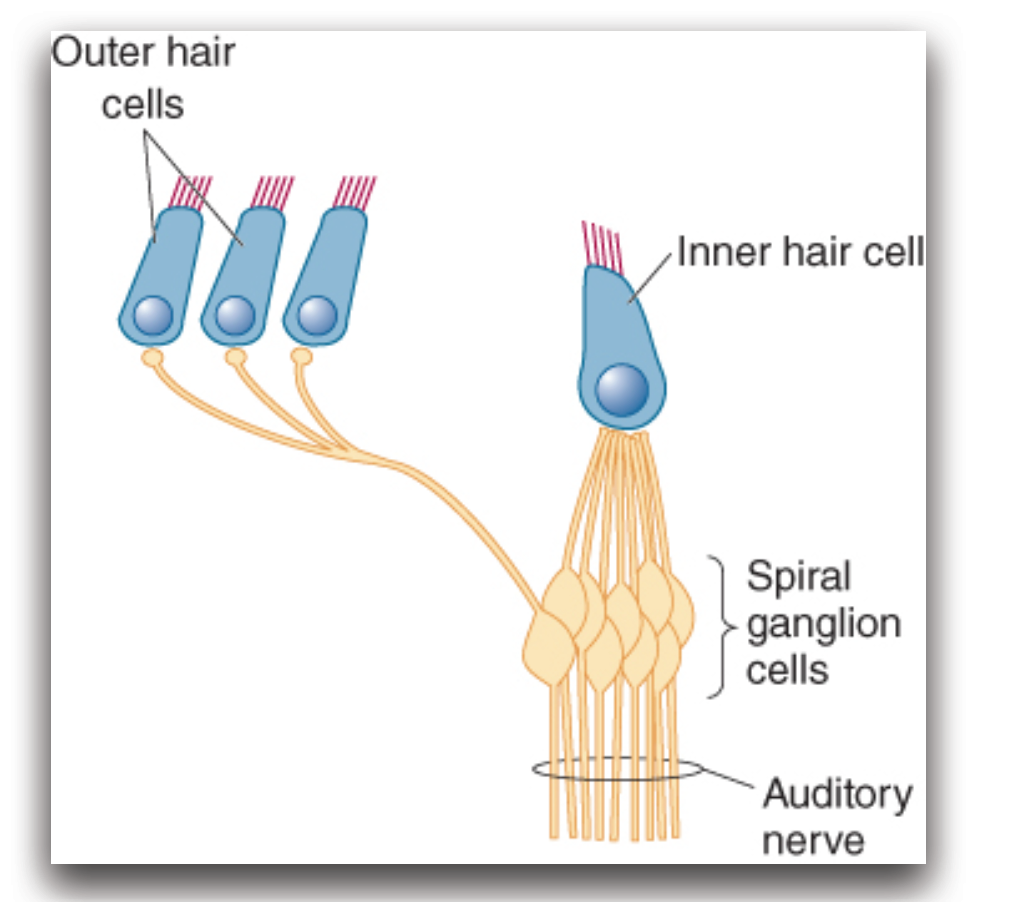
How do outer hair cells amplify the signal
Motor proteins shrink in response to bending of stereocilia, causing K influx and depolarization. The shortening increase the basilar membrane movement

What is the auditory pathway from spiral ganglion to auditory cortex
Spiral ganglion through auditory nerve to ventral cochlear nucleus then superior olive in brain stem, then through lateral lemniscus to inferior colliculus (midbrain), to Medial geniculate nucleus (thalamus), then auditory cortex

How is the auditory cortex organized
A1, surrounded by Belt, then Parabelt
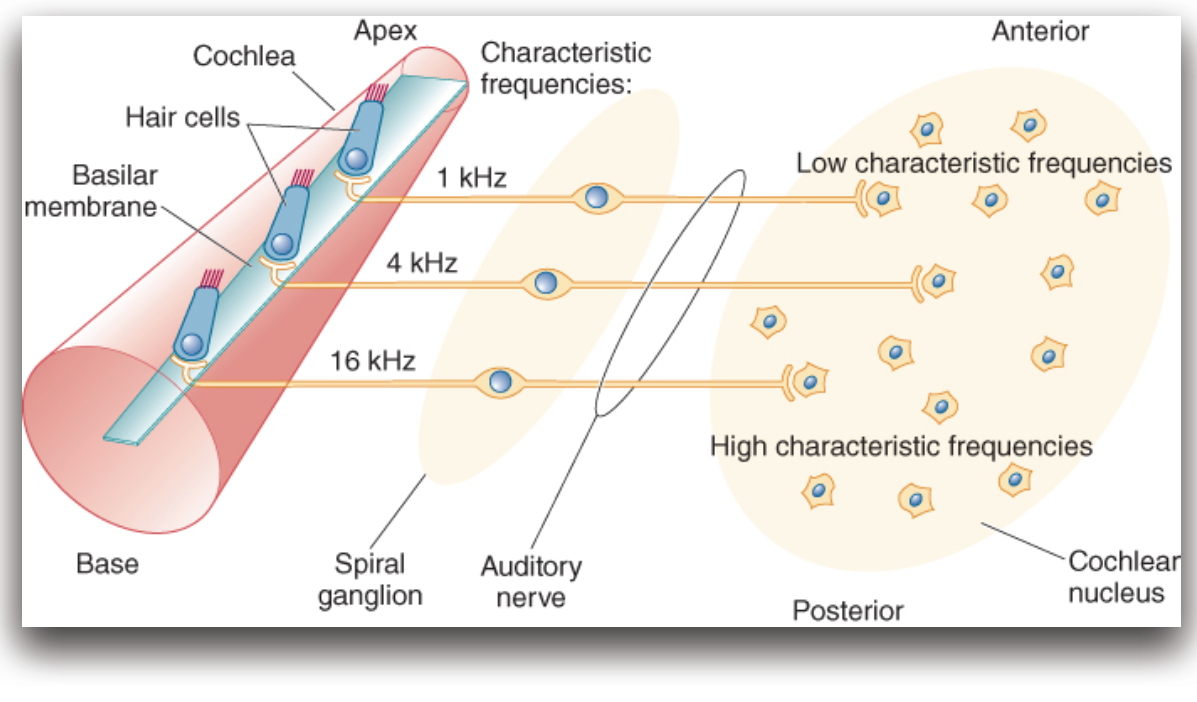
Within A1, increasing Hz ranges - tonopic organization via characteristic frequencies

How is sound intensity encoded
greater amplitude of basilar vibration, causing more extreme depolarization/hyperpolarization of hair cells, increasing/dec firing rates of nerves. Also more intense movement activates more nerves
How is frequency sensitivity enacted
Different parts of basilar membrane are sensitive to different frequencies (thicker = lower). Connected nerves also have characteristic frequencies, and carried onto cochlear nucleus
How is localization of sound divided? how does it occur in each division?
Horizontal plane - via interaural time differences - which ear receives sound first?, and interaural level differences - which ear receives louder sound?
Vertical plane - pinna curves assess elevation of sound source
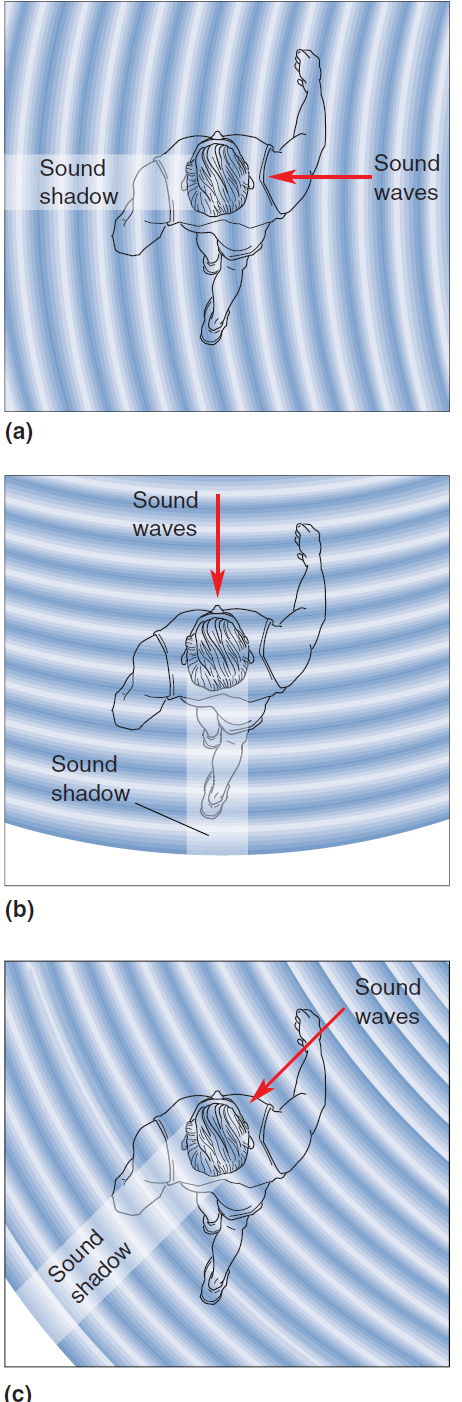
Deafness occurs from; less optimal sound localization/pitch discrimination from (in relation to cerebral injury)
bilateral auditory cortex lesions; partial/unilateral lesion
Hearing loss (in relation to ear structure)
conductive loss from damage to external/middle ear
sensorineural loss from inner ear damage

Ear infection, treatment
characterized by undrained fluid in mid-ear, from swollen eustachian tube
can be treated with tympanostomy tube inserted to eardrum to drain fluid

How does a hearing aid work
Picks up sound waves, amplifies them, and sends them out with a speaker to the eardrum

Tinnitus - definition and causes
ringing in the ear, frequently involved with cochlea or auditory nerve disease/damage, or exposure to loud sounds, changes in central auditory structures, damage to cilia in inner ear, earwax blockage, or ear infections

What does the vestibular system do
Balance - head and body location, head and body movements
What structures are associated with the vestibular system
otolithic organs: utricle/saccule, and semicircular canals

Which vestibular component detects angular acceleration, which detects head tilt and linear acceleration?
semicircular canals, otolith organs
Otolith organ strucure → function
macula sensory epithelium is vertically oriented. Vestibular macula contains hair cells, on bed of supporting cells. Cilia project into gelatinous cap, encrusted with otoconia (calcium carbonate crystals). Key to the tilt sensitivity of macula, higher density than surrounding endolymph

How does tilting a head backwards affect the vestibular system
Gravity pulls the otoconia, deforming the gelatinous cap, bending the cilia. Bending towards the especially tall cilia (kinocilium) results in depolarizing, excitatory receptor potential. Away = hyperpolarization

How are the utricle/saccule hair cells oriented with respect to each other
90 degrees ( saccular maculae are vertical, utricular maculae are horizontal - giving more specifity to sensor

Vestibular innervation?
vestibular nerve (crainal nerve VIII) connected, synapse with hair cells. Nerves directly connect to medial and lateral vestibular nuclei on the same side of the brain stem

Semicircular canal structure -→ function
Senses rotations
hair cells clustered within a sheet of cells (crista)) in a bulge along the ampulla canal.

Describe push/pull activaiton of semicircular canals
Vestibular axons fire at high rates at rest. can easily be up or down regulated.
Long head rotation leads to adaptation. when stimuli ends, opposite fire occurs
