Exam 3
 Call Kai
 Learn
Learn Practice Test
 Spaced Repetition
 Match
Match Flashcards
 Knowt Play
1/50

Name | Mastery | Learn | Test | Matching | Spaced | Call with Kai | Chat |
|---|
No analytics yet
Send a link to your students to track their progress
51 Terms
Two major events that occurred within the first couple of 100 millions years of Earth’s formation
The iron catastrophe and the formation of the moon
The Iron Catastrophe
• Homogeneous - growth of the planet by the aggregation of particles and meteorites
• Gravitational compression results in shrinkage and temperature rise. Denser material sinks, and lighter material rises
• The result of the planet’s differentiation is evident in the formation of the core, mantle, and crust
Formation of the Moon
• Mars-sized planetoid impacts the Earth
• Impact “splashes” material into Earth's orbit
• The Moon forms from a disk in a few 100 years
What was our planet like during the Hadean Eon?
• Hot, barren, and waterless
• Bombarded by comets and meteorites
• Widespread volcanism
• First atmosphere was totally nebular
The Early Atmosphere
• Anoxic and reducing
• Water vapor, carbon dioxide, and nitrogen
Komatiites
Ultramafic extrusive rocks that only formed during the Archean
What are the two ways Archean crust formed?
Mantle plume and typical subduction
Mantle Plume
• Komatiite partially melts
• Basalt gets to the surface and piles up
• The stack sinks and partially melts when pressure is high enough. Fractionation makes increasingly silica-rich magmas
Typical Subduction
• Density differences allow the subduction of mafic rocks
• Further partial melting and fractionation make higher silica melt that won’t subduct
What are the two hypotheses on plate tectonics during the Archean?
Greenstone belts and drip tectonics
Greenstone Belts
• Tens of km thick
• 1st ultramafic partial melting of ultramafics result in mafic magma
• Subsidence of basalts results in partial melting and more felsic magmas to form
Drip Tectonics
Thin, weak lithosphere sank vertically
3 Eras of the Proterozoic Eon from oldest to youngest
Paleoproterozoic, Mesoproterozoic, and Neoproterozoic
Archean Sedimentary Rocks
• Mainly deep marine active margins
• Turbidites, graywackes with volcanics
• Komatiites
Proterozoic Sedimentary Rocks
• Terrestrial passive margins
• Quartz sandstone, red beds, and limestone/carbonates
The Great Oxygenation Event
• Higher O2 (from cyanobacteria) caused a major extinction event
• Cyanobacteria and O2 reduced greenhouse gases, which caused Earth’s first ice age
Banded Iron Formation
• Sedimentary rocks > 15% iron
• Hematite interbedded with chert
• Chemically precipitated on the seafloor
The Proterozoic Eon Major Events
• First cyanobacteria and photosynthesis
• Atmospheric O2 increases and BIFs and methane decreases
• Glaciation and mass extinction of anaerobic organisms
4 Stages of Earth’s Atmosphere
Primordial gases (e.g., H and He), lost early on (first 100’s of million years)
Exhalations from the molten surface (volcanic venting); bombardment from icy comets and steady additions of CO2, water vapor, CO, nitrogen, hydrogen, and methane (Hadean, early Archean)
Addition of oxygen by plant/bacterial life (slowly during Archean and Proterozoic)
As CO2 is drawn down, formation of carbonate rocks (limestones), after the seas became less acidic (starts by beginning of Proterozoic, circa 2.4 Ga)
Nuna Supercontinent
• 1.8-1.4 Ga
• Late Paleo-Proterozoic
Grand Canyon
• The Vishnu Schist and Zoraster granites formed during the Mazatzal orogeny, which was part of the creation of the Nuna supercontinent
• After the formation of Nuna, erosion and uplift exposed the peneplained the basement crystalline rocks
• During the break up Rodinia, Antartica rifted from Laurentia, forming a new ocean. Sediments were deposited and then titled during rifting of Antartica and Laurentia
Snowball Earth
Occurred between 750-550 Ma
How could rocks may have helped build the first RNA?
Mafic rock glass acts as a catalyst helping link pre-existing nucleotide triphospates into longer RNA polymers
Where did early life begin?
In deep sea near hydrothermal vents
How did eukaryotes evolve?
• Symbiotic relationship between different prokaryotes
• Early eukaryotes “ate” but did not digest a cell, which became a mitochondrion to provide extra energy
When did eukaryotic cells evolve?
2 Ga
Acritarchs
• Unicellular, spherical microfossils with thick coverings that are resistant to chemical attack
• Planktonic and photosynthetic
• Common in rocks < 1.8 Ga
What are the 3 eras of the Phanerozoic Eon from oldest to youngest?
Paleozoic, Mesozoic, and Cenozoic
Paleozoic Continent - Laurentia
North America, Greenland, Ireland, and Scotland
Paleozoic Continent - Baltica
Northern Europe and Western Russia
Paleozoic Continent - Siberia
Russia east of the Ural Mountains and north of Mongolia
Paleozoic Continent - China
China, Indochina, and the Malay Peninsula
Paleozoic Continent - Gondwana
Africa, South America, India, Australia, and Antartica
Peneplained
Low-lying and flat land mass produced by erosion
Transgressive-Regressive Sequences
Sequences of sedimentary rock that reflect when the sea transgressed (sea-level rose) and when the sea regressed (sea-level dropped)
Sauk Paleozoic Sea-Level Cycle
Cambrian to Early Ordovician
Tippecanoe Paleozoic Sea-Level Cycle
Early Ordovician to Silurian
Kaskasia Paleozoic Sea-Level Cycle
Devonian to Mississippian
Absaroka Paleozoic Sea-Level Cycle
Pennsylvanian to Middle Permian
Eustasy
Global sea-level changes
Glacio-eustasy
Worldwide sea-level changes related to glaciations
Tectno-eustasy
Worldwide sea-level changes related to sea-floor spreading
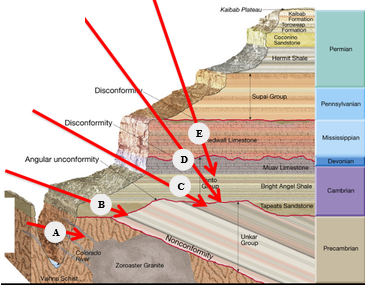
What is A pointing to?
The Vishnu Schist and Zoraster granites formed during the Mazatzal orogeny

What is B pointing to?
Peneplaining from the orogeny that formed Nuna that produced the lower GC SG
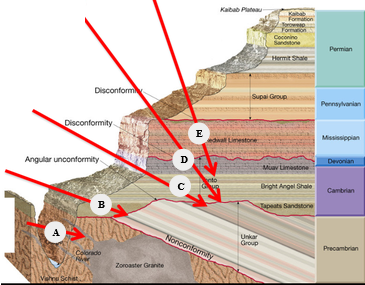
What is C pointing to?
During the break up of Rodinia, Antartica rifted from Laurentia, forming a new ocean. Sediments were deposited and then titled during rifitng

What is D pointing to?
During the late Proterozoic, an erosional surface by the peneplaining of the Neoproterozoic rocks

What is E pointing to?
During the Cambrian, a major transgression occurred (i.e., Sauk Transgression)
The Taconic Orogeny
A volcanic island arc approached and collided with the North American craton
Queenstone Clastic Wedge
• Foreland basin
• Thick deposits of first flysch (deep marine sediments) and then molasse (terrestrial sediments) were deposited as the Taconic Mountains eroded
Why were there shales in the eastern portion of the craton and red shales and sandstones in the easternmost area?
Because of the Taconic Orogeny
Mid-Ordovician Taconic Orogeny
Evidence of exotic terrane from western Connecticut and eastward is seen by exotic fossils there compared to Laurentia