College 2
 Call Kai
 Learn
 Practice Test
 Spaced Repetition
 Match
 Flashcards
 Knowt Play
1/29

Earn XP
Description and Tags
human error
30 Terms
Illusion of control
actions:
superstitious actions
misinterpretation of cause and effect
overconfidence
consequences
poor or no decision making
perseverance
increased risk taking
fundamental attribution bias
fundamental attribution bias
attributing one’s own mistakes to situational factors, while attributing others’ errors to personal factors
unfounded beliefs
beliefs held without evidence
external control
mind over body
coicidence
placebo
misunderstanding probabilities
actions
ignoring base rates
assuming dependence
overestimating low probabilities
consequences
resource misallocation
overreaction to rare events
complacency and reduced safety compliance
gambler’s fallacy
assuming dependence
if the ball landed on red 4x in a row the probability of black is higher
hot-hand fallacy
assuming dependence
if you guessed correctly 4x, you are on a ‘streak’ and the probability of being correct is higher the next time
the precautionary principle
enables decision-makers to adopt precautionary measures when scientific evidence about an environmental or human health hazard is uncertain and/or the stakes are high.
complacency
The disaster of the OceanGate Titan explorer was doomed to happen. Safety checks repeatedly showed problems with the submarine’s structure and control elements.
Yet, CEO Stockton Rush assumed it would be fine, because it always was.
loss aversion
actions
avoiding necessary risks and keeping the status quo
overreacting to near misses
overvaluing property
escalation in avoiding loss (sunk-cost effect)
consequences
avoiding (appropriate) risk-taking
failure to innovate
waste of resources
missed opportunities for safety improvements
sunk-cost effect
the tendency to continue an endeavor as a result of previously invested resources, like time, money, or effort, even when it is no longer rational to do so.
avoiding perceived risks
risks can be avoided due to the potential perceived loss
loss is subjective and is, as such, hard to quantify
‘loss of freedom’ as experienced by anti-vaxxers is an example that others would not see as a ‘real’ loss
the prospect theory
explains how people make decisions under risk and uncertainty
reference dependence
loss aversion + risk aversion
probability weighting
generally underestimate probabilities
overestimate small probabilities and underestimate large probabilities
diminishing sensitivity
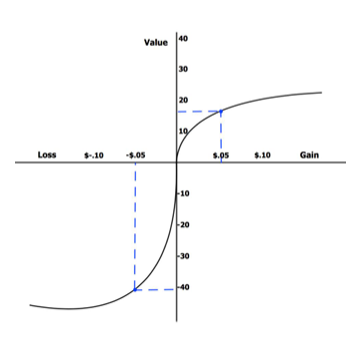
reference dependence
you get a bike for christmas, but you are very unhappy, because your sibling got a brand new car
diminishing sensitivity
risk taking decreases with higher value gains
winning 50 compared to 10 euro feels like a big difference
winning 5 million compares to 1 million feels like a smaller difference
go/no-go task
‘don’t press this button’
response inhibition
speed/accuracy trade-off
errors
post-error changes
2 systems: one fast and subconscious, one slow and conscious
refocus attention
post-error slowing
potential strategy shift

error-related negativity (ERN)
a negative response 50-100 ms after an error was made which is only seen for incorrect trials

error positivity (Pe)
a response that often follows the ERN, reflecting conscious processing of the error
‘oops’

feedback related negativity (FRN)
a negative response that follow 200-350 ms after negative feedback
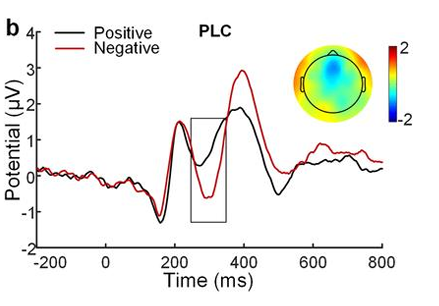
P3
a positive response that often follow the FRN, reflecting conscious processing of the negative feedback of of the mismatch
‘huh?’
‘ow?’

mismatch negativity (MMN)
a negative response that follow 100-250 ms after a mismatch
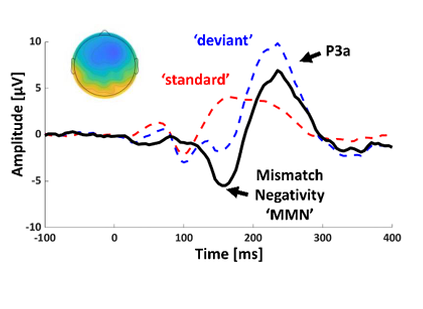
performance monitoring
error processing
feedback processing
conflict monitoring
sleep deprivation
sleep deficiency leads to an increase in errors
this is reflected by flattened ERNs

stress
Yerkes-Dodson law: performance is related to the level of arousal
some arousal is good → increased attention
too much arousal is bad → stress
cortisol
Why do we make errors?
our brain constructs the world around us
we interpret the world based on incoming information
this can lead to differences between how information is perceived and what it really is
Why do we make predictions?
fast processing in a dynamic world
sensory processing takes time. Catching a ball would be impossible if the trajectory of the ball would not be predicted
improving predictions will improve accuracy
efference copy
a copy of motor command that lets the brain predict the sensory effects of its own movement

prediction error
mismatch between prediction and actual outcome
repeated mismatches in similar situation will result in model updating
which is equivalent to learning from mistakes
readiness potential (RP)
we can see predictions (not just prediction errors in brain signals), particularly in the lateralized readiness potential (RP)
signals in the motor cortex prepare particular movement patterns, before we consciously made a decision
More work on the RP by Benjamin Libet makes us question our free will. If brain signals prepare out decisions before we consciously make them, are we responsible for them?
free won’t
While we prepare actions unconsciously, we have a veto to overwrite them = Free won’t. Note that the free won’t can be a little slower, which can results in speed errors (such as in the go nogo task).