Genetics MOHD unit 2
 Call Kai
 Learn
 Practice Test
 Spaced Repetition
 Match
 Flashcards
 Knowt Play
1/25

There's no tags or description
Looks like no tags are added yet.
26 Terms
Autosomal dominant polycystic kidney disease
1:1,000 most common potentially lethal single-gene disorder. 8-10% of all end-stage renal disease. Autosomal dominant inheritance (males and females affected equally)
Vertical inheritance - multiple generations - 50% chance of transmitting the mutant allele
15% of cases are de novo
Multiple bilateral renal cysts
extrarenal cysts
Intracranial aneurysms
Mitral valve prolapse
Multiple bilateral renal cysts (ADPKD)
Kidney enlargement, UTI, nephrolithiasis pain, hematouria, hypertension
End stage renal disease
Extrarenal cysts
Mostly on the liver
pancreas
seminal vesicles
most are asymptomatic
Autosomal dominant inheritance
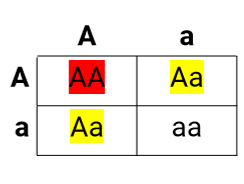
Incompletely dominant
.25 AA severely affected
.5 Aa affected
.25 aa unaffecte
if embryonic lethal then 2/3 Aa affected and 1/3 aa unaffected
Risk assessment
1st degree - .5 parent to child/siblings
2nd degree - .25 aunt/uncle→niece/nephew, grandparent to grandchild, half-siblings
3rd degree - .125 —> great-grandparents to great-grandchildren, first cousins
ADPKD genes
Multiple genes can result in same clinical phenotypel\
PKD1 - 78% —>polycystin1 - (more severe, early age of onset 55 y/o)
PKD2 - 15% —→ polycystin 2 - (later onset, 80 y/o)
IFT140
GANAB
DNAJB11
ALG5
ALG9
Sanger Sequencing
Uses primer with flourescent nucelotide tags at the end
Specific assay design for each region sequenced
expensive
does not detect large deletions/duplications
Next-gen sequencing
Fragment genomic DNA and select targets of interest
generate short reads — usually used for whole exome seq
can detct some intragenic deletions/duplications
Testing for ADPKD
NGS of multiple genes would be the quickest and most cost-effective
Cascade testing
24 y/o brother (50% risk) is tested and negative
27 y/o sister (50% risk) ultrasound → no renal cysts, so do you predict her risk
what about testing affected individuals daughter
Bayesian analysis
The probability of A happening given B already happened For individuals @ 50% risk for ADPKD clinical dx made if >or= 3 cysts are present from 15-39 y/o
Predictive genetic testing in children
We should not test kids for adult onset disorders
Takes away their autonomy of wanting to know their dx
Autosomal dominant disorders
Neurofibromatosis type 1 (NF1)
Marfan syndrome
Achondroplasia
NF1
1:3000
cafe-au-lait — tan spots
Neurofibromas (cutaneous, plexiform)
Lisch nodules, optic pathway glioma
macrocephaly, learning problems
NF1 gene encodes neurofibromin
Tumor suppressor gene
50% de-novo/50% inherited
can be mosaic (harder to diagnose, should probably get testing from abnormal spots)
Marfan syndrome
1:5,000-10,000
Aortic dilation/dissection
Mitral valve prolapse
Ectopia lentis/ high myopia
Tall stature with long limbs, chest deformity, scoliosis, arachnodactyly
FBN1- encodes fibrillin-1
Extracellular matrix protein
25% de novo, 75% inerited
Variable expressivity
Affected individuals with the same genotype have different manifestations of disease
Allelic heterogeneity
Multiple difference pathogenic variants (alleles) can cause the same phenotype (NF1, Marfans)
Achondroplasia
1:26,000: Most common skeletal dysplasia
Disproportionate short stature 4’1’’ women 4’4’’ men
Rhizomelic limb shortening
Narrow craniocervical junction 7.5% of risk without correction
motor delays, normal intellect
FGFR3 p.Gly380Arg
encodes GFR 3
no allelic heterogenity
80% de novo, 20% inherited
Paternal age effect
Homozygous is lethal
Autosomal recessive polycystic kidney disease (ARPKD)
1:10,000-40,000
Enlarged echogenic kidneys - 30% mortality in 1st yr due to pulmonary hypoplasia
50% progress to ESRD
50% liver involvement
75% have biallelic pathogenic variants in PKHD1
encodes fibrocystin, interacts with polycystin 1 and polycystin 2
Autosomal recessive inheritance
Horizontal inheritance - same generation
Consanguinity increases the risk of autosomal recessive disorders
homozygous pathogenic variant is inherited from a common ancestor

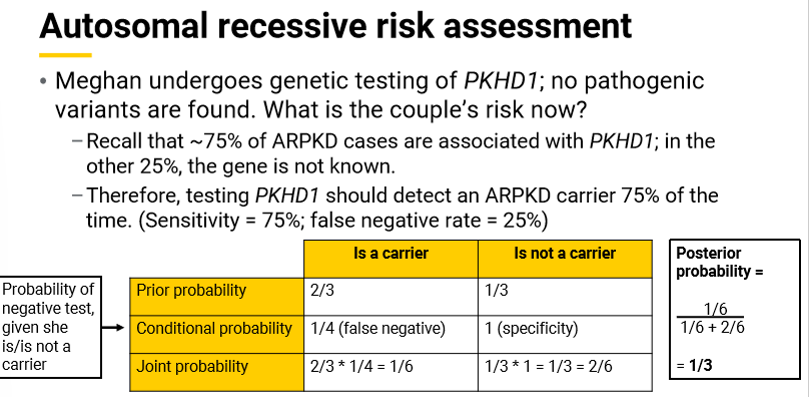
Autosomal recessive risk assessment
using her new risk after testing —→ .12%

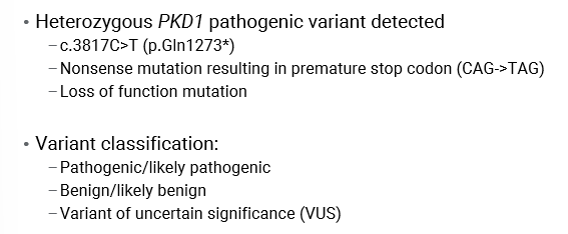
This individual has a nonsense mutation that results in a loss of function
Other variants:
Pathogenic/likely
Benign/likely
Variant of uncertain significance
What is the probabiliyt the sister has ADPKD given she has no renal cysts at age 25
50/50 chance as she is a first degree relative
false negative - 5/100 chance of negative ultrasound but has ADPKD
negative ultrasound given she has no ADPKD - 1 chance
joint probability
just under 5% —- not actually 50%


unaffected sibling carrier risk is 2/3 bc aa is fully affected

pseudodominance
disease appears to be vertically transmitted with 50% risk - when 1 carrier and 1 affected