Chapter 15 - Metabolism and Electron Carriers
 Call Kai
 Learn
 Practice Test
 Spaced Repetition
 Match
 Flashcards
 Knowt Play
1/71

There's no tags or description
Looks like no tags are added yet.
72 Terms
Why do cells need a constant input of free energy?
To power mechanical work, active transport, and biosynthesis
Biosynthesis
The synthesis of macromolecules and other biomolecules from simple precursors.
Combined, what do mechanical work, active transport, and biosynthesis do for the body?
Maintain homeostasis
(T/F) — Homeostasis, in a living organism, is at equilibrum
False—it is far from it
All things want to be at equilibrium, so how come our internal processes arent?
Being at equilibrium would kill us
Where is the free energy used to maintain homeostasis derived from?
The environment
Phototrophs
Capture energuy from sunlight
Includes all photosynthetic organisms
Chemotrophs
Capture energy through the oxidation of chemicals
Includes animals
In chemotrophs, the chemicals that are captured are often generated by who?
Phototrophs
Metabolism
Also termed intermediary metabolism, a highly regulated network of reactions built from a few recurring mechanisms
Begins with a particular molecule and results in the formation of some other specific molcule(s)
(T/F) — Metabolic reactions are highly regulated
True
Catabolism
Breaks down complex molecules into simpler ones
Generate/release energy
Think of a cat knocking a vase off a counter
Anabolism
Builds up complex molecules
Requires energy
Amphibolic
Can be anabolic or catabolic depending on the energy conditions of the cell
What two critical things does a pathway need?
Specific reactions (must yield only one particular product/set of products)
Every step must be favorable under real cell conditions (ΔG < 0)
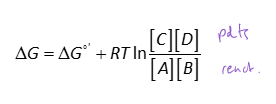
(T/F) — A step with a +ΔG°′ cannot run and will always be endothermic
False—ΔG is the determinant of whether a reaction can occur spontaneously or not
Coupling
Process of utilizing favorable (-ΔG) reactions to drive unfavorable (ΔG) reactions
Free-energu changes of coupled reactions add up
Where does coupling occur?
At the active site of enzymes
ATP — Structure
Adenine
Ribose
Triphosphate group
What does ATP act as?
The immediate donor of free energy; NOT a long-term storage molecule
How does catabolism get energy from fuels (fats and carbohydrates)?
Via extracting energy from them and capturing it through the production of ATP
How much ATP does the body hold?
100 g
How quickly is ATP used? What does this mean for its regeneration?
Within about a minute; it must have a high turnover rate to compensate
ATP → ADP Hydrolysis Reaction
ATP + H2O → Pi + ADP
Pi
Orthophosphate
What is the ΔG°′ value of ATP → ADP hydrolysis?
-30.5 kJ/mol
ATP → AMP Hydrolysis Reaction
ATP + H2O → AMP + PPi
PPi
Pyrophosphate
What is the ΔG°′ value of ATP → AMP hydrolysis?
-45.6 kJ/mol
In ATP hydrolysis, how is energy released?
The formation of new covalent bonds and noncovalent interactions with water
The increase in entropy of the products relative to the reactants
The free energy liberated in the hydrolysis of ATP is harnessed for?
Driving reactions that require an input of free energy
The active form of ATP is usually a complex of ATP and what metal ions?
Mg2+ or Mn2+
Balances the charges on ATP
What is the ΔG for ATP hydrolyses?
-50 kJ/mol
Why does ATP release so much energy?
Electrostatic Repulsion—The triphosphate carries ~4 negative charges close together; hydrolysis relieves this
Resonance Stabilization—Pi has more favorable resonance forms than the γ-phosphate of ATP (picture)
Entropy Increase—One molecule becomes two
Hydration—Water stabilizes ADP and Pi, making the reverse reaction less favorable

What compounds have higher phosphoryl-transfer potential than that of ATP?
Phosphoenolypyruvate, ΔG°′ = -60
1,3-BPG, ΔG°′ = -55
Creatine Phosphate, ΔG°′ = -43
In comparison: ATP, ΔG°′ = -30
What does it mean for a compound to have a higher phosphoryl-transfer potential than that of ATP?
They can transfer their phosphoryl group to ADP to form ATP
Why is ATP’s intermediate phosphoryl-transfer potential important?
It allows ATP to function efficiently as a carrier of phosphoryl groups
What compounds have lower phosphoryl-transfer potential than that of ATP?
Glucose-6-phosphate, ΔG°′ = -20
Glycerol 3-phosphate, ΔG°′
In comparison: ATP, ΔG°′ = -30
Creatine Phosphate
Buffers ATP in muscle (via creatine kinase)
Supplies ATP for roughly the first 4 seconds of a sprint, then anaerobic and aerobic metabolism take over
What turns ADP → ATP?
Fuel oxidation or photosynthesis
What does ATP hydrolysis power?
Motion, transport, biosynthesis, and signal amplification
Why are phosphate esters ideal regulatory molecules?
They are thermodynamically unstable yet kinetically stable in water (negative charges resist hydrolysis without enzymes)
Protein kinases add phosphate and the ester stays put until protein phosphatases remove it. Because it doesn’t fall off on its own, the cell controls when the switch flips
Protein Kinases
Add phosphates to proteins
Protein Phosphatases
Remove phosphates from proteins
(T/F) — Only phosphate has the chemical properties to meet the needs of living systems
True
GTP, UTP, and CTP
Some biosynthetic reactions are driven by these compounds instead of ATP (guanosine, uridine, and cytidine triphosphate)
Nucleoside monophosphate kinases and nucleoside diphosphate kinases transfer phorsphoryls between nucleotides
What is one of the primary roles of catabolism?
Generation of ATP
Oxidation
Loss of electrons
Reduction
Gain of electrons
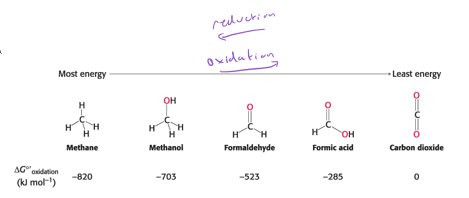
The more (reduced/oxidized) a carbon is, the (more/less) energy its oxidation releases
Reduced, more
Why are fats a more efficient fuel source than carbohydrates?
They are more reduced

When a fuel is oxidized, the oxidation takes place ___ carbon atom(s) at a time in the fuel molecules
1
Fuel oxidation energy is captured in what 3 forms?
Electrons carried by NADH and FADH2
High-Phosphorly-transfer compounds--
Ex: glyceraldehyde 3-phosphate (GAP) is oxidized, the energy is trapped as 1,3-bisphosphoglycerate (1,3-BPG), and 1,3-BPG then gives its phosphate to ADP to make ATP
Ion (proton) gradients
Ex: Oxidation pumps H⁺ across a membrane; H⁺ flowing back through ATP synthase makes ATP

Proton gradients generated by the oxidation of carbon fuels accounts for more than what % of ATP generation?
90%
Oxidative Phosphorylation
The generation of a proton gradient via the oxidation of carbon fuels

Activated Carriers
Small molecules to which a chemical group or electrons have been added, which can then be donated to another molecule
Many activated carriers function as what?
Coenzymes—small organic molecules that serve as cofactors for enzymes
What is the ultimate electron acceptor in the oxidation of fuel molecules?
O2
(T/F) — Electrons are transferred directly to O2
False
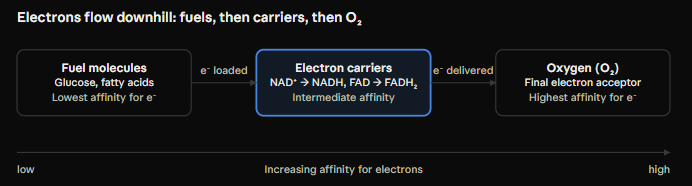
How do activated carries work?
Shuttle trucks; When fuels are oxidized, they release high-energy electrons. Fuels load these electrons onto carriers, who then deliver them to O2 indirectly in controlled steps
Carriers hold electrons more tightly than fuels, but less tightly than O2, so electrons flow “downhill”
ATP
Activated Carrier
Carries: Phosphoryl group
Reactive Part: Triphosphate group
Main Job: Kinases, active transport, biosynthesis, motion (ATP–ADP cycle)

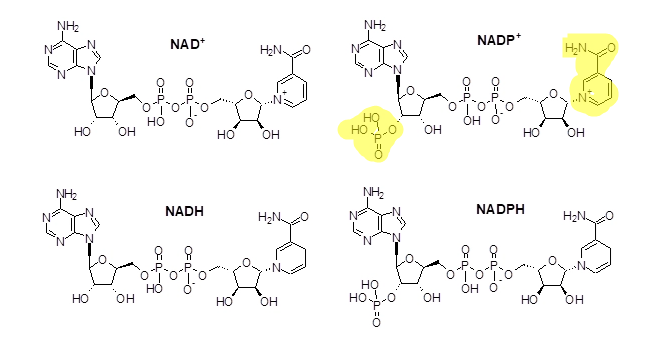
NAD+
Activated Carrier
Oxidized to Reduced: NAD+ → NADH
Carries: 1 H + 2 e — a hydride (H-)
Reactive Part: Nicotinamide ring (pyridine)
Vitamin Precursor: Niacin (B3)
Main Job: Fuel oxidation (catabolism) → ATP

FAD
Activated Carrier
Oxidized to Reduced: FAD → FADH2
Carries: 2 e + 2 H
Reactive Part: Isoalloxazine ring
Vitamin Precursor: Riboflavin (B2)
Main Job: Fuel oxidation (catabolism) → ATP

NADP+
Activated Carrier
Oxidized to Reduced: NADP⁺ → NADPH
Carries: 1 H + 2 e — a hydride (H-)
Reactive Part: Nicotinamide ring + plus phosphate on the 2′-OH of adenosine ribose
Vitamin Precursor: Niacin (B3)
Main Job: Reductive biosynthesis (anabolism)
Identified via its extra phosphoryl group to not be confused with NADH
CoA
Coenzyme A—Activated Carrier
Oxidized to Reduced: CoA-SH → acyl-CoA
Carries: Acyl groups
Reactive Part: Terminal -SH
Vitamin Precursor: Pantothenate (B5)
Main Job: Carries two-carbon (acetyl) fragments

Why are acyl groups important?
They are important constituents in catabolism (oxidation of fatty acids) and anabolism (synthesis of membrane lipids)
Acyl groups may be linked to the sulfhydryl group of CoA by thioester bonds.
The resulting derivative is called an acyl CoA.
An acyl group often linked to CoA is the acetyl unit.
This derivative is called acetyl CoA

Most activated carriers that act as coenzymes are derived from what?
Vitamins
What 4 things regulate metabolism?
Amount of enzyme
Rate of synthesis vs. degradation, usually via a change in the rate of transcription (of genes encoding the enzymes)
Catalytic activity
Allosteric effectors, reversible covalent modification, hormones, energy status
Accessibility of substrates
Compartmentalization (between cell compartments) separates opposing reactions
Hormones
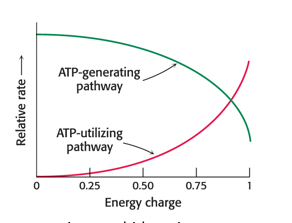
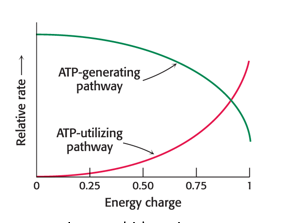
Energy Charge
Serves as an index of the energy status
Ranges from 0 (all AMP) to 1 (all ATP)
ATP-generating pathways are inhibited under high-energy charge
ATP-utilizing pathways are stimulated under high-energy charge
Energy Charge Formula

When, most notably, does energy charge drop?
In the muscle during high-intensity excerise; drops below 0.7
How does energy charge regulate pathways?
Enzymes are either allosterically inhibited or activated by binding to ATP or AMP in response to the charge
If high: ATP binds to ATP-generating enzymes to inhibit them and binds to ATP-using enzymes to stimulate them
If low: AMP (and ADP) binds to ATP-generating enzymes to stimulate them and binds to ATP-using enzymes to inhibit them
BINDING DOES NOT OCCUR AT THE ACTIVE SITE!