lecture 2 transcription
 Call Kai
 Learn
 Practice Test
 Spaced Repetition
 Match
 Flashcards
 Knowt Play
1/26

There's no tags or description
Looks like no tags are added yet.
27 Terms
rna polymerase reads the dna template strand _____ and uses it to build rna _____
3′ → 5′, 5′ → 3′
how does the mrna sequence compare to the dna coding strand (non-template strand?
they have the same base sequence when read 5′ → 3′, except mrna has uracil (u) wherever the coding strand has thymine (t).
the four stages of transcription in order
rna polymerase binds the dna
initiation
elongation
termination
what subunits make up the prokaryotic rna polymerase core enzyme and holoenzyme?
core enzyme (4 subunits): 2α, β, β′
holoenzyme (5 subunits): 2α, β, β′, σ (sigma) | holoenzyme = core enzyme + sigma factor
what happens when the rna polymerase core enzyme is mixed with dna and ribonucleoside triphosphates (rntps) in vitro?
without sigma, the core enzyme starts at random spots on the dna and makes different rna than the cell normally makes.
what happens when sigma factor is added to the rna polymerase core enzyme?
sigma helps rna polymerase bind promoters, specific sites on dna that tell it where to start transcription. this lets it make the same rna transcripts normally made in the cell.
prokaryotic promoter
a dna region upstream of the transcription start site, where rna polymerase binds to begin transcription.
−35 and −10 consensus sequences
conserved promoter sequences located about 35 and 10 bases upstream of the transcription start site. the sigma factor recognizes these sequences. the −10 sequence is called the pribnow box, or commonly labeled the tata box.

___________ recognizes and binds promoter sequences and some genes also have an upstream promoter element that can be bound by what? Binding to these consensus sequences positions the polymerase at the start site properly
σ factor (sigma factor), α (alpha)

during transcription initiation, what unwinds and separates a short region of dna to expose the template strand’s bases? what then diffuses randomly into the active site?
rna polymerase unwinds and separates the dna strands. ribonucleoside triphosphates (rntps) then diffuse randomly into its active site.
during transcription initiation, what bond does rna polymerase form after the first two ribonucleoside triphosphates (rntps) hydrogen-bond to the template bases? what is it called when polymerase pulls in dna while staying attached to the promoter?
rna polymerase forms a phosphodiester bond between the first two nucleotides. then, while polymerase stays attached to the promoter, its β and β′ subunits pull in dna and unwind about 20–25 base pairs as more nucleotides are added. this is called dna scrunching.

during the transition from initiation to elongation, what is abortive synthesis, and how does it end?
abortive synthesis is when rna polymerase repeatedly makes and releases short rna fragments of 8–9 nucleotides. once it makes a transcript about 10 nucleotides long, it can leave the promoter, release the sigma factor, and move along the dna to begin elongation.

during transcription elongation, how does rna polymerase extend the rna strand, what hybrid forms, and can it correct mistakes?
extension: rna polymerase builds rna 5′ → 3′ by adding each new ribonucleoside triphosphate (rntp) to the 3′ end.
hybrid: about 8–9 rna nucleotides stay paired with the dna template at a time.
proofreading: rna polymerase has weak proofreading ability and can remove an incorrect nucleotide

when does transcription elongation end?
rna polymerase continues making rna until it reaches a termination signal. rna synthesis then stops, and the transcript is released.

two types of prokaryotic termination signals
gc rich/poly A
dependent on rho (ρ) factor
how does a gc-rich hairpin end transcription?
self-complementary sequences in the rna pair up to form a gc-rich hairpin. the hairpin causes rna polymerase to pause and destabilizes the weak a–u base pairs between the dna template and the rna. the rna transcript detaches, ending transcription.
how does rho (ρ) factor end transcription?
rho binds a specific sequence on the growing rna and moves along it. when rna polymerase pauses, rho catches up and separates the rna–dna hybrid, releasing the rna transcript and causing rna polymerase to detach from the dna.
what is eukaryotic rna polymerase ii made of, and what does it need to initiate transcription?
rna polymerase ii is made of about 10 different polypeptides. it needs general transcription factors (tfii proteins) that assemble at the core promoter and help position the polymerase to start transcription.
what are the four core promoter elements shown for eukaryotic rna polymerase ii, in order from upstream to downstream?
bre — tfiib recognition element, upstream of the tata box.
tata box — about 25 bases upstream of the transcription start site.
inr — initiator sequence, overlaps the transcription start site (+1).
dpe — downstream promoter element, located after the transcription start site.
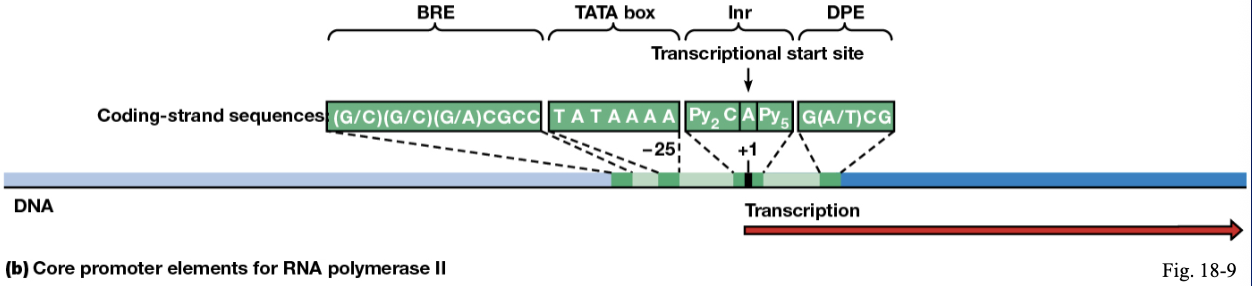
which core promoter elements are shown in a tata-driven promoter?
tfiib recognition element (bre), tata box, and initiator sequence (inr).
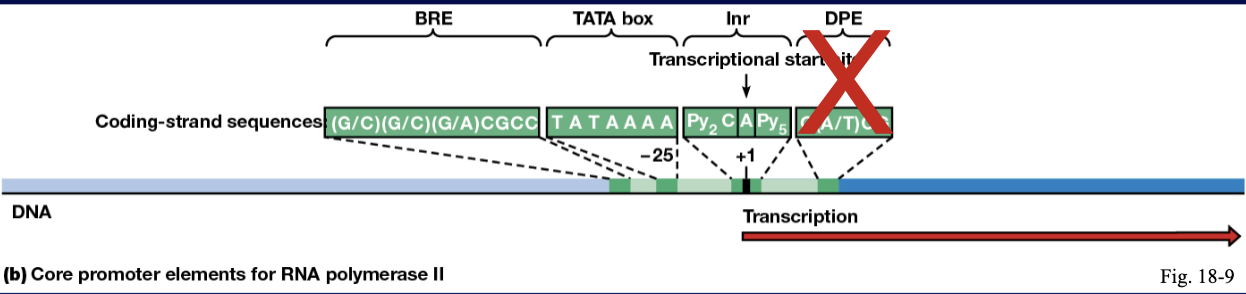
which core promoter elements are shown in a dpe-driven promoter?
initiator sequence (inr) and downstream promoter element (dpe).
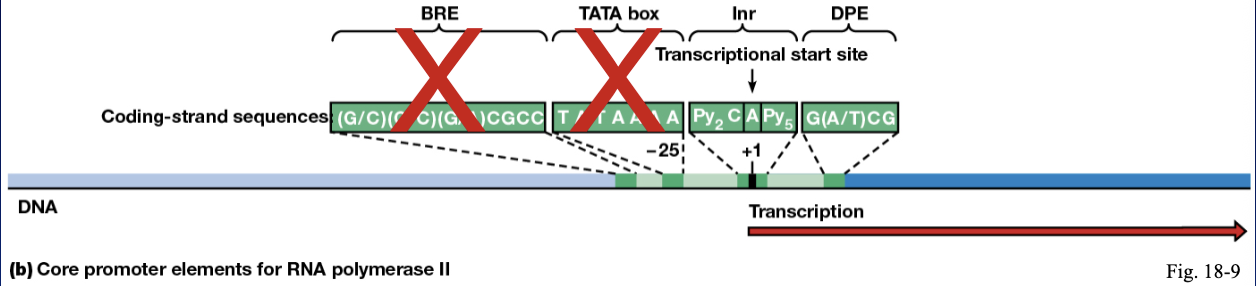
which general transcription factor binds the core promoter first, and how does it bind tata-driven and dpe-driven promoters?
tfiid binds first.
- tata-driven promoter — its tata-binding protein (tbp) binds the tata box and bends the dna by about 80°.
- dpe-driven promoter — other subunits of tfiid recognize the downstream promoter element (dpe).

after tfiid binds and the dna bends, what binds next to form the pre-initiation complex?
tfiia + tfiib bind first, then tfiif + rna polymerase ii, and finally tfiie + tfiih.

what are the two enzymatic activities of tfiih?
helicase activity helps unwind dna at the transcription start site.
kinase activity phosphorylates the tail of rna polymerase ii, helping it leave the promoter and begin elongation.
during transcription initiation, what sequence is repeated in the c-terminal domain (ctd) of human rna polymerase ii, and how does phosphorylation activate the polymerase?
the ctd contains 52 repeats of the heptapeptide y–s–p–t–s–p–s. each repeat has five potential phosphorylation sites (one tyrosine, three serines, and one threonine). during initiation, kinases, including tfiih, use atp to phosphorylate the ctd, activating rna polymerase ii for transcription.

what is the polyadenylation signal sequence, and where is the pre-mrna cut?
the cell recognizes 5′-aauaaa-3′, the polyadenylation signal in the growing rna. it cuts the rna 10–35 nucleotides downstream of that signal, releasing the pre-mrna.
once the pre-mrna is cut and released, does rna polymerase ii stop right away?
rna polymerase ii can keep moving along the dna for several hundred more base pairs before it stops. the extra rna it makes is degraded.