Psych 201 Exam 4
 Call Kai
 Learn
 Practice Test
 Spaced Repetition
 Match
 Flashcards
 Knowt Play
1/27

There's no tags or description
Looks like no tags are added yet.
28 Terms
What are the two types of mental representations?
Analogical representations
Symbolic representations
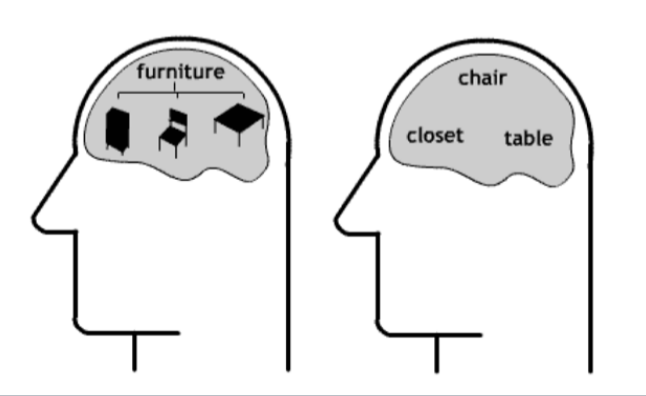
What type or representation resembles the things they represent (e.g., mental images) and does not require any decoding?
Analogical

What type of representation is abstract, involving arbitrary symbols (e.g., words, numbers) and requiring decoding?
Symbolic
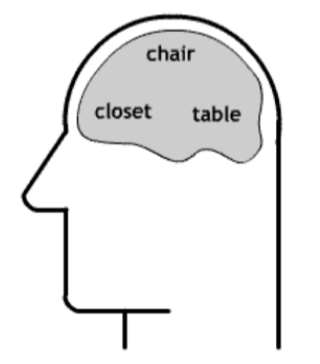
Which mental representation(s) do mental maps fall under?
Both analogical and symbolic

How is visual-spatial information stored?
As propositions (verbal/symbolic statements) and/or as visual images (analogical representations)

What is the time to mentally “move” between imagined points correlates with their real-world distance called?
Mental scanning

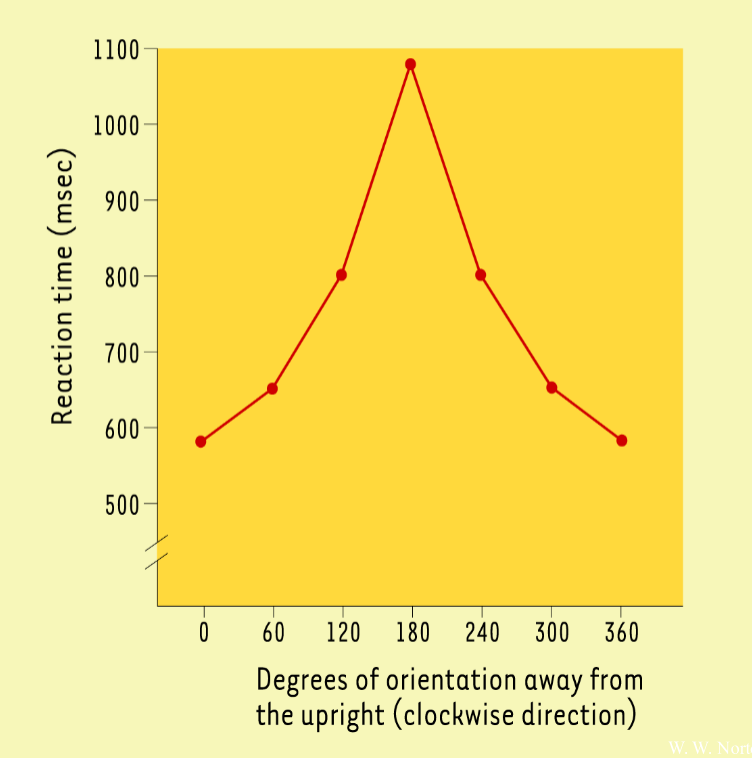
What is mental rotation?
Our responses slow down proportionally to the angle of rotation, suggesting we “rotate” images in our mind.
Which type of person is more likely to have eidetic imagery, sometimes called “photographic memory”?
Children

What are concepts?
Mental representations of groups or categories of related objects or events (e.g., a
concept of a dog, a chair, a dorm).
What are the two theories of concepts?
Prototype theory
Exemplar theory
What is prototype theory?
We represent a category by its most typical or average member (e.g., we think of a robin when we think “bird”). Objects are categorized based on how similar they are to the prototype.

What is exemplar theory?
All individual members of a category contribute. Your memory stores all the birds you’ve seen, and each example helps define “bird.”

How are mental concepts stored?
In associative networks

What does it mean that long term storage is hierarchical?
Each category has properties which are stored as high as possible in the hierarchy. Lower categories inherit the properties of the higher categories to which they belong.
Links between different categories and between categories and their properties.
Efficient => can make inferences. (E.g., A canary can sing and fly; a canary is an animal)
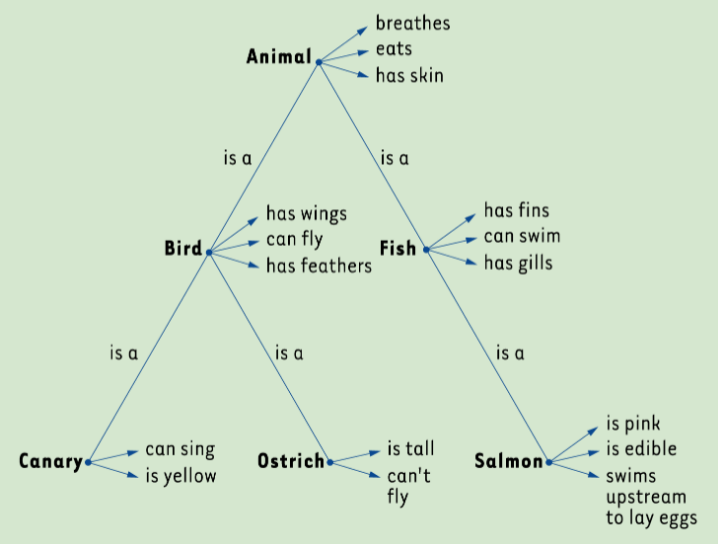

Which of these levels are basic, superordinate, and subordinate?

Which level of the hierarchy is the most cognitively efficient (the one you form prototypes for)?
The “basic” level

What is a schema? What is a script?
Schemas are mental representations of how objects, events and behaviors are organized (e.g., schema of a restaurant, a house, a wedding).
A script is a schema that guides a sequence of behavior
How might the forgetting curve of someone who did well in a class compare to someone who did poorly?
They would look about the same!
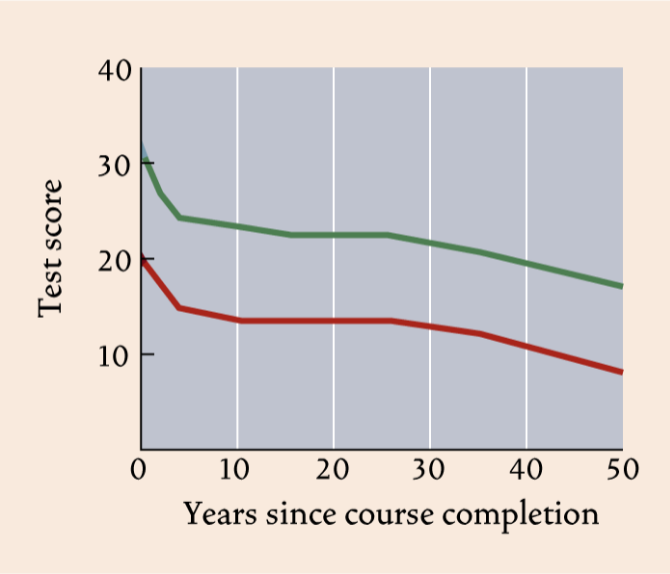
What can memory loss result from?
Decay (memories fade)
Interference
Poor retrieval cues
What is the difference between retroactive and proactive interference?
Retroactive interference: (new learning disrupts old memory)
Proactive interference: (old memory interferes with new)
What is the difference in recognition and retrieval?
Retrieving/recalling info – no stimulus present to help
Recognizing info – stimulus is there providing retrieval cues
What is the encoding specificity principle?
Recall is best when the context (or internal state) during retrieval matches the encoding context. Context and state aid memory by providing retrieval cues.
What does it mean that memory is reconstructive?
It is influenced by knowledge, expectations, and later information.
How do false memories arise?
Activation of related concepts
Schemas filling in missing details
Top-down processing “filling-in the blanks”
Misleading post-event information (e.g., Loftus study)
Does misleading information replace original information?
Nope! It has simply provided alternative/competing information.

Which of these models of memory retrieval are more accurate?
Reconsolidation: each memory is of the previous retrieval

What is Hebb’s rule?
Cells that fire together wire together.”
Repeated co-activation strengthens synaptic connections.
What is synaptic plasticity?
Functional and structural changes in synapses (connections between neurons) support learning and memory.