ch 16 host-microbe interactions
 Call Kai
 Learn
 Practice Test
 Spaced Repetition
 Match
 Flashcards
 Knowt Play
1/18

There's no tags or description
Looks like no tags are added yet.
19 Terms
a glimpse of history
ancients thought diseases were divine punishment
Leeuwenhoek’s discovery of microorganisms in 17th century led people to suspect they might cause disease
1876: Robert Koch offered evidence for what is now known as Germ Theory of Disease
showed Bacillus anthracis causes anthrax; later work on tuberculosis
formalized criteria for establishing the cause of a specific disease, now known as Kock’s postulates
bacteria are ubiquitous
we contact microorganisms daily
breathing, ingestion with food/drink, pick up on skin
most so not harm us, some can cause disease
most vulnerable are those with weak or defective defenses
immunocompromised
due to malnutrition, disease (cancer, ADS), surgery, genetic defects, alcohol or drug abuse, immunosuppressive therapy
remove by
washing
shed with dead epithelial cells
swallowed microorganisms: killed by stomach acid or eliminated in feces
the anatomical barriers as ecosystems
barriers: skin, mucous membranes
ecosystem for microorganisms
symbiotic relationships between host and microbes
mutualism: both partner’s benefit
E. coli in human colon
host: receives vitamin K and B vitamins from intestinal bacteria
bacteria: receive food, shelter from host
commensalism: one partner benefits, other is unharmed
microbes on skin: obtain food from host
host: neither harmed nor helped
parasitism: one organism benefits at expense of other
all pathogens
the human microbiome (normal microbiota)
microbes found on the body of healthy individuals
normally do not cause disease
resident microbiota - permanent
transient microbiota - temporarily
acquisition
composition changes due to:
physiological changes within host
changes in activity of host (weight loss, change in diet)
presence and condition of other microbes
the human microbiome (normal microbiota) - has protective role
protect against pathogens by competitive exclusion
covers binding sites to prevent attachment
consumes available nutrients
produces compounds toxic to other bacteria
when killed or suppressed, pathogens may infect and cause disease
examples
Lactobacillus vs. Candida albicans (vulvovaginal candidiasis)
Intestinal microbiota vs. Clostridium difficile
stimulate adaptive immune system
antibodies against normal microbiota also bind to pathogens
important in development or oral tolerance
lessens immune response to microbes in gut and food
basis of hygiene hypothesis, insufficient exposure to microbes leads to allergies
aid in digestion: break down of fibers
produces vitamin K and B vitamins
can become opportunistic pathogens
do not cause disease in their normal habitat, but do so when in different environments
cause disease when:
immune system is weakened
microbe number increases
microbe enters other sites
principles of infectious disease
infectious disease: diseases that can spread
infection: microbe colonizes and multiplies in host
subclinical: no or mild symptoms
symptomatic: show characteristic signs/symptoms
symptoms: changes felt by patient
pain, nausea, malaise
signs: changes that can be measured or observed
rash, fever, pus formation, and swelling
primary infection: the initial infection in a healthy person
caused by primary pathogen: a microbe that causes disease in healthy individuals
causes damage that makes the host vulnerable to developing a secondary infection
secondary infections
due to opportunistic pathogens: only cause disease when the host’s immune defenses are weakened or when introduced into an unusual location
examples…
stages of an infectious disease
incubation period:
time between contact with microbe to onset of symptoms
may vary with pathogen (few days for cold, years for leprosy)
illness: patient experiences signs/symptoms of disease
immune system trying to fight off infection
convalescence period: patient starts to recover
prone to secondary infections
are carriers – have no signs or symptoms, more likely to spread infectious agent
incubation period → illness → convalescence
Characteristics of Infectious Disease
Spread:
Communicable disease – can spread from one host to another
Contagious disease - easily spread
Non-communicable disease – cannot spread from one host to another
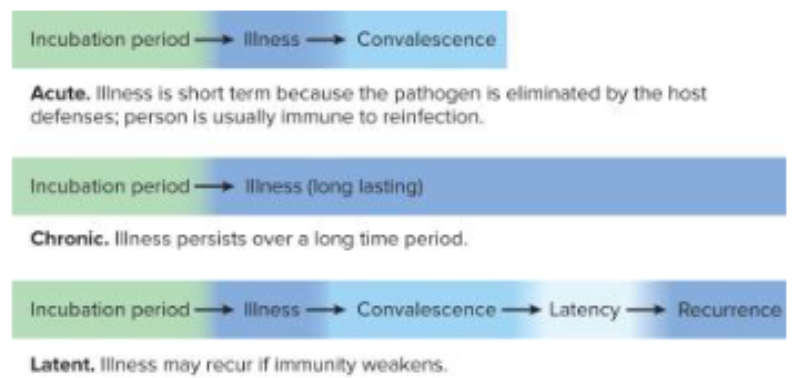
Duration of symptoms
Acute infections: symptoms develop quickly and more severe, last a short time (strep throat)
Chronic infections: develop slowly, last for months or years (TB)
Latent infections: microbe never eliminated
Symptoms may reoccur when immunity is weakened (reactivation)
Chicken pox → shingles, cold sores, genital herpes
Distribution of pathogen in host
Localized infection: microbe limited to small area (boil caused by Staphylococcus aureus)
Systemic infection: agent spread throughout the body via blood (measles)
Suffix -emia means “in the blood”
Bacteremia: bacteria circulating in blood stream
Septicemia: bacteria multiplying in bloodstream
Toxemia: toxins circulating in bloodstream
Viremia: viruses circulating in bloodstream
Sepsis: acute, life-threatening inflammation caused by infectious agents/products in bloodstream
Establishing the Cause of Infectious Diseases, pic
Koch’s Postulates
Developed by Robert Koch to establish that Bacillus anthracis causes anthrax
Today, provide the criteria for establishing that a given microbe causes a specific infectious disease
Microorganism is present in every case of disease
Organism is grown in pure culture from diseased
host
When pure culture is introduced into susceptible
hosts → produce same disease
Organism is recovered from experimentally infected hosts
Mechanisms of Pathogenesis
Successful pathogen overcome host defenses only long enough to multiply and exit
If pathogen overwhelms and kills host, it loses the chance for multiplying and opportunities for transmission
Thus, pathogens and hosts generally evolve toward balanced pathogenicity
Pathogen becomes less virulent while host becomes less susceptible
Pathogens cause disease by:
Producing toxins
Clostridium botulinum, Staphylococcus aureus
Colonizing mucous membranes, producing toxins
Vibrio cholerae, E. coli O157:H7, Corynebacterium diphtheriae
Invading host tissues by evading host defenses
Mycobacterium tuberculosis, Yersinia pestis, Salmonella enterica