Base & Rim
 Call Kai
 Learn
 Practice Test
 Spaced Repetition
 Match
 Flashcards
 Knowt Play
1/54

There's no tags or description
Looks like no tags are added yet.
55 Terms
Record Bases
used to establish the proper dimension between upper and lower arches
rigid, temporary form that represents the base of a denture and fits directly onto the master cast
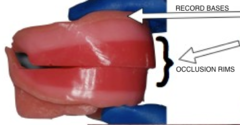
RB Function
provides a stable foundation to support the occlusal rim and helps register accurate jaw relations without rocking or shifting
interim denture base that supports the occlusal rim
RB are used to facilitate ___ records
maxillomandibular relation
MMR
the spatial position and orientation of the upper jaw (maxilla) relative to the lower jaw (mandible)
What is RB made of?
a rigid, relatively thin layer of wax, shellac or thermoplastic polmyer (Triad)

Occlusal Rims
wax placed on baseplate to measure height & width of missing teeth
occluding surface or block—typically constructed from baseplate wax—built on top of the record base
OR Function
simulates the space of missing teeth and tissues to record vertical dimension, jaw orientation, lip support, and the plane of occlusion
joins RB in facilitating MMR record, as well as shows how teeth of the denture should be arranged
Breakdown the OR functions in more detail:
• Used to relate casts on an articulator
• Wax occlusion rims simulate the position of the teeth
• Determination of midline of the arch
• Determination of smiling (high) lip line and speaking (low) lip line
• Determination of canine eminences
• Provide proper support of the lips and cheeks when appropriately contoured
• Aid in orientation of the
occlusal plane
• Serve as a means of transfer of the facebow record
• Used in determining vertical and horizontal jaw relationships: VDO, VDR, freeway space, CR
By convention, OR are slightly ___ than the dentition to be replaced
bulkier
Why bulkier?
provides additional stability during the bite records procedure
OR is basically ___
wax that is placed on top of RB
So, essentially, our master cast is just a mold of the patient's mouth that determines the shape/fit of the overall denture, while the BP and OR will show how we fill that denture in with teeth, as well as how that denture will occlude/move/fit in mouth?
yes
the master cast is a guide, but of course it is not at all a part of the ultimate denture... it is the segue between mouth and denture product
mouth —> custom impression —> master cast —> RB & OR .... —> eventually —> final denture to give to patient.. we will learn more about what comes next, next :)
Explain RB and OR very simply:
🪙 The Record Base (The Foundation)
What it is: A hard, rigid plastic pattern that is custom-molded to fit perfectly over your bare gums.
What it does: It acts like a temporary, tight-fitting foundation. It mimics the base of the future denture so the dentist can test how well it sits on your gums.
🕯️ The Occlusal Rim (The Wax Wall)
What it is: A block of dental wax shaped like a horseshoe that is built on top of the record base.
What it does: It takes the place of your missing teeth during the planning phase. Because wax is easy to melt and shape, the dentist can trim it down or add to it.
🤝 How They Work Together
The dentist places the combined wax-and-plastic piece into your mouth to record vital measurements:
Bite height: Finding how far apart your upper and lower jaws should sit.
Jaw alignment: Seeing how your upper and lower jaws come together.
Tooth placement: Marking where your centerline is and where your new teeth should eventually be placed in the wax.
What instruments do we need
• Separating medium (Vaseline)
• Baseplate wax
• Sticky Wax
• Wax spatula
• Hanau torch
• Red handled knife / Buffalo knife
• Acrylic burs
• mm Ruler
• Bunsen burner
• Triad resin
• Rim former / Putty knife / Hot
plate
Let's talk about making an RB: Step 1
block out master cast
Areas that may require blockout:
undercuts
frenum attachments
rugae
irregular soft/hard tissue surfaces
redundant soft tissue areas
However, you don't want to block out "too much" ... why?
because then RB won't stay in the mouth
Wax should be ___
thin enough to see through
RB: Step 2
lubricate casts
thin layer
RB: Step 3
adapt Triad to master cast
When adapting the Triad material, the Triad overlying the palate of the maxilla should be consistently ___ thick
1-2 mm
Why?
to facilitate speech
An XS thick RB may precipitate ___... you don't want this
gagging
XS thickness may also lead to RB impinging upon the tongue space, thus preventing the patient from articulating speech sounds in a normal fashion
Last but not least, ___ and ___ records made from overly thick RB may be inaccurate
VDO
CR
RB: Step 4
cure Triad RB in machine
RB: Step 5
trim borders of RB
— mark XS with pencil and trim this XS with flash
The XS that extends onto the ___ of the cast should be trimmed preferentially
land area
The only portion of the RB that is highly polished is the ___
periphery
— there is no need to use pumice to polish the RB (doing too much)
After you complete making the RB, it is optional to ___ in the RB — before you cure it
make dots
What for?
to gain more retention for upcoming wax placement of the OR
Characteristics of a proper, complete RB:
• Strength and rigidity
• Accuracy (closely approximates the contours of the final cast it was fabricated from) → Stability and Retention
• Smooth, rounded, well polished borders
• Thickness of borders and palate must resemble those of
the finished dentures
• Palate must be 1-2mm thick
• Thickness and contour of the denture borders are defined by the land area of the master cast
___ RBs are required for establishing MMR and verifying phonetics
Retentive
If RB is loose, the denture will be inaccurate. Accoridngly, you need to check the flanges for ___
overextension
After adjustment, if the record base is only slightly loose,
use ___ to help retain the record base
denture adhesive
What if the denture still has pronounced looseness?
you need to remake it
Let's pivot... what are the ideal dimensions for a maxillary OR?
22 mm base height
3-5 mm width at front
6 mm width moving towards back
8 mm at back
How about for a mandibular OR?
18 mm height
3-5 mm wide up front
6 mm wide moving towards back
8 mm wide at back
Why 18 mm for mandible?
1/2 to 2/3 up to the retromolar pad
Now, just like we did for the RB, let's detail the steps used to create OR... Step 1:
apply baseplate wax to RB
— over alveolar ridge areas
OR: Step 2
heat a sheet of baseplate wax over a Bunsen Burner until it is pliable, then roll or fold it into a long tube
OR: Step 3
starting from one end (tuberosity), press this roll of wax along the crest of the ridge
OR: Step 4
seal the wax to the RB with a hot wax spatula
Just to clarify, what is this wax?
the OR!! this is what composes it
OR: Step 5
adjust vertical dimensions of wax
OR: Step 6
contour — buccals and labials —the baseplate wax of the OR
fill in voids with additional wax
OR: Step 7
establish anterior overjet/inclination
The anterior extension of the wax rim should measure ___ from the incisive papilla
7-9 mm
This measurement can be performed with a ___ or ___ gauge
Boley
Alma
You want the anterior extension to be slightly ___, as well
proclined
— angled/tipped forward
The inclination of the wax rim is determined by the ___
ridge relationship
classes I - III
OR: Step 8
adjust horizontal dimensions of the wax rim
Give the ideal thickness per region:
• Anterior region: 3-5mm
• Premolar region: 6mm
• Molar region: 8mm
Lingual contours must not impinge on the ___
tongue spce
Before you begin making BP and OR, make sure to ___ on the master cast
mark landmarks
using red-blue pencil
Completed mandibular OR should have highest height at the ___ region
posterior