Agronomy Unit 1
 Call Kai
 Learn
 Practice Test
 Spaced Repetition
 Match
 Flashcards
 Knowt Play
1/191

There's no tags or description
Looks like no tags are added yet.
192 Terms
What is agronomy?
the branch of agriculture that deals with the study of plants, soils and the environment.
What does agros mean?
Field
What does nomos mean?
To manage
What does agronomy require knowledge of?
Soil science, chemistry, botany, genetics, cell biology, plant physiology, entomology, plant pathology, meteorology, Ag Econ, computer sciences, and plant taxonomy
What are some agronomy-related jobs?
Farming, crop consulting, seed, chemical, and fertilizer industries, gov jobs (USDA, NRCS, BLM, etc.), natural resource management, agribusiness (grain elevators, banks, etc.), animal waste management (feedlots/hog production facilities), corporate farm management, education, and research
What are the characteristics of hunting and gathering?
Nomadic, foraging lifestyle, wild game, leaves, roots, seeds, berries, fruit, and earth could only support ~100 million people
What are the characteristics of settlers?
Farming and ranching style of ag, modifies the environment to suit human needs, started ~10,000 years ago, domestication and cultivation of plants (wheat, barley, etc.) and husbandry of animals
What is domestication?
the adapting or taming of wild species to be used by humans
How many many plants are in the world?
Approximately 350,000 species of plants
How many plants are in OK?
~2,600 species
How many plants have been domesticated?
Fewer than 300 plant species
How many species are significant crop plants
About 15
What are the top 5 crop plants worldwide in order?
Wheat, corn, rice, soybean, and barley
What is the center of origin?
a place where a species originated from
What is the center of origin for wheat and barley?
Near/Middle East
What is the center of origin for maize (corn)?
Mesoamerica/Central America
What is the center of origin of soybeans?
China
What is the center of origin of oriental rice?
Southeast Asia
Where is the center of production for wheat?
US Great Plains
Where does potatoes originate from?
Peru
Where is the center of production for potatoes?
Eastern Europe
Where is the center of production for corn?
US Midwest
What does biological diversity mean?
Variation in forms, types, and wild relatives
How does the ‘Center Of Origin’ of crop plants relate to modern ag?
The “center of production” is often far from the “center of origin” and the place where the species originated provides the greatest biological diversity
In 1830, about (blank) hours of labor produced 100 bushels of wheat on 5 acres
275
In 1890, about (blank) hours of labor produced 100 bushels of wheat on 5 acres
45
In 1930, (blank) hours of labor produced 100 bushels of wheat on 5 acres
15
In 2000, (blank) hours of labor produced 100 bushels of wheat on 3 acres
2
What percent of the US work force that are farmers?
~1%
What was the Green Revolution?
Agricultural technologies were introduced into developing countries in the 1960-70’s
What were the characteristics of the Green Revolution?
New and improved varieties of plants- semi-dwarf, fertilizer responsive varieties (primarily wheat and rice), mechanization, fertilizers, pesticides, irrigation, and educational and technological assistance
Who was Norman Borlaug?
Father of the “Green Revolution” and won the Nobel Peace Prize, the Presidential Medal of Freedom, and the Congressional Gold Medal
What did Norman Borlaug do?
Developed semi-dwarf, high-yielding, disease-resistant wheat varieties at a research facility in Mexico and introduced these varieties and modern agricultural production techniques into Mexico, Pakistan, and India
What happened due to Borlaug’s actions?
As a result, Mexico became a net exporter of wheat in 1963 and wheat yields nearly doubled in Pakistan and India between 1965 and 1970
What is Borlaug credited for?
Saving a billion people from starvation
What is a farm?
A plot of land devoted to agriculture and to the raising of crops and domesticated animals
What does the USDA define as a farm?
A place from which $1,000 or more of agricultural products are sold annually
How many farms does the US have?
2.1 million
What is the average farm size in the US?
418 acres
Why is an acre used as a form of measurement?
An acre was the amount of land a man and a team of oxen could till in one day
What is percent of total farms make <$10,000?
55.7%
What is the average size of farms that make <$10,000?
97 acres
What is percent of total farms make >$500,000?
5.7%
What is the average size of farms that make >$500,000?
2,416 acres
As number of farms declined, (blank)
their average size increased
What percent of farmers have income from other sources?
Over 93%
Where do most farmers get extra income from?
Federally-funded farm programs (commodity payments, disaster payments, and conversation payments)
What are commodity payments?
Insurance after a bad year for crops
What were the USDA paying out to farmers?
Commodity ($5.2 billion), Conservation ($2.7 billion), and Disaster ($2.1 billion)

What was the USDA budget?

What is the top subsidies in the US?
Corn, cotton, wheat, Conservation Reserve Program, and soybean

What is CRP?
Conservation Reserve Program
What does CRP do?
The govt pays farmers to not plant on acres of land because it would destroy it or it needs to recover
Where is the CRP in place?

What does arable land mean?
From Latin arare, to plough, land that can be used for growing crops
What is the world rank by total acreage of crops in order?
Wheat, corn (maize), rice, soybean, and barley
What is the US rank by total acreage of crops in order?
Corn (maize), soybean, hay, wheat, and cotton
Where does corn grow?
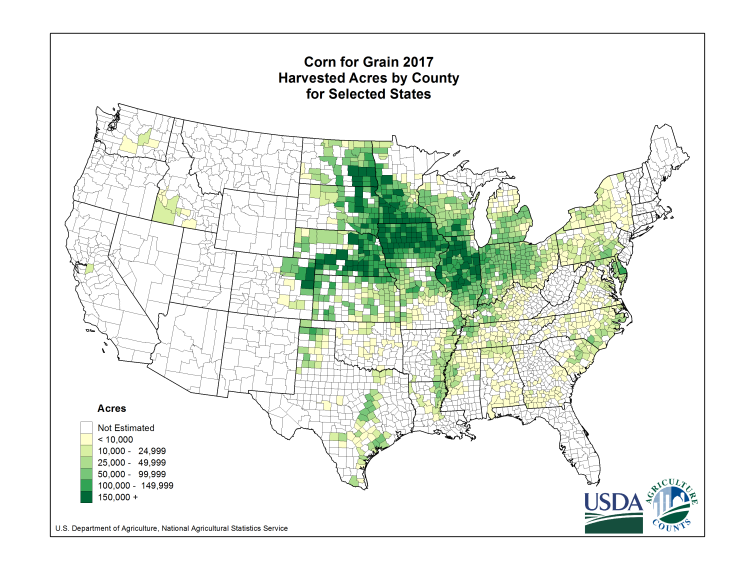
Where does soybeans grow?

Where is hay grown?
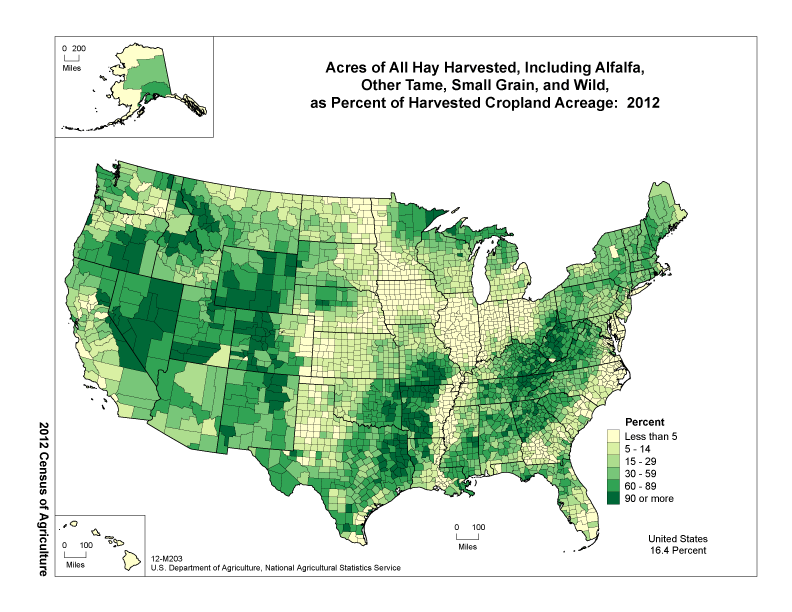
Where is wheat grown?

Where is cotton grown?
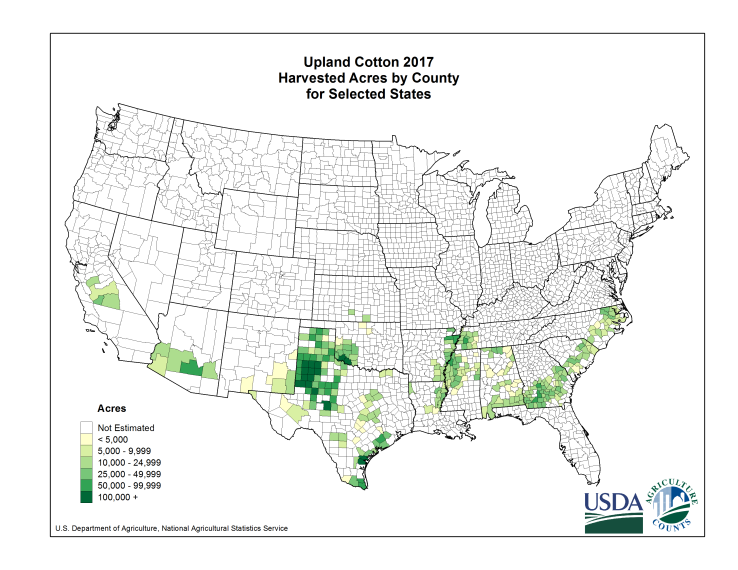
What are the top nine cash receipts for ag production?
CA, FL, IL, IA, KS, MN, NC, NE, and TX
Why is soybean the most exported crop?
It’s used for feed in China
What are the top 3 ag export countries?
China, Canada, and Mexico
What are some of the state and fed agencies that support ag?
Land grant unis (teaching, research, extension) [OSU, A&M, KS State, etc.], USDA, and Bureau of Land Management (BLM)
What states have land managed by BLM?
NM, CO, WY, MT, WA, OR, NV, ID, CA, UT, and AZ
Do more or less developed countries have more pop?
Less
What is the root cause of high pop growth rates?
Poverty
Who came up with the Malthusian Theory?
Thomas Malthus
What is the Malthusian Theory?
There will be a problem with being enough food for the world’s growing population in a world of limited land area, population will ultimately be controlled by food production, and rate of increase of human population is geometric, while rate of increase of food is linear
What has the Green Revolution helped with?
Better varieties, modern equipment, fertilizer, pesticides, and irrigation
What are some other limitations to food production?
Social and political issues and environmental limitations
What are the social and political issues limiting?
Poverty, wars, government abuse, food distribution
What are the soil limits?
Most of the arable soils best suited for crop production already in use, soil erosion reduces productivity, and salinization of irrigated lands
What are the water limits?
Agriculture is largest user of water (70%) and rate of use exceeds rate of recharge for Ogallala aquifer
What is the Ogallala aquifer?
The major groundwater resource for the High Plains

What is the Ogallala’s water bearing strata’s thickness?
1-1,300 ft depending on location; the average depth is 200 ft, and average depth in OK Panhandle is 10 ft to >300 ft
How many edible species of crops are there?
50,000
What are some examples of edible crops?
Pearl millet, teff, quinoa, amaranth, and oca tubers
What is biotechnology do?
Insert genes from related and unrelated organisms into crop plants using molecular biology techniques
What are some examples of biotechnology being used?
Bt corn, Roundup Ready, Liberty Link, genetically modified organisms (GMO’s), transgenic crops, and genetic engineering
What is the public’s perception of biotechnology?
Negative
What are the categories of agronomic crops?
Cereals-small grains, pulses, forages, fiber crops, root and tuber crops, cover crops, companion crops, green manure crops, and recreational turf crops
What are cereal crops?
Grasses grown for their edible seed that have high starch content (energy) that is required to be classified as cereal crops
What are some examples of cereal crops?
Wheat, corn, rice, oat, sorghum, barley, rye, and grain millets (pearl, foxtail, proso)
What are small grains?
A subclassification of cereal crops that are relatively short plants with small seeds
What are examples of small grains?
wheat, barley, rye, oat
What are pulse crops?
legumes grown for their edible seed
What are some characteristics of pulse crops?
plant species of the ‘Legume’ family and high in protein
What are some examples of pulse crops?
soybean, beans, peas, lentils, peanuts, chickpea, cowpeas
Legumes- (blank) develops into a (blank) containing (blank)
Flower, fruit/pod, seed
What is a fruit?
a mature ovary containing seed or seeds
What are forage crops?
plants grown as feed for livestock
What are some examples of forage crops?
Primarily grasses and legumes; fresh or preserved
What kind of animal can digest grass? Can pigs/humans digest grass?
Ruminant animals, animals with four part stomachs, can. No
What are the 10 types of forages?
Pasture, range, hay, silage, haylage, soilage, fodder, stover, straw, and feed concentrates
What is “pasture” forage?
introduced plant species such as bermudagrass, Old World bluestem, tall fescue, etc.
What are the characteristics of pasture forage?
Intensively managed (seeding, fertilizer, herbicides, irrigation)and adjust forage to the livestock
What is “range” forage?
native plants such as shortgrass prairie (buffalograss, blue grama) and tall grass prairie (big bluestem, little bluestem, switchgrass, and indiangrass)