Topic 1.2 - Bacteria
 Call Kai
 Learn
 Practice Test
 Spaced Repetition
 Match
 Flashcards
 Knowt Play
1/42

There's no tags or description
Looks like no tags are added yet.
43 Terms
What are the most disease-causing microorganisms in hospital?
Bacteria
What are the groups of bacteria? How do we split them?
Groups based on their shape - this shape is maintained by the rigid cell wall
Cocci or coccus (singulur)
spherical or round cells
rods or bacilli (bacillus)
rectangular shaped boxes
spirilla (spirillum)
curved or spiral shaped rods

What is gram stain? What’s in it?
A stain used to stain bacteria and make them more visible when viewed under the microscope
Gram staining uses dyes, Crystal Violet, Iodine and Safranine to differentiate bacteria from one another and from the background.
How is gram stain used for bacteria?
When bacteria is stained, there are two groups visible
ne group of bacteria appear dark bluish-black in color and are called gram positive
other bacteria are a pink to red color and are called gram negative.
What is the importance of gram reaction? (3)
Looking at the gram reaction and shape of bacteria is often the first step in identifying them in the laboratory.
The gram reaction determines the effectiveness of certain antibiotics.
Gram stain results assist the physician in initial selection of an appropriate antibiotic.
The gram reaction determines the effectiveness of certain disinfectants as well. Some disinfectants are more effective against gram positive than gram negative bacteria.
With the gram reaction and shape of cells, how many groups is the bacteria split into?
six groups
gram positive cocci
gram negative cocci
gram positive rods ( bacilli)
gram negative rods (bacilli)
gram positive spirilla
gram negative spirilla
What is Penicillin G effective against?
Penicillin G, for example, is quite effective in killing gram positive bacteria but is relatively ineffective against gram negative bacteria
What are endospores?
A special type of spore produced within the bacterial cell by some gram positive rods (bacteria)
Why is it called endospores?
to differentiate them from fungal spores borne on the ends of hyphae.
What are vegetative cells?
Bacterial cells that do not contain endospores
even Gram positive rods that are able to form spores exist as vegetative cells when they are actively growing and multiplying.
What is sporulation?
Process of creating spores which takes place when certain nutrients are depleted
What is the process of sporulation like?
One copy of the genetic material and a tiny amount of cytoplasm is enclosed by a layer of insulating material and the whole structure is covered with several compact layers of spore coat.

What type of cell is active vs dormant?
Vegetative cell vs endospores
How long do endospores remain dormant for? Examples?
Endospores may remain dormant for days, months and even years without nutrients or moisture.
Many of the bacteria found in dust, cereals, grains and soil exist as endospores.
When will endospore turn into a vegetative cell?
A “viable” endospore is able to germinate (grow) into a vegetative cell when moisture and nutrients are provided. One spore will germinate into one vegetative bacterium.

What are examples of spore forming organisms?
gangrene
tetanus
anthrax
These are found everywhere in the soil and normally don’t cause infections until special conditions are met
How does gangrene and tetanus result?
Gangrene and tetanus result when spores are introduced deep into injured tissue where blood flow has been disrupted and oxygen levels are low.
How does anthrax result?
nthrax will grow in the presence of oxygen, but requires other pre-disposing conditions such as damaged tissue or inhalation in to the lungs.
What is the significance of endospores in sterilization and disinfection? (4)
what is it resistant to
Endospores are quite resistant to heat. Most vegetative bacteria are killed by exposure to moist heat at 60-80°C for 10 minutes, but spores will survive these high temperatures. Some spores are killed by boiling, but others require a temperature of 121°C for 12-15 minutes for destruction.
Endospores are more resistant to disinfectants than vegetative bacteria. Low level disinfectants may not kill endospores and high-level disinfectants require extended exposure times.
Endospores are also very resistant to destruction by cold (viable spores have been discovered in the intestines of mammoths found in Siberian glaciers).
Endospores are also resistant to ultraviolet light, acids, alkalis and detergents.
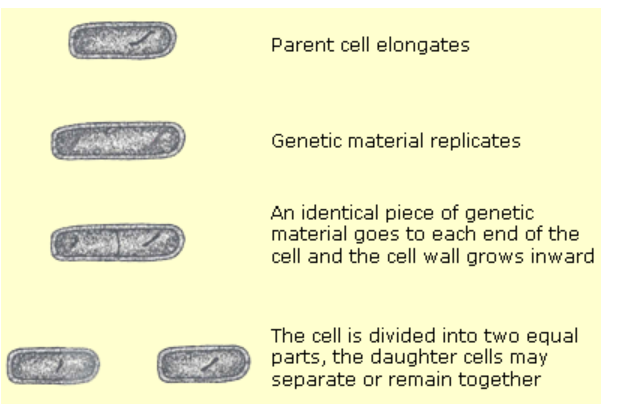
What is binary fission?
This is how almost all bacteria reproduce
elongation, genetic material replications (one on each end now), cell grows inward, cell into two parts
What is the generation time?
time it takes for binary fission to occur.
This is the time it takes for the population to double.
Is generation time the same for all bacteria? What affects it?
Generation time is not the same for all bacteria and is also affected by temperature and available nutrients.
What is the generation time for rapidly growing bacteria under ideal conditions?
15-30 minutes
What is the generation time related to?
Related to the rate at which bacteria causes disease
What is generation time of bacteria that caused gas gangrene? tuberculosis?
Gas gangrene: 8 minutes
Tuberculosis: 12-24 hours and takes weeks to produce disease
What does the generation time determine?
determines the amount of time required for bacteria to form visible growth on culture media.
What is a colony?
is a visible mass of bacteria that develops on the surface of a solid culture medium after a period of time and represents all the descendants of a single bacterial cell
the culture medium provides the necessary nutrients for bacterial growth
How fast do rapidaly growing bacteria form colonies?
18-24 hours
What would an isolated colony show as?
As one round body sitting by itself rather than clustering with others
Do bacteria keep growing forever?
No - don’t grow at their max generation time forever
reproduction is limited due to lack to nutrients, space, and build up of toxic waste materials
max is ~ 1 × 10^9 per ml or gram
What is the bacterial growth curve?
A curve that shows the different phases a bacteria goes through when introduced into a new medium or environment
What are the four phases?
lag phase
log phase
stationary phase
death phase or phase of decline

What is lag phase?
When bacterial cells are placed in a new environment, there is little or no increase in numbers for a short period of time.
This time is necessary for the cells to adapt to the new environment.
The lag phase is usually a few hours but may be much shorter or much longer in some situations.
What is lag period for food?
two hours and then bacteria can start growing
What is log phase?
This is a period of maximum growth of bacteria. All the cells are dividing at a constant rate.
What is stationary phase? What is constant here?
The bacteria eventually exhaust their supply of nutrients and stop growing and multiplying.
Even if nutrients are not used up, the end products of bacterial growth may accumulate and prevent further growth.
The number of live bacteria stays constant during this period
What is death phase?
Eventually the bacterial cells start to die and the number of live cells decreases.
In some cases, most of the bacteria die in a short period of time but in other cases, some live bacteria can linger for weeks, months or even years.
What bacteria can survive the longest?
Spores
How is the growth curve related to infection?
Growth curves are plotted using laboratory cultures but the same sequence of events often takes place when a microorganism invades a host:
What is the lag period in infection? name for it?
There are usually no disease symptoms for a period of time immediately following introduction of the microorganism into the host. This represents the incubation period of the disease, also called the lag phase of the growth curve.
What is the log phase of infection? What happens in here?
Onset of symptoms: fever, sore throat, swollen lymph glands, rash, vomiting or diarrhea, etc.
Acute stage of disease
with the assistance of the patients defenses and medical intervention, most patients recover in this phase. However, if these fail, the patient dies during this acute stage.
What is stationary phase of infection?
period of time during which the symptoms are no worse but there is also no sign of recovery.
What is the death phase of infection? Name?
Symptoms subside and recovery happens
death phase of microorganism not the host
The convalescent period of the disease covers the time needed for complete recovery.
varies and infectious microorganisms are discharged during this period
