IVC I (Cattle domestication? Mind-blowing)
 Call Kai
 Learn
 Practice Test
 Spaced Repetition
 Match
 Flashcards
 Knowt Play
1/33

There's no tags or description
Looks like no tags are added yet.
34 Terms
IVC time period
2600-1900 BCE
Bronze Age
Contemporary with ED Period in Mesopotamia (lots of trade)
IVC fun facts
5 urban centers found
No evidence that any one site is most important
Extends well beyond the Indus Valley
Study of the IVC
Early 20th century
But recorded by a spy (why is there always a spy involved) in the early 19th century
Harappa studied by Alexander Cunningham after the upper layers of burn brick were used as ballast for a rail line
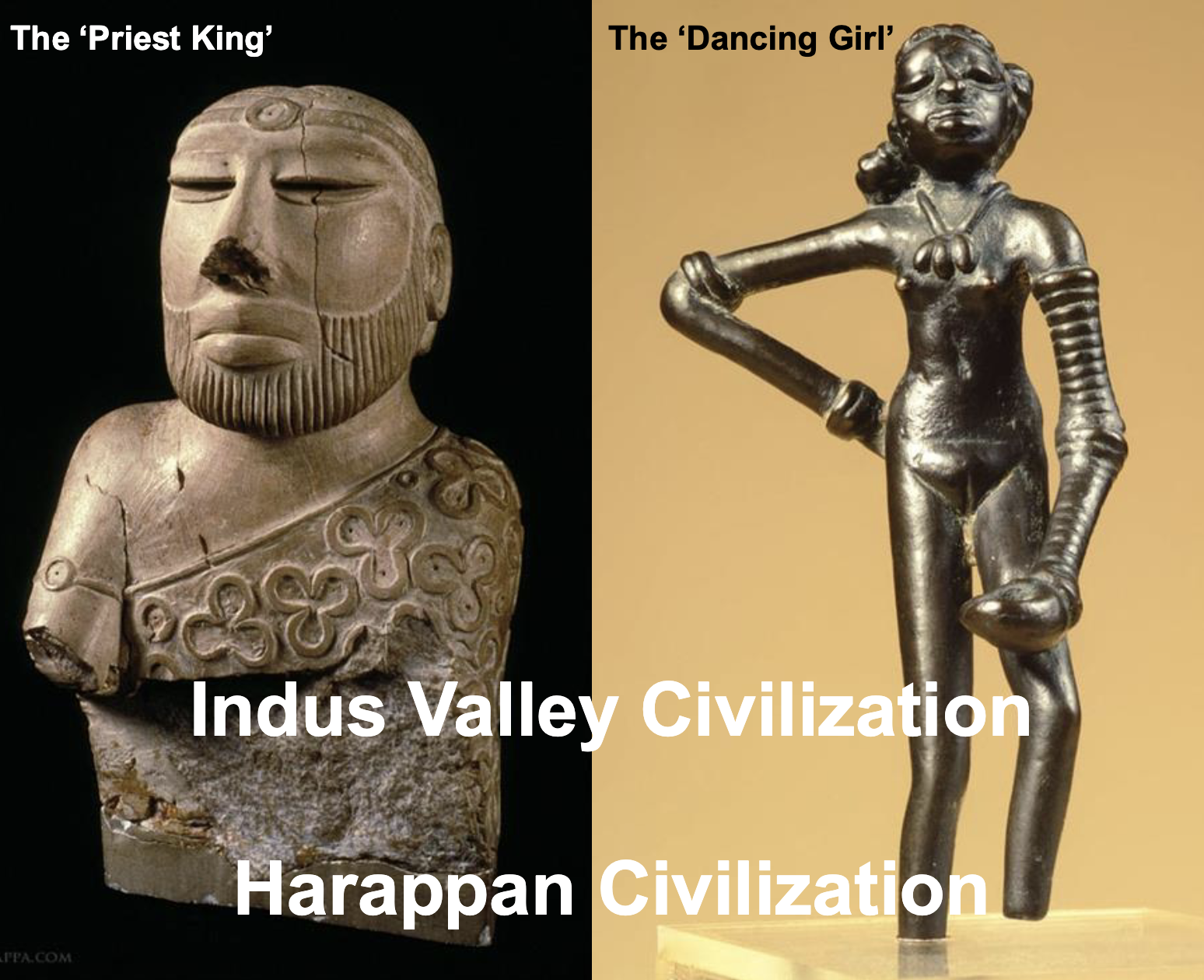
Two non terra-cotta human representations
“Priest King” and “Dancing Girl”
Names are conjecture, not substantiated
Geographic context of the IVC
Centered on the alluvial plain of the Indus River and its tributaries
Headwaters in the highlands
And we have also the Ghaggar-Hakra/ Sarasvati River
Had a seasonal flow that was redirected at some point during the urban period
Spread into Gujarat and Punjab
Prior to Partition, all sites were on the Pakistan side of the border, but afterwards, Indian archaeologists have found more in India
Very culturally significant to India as a nation
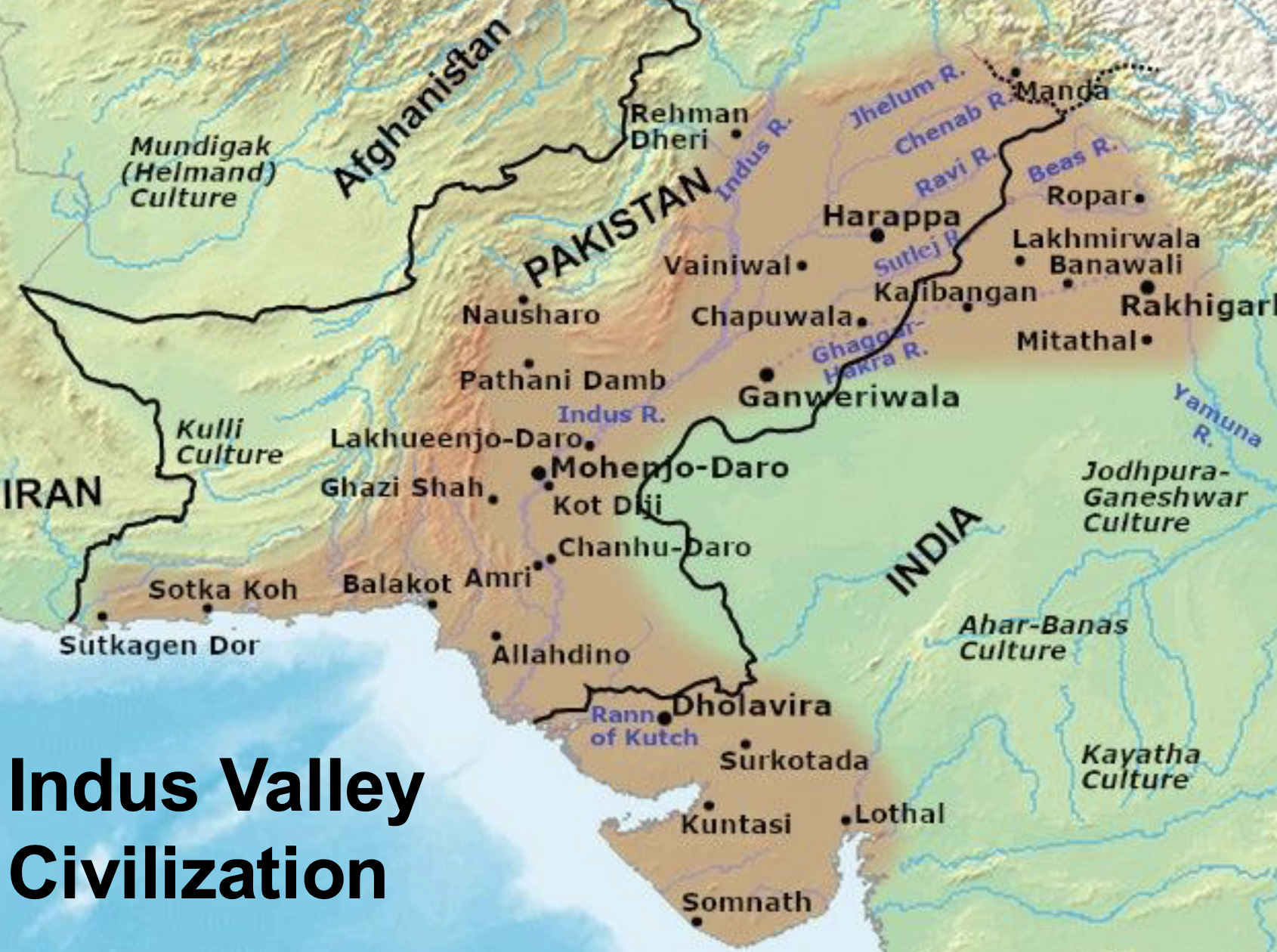
Harappa location
On the Ravi River (tributary of the Indus)
Mohenjo-Daro location
On the Indus
IVC precipitation and climate
2 climate systems:
Winter rain from the Mediterranean to the Indus (Rabi)
Watered crops in Mesopotamia
Flooding and alluvial sediments
Summer monsoon
Wind pattern from the Indian Ocean
Deposits rain near the Himalayas
IVC is at the periphery of this, not very affected
IVC Chronology
Some disagreements on timeline
Focus on the Integration Era
Urban period 2600-1900 BCE
Integration Era
Tremendous similarity across the area
Mature Harappan Subsistence Economy
Agriculture:
Two seasons with different crops (Rabi and Kharif)
Double cropping intensifies subsistence production
Pastoralism
Cattle (Zebu/ Bos indicus) most important
Water buffalo (Gujarat)
Sheep and goats
Marine foods and other wild foods are also important
Lots of crops come from West Asia (i.e. wheat)
Rabi crops
Cereals
Barley (a local domesticate) and wheat (from further west)
Pulses
Peas
Chickpeas
Flax
Produced linen
Kharif crops
Spring sown, late summer harvest
Domesticated later, probably in the eastern (more monsoon) zone
Millets
Mustard seed
Sesame
Dates
Cotton
Hemp
Rice (later)
Zebu cattle
Origins in the Indo-Iranian highlands (much earlier)
Used for meat, secondary products, traction (plows)
Sheep and goats in IVC
Goats may have been locally domesticated
Sheep introduced from West Asia
Products:
Wool and meat
Regional variation
Mehgahr
Important site *Not a city*
Occupied 7000-3200 BCE
Excavated in the ‘70s and ‘80s
Central to the early phase (pre-pre-urban) where domestication began
Mehrgahr domestication stuff
Evidence of durum wheat, gradually seeing domesticated barley
Increased reliance on domesticated species
By 4800 BCE, wild species were ~55% of resources
The process was slow-moving
Not a revolution (FUCK YOU, VERE)
Mehrgahr architecture
Mud-brick houses
Enter from the roof
4 equal rooms
Similar to West Asia
Some public structures
Grain storage?
Mehrgahr society
Developing social differences in burials by ~4300 BCE
Women had more materials - matrilocal society?
Mehrgahr economy (not econ bros because matrilocal)
Early evidence for long-distance trade
Seashells, lapis lazuli beads by at least 6000 BCE
By 4000 BCE - skilled pottery, crafts, later specialization
Later, copper, faience beads
Early settlement patterns
Not as many systematic surveys
Expansion in the western highlands
4000-3200 BCE
By 3800 BCE, further settlement in the uplands east of the Indus
Similar ceramics to other
Likely pastoral camps at first
Not much in the Indus Valley at this time
But the alluvial settlements may cover up evidence
Era of regionalization/ Early Harappan
3200 BCE - 2600 BCE
Settlements in the Indus Valley
Hallmarks of later things going on
Pre-urban precursors
4-5 important regional site and practice configurations
Patterns of similarity in the Early Harappan
3x increase in settlement towns
Expansion of agriculture
Millets (kharif crop) at Harappa
Early double-cropping
Surplus agriculture
Craft continuity from earlier
Ceramic and copper
Increased segregation of craft from residential areas in town center
Specialized producers (Childe ☹ )
Also some tool production centres
Weights and measures later
Increase in trade (metal ores)
Not a lot of ores in the Indus Valley, came from the highlands
Earliest use of seals in evidence
Evidence for some standardized weights
Some town centre standardization across regional phases
I.e. Kalibangan
Public architecture at at least 7 sites
Enclosure walls, NSEW orientation, neighbourhoods, craft specialization
Emergence of civic authority?
Social distinctions into civil management?
Era of Integration/ Mature Harappan
2600-1900 BCE
Bronze Age period
IVC area
800,000 - 1,000,000 km2
IVC cultural signatures
Formally planned cities
Monumental architecture and urban public works
Regional settlement hierarchies
Artifact standardization
Writing
Undeciphered ☹
Standardized weights and measures
Very widespread
Widespread use of seals
Craft specialization
Bronze
Beads (very important)
Ceramics
Faience
Extensive trade and commerce
As far as Southern India and Mesopotamia
Including remote trade entrepots
Significant uniformity, but important regional differences in site planning
Site patterns in the Integration Era
Urban sites emerge
More rural settlements
Increasing size and hierarchy of settlements
More site types - links between urban and rural sites
Some functional differences between sites
Integration between rural and urban
Settlement hierarchy
Loved by Social Evolutionists (bad bad bad) as measures for “the state
IVC urban centres
Harappa
Upper Indus Valley
Mohenjo-Daro
Lower Indus Valley
Rakhigarhi
Ganweriwalla
Dholavira
Each ~500 km away from each other