UNIT 7.2 ERYTHROCYTE METABOLISM
 Call Kai
 Learn
 Practice Test
 Spaced Repetition
 Match
 Flashcards
 Knowt Play
1/52

There's no tags or description
Looks like no tags are added yet.
53 Terms
anaerobic glycolysis
plasma glucose
RBC relies on __ for its energy which utilizes _
Heme (iron + protoporphyrin IX)
Globin (protein)
2 components of Hgb
4
4
In every hemoglobin molecule, there are __ globin chains and _ heme
heme
The hemoglobin is able to bind the oxygen to the lungs due to the _ portion
oxidized form (ferric)
When the iron is in _, the hemoglobin molecule or that particular heme is no longer capable in binding oxygen
reduced form (ferrous)
Heme portion of the Hgb can only bind Oxygen when the iron is in its _
Intracellular cationic gradient maintenance
Maintenance of membrane phospholipid distribution
Maintenance of skeletal protein deformability
Maintenance of functional hemoglobin with ferrous iron
Protecting cell proteins from oxidative denaturation
Glycolysis initiation and maintenance
Glutathione synthesis
Nucleotide salvage reactions
ENUMERATE
RBC metabolic processes requiring energy
(Plasma) Glucose
principal source of energy of our mature RBCs
Galactose
Fructose
Mannose
ENUMERATE
Other sources of energy for RBC
permeable
RBC membrane is _ to glucose
impermeable
RBC membrane is _ to lactose, sucrose, maltose
Embden-Meyerhof pathway (EMP)
90-95% of glucose is metabolized by the _
Hexose Monophosphate Shunt (HMP)/ Pentose Phosphate Shunt (PPS)
5-10% of glucose is metabolized by the _
Iron (heme)
Sulfhydryl groups (globin)
Two sites on the Hgb molecule which are prone to oxidation
Embden-Meyerhof Pathway
Hexose Monophosphate Shunt
Methemoglobin Reductase Pathway/ Diaphorase Pathway
Rapoport-Luebering Pathway
ENUMERATE
Metabolic Pathways in Erythrocytes
Embden-Meyerhof Pathway (EMP)
major source of RBC energy
90% - 95% of Anaerobic glycolysis
main metabolic pathway in RBCs
T
T or F
EMP requires glucose for energy production
2 ATP
How many ATP molecules are produced per EMP cycle
PK (pyruvate kinase) deficiency
most common deficiency in the EMP
Hereditary Nonspherocytic Hemolytic Anemia
This is a group of inherited disorders in which RBCs are destroyed prematurely because of defects in RBC metabolism, particularly enzyme deficiencies.
T
T or F
There is hemolytic anemia if there is PK deficiency.
Directly proportional
↑ glycolysis ↑ intracellular pH (hypoxia)
Relationship between Rate of glycolysis and pH
Hexokinase
6-Phosphofructokinase
Major glycolytic enzymes in the EMP that will be increased/stimulated once there is ↑ intracellular pH (hypoxia)
Inversely proportional
↑ ATP levels ↓ Rate of Glycolysis
Relationship between the rate of glycolysis and ATP levels
HMP Shunt / PPP
detoxifies peroxide (H2O2)
role is to protect the cells from oxidative products
HMP Shunt / PPP
maintains membrane proteins & lipids, enzymes, and heme iron in its ferrous state
G6PD
In HMP Shunt, NADP is reduced to NADPH in the presence of _
Glutathione reductase
In HMP Shunt, NADPH converts oxidized glutatgione (GSSG) → reduced glutathione (GSH) in the presence of _
H2O + O2
Glutathione peroxidase
Reduced glutathione reduces peroxide to __ in the presence of _
G6PD deficiency
most common inherited RBC enzyme disease worldwide
Heinz bodies
G6PD deficiency → denatured globin chains → formation of _
G6PD
provides the ONLY means of generating NADPH for glutathione reduction
Reduced glutathione (GSH)
the principal reducing agents in the cell
Methemoglobin Reductase Pathway / Diaphorase Pathway
Main pathway the reduces your methemoglobin to hemoglobin
Methemoglobin
metheme
Once iron is in ferric state, Hgb will become __ and Heme portion will become _
methemoglobin reductase/cytochrome b5 reductase/diaphorase
In MRP, NADH transfers electrons to _
NADH = Diaphorase 1
MRP
_ is the main source for electron donation in the reduction process. It acts as a coenzyme with methemoglobin reductase.
NADPH = Diaphorase 2
plays a minor role in methemoglobin reduction
NADH Methemoglobin Reductase Pathway (major) = diaphorase 1
NAPH Methemoglobin Reductase Pathway (minor) = diaphorase 2
ENUMRATE
2 Methemoglobin Reductase Pathways in converting methemoglobin to hemoglobin & their corresponding enzyme
Methemoglobinemia
an increased amount of methemoglobin (MetHb) in the blood
T
T or F
HMP has a better long term effect by preventing formation of methemoglobin, while the MRP only has a short term effect since it only reversed the formed methemoglobin.
Rapoport-Luebering Pathway
Rapoport–Luebering Pathway
side pathway of glycolysis in RBCs that produces 2,3-BPG/DPG (2,3-bisphosphoglycerate or Diphosphoglycerate)
2,3-BPG/DPG
regulates O2 delivery to tissues by competing w/ O2 for the O2 binding site of Hgb
Directly proportional
↑ BPG = ↑ O₂ release
Relationship between BPG and O2 release
EMP diverts toward the HMP shunt
What metabolic pathway will dominate when oxidative products or reactive oxygen species (ROS) increase in the RBC?
EMP continues/increases glycolysis
What metabolic pathway will dominate when ATP levels are depleted?
Rapoport–Luebering pathway
What metabolic pathway will dominate when hemoglobin is not releasing enough oxygen to the tissues?
methemoglobin reductase pathway
What metabolic pathway will dominate when methemoglobin builds up or hemoglobin iron becomes oxidized from Fe²⁺ to Fe³⁺?
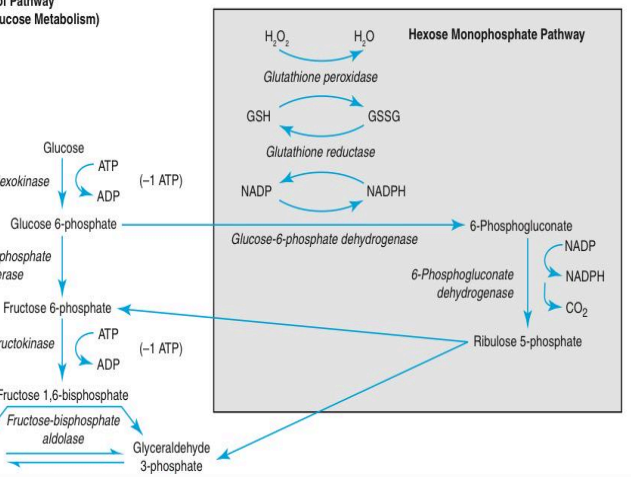
Explain the HMP Shunt / PPP
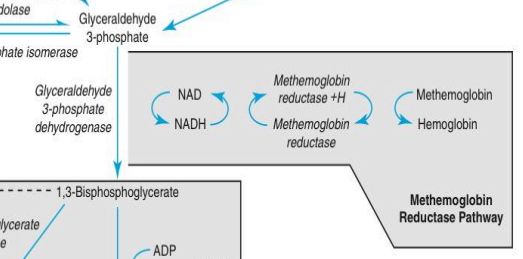
Explain the MRP

Explain the Rapoport-Luebering Pathway

Explain the EMP