Chemistry chapter 9
 Call Kai
 Learn
 Practice Test
 Spaced Repetition
 Match
 Flashcards
 Knowt Play
1/27

There's no tags or description
Looks like no tags are added yet.
28 Terms
Solutions
a homogeneous mixture of two or more substances. Has two components solvent and solute.
Solute
A substances that is present in smaller amounts and is spread evenly throughout the solution. cannot be separated by filtration but it can be separated by evaportion. (salt)
Solvent
The substances present in the greater amount (water)
Solutions with ionic solutes
If its is ionic then it breaks apart
ex:
NaCl (s) —→ Na+1(aq) + Cl-1(aq)
Like dissolves like
polar solvent dissolves ionic/polar solutes
nonpolar solvent dissolves nonpolar solutes
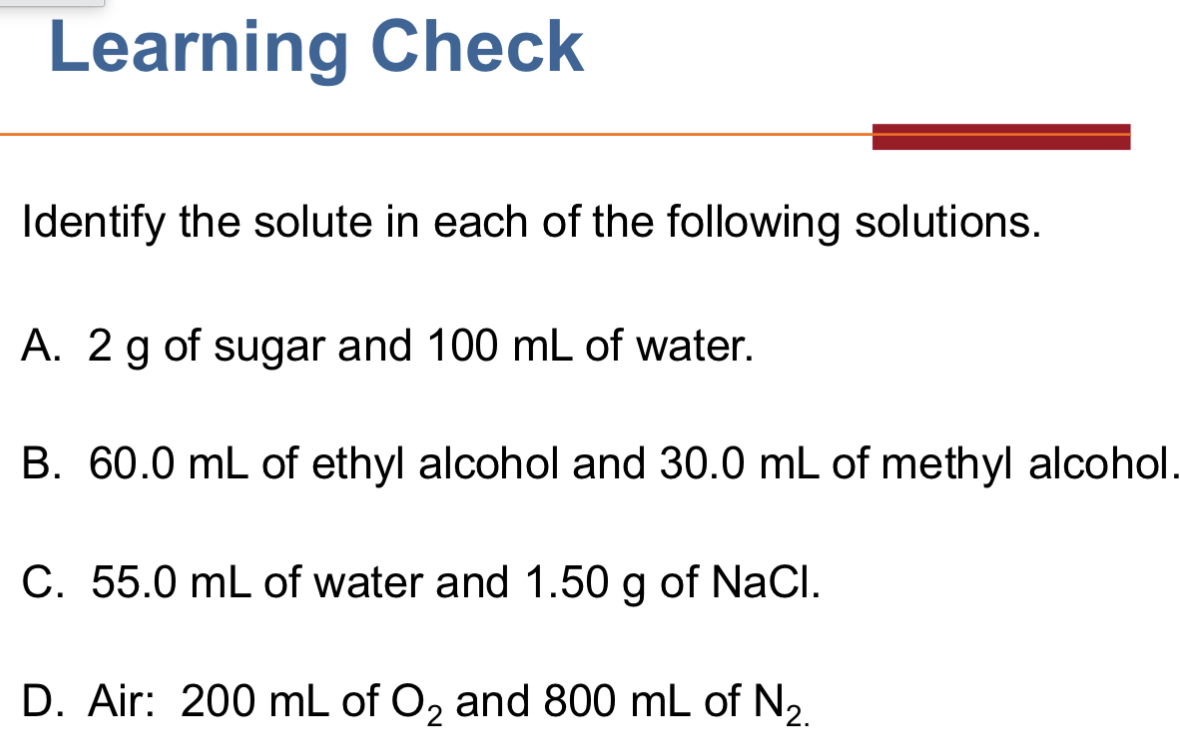
A. 2 g of sugar
B. 30 mL of methyl alcohol
C. 1.5 g of NaCl
D. 200 mL of O2
Strong electrolytes
dissociate 100% in he water producing positive and negative ion
conducts an electric current in water
in equations show the formation of ions in aqueous (aq) solutions
H2O 100% ions
NaCl (s) —→ Na+1(aq) + Cl-1(aq)

3) Ca2+(aq) + 2 Cl-1

Complete each of the following equations for strong electrolytes in water:
1)3 K+1 (aq) + PO4-3(aq)
Weak Electrolytes
dissociate only slightly in water
in water forms a solution of a few ions and mostly undissociated molecules

Nonelectrolytes
dissolve as molecules in water
do not produce ions in water
do not conduct an electric current

Solubility
the maximum amount of solute that dissolves in a specific amount of solvent (temperature sensitive for solutes, expressed as grams of solute in 100 grams of solvent)
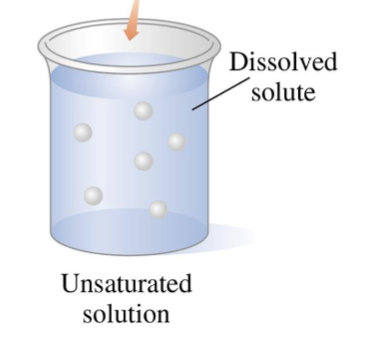
Unsaturated solutions
contains less the maximum amount of solute and can dissolve more solute
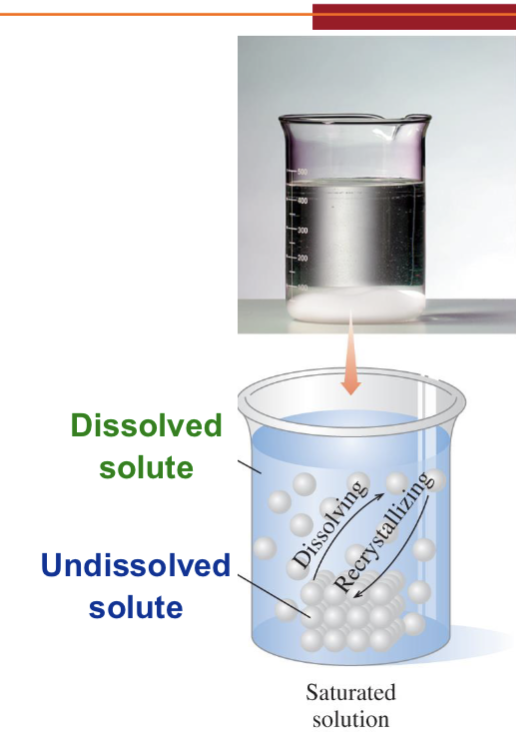
Saturated solutions
contains the maximum amount of solute that can dissolve and has undissolved solute at the bottom of the container
Effect of temperature on solubility
solubility depends on temperature
Solubility of a solid depending on temp
Solubility of a solid increases as temperature increases and decreases and temp decreases
Solubility of gasses depending on temperature
Solubility of gasses decreases as temp increases and the solubility increases as temperature decreases
Solubility and pressure
for gases as pressure increases the solubility increases too and as pressure decreases the solubility decreases too. For solids and liquids pressure has little effect.
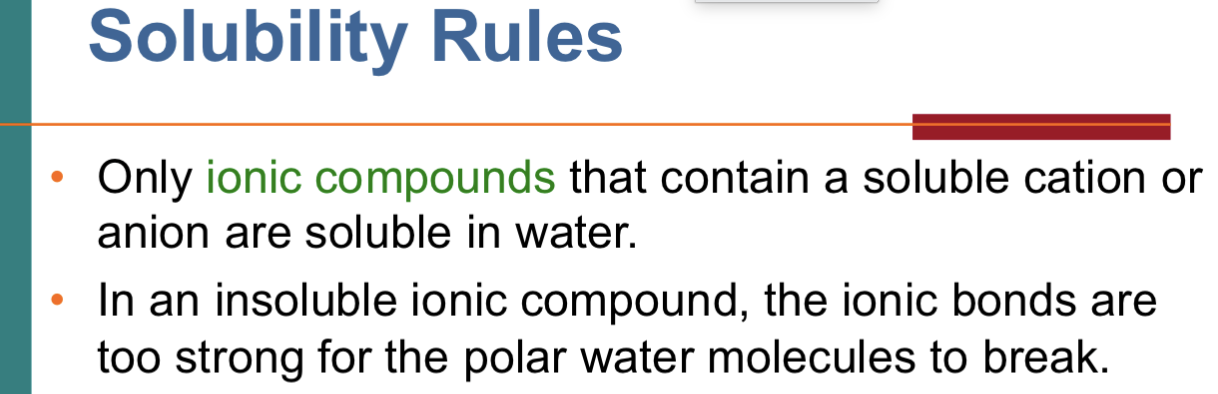
Solubility rules
Rule #1
1st element) column 1 or NH+1 - soluble
Rule #2
2nd element) NO3-1 - soluble
Rule #3
Column 17-mostly soluble except Ag, Pb, Hg
Rule #4
SO4-2 -moslty soluble except column 2, Pb, Hg
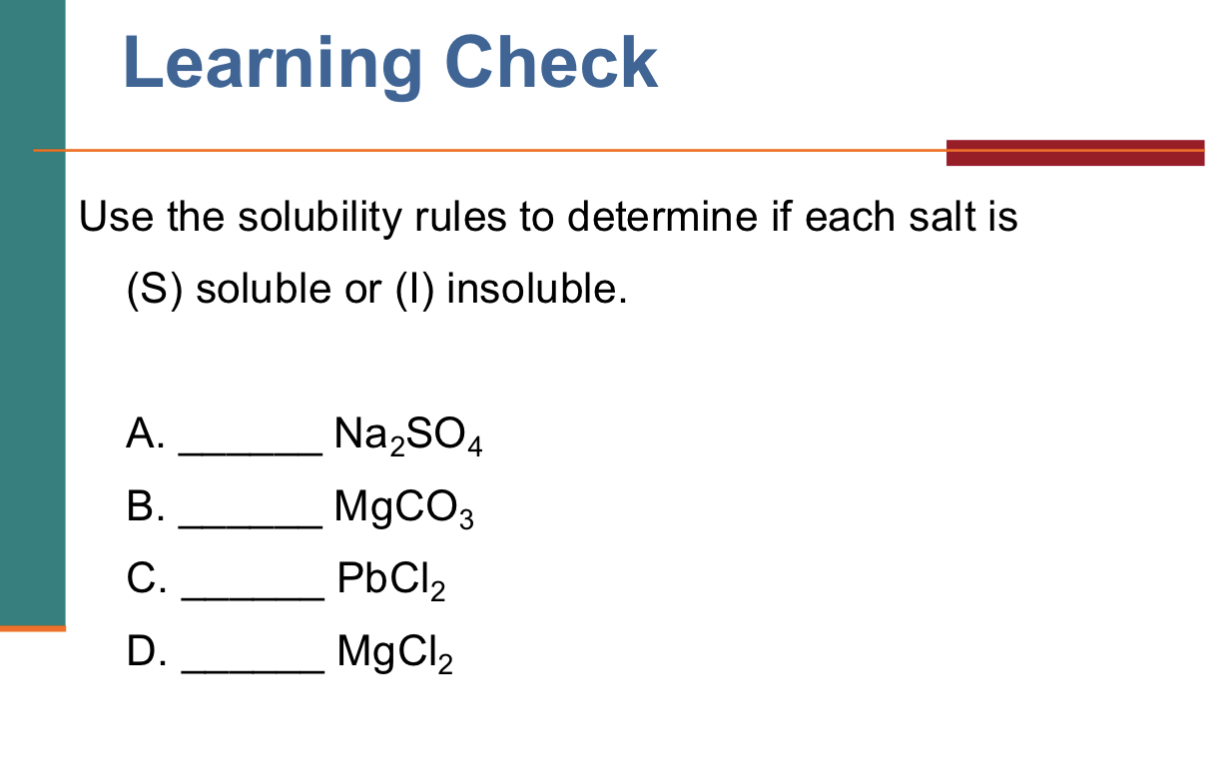
A. S Na2SO4
B. I MgCO3
C. I PbCl2
D. S MgCl2
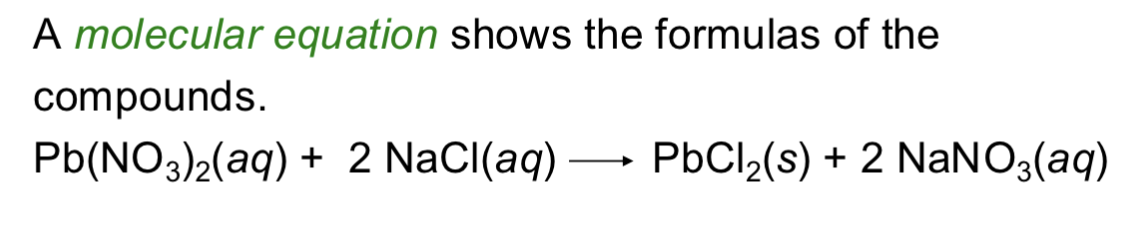
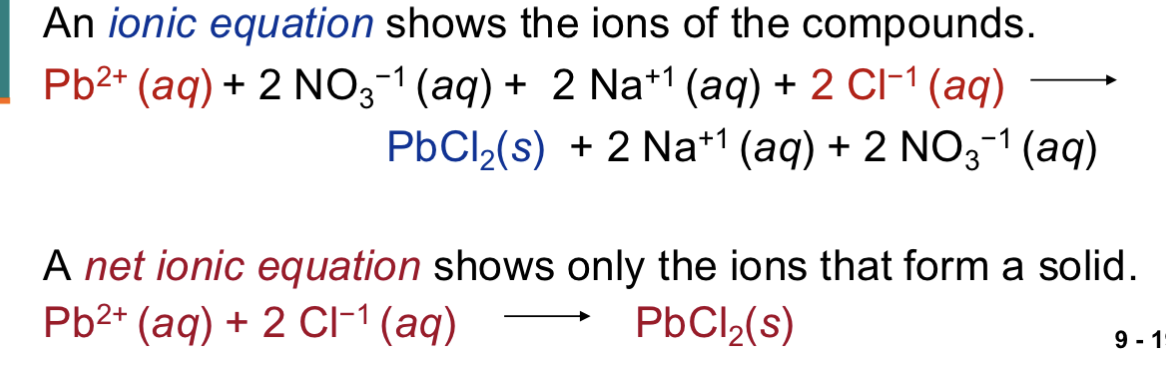
Equations for forming solids
soluble: (aq)-split
insoluble: (s)-keep together
net name of Pb+2 + 2 NO3-1 + 2 Na+1 + 2 Cl-1 —→ PbCl2 + 2 Na+1 + 2 NO3-1
Pb+2 + 2 Cl-1 —→ PbCl2 +
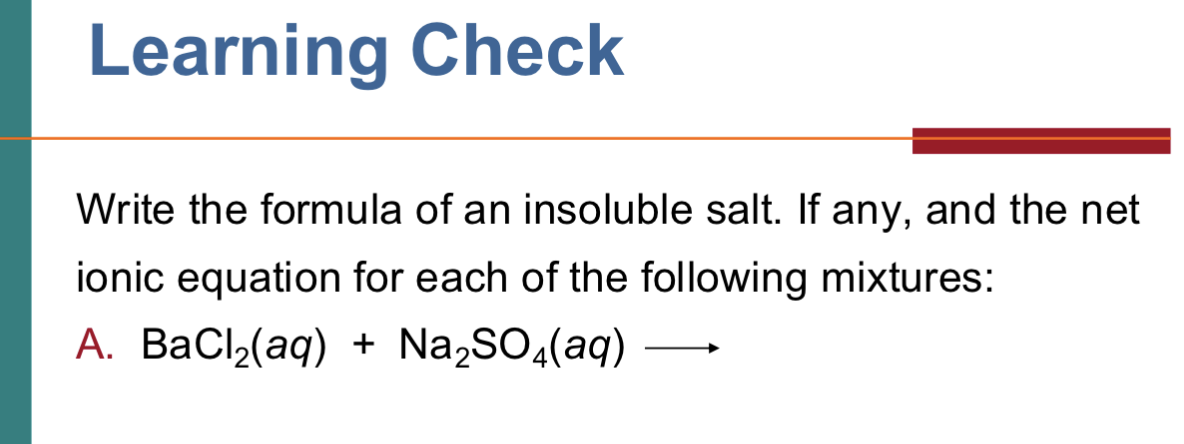
BaCl2(aq) + Na2SO4(aq) —→ BaSO4(s) + 2 NaCl (aq)
Ba+2 + 2 Cl-1 + 2 Na+1 + SO4-2 —→ BaSO4 + 2 Na+1 + 2 Cl-1
Ba+2 + SO4-2 —→ BaSO4

INSOLUBLE SALT FORMULA and net ionic equations
—> AgCl(s) + KNO3(aq)
Ag+1 + Cl-1 —→ AgCl

INSOLUBLE SALT FORMULA and net ionic equations
—→ KCl (aq) + NaNO3 (aq)
No net ionicu
Mass percent (%m/m)
