Quiz 2: Pregnancy, Obstetrics, & BSE (copy) (copy)
 Call Kai
 Learn
 Practice Test
 Spaced Repetition
 Match
 Flashcards
 Knowt Play
1/99

Earn XP
Description and Tags
100 Terms
Black =
fluid
You can see the ___ on ultrasound?
pulse of pregnancy
In ultralsound, cervix looks like:
a flower
Uterus in ultrasound =
typically looks gray

What does this show?
Ultrasound image of bovine ovary with a corpus luteum (CL) and follicle (F) — (Upper image has diagrammatic representations of structures in lower image)
Real-time, B-mode ultrasonography reported to detect pregnancy in cattle as early as:
9 to 12 days in gestation
More realistically, day:
22 is probably the earliest with most waiting until day 35 to do ultrasound to detect pregnancy
The advantages of using ultrasonography for detecting pregnancy are:
the embyo can be detected earlier than by rectal palpation and direct manipulation of the gravid tract is unnecessary
Ultrasonography can also be used to detect:
infections of the uterus

What is this?
ultrasound images throughout pregnancy

Placentomes =
Placentomes, which consist of fetal cotyledon and maternal caruncle, in the pregnant cow as detected by transrectal ultrasonography (7.5 MHz probe)
CL w/ cavity =
CL is regressing
Parturition is divided into three stages:
There is no clear demarcation between the stages, it is usually a normally continuous process
Before parturition (pre-first stage):
begin to see mammary development and relaxation of ligaments — Tail head may appear raised and gluteal muscles sunken, vulva lengthens
Ligaments relax due to:
relaxin
First Stage of Parturition signs:
Apparent discomfort, cessation of eating, pawing at the ground, circling, and lying down
First Stage of Parturition changes to the body:
Cervix begins to soften and dilate
Onset of cervical dilation and uterine contractions cause the chorioallantois to be pushed into the vagina
Fetus adopts birth posture
Second Stage of Parturition: Calf is normally
preceded by the amnion
Second Stage of Parturition: Fetal parts may
be visible through the amnion
Second Stage of Parturition: The fetal nose normally is
is level with and rests on the fetlock joints of the forelimbs
Second Stage of Parturition: Intensity and frequency
of abdominal straining increases
Second Stage of Parturition: Fetus is expelled
and umbilical cord may stay intact and may not rupture until cow stands
Third Stage of Parturition =
Placental circulation is lost
Uterine and abdominal contractions continue
Placenta is expelled
Fetal membranes should be expelled within:
12 hours
membrane retention beyond this time will most likely:
result in a condition known as “retained placenta”
Retained placenta =
no more blood supply = dying tissue —> will rot inside her and cause infections
Parturition and Assistance =
Only assist when problems are obvious
If problems, dystocia, are present human intervention may be needed
Most rules of thumb are if the calf is not on the ground within:
two hours it may need to be pulled

What is this?
delivery plan flowchart
Parturition and Assistance Equipment needed:
Lube (lots and lots of lube)
Disinfectants (to prevent introduction of bacteria from your own hands and arms)
Calf chains
Calf Jack
Epidural*
Dystocia Problems (Malposture):
Lateral deviation of the head
Downward deviation of the head
Retention of the forelimb
Shoulder flexion
Retention of hindlimb (hip-lock)
Hip flexion (Breech)
Simultaneous presentation
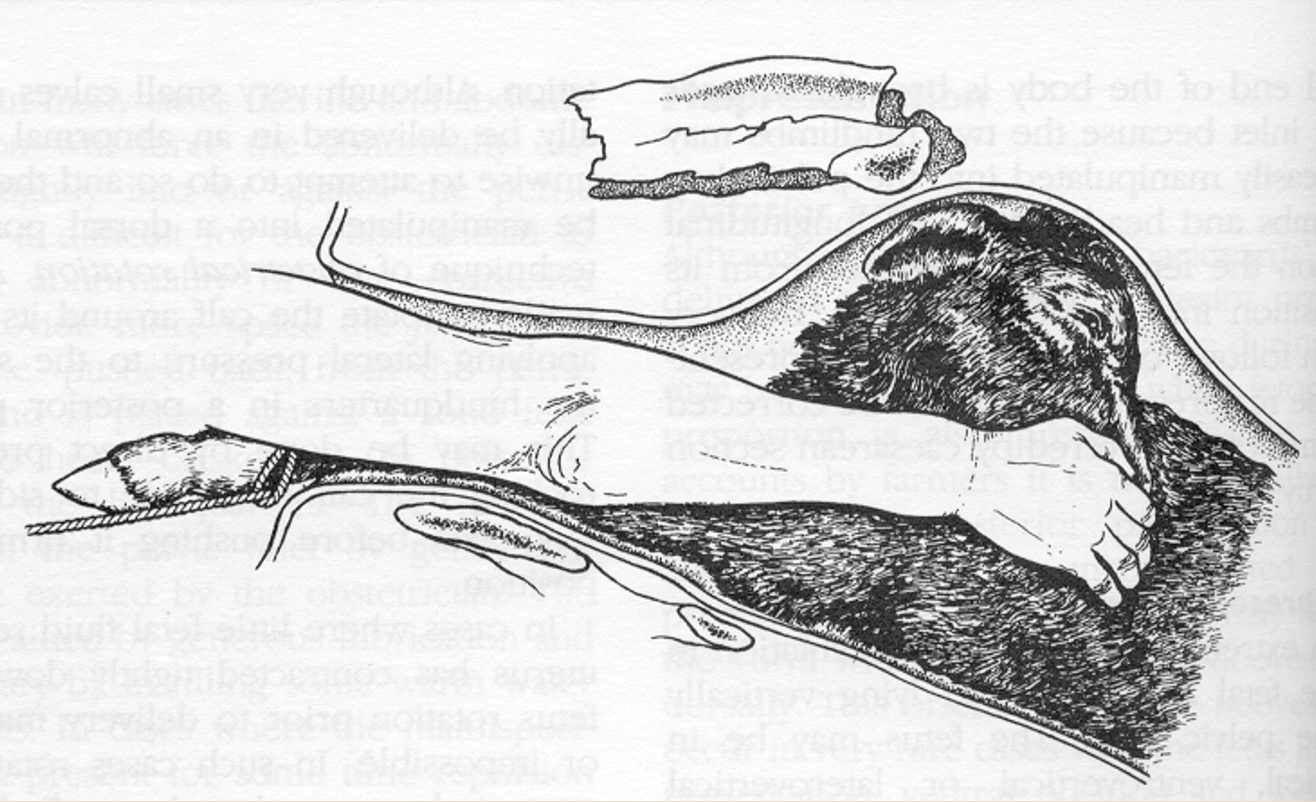
What is this showing?
Lateral deviation of the head
First step =
wash hands/use disinfectant
Disinfectant used =
chlorohexidine

What is this showing?
Retention of Forelimb (Stage 1)

What is this showing?
Retention of Forelimb (Stages 1 & 2)
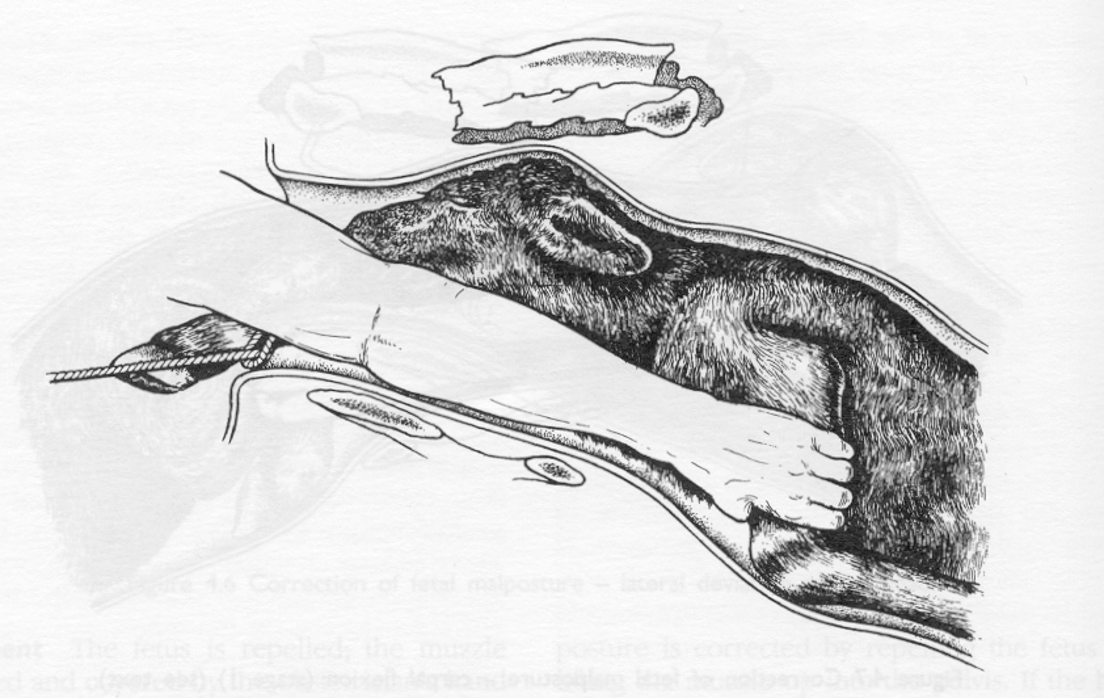
What is this showing?
Shoulder Flexion

What is this showing?
Hock flexion (breech presentation)

What is this showing?
Simultaneous Presentation
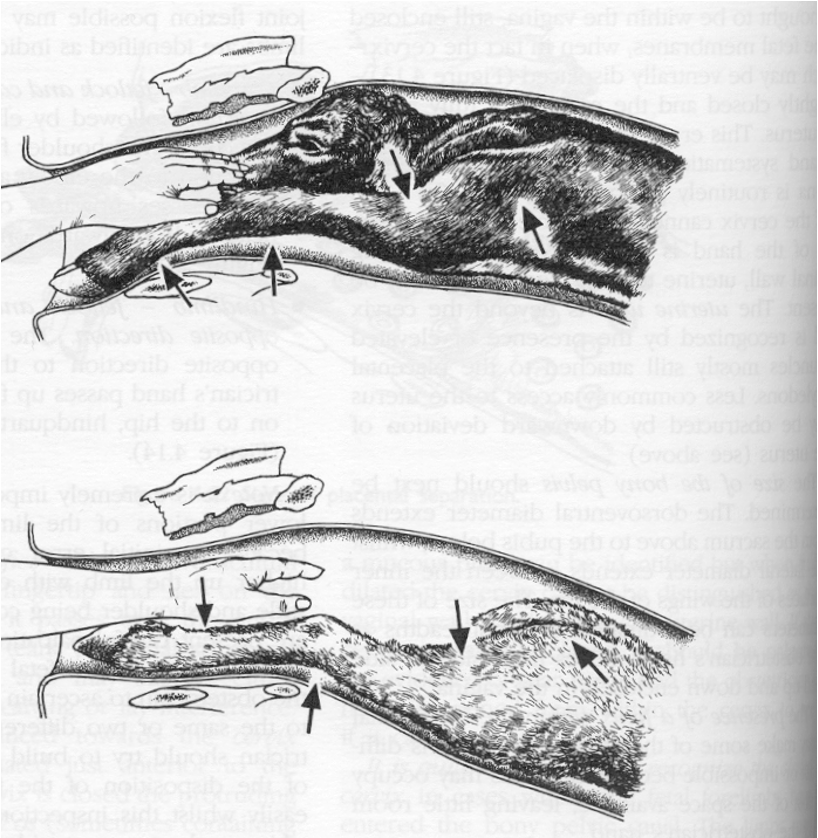
Which way is the calf coming out ?(normal or breech)
Palpate the joints
Pulling the Calf:
First rule of thumb and most important:
Cleanliness and Lubrication
Check for live calf
Place chains on legs properly
Stretch vulva if needed
Only pull when:
the cow is straining (Do not hook her up to a tractor)
In case of shoulder or hip lock:
another person must rotate the calf
An epidural may be given to animals that are:
straining too much and assistance is compromised
Once calf is on the ground:
Clean the airways
Go back and check for another:
calf
Is the calf alive or dead?
Grasping or Pinching Foot
Flex Joints
Pinch Eyeballs
Anal Palpation

What does this image show?
Correct placement of chains for pulling calf

Incorrect placement of chains can cause:
fractures — calf won’t make it then

Why is this another incorrect placement of chains?
traction on both forelimbs simultaneously often results in shoulder lock
If the calf is not breathing after delivery:
can do mouth to nose resuscitation
When pulling is not an option, what can be done?
C-section
Fetotomy
C-section =
Calf still alive, perform a Caesarian section
Fetotomy =
Calf not alive or just too big, fetotomy
Use of obstetrical wire to cut the calf into pieces for easy removal

Diprosopus bovine monster is:
an example of a mutation

Parasitic limbs:
another mutation

What is a prolapsed uterus?
when the muscles, ligaments, and tissues of the pelvic floor stretch or weaken, causing the uterus to slip down into or protrude out of the vagina
Simultanuous presentation =
will see either 3 or 4 feet instead of just 2
Having lube is very important and the kind used is:
J lube (powder activated with liquid)
What is obstetrics?
a branch of medical science focused on pregnancy, childbirth, and the postpartum (after childbirth) period
Leg chains correct placement:
loop on top & chain connecting 2 loops in the middle on top of the leg, not under leg
How can the airways be cleared?
pick up & swing calf from back legs to clear airways

How to fix prolapsed uterus?
use cold water to clean it off, set on clean surface, put back in, stitch closed is needed
Moms lick baby off and:
eat the placenta
Breeding soundness exam is done on:
a bull
(NAHMS) =
The National Animal Health Monitoring System
At each category of operation based on herd size, the percentage of cattlemen who utilized a BSE was:
equal to or greater than those that utilized palpation for pregnancy and several other veterinary services
Historically a major selling point for the procedure (BSE) is that:
of being "calf crop insurance" (dud bull=no calves)
There are 3 additional justifications for the utilization of this tool =
Highly fertile bulls sire more fertile daughters
Highly fertile bulls get a higher percentage of females bred
Highly fertile bulls get more females bred earlier in the season
A routine BSE includes =
a physical examination, a reproductive examination (internal and external genitalia), and the collection and examination of semen
Bulls are then classified as:
satisfactory, unsatisfactory, or deferred
Although bulls received a numerical score in the early days of this exam, bulis are now on more of a:
pass/fail basis with "passing" dependent on meeting minimal standards in each crucial aspect of the exam
What factors ensure that a baseline of fertility is established and that a high "score" in one area will not allow a bull with a deficiency in another area to pass?
Minimum thresholds for scrotal circumference, motility, and morphology
For a bull to perform in a natural mating environment he must be able to:
see, eat, stand on his rear legs and deposit an ejaculate into the vagina of a cow
If multiple examinations (5-80+ bulls) are being performed, the bulls should be carefully observed as they are:
gathered and as they move around in the pen, down the alley, and as they leave the chute
When the bull has been caught:
go to his head, verify his ID if tag or tattoo, evaluate vision while looking for evidence of squamous cell carcinoma or other lesions/defects around the eyes
Quickly evaluate mandibular symmetry, specifically:
swelling or conversely muscle atrophy, which might indicate infection, injury, or dental problems
As you return to the side of the chute take a good look at:
the feet, specifically looking for inter-digital fibroma, screw claw, etc.
Evaluate the conformation of the:
sheath and look for evidence of injury to both the sheath and prepuce
Questions to ask when palpating the scrotum and its contents?
Do the testicles move freely within the scrotum?
Are the testicles symmetrical in size and texture?
Does palpation of the epididymes elicit pain?
Why is the scrotal circumference measured?
because it represents the sperm producing capacity of the bull
Why is a sperm count of the sample not used?
because the product resulting from electroejaculation is the result of external variables
The scrotal measurement may complete your examine if:
the circumference does not meet minimum standards
Examining the penis:
If you are able to extend the penis, evaluate it for warts, hair rings, and lacerations (scars). If the penis can not be extended at this time, evaluate it during electroejaculation.
Per rectum evaluation should include:
palpation of the seminal vesicles, ampullae, and internal inguinal rings
Seminal vesiculitis (Vesicular adenitis is the correct term) is usually manifested by:
pain or uhilateral swelling on palpation
The inguinal rings äre evaluated to determine if:
an inguinal hernia is present or likely
Sperm motility can be quickly and easily assessed by:
evaluating the sperm motion either grossly or individually using various microscope objectives
The minimum threshold for sperm motility:
a minimum of 30% motility
What must never be excluded from a BSE?
the evaluation of Sperm morphology
Keys to performing this exam quickly and competently are:
the preparation of a diagnostic slide, use of the oil immersion objective of a good quality light microscope, and the ability to distinguish a normal from abnormal sperm.
Minimum threshhold for sperm morphology:
70% normal sperm of 100 total sperm examined
A BSE provides a _____ of the breeding potential/fertility of a bull?
"snapshot"
The spermogram aspect reveals a:
historical picture as well because abnormalities of the sperm as revealed by poor motility or morphology may be the result of an insult to spermatogenesis that occurred 1-3 months prior to the exam
BSE is better at identifying:
an infertile bull than differentiating between the levels of fertility among fertile bulls
Cow estrous cycle length:
~21 days
Estrous vs estrus:
Estrous = cycle
Estrus = heat
Cow duration of estrus?
15–18 hours
Signs of estrus =
Mounting or attempting to mount other cattle
Clear, stringy vaginal mucus discharge
Swollen, reddened vulva
Increased restlessness, pacing, and frequent bellowing
Roughed-up hair or mud/scratches on the tailhead and hips
Chin resting on another animal's back
Estrus detection methods:
Visual Observation
Heat Mount Detectors & Patches
Tail Chalk / Paint
Electronic & Automated Technologies