Art History Italian Baroque Sculpture and Painting

0.0(0)
Studied by 0 people
call kaiCall Kai
learnLearn
examPractice Test
spaced repetitionSpaced Repetition
heart puzzleMatch
flashcardsFlashcards
GameKnowt Play
Card Sorting

1/4

encourage image

There's no tags or description

Looks like no tags are added yet.

5 Terms

1
New cards

Terms

Tenebrism: Caravaggio style that uses extreme, high-contrast light and dark to create a dramatic "spotlight" effect against an intense, pitch-black background

Verism: Caravaggio style of extreme realism in art where subjects are shown with complete truthfulness—including all natural flaws

Renaissance Idealism: the practice of depicting human figures, nature, and objects not as they strictly or imperfectly appear in reality, but as a heightened, perfected version inspired by classical Greek and Roman ideals of beauty, proportion, and virtue

Landscape Painting: an artwork whose primary subject is natural scenery

Counter-Reformation: the religious art style created by the Roman Catholic Church in the 16th and 17th centuries to fight back against the Protestant Reformation and bring people back to Catholicism

<p><u>Tenebrism:</u> Caravaggio style that uses extreme, high-contrast light and dark to create a dramatic "spotlight" effect against an intense, pitch-black background</p><p><u>Verism:</u> Caravaggio style of extreme realism in art where subjects are shown with complete truthfulness—including all natural flaws</p><p><u>Renaissance Idealism:</u> the practice of depicting human figures, nature, and objects not as they strictly or imperfectly appear in reality, but as a <strong>heightened, perfected version</strong> inspired by classical Greek and Roman ideals of beauty, proportion, and virtue</p><p><u>Landscape Painting:</u> an artwork whose primary subject is natural scenery</p><p><u>Counter-Reformation:</u> the religious art style created by the Roman Catholic Church in the 16th and 17th centuries to fight back against the Protestant Reformation and bring people back to Catholicism</p>
2
New cards
<p>Bernini’s David</p>

Bernini’s David

Action vs. Stillness: Unlike Michelangelo's David (which shows David before the battle in a calm, contemplative pose) or Donatello's/Verrocchio's versions (which show him after the victory), Bernini captures the climax of active combat—coiled in a dynamic, high-tension twist right as he hurls the stone

STORY: Goliath talks bad abt the Israelites’ God, says bring out ur best warrior to end this war. David comes out as a 13 year old with a slingshot and kills him with a rock. message → God was on his side

<p><strong>Action vs. Stillness:</strong> Unlike Michelangelo's <em>David</em> (which shows David <em>before</em> the battle in a calm, contemplative pose) or Donatello's/Verrocchio's versions (which show him <em>after</em> the victory), Bernini captures the <strong>climax of active combat</strong>—coiled in a dynamic, high-tension twist right as he hurls the stone</p><p>STORY: Goliath talks bad abt the Israelites’ God, says bring out ur best warrior to end this war. David comes out as a 13 year old with a slingshot and kills him with a rock. message → God was on his side</p>
3
New cards
<p>Ecstasy of Saint Teressa</p>

Ecstasy of Saint Teressa

  • Made from one piece of marble

  • Made for Cornaro → spanish family who worked in rome

  • Teresa was a mystical saint: those who have visions of Jesus

  • Father dies when she is young and during deep mourning she has a vision of when an angel pierces her heart with a golden arrow, filling her with the love of God

  • physical and sensory/sexual metaphor

  • Church making art that’s exciting as to say “stay with us! we are popular!” COUNTER-REFORMATION


<ul><li><p>Made from one piece of marble</p></li><li><p>Made for Cornaro → spanish family who worked in rome</p></li><li><p>Teresa was a mystical saint: those who have visions of Jesus</p></li><li><p>Father dies when she is young and during deep mourning she has a vision of when an angel pierces her heart with a golden arrow, filling her with the love of God</p></li><li><p>physical and sensory/sexual metaphor</p></li><li><p>Church making art that’s exciting as to say “stay with us! we are popular!” COUNTER-REFORMATION</p></li></ul><p></p>
4
New cards
<p>Calling of St. Matthew (Caravaggio)</p>

Calling of St. Matthew (Caravaggio)

  • Tenebrism and Verism

  • 2nd School → School of Caravaggio

  • 1st School (talked abt during “Flight Into Egypt” which im not including LOL) → School of Bologna by Carracci to move away from the artificial and stylized painting style

  • Caravaggio is like Anti-Raphael … didn’t gaf abt the church, was friends with crooks (who he used as models here) and spent time with women

  • Using models from his friends was very verisitc and real and relatable showing real humans

  • Del Monte and Borghese were 2 cardinals that loved Caravaggio sm that they helped him get outta execution for killing a man

  • Subject Matter: The biblical moment when Jesus Christ calls Matthew (a tax collector) to become an apostle. Jesus points to Matthew, who sits at a table counting money with other men

  • Naturalism / Realism: Figures wear contemporary 16th-century clothing rather than traditional biblical robes (except Christ and Peter).

  • Gesture & Composition: Christ’s hand gesture mirrors Michelangelo’s Creation of Adam on the Sistine Chapel ceiling, symbolizing Christ as the "second Adam" of spiritual rebirth and conversion


<ul><li><p>Tenebrism and Verism</p></li><li><p>2nd School → School of Caravaggio</p></li><li><p>1st School (talked abt during “Flight Into Egypt” which im not including LOL) → School of Bologna by Carracci to move away from the artificial and stylized painting style</p></li><li><p>Caravaggio is like Anti-Raphael … didn’t gaf abt the church, was friends with crooks (who he used as models here) and spent time with women</p></li><li><p>Using models from his friends was very verisitc and real and relatable showing real humans </p></li><li><p>Del Monte and Borghese were 2 cardinals that loved Caravaggio sm that they helped him get outta execution for killing a man</p></li><li><p><strong>Subject Matter:</strong> The biblical moment when Jesus Christ calls Matthew (a tax collector) to become an apostle. Jesus points to Matthew, who sits at a table counting money with other men</p></li><li><p><strong>Naturalism / Realism:</strong> Figures wear contemporary 16th-century clothing rather than traditional biblical robes (except Christ and Peter).</p></li><li><p><strong>Gesture &amp; Composition:</strong> Christ’s hand gesture mirrors Michelangelo’s <em>Creation of Adam</em> on the Sistine Chapel ceiling, symbolizing Christ as the "second Adam" of spiritual rebirth and conversion</p></li></ul><p></p>
5
New cards
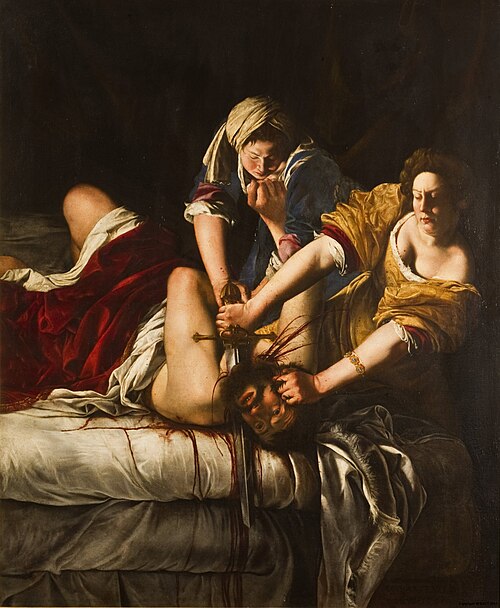
<p>Judith and Holofernes</p>

Judith and Holofernes

  • Artemisia Gentileschi → most successful female painter up until this point. father was famous painter who sent her to apprentice Tassi. Tassi rapes her and she is tortured in court to make sure her story was correct. Tassi is exiled, murders his wife, and is executed

  • Subject Matter: Judith, a Jewish widow, sneaks into the tent of the Assyrian general Holofernes—who has been lusting over her—and decapitates him in his sleep with the help of her maidservant

  • Personal Expression: Reflects Gentileschi’s own biographical trauma as a survivor of sexual assault and a public trial, infusing the work with intense female agency and rage.

<ul><li><p>Artemisia Gentileschi → most successful female painter up until this point. father was famous painter who sent her to apprentice Tassi. Tassi rapes her and she is tortured in court to make sure her story was correct. Tassi is exiled, murders his wife, and is executed</p></li><li><p><span><strong>Subject Matter: </strong>Judith, a Jewish widow, sneaks into the tent of the Assyrian general Holofernes—who has been lusting over her—and decapitates him in his sleep with the help of her maidservant</span></p></li><li><p><strong>Personal Expression:</strong> Reflects Gentileschi’s own biographical trauma as a survivor of sexual assault and a public trial, infusing the work with intense female agency and rage.</p></li></ul><p></p>



