HES 346 Biomechanics: Bone Growth, Joints, and Levers Study Guide
 Call Kai
 Learn
Learn Practice Test
 Spaced Repetition
 Match
Match Flashcards
 Knowt Play
1/26

There's no tags or description
Looks like no tags are added yet.
Name | Mastery | Learn | Test | Matching | Spaced | Call with Kai | Chat |
|---|
No analytics yet
Send a link to your students to track their progress
27 Terms
What are the main functions of the skeletal system?
Support, protection, movement, mineral storage, and blood cell production.
What are the two main types of bone cells?
Osteoblasts (bone-building) and osteoclasts (bone-resorbing).
What are the building blocks of bone?
Calcium carbonate, calcium phosphate, collagen, and water.
What are the two types of bone tissue?
Cortical (compact) bone and cancellous (spongy) bone.

What are the different types of bones?
Short, flat, irregular, long, and sesamoid bones.

What is Wolff's Law?
Bone adapts to the loads under which it is placed, increasing or decreasing its mass accordingly.
What factors affect bone development?
Physical stress, nutrition, overuse injuries, and injuries or fractures.
What are the three types of joints based on movement?
Immovable, slightly movable, and freely movable (synovial) joints.

What are the characteristics of synovial joints?
Articular cartilage, joint capsule, joint cavity, synovial fluid, and ligaments.

What is the stress-strain relationship?
The relationship between the applied force (stress) and the resulting deformation (strain) of bone.
What types of stress can be applied to bone?
Compression, tension, shear, bending, and torsion.

What is mechanical advantage in the context of levers?
The ability of a lever system to amplify force or speed/ROM based on its configuration.
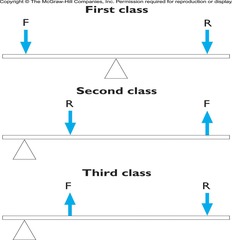
What are the three classes of levers in the human body?
First class (effort and load on opposite sides of the axis), second class (load between effort and axis), and third class (effort between load and axis).
What factors affect torque production?
Amount of force, length of the lever/moment arm, and angle of attachment.
How does the angle of pull affect muscle force?
The angle of pull changes throughout the range of motion, affecting the moment arm length and the type of muscle force (rotary, stabilizing, dislocating).
What happens during a bicep curl?
The elbow flexes, requiring muscle force to lift the weight against gravity.
What is the difference between linear distance and linear displacement?
Linear distance is the total path traveled, while linear displacement is the straight-line distance from start to end position.
What is the role of exercise machines in resistance training?
They incorporate rotary and stabilizing components to provide variable resistance.
What is the significance of angle of attachment in biomechanics?
It affects the moment arm length and the effectiveness of muscle force during movement.
What is the relationship between moment arm length and torque?
There is a direct relationship; as moment arm length increases, torque also increases.
What are the potential effects of space travel on bone health?
Astronauts should engage in weight-bearing exercises to preserve bone density.
What is osteoporosis and how can it be prevented?
Osteoporosis is a condition characterized by weakened bones; prevention includes adequate nutrition and weight-bearing exercise.
What is the difference between bone hypertrophy and atrophy?
Hypertrophy is the increase in bone mass due to stress, while atrophy is the decrease in bone mass due to lack of stress.
What is the role of stabilizing and dislocating forces in joint mechanics?
Stabilizing forces help maintain joint position, while dislocating forces can lead to joint injury.
What is the significance of the elastic limit in joint properties?
It is the maximum stress that a joint can withstand without permanent deformation.
What is torque?
Torque is the rotational force produced by muscles around a joint.
How does muscle insertion affect force production?
The position of muscle insertion affects the moment arm length and thus the potential torque produced.