5 Horizontal gene transfer
 Call Kai
 Learn
Learn Practice Test
 Spaced Repetition
 Match
Match Flashcards
 Knowt Play
1/24

There's no tags or description
Looks like no tags are added yet.
Name | Mastery | Learn | Test | Matching | Spaced | Call with Kai | Chat |
|---|
No analytics yet
Send a link to your students to track their progress
25 Terms
What is HGT/LGT?
The unidirectional transfer of genetic material between cells that is uncoupled with cell division (DNA from any source other than parental)

Why do bacteria take up DNA?
Genetic diversity (new genes; new alleles)
template to repair damaged DNA
Food (C, N, P, nucleotides
What are the 3 main requirements for HGT
must be able to uptake/recieve the DNA
DNA must resist destruction
The DNA must be able to be encorperated into the host
Why is HGT more likely to occur between closely related organisms?
inhabit the same environments
have compatible DNA delivery/uptake systems
have similar genome structure and mechanisms that control recombination, replication, and gene expression (if dissimilar genome structures occur ribosomes might stall with the new mRNA or produce misfolded proteins)
How can HGT be detrimental to recipients?
if new DNA size is too large, pulls too much from cellular resources for replication, transcription, and translation
unoptimal DNA stall ribosomes and misfold proteins
might interfere with cellular homeostasis
incoming dna contains transposons that might hop into important genes
How can HGT be detrimental to donors?
DNA release might require donor cell to lysis
machinery that exports DNA is metabolically expensive
some machinery that exports DNA can be receptors for bacteriophages
What are the most common mechanisms of HGT?
Transformation - recipient imports DNA that is free in the environment
Transduction - DNA transfers from donor to recipent cell is mediated by certain types of bacteriophages
Conjugation - direct cell to cell unidirectional transfer of DNA that is mediated by pilus. Transferred DNA can be specific plasmids and ICEs (integrative conjugative elements)
What are the 6 steps of the Phage lytic cycle?
absorption
DNA entry
DNA replication
transcription and translation
phage assembly
Host cell lysis
What is a TypeIVss?
Type IV secretion system can deliver DNA and proteins to a diversity of bacterial, fungal, plant, and human cells; as well as import DNA into bacteria
How do type IV pilus apparatus function?
They cross the inner and outer membrane. The pilus grows when the atp synthase spins clockwise and shrinks when spun counter clock wise. The pilus can grab onto DNA and walls and are grown with the addition of proteins (and shrunk by the removal of them).
What is the function of ComEA?
It binds to DNA getting pulled by the pilus and pulls it thorugh
What happens to dsDNA when it enters the bacteria through T4ss?
The dsDNA gets pulled apart to only have a single strand. If the DNA is already ss, then nothing happens.
What are the genes needed to ensure a plasmid is conjugative?
DNA site recognized by relaxase, genes for relaxase, Type IV coupling protein (always at the base of the T4ss), Type IV secretion system.
How does relaxase work during conjugation?
Relaxase covalently bonds to DNA, cleaves the DNA, unwinds it, then the relaxase unfolds, passes through the pilus, refolds when in the other cell, and continues to pull the DNA fully through to the recipient cell. (Single-stranded binding proteins protect the DNA along the way)
The relaxasome is the same as the relaxase. True or false?
False, the relaxasome contains relaxase along with other componets such as TraM, TraY, and TraI.
What are ICEs?
Integrative conjugative elements OR conjugative transposons
Integrated into DNA sites via site specific recombination
excise to be transferred (plasmid-like state)
transferred between cells using T4SS
A signal is needed to start the process for a ICE to jump from its DNA

Describe the attachment of a tail phage infection.
The tail phage has it’s tail extended to latch onto any surface signals that will allow it to bind. Once attached, the tail shrinks, pulling the capsid closer to the surface for injection.
How do bacteria defend against phage DNA?
The restriction modification system utilized restriction enzymes paired with methylase. The restriction enzyme cleaves apart phage DNA while the methylase ensures the endonucleases don’t cut DNA. Membrane bound nucleases are commonly used by bacteria, when the tail of the phage breaks through the membrane it activates an imbedded nuclease.
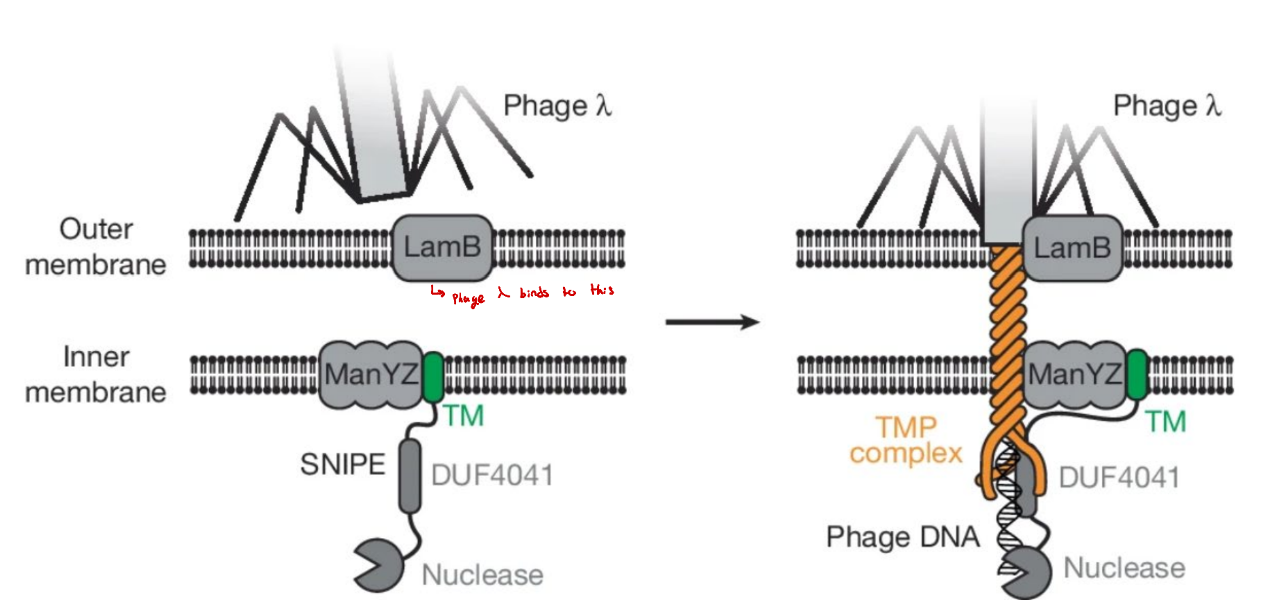
Restriction enzyme
endonucleases that cuts both sides of a dsDNA that has NOT been methylated. Some phages have methylated DNA to bypass this defense mechanism. Some phages don’t have the location to allow restriction enzymes to recognize the site.
Methylase
a modification enzyme that methylates host DNA at specific sequences to prevent restriction enzymes from cutting them. Bacteria always create more methylase than restriction enzymes.
What is CRISPR?
Clustered, regularly, interspaced, short, palindromic repeats
They are adaptive, heritable, genetic immune system for prokaryotes
What are Cas proteins?
CRIPSR associated proteins that cleave specific and recognizable DNA or RNA sequences with the help of guiding RNA molecules.
How is CRIPSR used as a defense mechanism?
It uses Cas proteins to cleave infection DNA and incorporates it into the bacterium’s genome (into CRISPR array) as a spacer (with repeats inbetween). Then in future infections the bacteria uses the stored DNA to create crRNA that guides Cas proteins to cleave infection DNA.

How can phage DNA be incorporated into a bacteria’s genome?
Integration at specific sites can be catalyzed by enzymes (integrases or transposases). If donor DNA and recipient DNA have similar regions, homologous recombination can occur.

What are PAIs and how can they be identified?
Pathogenicity islands - genomic islands that confer virulence
Can be recognized because they have different G+C content as well as have continuous blocks of virulence genes.
note: not all genomic islands are virulent
