MACRONUTRIENT BIOCHEMISTRY - EXAM #2 - KENT STATE UNIVERSITY
 Call Kai
 Learn
Learn Practice Test
 Spaced Repetition
 Match
Match Flashcards
 Knowt Play
1/87

There's no tags or description
Looks like no tags are added yet.
Name | Mastery | Learn | Test | Matching | Spaced | Call with Kai | Chat |
|---|
No analytics yet
Send a link to your students to track their progress
88 Terms
what is the serosa?
Serosa is the outermost layer of the GI tract
what is the muscularis externa?
The muscularis externa is responsible for segmentation and peristalsis via circular and longitudinal muscle movements
what are the submucosa/mucosa?
these are Gut-associated Lymphoid Tissues (GALT); they are composed of WBCs, lymphocytes, and macrophages which provide the defense against bacteria and foreign bodies
what are the secretory glands of the GI tract?
exocrine and endocrine glands - exocrine glands are glands that secrete their products via ducts while endocrine glands are ductless glands that secrete their products directly into the blood stream
what is the sphincter of Oddi?
found between common hepatic-bile duct and duodenum and it empties bile, enzymes, and HCO3 into the duodenum
what are the functions of the mouth?
Chewing which is used to mix food and saliva from glands; allows for partial digestion with the use of alpha-amylase and lingual lipase enzymes, and swallowing which allows the transfer of food to the next phases of digestion
what are the glands within the mouth?
Parotid gland - secretes water, lytes, and enzymes (only gland not secreting mucus)
Submandibular and sublingual glands - secrete water, lytes, enzymes, and mucus
what is the function of the esophagus?
Esophagus is 10 inches long with swallowing initiating peristalsis; there is no mucus secretion within the esophagus; the lower esophageal sphincter provides neural and hormonal regulation and the pressure on LES decreases upon swallowing
what are some clinical conditions that are related to LES gastric reflux and what are some contributing factors to these problems?
irritation of esophagus mucosa by acidity; burning sensation (heartburn); contributing factors include smoking, alcohol, chocolate, and high fat food
what are some clinical conditions that are related to LES achalasia?
Achalasia is the failure of the LES relaxation which can be aided by botox injections or surgery to relax the LES muscle
what is the function and anatomy of the stomach? How does the anatomy aid the function of the stomach?
The stomach is a J-shaped organ with a volume ranging from 50 to 1200 mL; the structure of the stomach is the body (including fundus) which serves as a reservoir and produces the gastric juice, and the antrum (pyloric portion) which grinds and mixes food with digestive juice forming chyme, the antrum provides strong peristalsis; the gastric pit is an indentation-like tube within the epithelium in the stomach, it is rich in secretory cells which aid digestion process
what is a gastric pit? Cell breakdown? Cell functions?
Gastric pits include mucous cells, parietal cells, chief cells, ECL cells, and G cells; mucus cells secrete mucus which lubricates and protects gastric lining from acid/enzyme; aspirin is often found inhibiting mucus production; chief cells respond to ACh and gastrin, release pepsinogen which will eventually be activated to pepsin by gastric acid; parietal cells respond to ACh, gastrin, CCK, and histamine releasing intrinsic factor (IF) for Vitamin B-12 digestion and HCl which activates pepsinogen to pepsin, denatures proteins, serves as a bactericide, and releases nutrients from foods; ECL cells respond to ACh and gastrin releasing histamine to stimulate parietal cells (HCl/IF) via paracrine glands; G cells respond to ACh upon thinking of/seeing food, entry of food into stomach, and gastric distension, G cells release gastrin to stimulate parietal cell to release HCl, chief cell to release pepsinogen, while increasing gastric and intestinal motility

what are mucus (goblet) cells and their function?
secretes mucus which lubricates and protects the gastric lining from acid/enzyme; aspirin can inhibit mucus production
what are G cells and their functions?
G cells respond to ACh upon thinking or seeing food, entry of food into stomach, and/or gastric distension; G cells then release gastrin, a hormone, to stimulate parietal cell to release HCl, stimulate chief cell to release pepsinogen while also increasing gastric and intestinal motility
what are ECL cells and their functions?
respond to the stimulation of ACh and gastrin; release histamine to stimulate parietal cell release of HCl and IF via paracrine glands
what are chief cells and their functions?
Chief cells respond to ACh and gastrin releasing pepsinogen which will be activated to pepsin by gastric acid (HCl)
what are parietal cells and their functions?
respond to ACh, gastrin, histamine, and CCK releasing IF for digestion of B12 and HCl which activates pepsinogen to pepsin, denatures proteins, serves as a bactericide, and releases nutrients being stored in foods
what are the mechanisms of acid secretion control?
hormone, paracrine, and neurocrine glands; hormones are released into blood and reach their targets via the bloodstream, ex. gastrin; paracrine glands release their products into the tissues reaching their targets via diffusion, ex. histamine and somatostatin; neurocrine glands release their products from nerve terminals, reaching their targets via synaptic diffusion, ex. ACh and gastrin-releasing peptide (GRP)
what is the use of acetylcholine in the regulation of HCl secretion?
ACh (neural) is secreted by the parasympathetic vagal nerve by seeing, smelling, and entry of food stimulating ECL, G, parietal, and chief cells
what is the use of gastrin in the regulation of HCl secretion?
Gastrin (hormonal) is released from G cells responding to stimulation from ACh which stimulates ECL, chief, and parietal cells
what is the use of CCK in the regulation of HCl secretion?
CCK (hormonal) is released from SI cell upon entry of food into small intestine (fat/AA) stimulating the parietal cell
what is the use of histamine in the regulation of HCl secretion?
Histamine is released from ECL cells around parietal cells responding to the stimulation from gastrin and ACh stimulating the release of HCl from H2 receptor
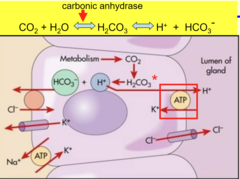
what is the mechanism of HCl production?
Ligands (stimulants) bind their receptors
Activate carbonic anhydrase to convert CO2 + H2O to H2CO3 which then converts to HCO3 and H+
HCO3 transported into blood stream in exchange for Cl-
Cl- then co-transported with K+ into stomach lumen
H+ is transported into stomach lumen in exchange of K+
what is a peptic ulcer? how does one develop?
Peptic ulcer stems from the erosion of the GI mucosa in either the stomach or duodenum - 2 major sites where too much HCl can cause an ulcer; caused by excessive HCl production and/or destruction of mucosal barrier from aspirin, H. pylori, stress, and/or alcohol consumption
what is Zollinger-Ellison syndrome?
tumor in pancreas acting like a G-cell, this causes secretion of excess gastrin which in turn causes a gastric ulcer (secondary)
how much chyme is emptied into duodenum per contraction?
1-5 mL (< or = 1 tsp) chyme enters duodenum at a time
what is a pacemaker's use in gastric emptying?
determines frequency and rate of contractions, regulated by GI hormones/neuropeptides
what is duodenal feedback?
duodenum receptors responding to acidity digestion products of CHO, fat, and protein; osmolarity difference; and distension; hormones involved include CCK, secretin, motilin, and somatostatin
what are accessory organs involved in gastric emptying? what does each do?
liver, gallbladder, pancreas; liver makes bile from cholesterol; gallbladder concentrates and stores the bile; pancreas produces digestive enzymes and HCO3- (bicarbonate)
what is the anatomy of the small intestine?
duodenum - 10" long, 90% of total digestion, mixing bowl receiving chyme from stomach, and digestive secretions from pancreas and liver; jejunum; ileum; large folds of mucosa; villi - fingerlike projections on the lining of SI; microvilli - absorptive cells on villi forming brush border, trap nutrients for final digestion, and SI digestive enzymes are found here; crypts of Lieberkuhn - glands located between villi, cells in crypts - secrete intestinal juice, migrate upward to tips of villi becoming absorptive cells, shed into the lumen of the intestine every 2-5 days, it is important they breakdown at a high turnover rate to prevent development into cancer cells; brunner's glands - at beginning of duodenum, produces alkaline mucus to protect from stomach acid

what are the crypts of lieberkuhn?
glands located between villi, the cells in the crypts secrete intestinal juice, migrate upwards to the tips of villi becoming absorptive cells, shed into the lumen of the intestine every 2-5 days which allows the prevention of cancer cell development
what are brunner's glands?
beginning of duodenum, produces alkaline mucus to protect SI from excessive damage from stomach acid
what are the proteases secreted by pancreas?
trypsinogen, chymotrypsinogen, proelastase, procarboxypeptidase, and collagenase - produce mono-, di-, tri-, and oligo-peptides
what are aminopeptidases?
further hydrolyze some tri- and oligopeptides;
what is the small intestine's role in CHO digestion?
pancreatic enzymes: alpha-amylase hydrolyzes alpha-1,4 bonds; alpha-dextrinase hydrolyzes alpha-1,6 branches
Brush border enzymes: isomaltase hydrolyzes alpha-1,6 branch of isomaltose, maltase, lactase, and sucrase hydrolyze maltose, lactose, and sucrose, respectively
what is pancreatic lipase?
an enzyme that breaks down complex lipids into products (i.e. fatty acids) that are easily absorbed as long as there is bile present; triglyceride broken down into monoglyceride, 2 FFAs, and glycerol
what is pancreatic colipase?
binds triglyceride and pancreatic lipase to displace bile
what is required for activation of phospholipase and cholesterol esterase?
bile
what does the pancreatic secretion of HCO3- do in digestion?
neutralizes chyme from stomach
what does pancreatic secretion of enzymes do in digestion?
enzymes digest 50% CHO, 50% protein, and 90% lipids
what is bile?
bile is a yellowish fluid that is made in liver and stored in gallbladder; 85% water, 7-10% bile salts, 3% pigments, electrolytes, etc.; have both hydrophilic and hydrophobic sides emulsifying fats; bile production stems from a series of cholesterol oxidation and conjugation with glycine or taurine improving the solubility to form micelles; combines bile acid with K/Na to form bile salt and sends it to gallbladder for storage where 90% of water is removed; in response to fat/AAs in duodenum, intestine secretes CCK which stimulates gallbladder contraction allowing for bile secretion into duodenum via common hepatic-bile duct

what is the function of bile?
bile emulsifies fats forming micelle; acts like a detergent breaking lipids into fat droplets forming micelle; it also increases exposed surface area for lipase action
what is micelle?
aggregates of fat droplets that remain suspended in water; hydrophobic center derived from cholesterol part of bile acids and hydrophilic side derived from AA part of bile acids
what is enterohepatic circulation?
Micelles travel to brush border
Micelle contents (fats) diffuse through UWL and into enterocytes
Bile salts released back to lumen
In ileum, reabsorbed through enterohepatic circulation (90-95%)
Reused for synthesizing new bile

how do blood cholesterol and bile interact?
you can reduce blood cholesterol by eating a high fiber diet due to the body's ability to increase bile excretion with fiber pushing bile through our GI tract and cholesterol being needed to increase bile production; fiber also reduces reabsorption of bile into enterohepatic circulation
what is the structure and function of the colon?
includes the ascending, transverse, and descending sections as well as the sigmoid section; colon reabsorbs water and electrolytes, dehydration of unabsorbed materials - 1 L of chyme reduced to 200 mL of defecated material; HCO3- secretion into colon which neutralizes acids produced by colonic bacteria via action on CHO

what is the use of bacteria within the colon?
trillions of microbiota are found in our large intestine to protect our systems; the bacteria synthesize a small amount of vitamin K and biotin; CHO digestion of fiber cannot take place - this allows for utilization of fiber as food for gut microbes which create SCFAs (acetate, butyrate, and propionate); butyrate acts as E for colon cells while regulating cell growth
what is a carbonyl group?
Functional group composed of a carbon atom double-bonded to an oxygen atom; aldose or ketose
aldehyde vs ketone?
aldehyde - anomeric C has at least one H
ketone - anomeric C has no H
aldose vs ketose?
aldose - aldehyde on #1C (glucose)
ketose - ketone on #2C (fructose)
what is the difference between the two Harworth projection formulas?
Alpha form - when OH group of anomeric C is drawn below plane of the ring
Beta form - when OH group of anomeric C is drawn above plane of the ring
what is anomeric carbon?
the new chiral center formed in ring closure; it was the carbon containing the carbonyl in the straight-chain form
what are monosaccharides?
(CH2O)n; the simplest form of sugar - glucose, fructose, and galactose; glucose being the major source of E, galactose and fructose also being common in the diet; ribose and deoxyribose are parts of our DNA and RNA
what are oligosaccharides?
short-chain polymers (2-10) of monosaccharide units; attached via glycosidic bonds - bond formed between hydroxyl groups of two monosaccharides, can be alpha- or beta- bond; most commonly found as disaccharides
what are the disaccharides and where are they commonly found?
maltose - formed from hydrolysis of starch, found in malt beverages like beer and malt liquors, glc-glc linkage
lactose - found in milk and milk products, glc-gal linkage
sucrose - found in cane and beet sugar, glc-fruc linkage

what is the cause of lactose intolerance and how to handle?
body's lack of the enzyme lactase; fermentation in colon by bacteria; can cause bloating, gas, diarrhea, and abdominal pain; should avoid milk/dairy products
what are polysaccharides?
>10 monosaccharides; forms starch, glycogen, and fiber; starch vs fiber - difference is starch is formed by alpha-1,4 bonds while fiber is formed using beta-1,4 bonds making fiber indigestible
what is starch?
starch is the storage form of glucose in plants;
amylose - liner, unbranched structure, 15-20% of total starch content, glucose residues attached via alpha-1,4 glycosidic bonds
amylopectin - branched chain polymer by alpha-1,4 and alpha-1,6 bonds, 80-85% of total starch content

what is glycogen?
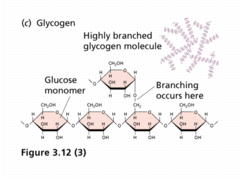
storage form of glucose in animals, liver and muscle; highly branched by alpha-1,4 and alpha-1,6 glycosidic bonds; more alpha-1,6 bonds found in glycogen then in amylopection
In fasting/exercising, releases terminal glucose molecules
Is broken down from "end" of molecule, more branches mean more ends, more glucose that can be released at once
what is fiber?
Glycosidic bonds between glucose : β1-4
No digestive enzymes for this bond in human body
Soluble - binds bile for excretion; lowers blood cholesterol
Insoluble - bulking agent and energy source for bacteria; prevents constipation and hemorrhoids
what is the process and function of soluble fiber?
Soluble fiber gets wet --> sticky --> bind nutrients including bile --> bile which is used in digestion is eliminated in digestion by leaving in stool --> need to make more bile --> utilized blood cholesterol to make more bile
what is alpha-amylase? lingual vs pancreatic alpha-amylase?
specific for alpha-1,4 glycosidic bonds in polysaccharides (starch) - cannot digest alpha-1,6 linkages
lingual alpha-amylase - inactivated at gastric pH, produces dextrin that contains alpha-1,6 branching points; maltose, maltotriose, glucose; only works in mouth and esophagus
pancreatic alpha-amylase - produces maltose, maltotriose, isomaltose, and glucose

what is required for absorption of glucose and galactose?
requires E and carrier, active transport; sodium pump (Na+/K+ ATPase)

what is required for absorption of fructose?
not as well understood as absorption of glucose, but fructose is absorbed via passive diffusion with fructose proceeding down a concentration gradient utilizing carrier GLUT 5

what is done in transportation of monosaccharides?
monosaccharides are transported to liver through portal circulation with glucose being metabolized in glycolysis and fructose and galactose being converted to intermediates for glycolysis
what is the importance of blood sugar and its regulation?
important because regulation provides cells with constant glucose supply; glucose is the exclusive fuel for brain and RBCs; blood sugar is hormonally regulated by glucagon and insulin as well as epinephrine and cortisol; blood sugar is tightly regulated between 4 and 6 mmol/L between meals but getting up to 10 mmol/L after meals
Regulated by liver glycogen metabolism -
Glycogenesis
Glycogenolysis
Gluconeogenesis
what is the main source of energy in metabolism? How is this energy synthesized?
Main source of energy is ATP which is synthesized through either substrate-level or oxidative phosphorylation; yields E when hydrolyzed to ADP + Pi
what is substrate-level phosphorylation?
direct transfer of phosphate group from another high energy substrate to ADP to create ATP, this occurs during TCA cycle and glycolysis in the cytosol of the cell
what is oxidative phosphorylation?
E producing pathways (TCA/glycolysis) produce NADH/FADH2; oxidative phosphorylation occurs when NAADH/FADH2 carry electrons to ETC; in ETC ATPase is powered by electron transfer through the chain and combine ADP + Pi to create ATP; takes place in inner membrane of mitochondria
oxidation vs reduction?
Oxidation is loss of electrons
Reduction is gain of electrons
They occur as a couple reaction
What are the functions of HCl?
Activates inactive zymogen pepsinogen to active pepsin
Denature proteins
Serves as bactericide
Nutrient release
What is the function of the LES?
regulates the movement of food from the esophagus into the stomach; preventing acid from entering the esophagus; found between esophagus and stomach
What is the function of the pyloric sphincter?
Prevents the contents of the small intestine from backing up into the stomach; controls release of chyme
What is the function of the ileocecal sphincter?
It joins the ileum of the small intestine to the cecum of the large intestine and helps regulate the flow of chyme; found between small and large intestines
What is the function of the anal sphincter?
Opens to the outside as a means of expelling waste from the body
What are the H2 receptor blockers?
tagamet, zantac, pepcid
What are the proton pump blockers?
Aciphex, Nexium, Prevacid, Prilosec, Protonix
net gain of glycolysis?
2 ATP, 2 NADH, 2 pyruvate
net gain of TCA Cycle?
6 NADH, 2 FADH2, 2 ATP, 4 CO2
net gain of intermediate step?
2 NADH
what is the NADH/FADH2 - electron carrier?
Accept electrons released fromGlycolysis, Intermediate step, & TCA cycle
Carry them to ETC for oxidative phosphorylation to produce ATP
NAD+ accepts 2 electrons and 1 proton to become NADH + H+
FADH2 accepts 2 hydrogen (2 proton & 2 electrons)
What is the process/breakdown of glycolysis?
Starter: glucose
End product: pyruvate
In aerobic condition, pyruvate converts to acetyl CoA and enters TCA cycle; TCA cycle produces NADH/FADH2, electrons carrier; Electrons are transferred to ETC for ATP production
In anaerobic condition, Pyruvate converts to lactate
What are the number of carbons found in each major molecule of glycolysis and TCA Cycle?
Glucose- 6
Pyruvate -3
Acetyl CoA-2
Oxaloacetate - 4
Citrate - 6
What is a hexose monophosphate shunt?
production of 5-carbon monosaccharides and NADPH; utilized for nucleic acid and nucleotides which are not involved in E metabolism
What are the SCFAs formed during bacteria digestion of fiber?
acetate, butyrate, and propionate; butyrate is used as E for colon cells while regulating cell growth
What is a hormone?
released into blood and reach their destination via the bloodstream, ex. gastrin
What is a paracrine?
released into tissue and reach their targets via diffusion
what is a neurocrine?
released from nerve terminals and reach their targets via synaptic diffusion