Geometry Proofs and Theorems
 Call Kai
 Learn
Learn Practice Test
 Spaced Repetition
 Match
Match Flashcards
 Knowt Play
1/44

There's no tags or description
Looks like no tags are added yet.
Name | Mastery | Learn | Test | Matching | Spaced | Call with Kai | Chat |
|---|
No analytics yet
Send a link to your students to track their progress
45 Terms
Segment Addition Postulate
If three points A, B, and C are collinear and B is between A and C, then AB + BC = AC

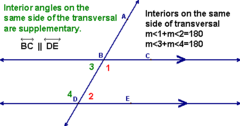
Same Side Interior Angle Theorem
If two lines are cut by a transversal, the same side interior angles are supplementary
Isosceles Triangle Theorem
If two sides of a ∆ are congruent, then the angles opposite these sides are congruent

No Choice Theorem / 3rd Angles Theorem
If two angles of a ∆ are congruent to two angles of another ∆, then the third angles are congruent

Right Angle Congruence Theorem
If two angles are right angles then they are congruent

Angle Addition Postulate
If you place two angles side-by-side then the measure of the resulting angle will be equal to the sum of the two original angle measures
Perpendicular Line Postulate
If there is a line and a point not on the line, then there is exactly one line through the point parallel to the given line

Triangle Angle Sum Theorem
The sum of the measures of the interior angles of a triangle is 180º

Congruent Complements Theorem
If two angles are complements of the same angle (or of congruent angles), then the two angles are congruent

Corresponding Angles Postulate
If two parallel lines are cut by a transversal, then corresponding angles are congruent

Alternate Interior Angle Theorem
If two lines are cut by a transversal, then alternate interior angles are congruent

Linear Pair Theorem
If two angles form a linear pair, then they are supplements

Triangle Exterior Angle Theorem
The measure of an exterior angle of a triangle is equal to the sum of the non-adjacent ("remote") interior angles of the triangle

Congruent Supplements Theorem
If two angles are supplements of the same angle (or of congruent angles), then the two angles are congruent

Converse of the Corresponding Angle Postulate
If two lines are cut by a transversal, and corresponding angles are congruent, then the lines are parallel

Converse of the Alternate Interior Angle Theorem
If two lines are cut by a transversal, and alternate interior angles are congruent, then the lines are parallel

Converse of the Same Side Interior Angle Theorem
If two lines are cut by a transversal, and same side interior angles are supplementary angles, then the lines are parallel

Congruence
Having the same measure

Right Angle
An angle with a measure equal to 90º

Alternate Interior Angles
When two lines are crossed by a transversal, the pairs of angles on opposite sides of the transversal, but inside the two lines

Angle Bisector
A ray that divides an angle into two different congruent angles

Linear Pair
Two adjacent angles whose non - shared rays form a line

Corresponding Angles
Angles at the same location at each intersection

Isosceles Triangle
A ∆ with two congruent sides

Segment Bisector
A segment, line, or plane that intersects a segment at its midpoint
Vertical Angles
Two non - adjacent angles formed by the intersection of the two lines

Same Side Interior Angles
A pair of angles on one side of a transversal line, and on the inside of the two lines being intersected

Base Angle
The side of a triangle from which the height is constructed
Complementary Angles
TWO angles whose measures have a sum of 90º

Supplementary Angles
TWO angles whose measures have a sum of 180º
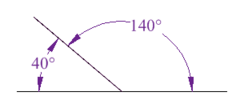
Alternate Exterior Angles Theorem
If two lines are cut by a transversal, then alternate exterior angles are congruent

Addition Property of Equality
If a = b, then a + c = b + c

Subtraction Property of Equality
If a = b, then a - c = b - c

Multiplication Property of Equality
If a = b, then a • c = b • c

Division Property of Equality
If a = b and c ≠ 0, then a/c = b/c

Substitution Property of Equality
If a = b, then a may replace b in any equation or expression

Reflexive Property
a = a

Symmetric Property
If a = b, then b = a *ONLY EQUALITY*

Transitive Property
If a = b, and b = c, then a = c *ONLY CONGRUENCY*

Distributive Property
a(b + c) = ab + ac

Vertical Angles Theorem
If two angles are vertical angles, then they are congruent

Theorem
A conjecture that is proven
Postulate
An accepted statement of fact
Converse of the Isosceles Triangle Theorem
If two angles of a ∆ are congruent, then the sides opposite the angles are congruent

Conditional
A statement that can be written as "if p, then q" where p and q are two simple statements.