3 P's 2- EXAM 3
 Call Kai
 Learn
 Practice Test
 Spaced Repetition
 Match
 Flashcards
 Knowt Play
1/208

There's no tags or description
Looks like no tags are added yet.
209 Terms
Peristalsis
Wave-like muscle contractions that move GI contents from mouth to anus
Occurs in:
Lower 2/3 of the esophagus
Stomach
Small and large intestines
Stimulation of Peristalsis
Parasympathetic nervous system
Mechanoreceptors
Chemoreceptors
Parasympathetic nervous system
Vagus nerve and parasympathetic fibers
➜ Increases peristalsis
Mechanoreceptors
Activated by stretching or distension
➜ Increases peristalsis
Chemoreceptors
Respond to chyme composition (chemicals, nutrients)
➜ Increases peristalsis
What Slows Peristalsis
Opioid medications
Dehydration
Immobility
Electrolyte imbalances (especially low potassium)
Sympathetic nervous system activation (stress, pain, “fight or flight”)
Aging (slower GI motility)
Post-operative states (temporary ileus)
Clinical Examples of Altered Peristalsis
Constipation → reduced motility & slowed stool transit
Ileus → temporary absence of peristalsis
Diarrhea → increased motility reduces nutrient/fluid absorption
Obstruction → peristalsis increases early, then decreases if prolonged
Gastroesophageal Reflux Disease (GERD)
lower esophageal sphincter (LES) becomes weak or relaxes at the wrong time.
This causes
inflammation, irritation of the mucosal lining (esophagitis), and can lead to tissue damage if reflux continues.
Common factors contributing to LES dysfunction:
Obesity
Pregnancy
Hiatal hernia
Smoking
Foods that relax LES (chocolate, caffeine, alcohol, fatty/spicy foods)
Common Signs & Symptoms
Heartburn (burning sensation behind the sternum)
Regurgitation of sour or bitter fluid into throat or mouth
Dysphagia (difficulty swallowing)
Chest pain that may mimic cardiac pain
Chronic cough, hoarseness, or sore throat (especially worse at night or when lying flat)
Increased belching and bad breath (halitosis)
Complications (If GERD is not treated)
Esophagitis → inflammation that can cause ulcers
Strictures → scar tissue formation causing narrowing → worsens swallowing issues
Barrett’s esophagus
Lining of esophagus changes to a precancerous type of tissue
Increases risk for esophageal adenocarcinoma
Respiratory issues from aspiration:
Chronic cough
Asthma flare-ups
Pneumonia
Gastritis
Inflammation and redness of the gastric (stomach) lining.
Can be acute or chronic, and erosive or nonerosive
Often resolves once
underlying cause is treated
what can develop when gastritis is untreated
Peptic Ulcer Disease (PUD)
A defect in the lining of the stomach or duodenum
Acute Gastritis – Common Causes
Aspirin or NSAID use
Heavy alcohol consumption
Smoking
Certain infections
Stress-induced (↓ bicarbonate in mucosal lining)
Chronic Gastritis – Common Causes
Helicobacter pylori infection (most common)
Autoimmune disease
Crohn’s disease
Gastric surgery
Other infections (e.g., HIV)
Risks if Untreated
Gastric cancer
Peptic ulcers
Gastric bleeding
Perforation
Irritable Bowel Syndrome (IBS)
May occur due to:
Following infection
Triggered by stress
From food intolerances
Related to brain–gut interaction
Due to inflammatory processes
Clinical Manifestations of IBS
Diarrhea and/or constipation with abdominal pain (primary presentation)
Additional symptoms:
Cramping
Gas
Bloating
Fullness
Pain often worsens with
changes in bowel habits
pain improves
after a BM
Assessment Focus for IBS
GI signs and symptoms
Stress and psychosocial factors
History of food intolerances or triggers
— patient may have a history of mucus in the stool. Focused patient history information should include stool frequency, amount, and any precipitating factors
Diverticular Disease
Multiple contributing mechanisms believed:
Connective tissue abnormalities in the intestine → development of asymptomatic diverticulosis
Gut microbial changes and certain medications → may lead to acute diverticulitis and diverticular hemorrhage
Risk factors for diverticular disease:
Older age
Male sex
Smoking history
Higher BMI
Clinical Manifestations
Nonspecific GI symptoms:
Lower abdominal pain
Bloating
Diarrhea
More severe cases may include:
Fever
Bloody stools
Inflammatory Bowel Disease (IBD)
Chronic inflammation of the GI tract
Two primary types:
Crohn’s Disease (CD)
Ulcerative Colitis (UC)
Crohn’s Disease (CD)
inflammation can occur anywhere in the GI tract; affects multiple layers
Develops skip lesions — patchy inflammation with normal tissue between
Crohn’s Disease (CD) presents higher risk for
Strictures (narrowing from scarring)
Fistulas (abnormal connections between organs)
Associated systemic diseases: arthritis, kidney disease, gallstones
Ulcerative Colitis (UC)
inflammation only in innermost layer of large intestine/colon
Begins in colon
Continuous spreading of inflammation
Most common age of onset
15–30 years
ibd leads to
Chronic mucosal inflammation → edema, bleeding, ulcers, electrolyte loss
mnemonic for cd and uc
Think “C” for Crohn’s — “Cobblestone,” “Complications,” and “Can be anywhere.”
Think “U” for Ulcerative Colitis — “Ulcers in the Colon only.”
Clinical Manifestations
Weight loss
Abdominal pain & bloating
Diarrhea (often chronic)
Possible secondary symptoms:
Vomiting
Fever
Eye redness or pain
Joint pain
Skin rash
Stress does not cause IBD, but can
worsen symptoms
right upper quadrant (RUQ): houses
liver, gallbladder, right kidney (posterior abdomen), and a portion of the small intestine and large intestine
left upper quadrant (LUQ): houses
stomach, the spleen, pancreas, left kidney (posterior abdomen), another portion of the small intestine and large intestine, and a portion of the liver
right lower quadrant (RLQ): houses
appendix, part of the large intestine (cecum and ascending colon), the right ovary and fallopian tube in females, upper part of the right side of the bladder (the uterus is located below the lower quadrants in the abdominopelvic region)
left lower quadrant (LLQ): houses
lower part of the large intestine (descending colon), sigmoid colon, and the left ovary and fallopian tube in females, and the upper part of the left side of the bladder
Abdominal Assessment: Key Points
1. Inspection (Look First)
Patient supine, knees slightly bent, arms at sides (reduces muscle tension).
Look for contour: flat, rounded, scaphoid (sunken), or protuberant (bulging).
Check for symmetry and distention (gas, obesity, or fluid).
Note any masses or bulges → may indicate hernias.
Inspect skin: color, scars, striae (stretch marks).
Umbilicus should be midline and inward.
Watch for visible pulsations (may be normal in thin pts; otherwise abnormal).
Visible peristalsis may suggest intestinal obstruction
2. Auscultation (Listen Before Touching)
Use warm diaphragm of stethoscope.
Start in RLQ → move clockwise (RLQ → RUQ → LUQ → LLQ).
Listen 1 minute per quadrant; if no sounds, listen up to 5 minutes.
Normal = irregular gurgling sounds.
Hyperactive = loud/fast (e.g., gastroenteritis, obstruction).
Hypoactive = slow/faint (e.g., constipation, post-op, peritonitis).
Borborygmus = loud “stomach growling” → hyperactive.
Do NOT hear vascular bruits → if present, report (possible aneurysm or renal artery stenosis).
3. Palpation (Touch Last)
Have patient empty bladder first & bend knees to relax abdomen.
Light palpation only (about 1 cm/0.5 in deep).
Use flat fingers, not fingertips.
Move clockwise, starting in RLQ.
Palpate tender/painful areas last.
Feeling for: tenderness, guarding, rigidity, masses.
Deep palpation is performed only by advanced providers
Hernias are a common cause of
abdominal bulges
There are different types of hernias; they are named for
their location on the body
hernia types
epigastric hernia, involves the upper part of the stomach
femoral hernia, similar to the inguinal hernia but lower in the groin; most commonly found in females
incisional hernia, results from a surgical incision (healed or not fully healed)
inguinal hernia (direct or indirect), the most common type of hernia that occurs in the groin or scrotum
umbilical hernia, found at the belly button
stool chart
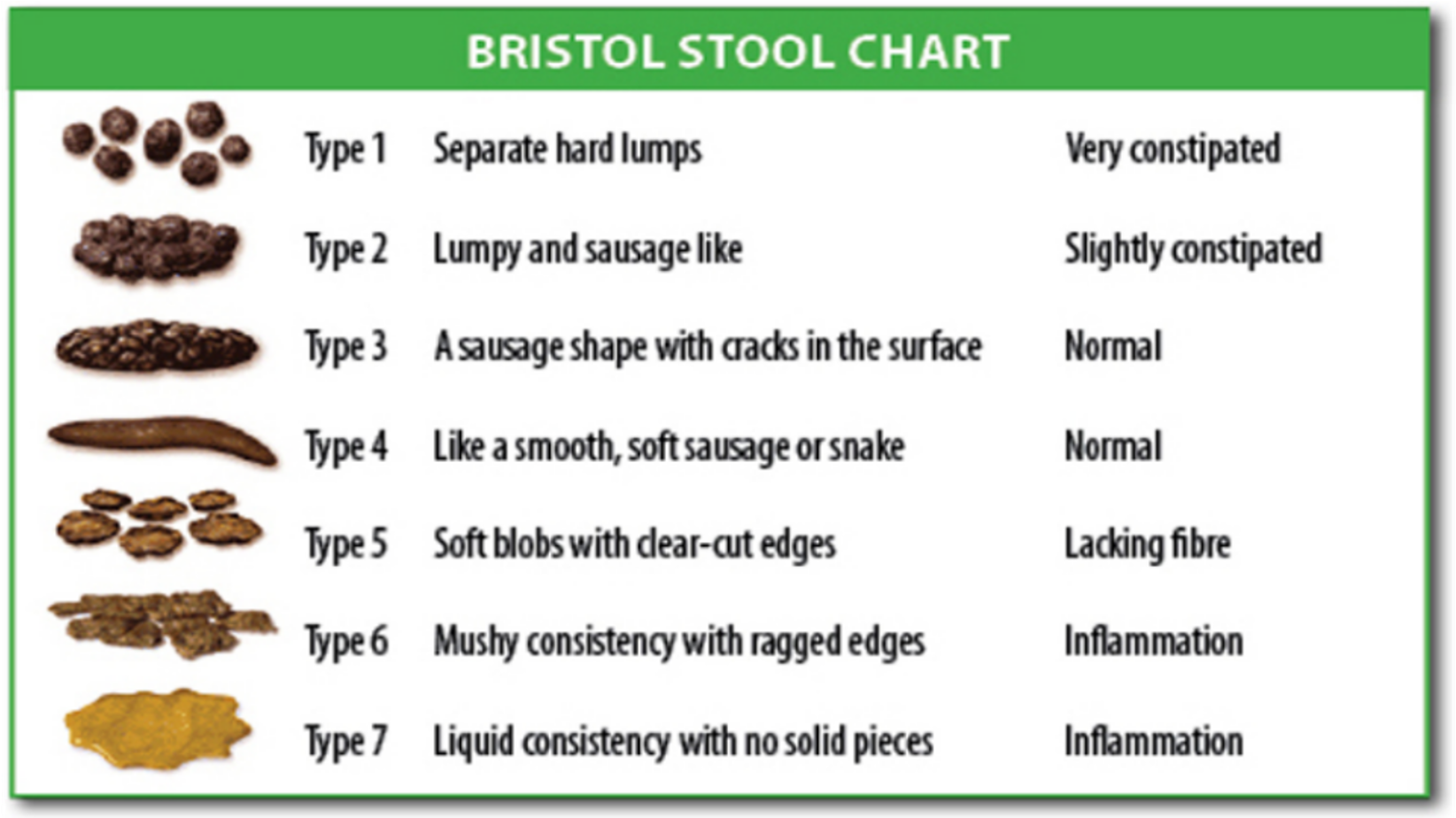
When taking a client’s health history, nurses should ask about:
Dietary practices: food preparation, food shopping and accessibility, healthy and unhealthy food choices, cultural or religious food preferences, meal timing, food allergies or intolerances
Nutritional supplements: vitamins, minerals, herbal or natural supplements, need for nutritional counseling
Oral health: dental history, tooth or gum disease, oral mucosal integrity
Appetite: recent changes
Preventive health: hydration habits, exercise habits, colonoscopy history
Bowel movements: changes in patterns
Weight: recent unintended weight gain or loss
Drug Therapy for Gastritis/ Peptic Ulcers- 6
•cimetidine (Tagamet) – Histamine (H2) Antagonist
•omeprazole (Prilosec) - Proton Pump Inhibitor
•sucralfate (Carafate) - Mucosal Protectant
•aluminum hydroxide (Amphojel) – Antacid
•misoprostol (Cytotec) - Prostaglandin E Analog
•Antibiotics- clarithromycin (Biaxin), amoxicillin (Amoxil), metronidazole (Flagyl), tetracycline
Histamine (H2) Antagonist – “dine”
cimetidine (Tagamet)
Action
•Blocks histamine receptors to stop gastric acid production
•Short-term tx of active duodenal and active benign gastric ulcers, erosive GERD, and hypersecretory conditions
Histamine (H2) Antagonist – “dine”
cimetidine (Tagamet)
ADR
diarrhea
headache
dizzy
confusion
agranulocytosis
gynecomastia
Histamine (H2) Antagonist – “dine”
cimetidine (Tagamet)
•Client instructions/Nursing considerations:
•Best if taken 30 minutes before breakfast
•Avoid antacids within 1 hour of administration
Histamine (H2) Antagonist – “dine”
cimetidine (Tagamet)
contraindi- •Drug Interactions
•Warfarin
Phenytoin
Theophylline
Metronidazole
Ketoconazole
Proton Pump Inhibitor (PPI) – “zole”
omeprazole (Prilosec)
Action
•Suppresses gastric acid secretion by inhibiting the H+, K+, ATPase enzyme system (proton pump)
Used for Peptic Ulcers, GERD, Erosive esophagitis, & H. pylori
Proton Pump Inhibitor (PPI) – “zole”
omeprazole (Prilosec)
ADR
diarrhea, abd pain, ha, n/v, zinc/magnes/b12 deficiency, pneumonia, osteoporosis
Proton Pump Inhibitor (PPI) – “zole”
omeprazole (Prilosec)
pt instruct
•Assess for worsening GI symptoms
•Given with or without food
•Avoid antacids within 1 hour of administration
•Monitor for respiratory infection and/or pneumonia with
Proton Pump Inhibitor (PPI) – “zole”
omeprazole (Prilosec)
contraind
•Rilpivirine
Proton Pump Inhibitor (PPI) – “zole”
omeprazole (Prilosec)
Assess for Worsening GI Symptoms
When assessing a client’s response to medications for hyperacidity and antiulcer treatment, monitor signs and symptoms of GI distress—weight, bowel habits, nausea, vomiting, abdominal pain, bloating, or belching. Follow provider instruction on dietary intake; some GI conditions require increased fiber and fluids, while others may require “bowel rest” that involves smaller meals with soft foods.
Proton Pump Inhibitor (PPI) – “zole”
omeprazole (Prilosec)
Drug Interactions
Amoxicillin
Clarithromycin
Diazepam
Proguanil
Moclobemide
Phenytoin
Warfarin
Mucosal Protectant
sucralfate (Carafate)
Action
•Coats ulcer via chemical reaction
Mucosal Protectant
sucralfate (Carafate)
ADR
constipation, generally well-tolerated
Mucosal Protectant
sucralfate (Carafate)
admin
Give on empty stomach 1 hour before meals
Avoid antacids 30 minutes before or after taking
Avoid all other other medications 2 hours before or after taking
Antacids
calcium carbonate
Action
•Antacids neutralize gastric acidity and elevate the pH of the stomach. Elevated pH also inactivates pepsin, a digestive enzyme.
Relieve heartburn, acid indigestion, and upset stomach.
Antacids
calcium carbonate
ADR
constipation, rebound hyperacidity, hypercalemia
Antacids
calcium carbonate
pt instruct
•Take with a full glass of water
•Do not administer calcium carbonate within 1-2 hours of other medicines
Antacids
calcium carbonate
contraindi
• preexisting kidney disease
Antibiotics types
•Clarithromycin (Biaxin)
•Amoxicillin (Amoxil)
•Metronidazole (Flagyl)
•Tetracycline
antibiotics used for
H. Pylori infections
Pathophysiology of Nausea & Vomiting
Nausea and vomiting are
protective reflexes controlled by the medulla oblongata in the brain.
three primary input pathways that trigger the vomiting response:
Vomiting Center (VC)
Chemoreceptor Trigger Zone (CTZ)
Vestibular Center
Vomiting Center (VC)
Located in the medulla
Directly stimulated by odor, taste, pain, and emotional stress
Coordinates the muscular response to produce vomiting
Chemoreceptor Trigger Zone (CTZ)
Located outside the blood–brain barrier
Sensitive to toxins, medications, metabolic imbalances
Activates the vomiting center when harmful substances are detected
→ This is why many anti-emetic drugs act on CTZ receptors
Vestibular Center
In the inner ear balance system
Stimulated by motion or vertigo
Uses acetylcholine and histamine pathways
→ Targeted by antihistamines for motion sickness
Motor Response
VC sends signals to: 3 places
Diaphragm – contracts forcefully
Abdominal muscles – compress stomach contents
Esophageal sphincters – relax to allow expulsion
Nausea vs. Vomiting
Nausea =
Vomiting =
Nausea = subjective sensation of needing to vomit
Vomiting = physical forceful expulsion of gastric contents
Key Takeaways
Nausea and vomiting are central-nervous-system mediated reflexes
Medications help by blocking neurotransmitters in one or more pathways (e.g., dopamine, serotonin, histamine)
Drug Therapy for Nausea- antiemetics
•ondansetron (Zofran) - Serotonin Antagonist
•Scopolamine- Antihistamine/Anticholinergic
•metoclopramide (Reglan) - Dopamine Antagonist/Prokinetic
Serotonin Antagonist – “tron”
ondansetron (Zofran)
Action
•Blocks serotonin receptors in the GI tract, the chemoreceptor trigger zone (CTZ), and the vomiting center (VC)
•Indication: Nausea
Serotonin Antagonist – “tron”
ondansetron (Zofran)
ADRs
dizzy, HA, constipation
Serotonin Antagonist – “tron”
ondansetron (Zofran)
pt instruct
admin PO or IV
30 min before chemo
1 hr pre op, and gain post op
1-2 hr prior radiation therapy
Serotonin Antagonist – “tron”
ondansetron (Zofran)
acts by
inhibiting the serotonin receptors and preventing activation of the vomiting reflex.
Serotonin Antagonist – “tron”
ondansetron (Zofran)
one of the most effective antiemetics used to treat
postoperative nausea and vomiting as well as nausea and vomiting associated with chemotherapy and radiation therapy.
Serotonin Antagonist – “tron”
ondansetron (Zofran)
what can occur if administered concurrently with other serotonin antagonists or selective serotonin reuptake inhibitors.
serotonin syndrome
rare but serious adverse effect of ondansetron is
QT prolongation that can cause an abnormal cardiac rhythm
Prokinetics
metoclopramide (Reglan)
Action
•Metoclopramide blocks dopamine and may also sensitize tissues to acetylcholine
• Promotes peristalsis
Prokinetics
metoclopramide (Reglan)
ADRs
drowsy, restless, •Movement disorders- Tardive Dyskinesia, SI/depression
Prokinetics
metoclopramide (Reglan)
pt instruct
•Report depression or abnormal muscle movements
• Can be administered orally, intramuscularly, and intravenously
Prokinetics
metoclopramide (Reglan)
contraindi
•Gastrointestinal hemorrhage, mechanical obstruction, or perforation
•Pheochromocytoma
•Seizures
Prokinetics
metoclopramide (Reglan)
Health Teaching & Health Promotion
Teach clients to immediately inform the health care provider if they experience new feelings of depression or abnormal muscle movements they cannot control
such as the following:
Lip smacking, chewing, or puckering of the mouth
Frowning or scowling
Sticking out the tongue
Blinking and moving the eyes
Shaking of the arms and legs
Antihistamine/Anticholinergic
scopolamine
Action
block ACh receptors in the vestibular center and within the brain to prevent nausea-inducing stimuli to the chemoreceptor trigger zone (CTZ) and the vomiting center (VC). They also dry GI secretions and reduce smooth muscle spasms
Antihistamine/Anticholinergic
scopolamine
indication
•Prevent motion sickness and treat nausea and vomiting
Antihistamine/Anticholinergic
scopolamine
ADRs
•sedation, anticholinergic effects
blind as bat- dilated pupils
dry as bone
red as beet- flushed skin
mad as a hatter
tcahycardic
Antihistamine/Anticholinergic
scopolamine
methods of admin
•oral, subcutaneous., or transdermal patch
Drug Therapy for Constipation
•psyllium (Metamucil) - Bulk-Forming Agent/Laxative (Fiber supplement)
•docusate sodium (Colace) - Surfactant Laxative/Stool Softener
•bisacodyl (Dulcolax) - Stimulant Laxative
•psyllium (Metamucil) - Bulk-Forming Agent/Laxative (Fiber supplement)
actions
Absorbs water from the intestines, stimulates peristalsis, adds bulk
•psyllium (Metamucil) - Bulk-Forming Agent/Laxative (Fiber supplement)
ADRs
esophageal obstruction
•psyllium (Metamucil) - Bulk-Forming Agent/Laxative (Fiber supplement)
pt instruct
Patient must take with at least 8 oz of liquid
Powder form is mixed with liquid & taken immediately
Monitor I&Os
Decreases absorption time of other PO meds
•docusate sodium (Colace) - Surfactant Laxative/Stool Softener
action
Changes surface tension of stool, increases absorption of water