ANATOMY OF PHONATION PT 1 -Cartilages
 Call Kai
 Learn
Learn Practice Test
 Spaced Repetition
 Match
Match Flashcards
 Knowt Play
1/82

Earn XP
Description and Tags
Be able to explain the biological functions of the larynx For each of the cartilages (and the hyoid bone) of the larynx, be able to: Identify it on a diagram Describe its structure (including the type of cartilage, landmarks, and how it is positioned and attached relative to the other cartilages) Describe its function(s) and/or purpose(s), and movement (if it moves) Describe how all of the laryngeal cartilages (and the hyoid bone) work together for phonation (adduction, abduction, and pitch changes)
Name | Mastery | Learn | Test | Matching | Spaced | Call with Kai | Chat |
|---|
No analytics yet
Send a link to your students to track their progress
83 Terms
What are the biological functions of the larynx?
P,P,B,L,C,D
Airway protection, phonation, breath holding, lifting/stabilizing the trunk, childbirth, and defecation
How does the larynx help with lifting?
It helps with lifting and stabilizing the trunk.
How does the larynx protect the airway?
It seals the airway when foreign objects enter, usually food or liquid
What is the larynx’s “last safety valve”?
It helps prevent foreign matter from entering the airway.
What is penetration?
Material enters the airway but does not go below the vocal folds.
What is aspiration?
Material enters the airway and goes below the vocal folds.
There are _____ unpaired cartilages AND _____ paired cartilages in the _______
3; 3; Larynx
3 unpaired cartilages ARE:
Cricoid
Thyroid
Epiglottis
3 paired cartilages ARE
Arytenoid
Corniculate
Cuneiform
Hyaline =
firm/supportive
Elastic =
flexible/bendy
3 unpaired cartilages: hyaline vs elastic
Cricoid –
Thyroid –
Epiglottis –
hyaline
hyaline
elastic
3 paired cartilages: hyaline vs elastic
Arytenoid –
Corniculate –
Cuneiform –
hyaline
elastic
elastic
Larynx: 1 bone
Hyoid bone

1
Hyoid bone
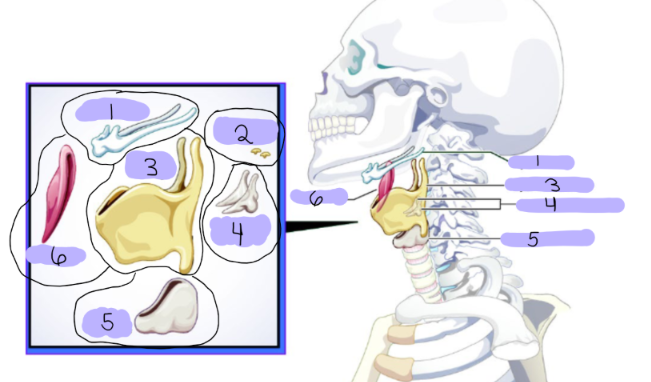
2
Corniculate

3
Thyroid

4
Arytenoid
5
Cricoid
6
Epiglottis
What type of cartilage is the cricoid cartilage?
Hyaline
Is the cricoid cartilage paired or unpaired?
Unpaired
What is the shape/structure of the cricoid cartilage?
Complete ring; looks like a signet ring
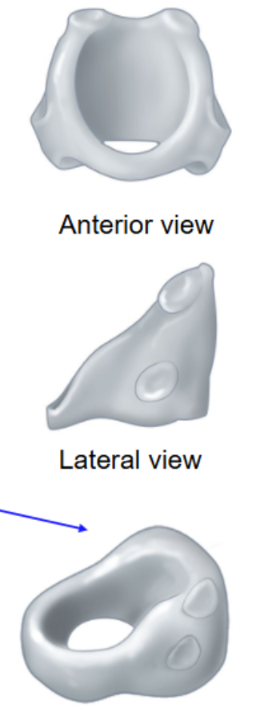
Where is the cricoid cartilage located?
At the top of the trachea
What is the position of the cricoid cartilage compared to the thyroid cartilage?
Just below the inferior thyroid notch
How does the cricoid cartilage differ from front to back?
Thicker/higher in the back and thinner/narrower in front
What cartilage does the cricoid articulate with?
Thyroid cartilage
What joint connects the cricoid and thyroid cartilages?
Cricothyroid joint
What are the primary movements of the cricothyroid joint?
Rocking (rotating) and gliding (secondary)

Which cricothyroid joint movement is primary?
Rocking
What is the secondary cricothyroid joint movement?
Gliding
What type of cartilage is the thyroid cartilage?
Hyaline
Is the thyroid cartilage paired or unpaired?
Unpaired
What is the thyroid cartilage's main structural characteristic?
Largest laryngeal cartilage
What are the important landmarks of the thyroid cartilage?
the cricothyroid notch
What cartilage does the thyroid cartilage articulate with?
Cricoid cartilage
How does the thyroid cartilage articulate with the cricoid?
Via paired processes
What movements does the thyroid cartilage make with the cricoid?
Rocks forward and backward and glides
What joint allows the thyroid and cricoid cartilages to move together?
Cricothyroid joint
What is the relationship between cricothyroid movement and pitch
The movement can be observed during a pitch glide
What type of cartilage is the epiglottis?
Elastic
Is the epiglottis paired or unpaired?
Unpaired
What is the shape of the epiglottis?
Leaflike
What is the main function of the epiglottis?
Folds to protect the airway during swallowing
What is the small stem at the base of the epiglottis?
where the thyroepiglottic ligament attaches
What type of cartilage are the arytenoids?
Hyaline
Are the arytenoids paired or unpaired?
Paired
What shape are the arytenoid cartilages?
Tetrahedron, not pyramid
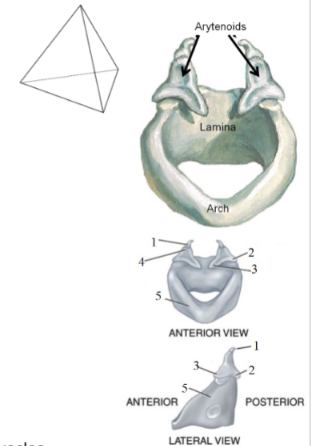
Where do the arytenoids sit?
On the high-backed posterior and superior (curved & angled) facet of the cricoid
What allows the arytenoids to have a wide range of movement?
Their articulation with the cricoid cartilage
What are the three movements of the arytenoids?
Rock, glide/slide, and rotate

What attaches to the posterior part of the arytenoids?
Vocal folds
What is the function of the muscular process of the arytenoid?
Attachment for abductor/adductor muscles

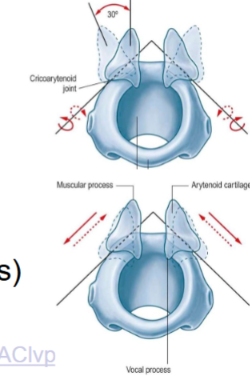
What is the function of the vocal process of the arytenoid?
Attachment for vocal fold muscles
What does rocking of the arytenoids allow the vocal folds to do?
Adduct/abduct and slightly shorten/lengthen
What does anterolateral gliding of the arytenoids affect?
Vocal fold length
How much rotation occurs around the arytenoid's vertical axis?
Very little
What cartilages are connected by the cricoarytenoid joint?
Cricoid and arytenoid
What are the movements of the cricoarytenoid joint?
Rocking, gliding, and rotating

Which cricoarytenoid joint movement is primary?
Rocking
If rotation occurs at the cricoarytenoid joint, how much occurs?
Minimal
What type of cartilage are the cuneiforms?
Elastic
Are the cuneiforms paired or unpaired?
Paired
Where are the cuneiform cartilages located?
Within the aryepiglottic folds
What is the function of the cuneiform cartilages?
Provide support for the aryepiglottic folds
What is a key landmark/location to remember for the cuneiforms?
Aryepiglottic folds
What type of cartilage are the corniculate cartilages?
Elastic
Are the corniculate cartilages paired or unpaired?
Paired
Where are the corniculate cartilages located?
On the superior surface of each arytenoid
What are the corniculate cartilages a landmark for?
The aryepiglottic folds
Cricoid and thyroid cartilages are attached via the ____, ______, and posterior ______ligaments
anterior, lateral, ceratocricoid

Cricoid and arytenoid cartilages are attached via the ___________and posterior ____________ ligaments
anterior, cricoarytenoid

Is the hyoid a cartilage or a bone?
Bone
Is the hyoid paired or unpaired?
It is one bone, not a paired cartilage
What is the main structural role of the hyoid?
Union between the tongue and laryngeal structures
What is another important function of the hyoid?
Anchor point for the extrinsic laryngeal muscles
What does the hyoid loosely articulate with?
The superior cornu of the thyroid cartilage
What are the parts of the hyoid bone listed in lecture?
Greater and lesser cornu/horns and body
What are the three main parts of the hyoid?
Greater cornu, lesser cornu, and body
How the Cartilages Work Together for Phonation
Arytenoids
Rock to help the vocal folds adduct and abduct.
Their muscular processes provide attachment for the muscles that control abduction/adduction.
How the Cartilages Work Together for Phonation
Cricoid + Thyroid
The cricoid and thyroid form the cricothyroid joint.
The primary movement is rocking.
The secondary movement is gliding.
This joint is involved in changing vocal fold length and tension through the cricothyroid (CT) muscle.
How the Cartilages Work Together for Phonation
Thyroid Movement
The thyroid cartilage can rock forward and backward.
It can also glide.
How the Cartilages Work Together for Phonation
Pitch
The CT muscle rocks the thyroid downward.
This lengthens and tenses the vocal folds.
Lengthened and tensed vocal folds raise pitch