Food microbiology
 Call Kai
 Learn
Learn Practice Test
 Spaced Repetition
 Match
Match Flashcards
 Knowt Play
1/57

There's no tags or description
Looks like no tags are added yet.
Name | Mastery | Learn | Test | Matching | Spaced | Call with Kai | Chat |
|---|
No analytics yet
Send a link to your students to track their progress
58 Terms
development microbiology
people knew of problems but not what caused them → that came between 1632-1723 Antoni Van Leeuwenhoek
Nicolas Appert → method of cooking foods at 100 degrees for several hours in glass jars
Louis Pasteur→ disocvered chiral components, invented pasteurization, saw that spontaneous generation is not possible, vaccination rabies → first microbiologist
1896- first documents on food poisoning case that was actually investigated on specific bacteria/cultures
until 1960 food research was mostly descriptive and qualitative science to determine what happens
now its more of a science
modern methods unravel underlying principles
-Genomics (genes present)
-Transcriptomics (gene expression)
-Proteomics (protein)
-Metabolomics (product metabolism)
food microbiology is an ancient field but it constantly evolves by changes in
food microbes
food research
food control
food consumption
spoilage and its causes
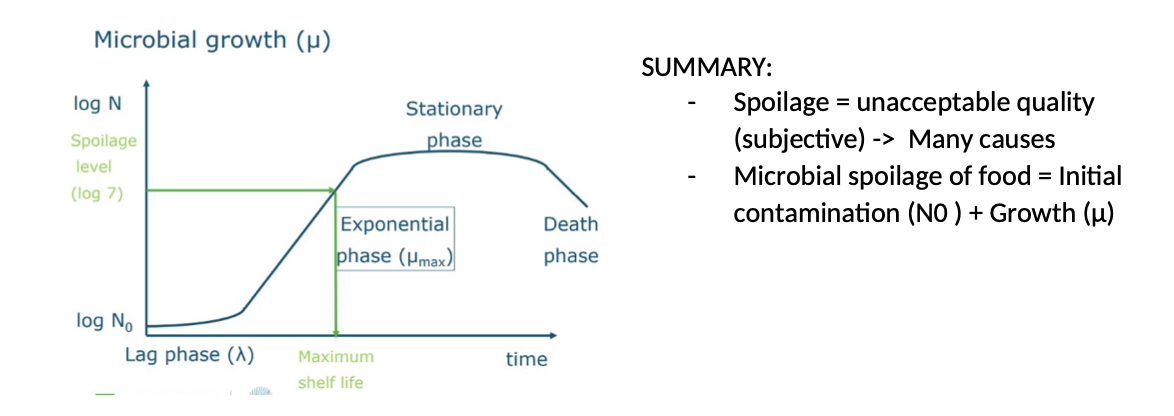
spoilage= unacceptable quality (subjective), process of decreasing quality
causes- microbial (acidification, odor formation), mechanical (bruised, broken), insect damage, chemical and enzymatic (browning, fat oxidation), physical physiology of product itself (over ripening)
microbial spoilage
mostly metabolic products produced during growth
sometimes also microbes themselves (mould)
rule of thumb (convention); spoilage becomes notable at 10^7 cells (cfu) per gram food/ml liquid food
shelf life depends on initial contamination of the food (No) and proliferation (growth in time (µ))
Initial contamination (N0)
Primary contamination raw materials:
Animals: skin, intestines
Plants: soil, manure, water
Secondary contamination
Water: process, rinsing, cooling, cleaning
Equipment: machines, tools, surfaces
Air: aerosols, dust
People: hands, hairs, coughing, sneezing
Vermin: rodents, birds, insects
- Many organisms are needed: growth is exponential
- Lag phase -> exponential phase -> stationary phase -> death phase
- Shelf life is mainly determined by lag phase & exponential growth phase until spoilage level is reached
microbial spoilage of food=
initial contamination N0 + growth µ
contamination with microorganisms
Micro-organisms: organism on micrometer scale (µm) 1 µm=0.001
mm:
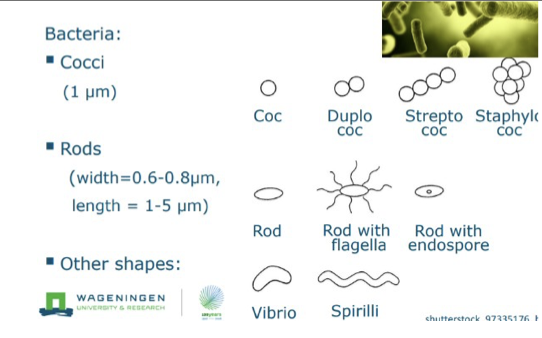
Bacteria:
Cocci: 1 µm
flagella
o Other shapes:
Vibrio
spirilli
o Rods: width=0.6-0.8 µm, length=1-5 µm. Rods can contain endospores, and may have a
Fungi
o Yeasts:
o Moulds
5-10 times bigger than bacteria 10 µm unicellular
Remain as unicellular organisms
Often grow by budding
Grow as multicellular organisms: Filamentous fungi (multicellular
10 µm multicellular
Viruses
Viruses 40x smaller than bacterial coc
Virus (25-30nm= 0.025-0.030 µm) (too small to be seen with light microscope)
Strictly no micro-organism (needs host to multiply)
Doesn’t grow in food; yet major cause foodborne disease
Parasites
- Are sometimes transferred by foods
- Tick for example not
sizes of microorganisms
Microorganisms: Micro: 1 mm is 0.001 mm
Parasites>moulds>yeasts>bacteria>viruses
Viruses (≈ 0.03 – 0.3 mm)
Bacteria (≈ 0.5-5 mm)
Yeasts (≈ 5-15 mm)
Moulds (> 5 mm)
Parasites (> 5 mm)
ecological niche
suitable environment which has resources needed for growth (nutrients), physico-chemical conditions that do not hinder the organism (ex. pH within acceptable limits)
the typical flora of a certain environment- repeatedly found over time, properties best fitted for survival in that environment (competitive advantage)
growth kinetics
food is spoiled before the stationary phase is reached (spoilage level log7), the main relevance is the lag phase and the exponential phase

exponential phase
if bacterium is adapted to its environment and has sufficient nutrients, it will start multiplying, it then divides at approximately constant time intervals: generation time GT (time needed for the population to double)
often a logarithmic scale is used to linearize the growth
pay attention because sometimes log is used and sometimes ln, if ln is used different scale

exponential growth is log linear growth
N= number of generations
growth kinetics- study of increase of cell number in time (growth rate)
kinetic model- describes growth kinetics mathematically

worst case- exponential growth (lag time λ = 0)
in order to make shelf life longer
either increase the upper nominator (decreasing level of initial contamination) or decrease the denominator (decrease the growth rate)
growth rate influenced by
intrinsic factors: (physio chemical properties of food) nutrients, pH, water activity, preservatives
Extrinsic factors: (properties of food environment) temperature, relative humidity, gas composition
Implicit factors: (properties and interactions mo) µmax, interactions, succession in time
Processing (changed food/environment/mo) to perserve (pasteurisation, irradiation) to process to desired product (slicing, packing)
microorganism have metabolism (except viruses)
catabolism- the metabolic routes involved in the degradation of a carbon and energy source to generate precursors for cell components and energy for cell maintenance
anabolism- the metabolic routes involved in the biosynthesis of polymeric cell compounds (DNA, RNA, protein, lipids, cell wall constituents)
micro organisms in foods
mostly chemoheterotrophs: use performed molecules from other organisms as energy and carbon source
enzymes are important in metabolism: help to transform substrate (food) in products (metabolites)
food may contain: starch, glycogen, lactose, glucose, protein, peptides, amino acids, lipids, free fatty acids, spore elements, vitamins, water
antimicrobial barriers protect nutrients
physical barrier shell of nuts, macromolecules, resistant to degradation peel of fruit or fatty lining of meat
aim: to hinder growth → longer shelf life: lack of access to water, lack of access to nutrients, no protection against environment (UV, desiccation)
difference between micro organisms
some have enzumes set to attack macromolecules, for example moulds in nature recycle a.o. dead leaves of plants
fastidious, ex. no growth on fruits lacking vitamin B, for example lactic acid bacteria are milk adapted (milk is rich in nutrients)
barrier degrading enzymes (break down antimicrobial barriers):
pecolytic enzymes, amylolytic enzymes, lipolytic enzymes and proteolytic enzymes
types of enzymes table

what happens with meat
meat is rich in proteins, has high water activity
easiest components for example glucose is broken down first, then the next, etc .
typical meat spoilage flora Pseudomonas prefers glucose> lactic acid>creatine
how to perserve nutrients and barriers?- by changing product formulation (increase or decrease nutrients), by processing (introduce or remove barriers)
application 1- increasing nutrients
fermented sausage- lactic acid bacteria should produce lactic acid quickly to protect against pathogenic bacteria
problem- lactic acid bacteria have high requirement for manganese
solution- add extra nutrients to the sausage ex. spices (Containing manganese)
application 2- introducing new barriers
example butter- water in oil emulsion
microbial spoilage- lipolytic enzymes produced by cold loving pseudomonas cells from wash water
compartmentalization- seperate cells from nutrients by making very small water droplets
pH
describes the acidity of a substance
Acidic (pH<7): stomach acid (2), vinegar (3)
Neutral (pH=7) pure water
Alkaline (pH>7) soap (10), bleach (13)
growth rate declines when the pH does not equal the optimal pH
difference between microorganisms:
most foodborne bacteria: optimal pH; about 7
yeast: optimal pH about 4.5
moulds: optimum pH about 3.5


we have acidophilic organisms, nuetrophilic organisms, alkalophilic organisms based on which environment they prefer
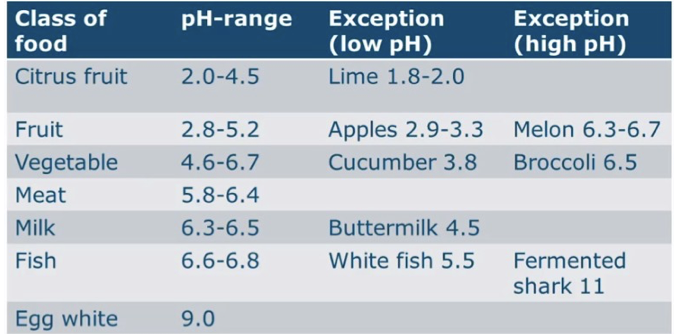
class of food vs, pH range
difference between acids
strong acids directly dissociate into their proton and anion
however many organic acids do not totally dissociate → there is an equilibrium between the dissociated and undissociated form this ration is described by:

this distinction between A- and HA concentration is important because undissociated acids pass the membrane easily
so if food product has a low pH, is very acidic it has much H+ so a lot of undissociated acid is formed and can pass the barrier, within the cell it is more nuetral and acid can now again dissociate making the interior of the cell more acidic, the organism now transports H+ to the outside of the cell to keep the inside nuetral which costs a lot of energy for the cell which slows down the growth of the micro organism
so pumping protons out slows growth of microorganisms
the higher the pKa the more undissociated acids we have → the more this process takes place
applications of pH in food preservation
fermentation- lactic acid bacteria produce weak acids (lactic acids) → that lower pH → and inhibit growth of pathogenic bacteria (applied in salami and sauerkraut)
acidic preservative- add acid to lower pH
pitfalls of pH in food preservation
pathogenic bacteria can grow in low acid food products if the pH > 4.5, and therefore these products generally need to be stringently cooked in order to inactivate these pathogens
we can lower the pH in order to inhibit growth of pathogenic bacteria however if we do so in certain products this allows for moulds and yeasts to grow as these are much more resistant to low pH environments → they then break down (dissimilate) the acid → increasing the pH again → allowing for these pathogens to grow again
this also allows for other acid tolerant bacteria to growm proteolytic microorganisms can also break down acid
pathogenic bacteria can grow
Redox potential
Eh = tendency of a medium to accept or donate electrons
o Characteristic of food product => so intrinsic factor!
o Gas atmosphere => extrinsic factor

aerobic organisms: gain energy by making use of oxidative phosphorylation using O2 as terminal electron acceptor
superoxide dismutase and catalase are enzymes present in aerobic organisms that break down/disable the toxic products of oxygen

Anaerobic organisms do not contain the enzymes SOD or catalase, and thus cannot grow at high redox potentials in presence of O2
terms to describe oxygen preference
obligate aerobe- needs atmospheric O2 for growth ex. Bacillus
microaerophile- requires O2 below 0-10% damaged by 20% O2 ex. campylobacter, can grow in atmospheric O2 if oxygen scavenger pyruvate is present
facultative anaerobe- do not require O2, grows better with O2 ex. E.coli
Aerotolerant anaerobe- Grows equally well in presence or absence of O2 ex. lactic acid bacteria, uses accumulation of manganese to destroy superoxide radical
obligate anaerobe- does not tolerate O2 and dies in its presence ex. clostridium
redox potentials in foods
negative Eh: whole grain wheat (-360), meat (-200)
positive Eh: spinach (+74), lemon (+383), pear (+436)
effect of other factors: milling, grinding → higher access to O2 → higher Eh, steak vs minced meat
Low pH → many H+ → higher Eh
Nernst equation

58 mV increase of Eh when pH drops one unit
So redox potential Eh is determined by the temperature, amount oxidant, amount reductant and proton concentration
The more acidic the food -> the H+ concentration is higher -> Eh higher
This is why lemon and pear also have a high redox potential, oxygen is present and are acid food products
Microbial growth -> consume oxygen (-> sometimes produce reductants like hydrogen) ->less O2 -> lower Eh of the food
The effect of carbon dioxide in gas atmosphere
CO2 together with water can dissolve in the water phase and transform to carbonic acid: CO2 + H2O → H2CO3 (carbonic acid)
Carbonic acid can partly dissociate into bicarbonate and a proton
H2CO3 → H+ + HCO3- (bicarbonate pK =6.4)
lowering the pH of the food product
this carbonic acid is a weak acid and can have a weak acid effect on the bacterial growth → it can enter the bacterial cell and dissociate there, acidifying the interior of the cell
so carbon dioxide in the gas phase has an antimicrobial effect: most sensitive micro organisms: moulds, oxidative gram - bacteria, most resistant micro organisms are gram + bacteria (especially lactobacilli) and some yeasts (Brettanomyces spp.)
growth inhibition of CO2 works best when: larger effect with oxygen O2 present than without, larger effect at low temperature: because at lower temp CO2 has a higher solubility in water (higher carbonic acid concentration in the water phase)
application in preservation: vacuum
vacuum packaging: exclude all air from the package
within the package; if a little oxygen still present, the product or microorganism still consumes that oxygen and respires → residual respiration → O2 is consumed → and CO2 is produced a little → working positively even more inhibiting for microbial growth/flora
application: cooked meats, fish, prepared salads
colour of meat changes, as haemoglobin and haemoglobin change color due to absence of oxygen so often MAP is used instead
application in preservation: MAP
MAP- modified atmosphere packaging
package is flushed with gas mixture (O2 down (but still present (red color remains), CO2 up)), example is bread or meat
atmosphere changes during storage (respiration of product/mo; permeability to gases of packaging)
application in perservation: CAP
Controlled atmosphere packaging
used for large storage rooms: fruit, bulk container
atmosphere is changed and kept constant
even if respiration or exchange with outside → atmosphere is brought back to stay constant
Water activity and relative humidity
water activity is an intrinsic factor and relative humidity an extrinsic factor
water activity is a measure of free water (the other fraction of water is bound in food)

water activity differences between microorganisms
xerophilic- grow on dry foods (aw, min=0.6), fungi (dehydrated foods) as aspergillus
Osmophilic- grow: in high concentrations of unionized compounds (sugar), aw, min=0.62, yeasts as Zygosaccharamyces baili (jam)
halotolerant- grow in salted products (tolerate elevated levels of sodium chloride), staphylococcis aureus (cooked meat products)
halophilic (obligate); requires high levels of salt (sodium chloride), usually above about 0.2M to grow
Vibrio parahaemolyticus (inshore water)

we can see that bacteria tend to grow at higher water activities, with staphylococcus and halophilic bacteria growing at relatively low water activities
yeasts grow at lower water activites than bacteria
moulds are abe to grow at even lower water activities
microorganisms are not able to grow in foods which have water activity of 0.6 or lower
reduce aw

preservation pitfalls
Preservation pitfall: non-microbial spoilage
- Best growth at higher water activities: bacteria>yeasts>fungi
- But at lower water activities non microbial spoilage takes place:
Enzyme activity, non-enzymatic browning and lipid
oxidation, So for example powder products can spoil not by
microorganisms but by lipid oxidation
Preservation pitfall: local changes in aw
- Bulk commodities (ships, silo’s) and packaged products
Sun shines, temperature rises, water evaporates
Sun down (or moves), temperature drops, water condensates on top of the product
-> area with local higher aw, microbial growth possible
- Effect accelerated by micro-organisms, e.g. fungi producing extra moisture allowing other organisms to grow also
Preservation pitfall: product reformulation
- For Health we often want to remove sugar & remove salt -> then we take away limits that
stop bacterial growth: for example in hazelnut conserve
Old process: 10 min heating 90°C + glucose syrup
New process: 10 min heating 90°C + aspartame
- Effect new product formulation:
Aspartame does not reduce aw
Hazelnut preparation: low-acid food with pH 5.0-5.5
Clostridum botulinum spores surviving the heat treatment of puree can grow out and
produce toxin
Effect on people 27 people sick, 1 person died
Preservatives
substances capable of inhibiting, retarding or arresting the growth of micro-organisms or any deterioration resulting from their presence or of masking the evidence of any such detoriation
- Not: substances added to with primary aim to inhibit chem reactions (e.g. antioxidants)
or to emulsify (phosphates)
- Effect:
Microbicial (kill)
Microbistatic (prevent growth)
Natural preservatives: present in product
- Milk:
o Lactoperoxidase system: hydrogen peroxide and theoxinate form toxic
component for microbial growth
o Lysozyme
o Lactoferrin
o Antibodies
-Eggs:
o Lysozyme
o Avidine
o Conalbumine
o (alkalic pH + egg shell barrier)
Added preservatives
Added preservative: Acids
- Protect against all kinds of micro bacteria
- Certain acid concentrations are needed

Added preservative : Sulfite SO2
- SO2 can penetrate cells (like undissociated acids), best applied at low pH foods
- Mechanism: disrupts microbial metabolism
- Use: inhibit yeast and lactic acid bacteria
Wine production: wine yeast Saccharomyces cerevisiae tolerant to SO2 levels around 100 mg/l
Fruit storage: dried fruits (raisins)
Drawback: destroys vitamin B1 (thiamine)
Use in meat products prohibited (with some exceptions)
Added preservative : Nitrite
- Nitrite is used in meat products
- Nitrite above 100 mg/kg inhibits Clostridium botulinum, which might survive the heating
process applied to many cured meats
- Drawback:
Nitrate + secondary amine -> N-nitrosamines15
N-nitrosamines are thought to be carcinogenic
By Addition of asorbic inhibits this reaction -> soften together
Added preservative: Natural
Chemical preservatives perceived unnatural
Quest for “natural” alternatives:
Bacteriocin (nisin)
Essential oils (plants)
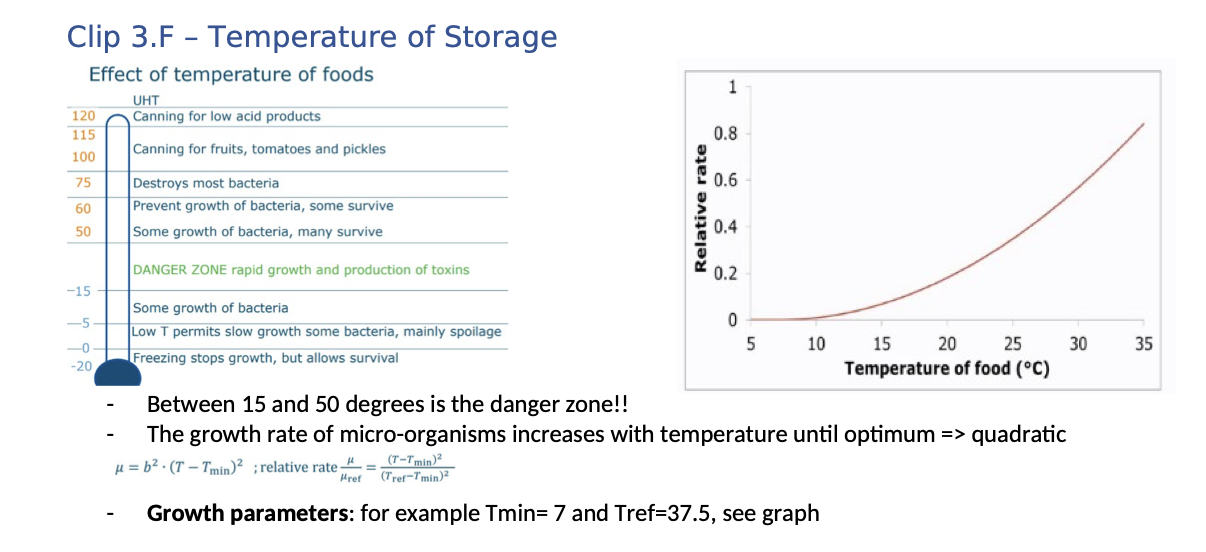
temperature of storage
Psychrophile
Love the cold, have a max growth temp of 15-20 degrees, don’t grow in our bodies for example
- Moulds (frozen, low Aw foods)
- Microflora originating from cold blooded animals (fish)
Tmin=-5 to 5
Topt =12-15
Tmax =15-20
Psychrotolerant
Able to grow at low temp & warmt temp, but like higher temperatures.
- Pseudomonas (rich,wet,O2 )
- Lactobacilli (rich, wet, no O2 )
Tmin=-5 to 5
Topt=25-30
Tmax=30-35
Mesophile
Like intermediate temperatures
- Microflora warm-blooded animals (man, cattle, poultry)
- Entero’s as E. coli, Salmonella
Tmin= 5-15
Topt=30-40
Tmax=40-47
Thermophile
Like the heat, not able to grow at room temp
- Bacillus stearothermophilus
- Desulfotomaculum nigrificans
- Cl. thermosaccharolyticum
Tmin=40-45
Topt=55-75
Tmax=60-90
Thermotolerant (Thermoduric)
Like heat very resistant to heat treatment.
- Thermoduric vegetative cells: Microbacterium, Enterococcus
- Sporeformers: Bacillus(O2 ), Clostridium(no O2 )
Withstand T> Tmax (survives mild pasteurization)17
- As we can see some pathogens can still grow in the freezer at 5 degrees,
- Pseudomonas can grow at very low temperatures (-8), however since at temp below 0 water is mainly in the ice state, and thus based on water activity it cant grow at 8. But at low temp this is the fastest grower!
difference between growth rate (mew) and generation time (GT)
Growth rate measures how fast a microbial population increases in number or mass over a specific period, whereas generation time measures the exact time it takes for a population to double
implicit factors
properties of microorganisms themselves, as well as interactions between microorganisms
properties of microorganisms: growth
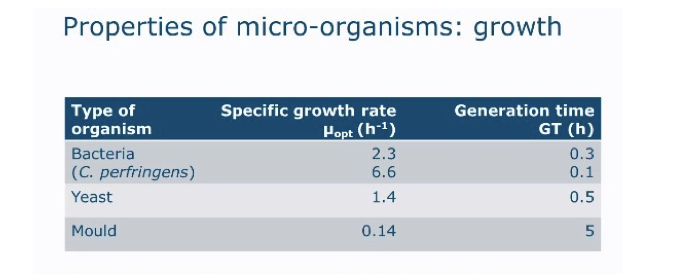
Bacteria have the greatest specific growth rate and shortest generation time
Clostridum perfringens has the fastest specific growth rate of 6.6 and generation
time of 0.1h= 6 minutes
Under optimum conditions highest growth rate Bacteria>Yeasts>Moulds
Highest growth rate generally dominates flora
Not only µopt, also conditions
Bacteria cannot dominate if growth rate is limited by unfavourable conditions (low
aw, low pH)
Properties of Microorganisms: pre-history/physiological state
Depends on history of the cell
- Physiological state
Organism comes from exponentially growing cells
If conditions are still good in new niche -> will just continue growing
Or does it grow from Stationary phase cells
Needs to re-adapt to new food product will at beginning have slower growth
-Previous exposure to environmental stresses
The organism needs some time before it takes off
Injury caused by freezing, or desiccation
Or Endospore formation
First have to germinate and become a cell
examples of interactions in food vs between micro organisms

Type of interaction | A | B | In words |
Competition | - | - | Both populations compete for the same limiting resources (nutrients, space), negatively affecting each other. |
Symbiosis (obligate mutualism) | + | + | Both populations mutually benefit and are physiologically dependent on each other. |
Mutualism / synergism (facultative) | + | + | Both populations benefit from the association, but the relationship is not obligate. |
Commensalism | + | 0 | Population A benefits, while population B is unaffected. |
Succession / proto-cooperation | 0 | + | Population A creates conditions or releases metabolites that allow population B to grow. |
Amensalism / antagonism | - | 0 | Population A secretes compounds or sequesters nutrients, which lowers the growth of B. |
mutual interaction can be beneficial, nuetral, detrimental
examples of interactions on surfaces
microorganisms can be found on surfaces in these structures
mono layer
thin biofilm
biofilm with internal structure

biofilm- protects microorganisms against cleaning and disinfection agents
quantitative microbiology hurdle effect
- Hurdle effect: combination of sub-optimal factors which preserves the product sufficiently
(where each factor on its own might not each this aim)
o E.g.: Fermented sasusage: sals and low pH and lactic acid
We need to understand how new factors affect influence the validity of food preservation -> safety
- New product formulation (less sugar or salt)
- New process (other inactivation treatment, can size)
- New packaging material (other gas permeability
- New target groups (storage in other climate)
- New micro-organisms (new country for raw materials, change in relevant resistance)
evaluation spoilage potential and health risk
We need to evaluate spoilage potential and health risk
1. As the expert?
a. Pr: quick, indication proposed change good or bad idea
b. Con: not quantative (size risk/shelf life?)
2. Challenge test = deliberately contaminate the product with organism(s) of
interest (spiking) and fallow the fate of the organism during distribution and
storage
a. b. 3. Pro: representative for the product and organism
Con: time consuming expensive, only representative for the
condition as used
Storage test= fallow the fate of the product without spiking (test under
natural conditions)
predictive microbiology
- Describe the fate of micro-organisms by mathematical
models
- Primary growth model: contamination level in time
(specific growth rate)
- Secondary growth models: describe the influence of
intrinsic and extrinsic factors of the food products (e.g. pH
and temp) on growth rate

gamma modelling
compare effect factors: Primary and
secondary growth models combined with characteristic of
microorganisms -> to calculate how fast a microorganism
will grow
- For example for Listeria:
o The fraction of µopt is termed “y”
o For Listeria µopt, =1h^-1


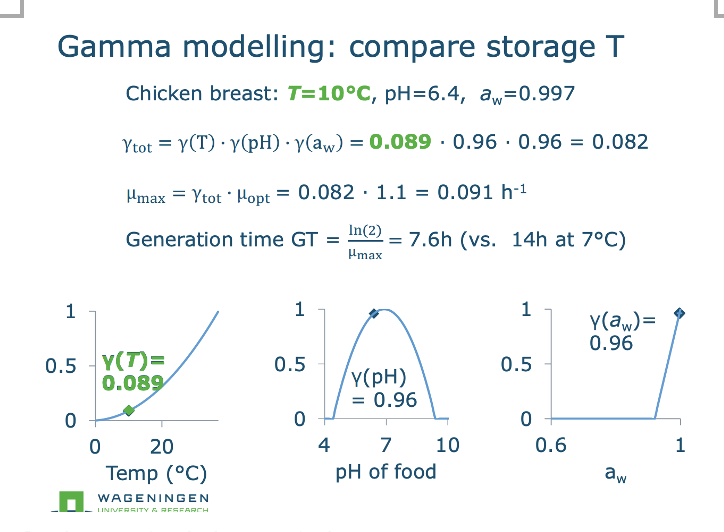
primary and secondary growth model
