unit 2 A&P - Heart Sound, Arteries, Vein
 Call Kai
 Learn
 Practice Test
 Spaced Repetition
 Match
 Flashcards
 Knowt Play
1/84

There's no tags or description
Looks like no tags are added yet.
85 Terms
Lub (S1)
closure of atrioventricular valves (mitral/tricuspid)
Dub (S2)
closure of semilunar valve (aortic/pulmonary valves) after ventricular contraction
bradycardia
slow heart beat (slower than 60 bpm)
tachycardia
fast heart beat (faster than 100 bpm)
pacemakers
electronic device in chest or abdomen that monitors heart rhythm and sends electrical pulse to help heart beat at normal rate
fibrillation
rapid unsynced contraction of muscle fibers, commonly occurring in heart walls; AFib happens in atria, VFib happens in ventricles which means drop in blood pressure and cardiac arrest
defibrillators
device that delivers shock to heart to restore it to a normal rhythm during cardiac arrest
ascending aorta

descending aorta

thoracic aorta
upper portion of the aorta (largest artery), carries OXYGENATED blood from heart to upper body before going down to lower body

abdominal aorta
carries OXYGENATED blood from heart to lower body

pulmonary trunk
carries DEOXYGENATED blood from right ventricle to the lungs

pulmonary arteries
carries DEOXYGENATED blood from right side of the heart into the lungs so it can pick up OXYGENATED blood

brachiocephalic artery

common carotid arteries

internal carotid arteries
supplies oxygenated blood into brain eye forehead

external carotid arteries
supplies oxygenated blood into neck face scalp

superficial temporal artery
branches off from external carotid artery

vertebral artery
The tiny artery close to the carotid

circle of willis (cerebral arterial circle)
Ring-shaped arteries at the base of the brain that connect the front and back circulation; made up of the anterior communicating artery, anterior cerebral artery, posterior communicating artery, posterior cerebral artery

subclavian artery

axillary artery
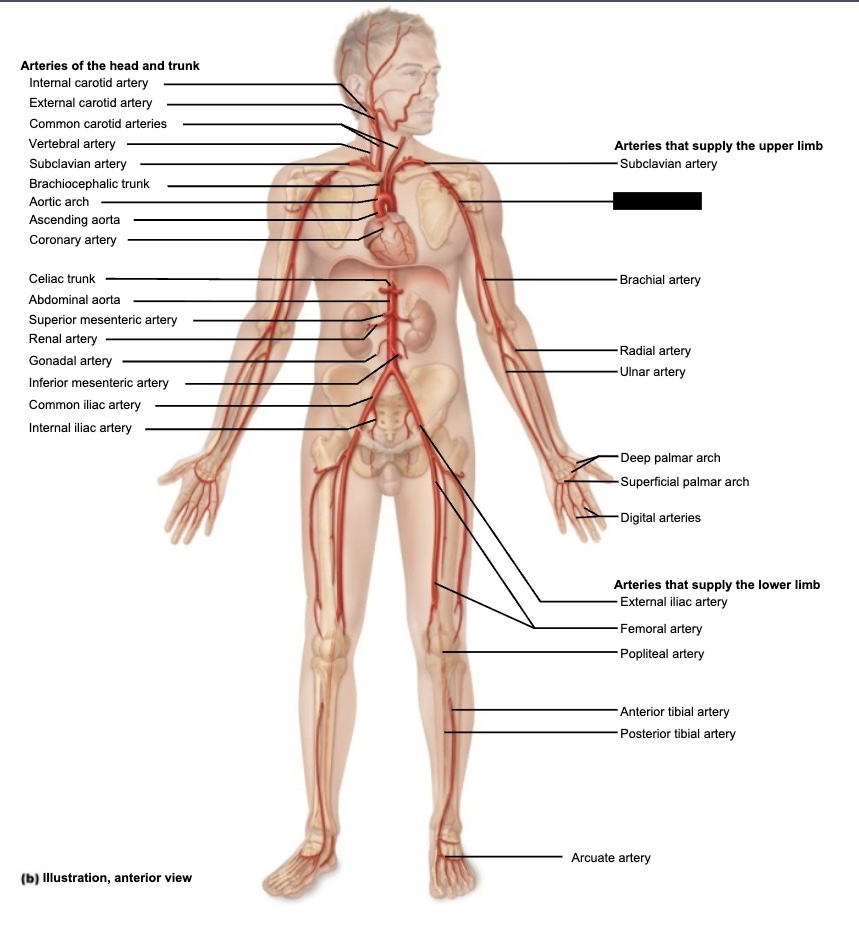
brachial artery

radial artery

ulnar artery

intercostal artery
arteries in rib

inferior phrenic artery
hint: phrenic is sheet of muscle that separates chest from abdomen

internal thoracic artery

celiac trunk

gastric (L)
supplies part of the stomach and inferior esophagus

splenic artery

hepatic artery
arteries in the liver; hepatic - associated in liver

renal artery

superior mesenteric artery
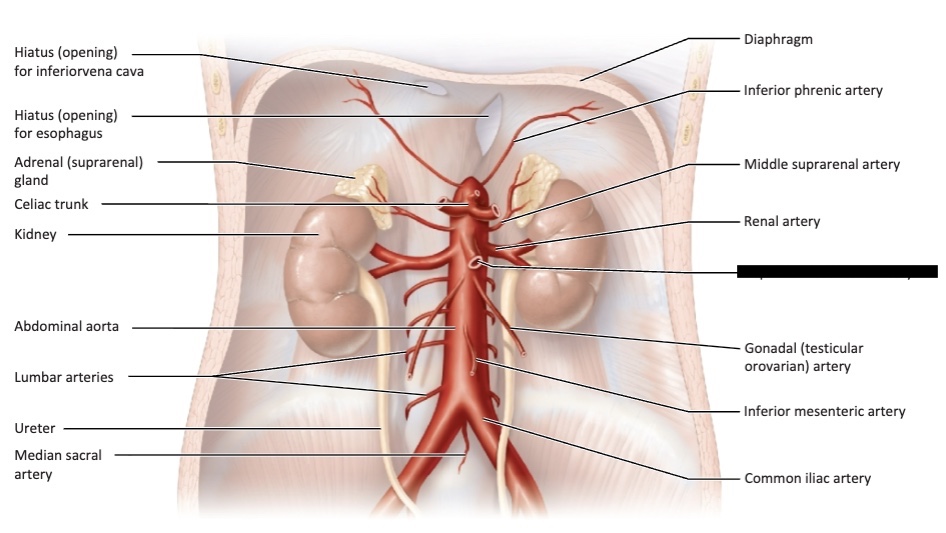
inferior mesenteric artery

gonadal (ovarian or testicular arteries)

iliac artery
supplies oxygenated blood to pelvis, reproductive organs, and lower body; made up of common, external and internal iliac
common iliac artery

external iliac artery

internal iliac artery

femoral artery

popliteal artery

anterior tibial artery

posterior tibial artery

coronary sinus vein
largest vein in heart; collects DEOXYGENATED blood and delivers it to right atrium; sits posterior of the heart in left atrioventricular groove called coronary sulcus (its literally just a groove)

pulmonary vein
carries OXYGENATED blood from the heart to the left atrium of the heart

superior vena cava

inferior vena cava

brachiocephalic vein

jugular vein
carries DEOXYGENATED blood from head, brain, and face towards heart
external jugular vein

internal jugular vein

superficial temporal vein

subclavian vein

axillary vein

cephalic veins

brachial vein

basilic vein
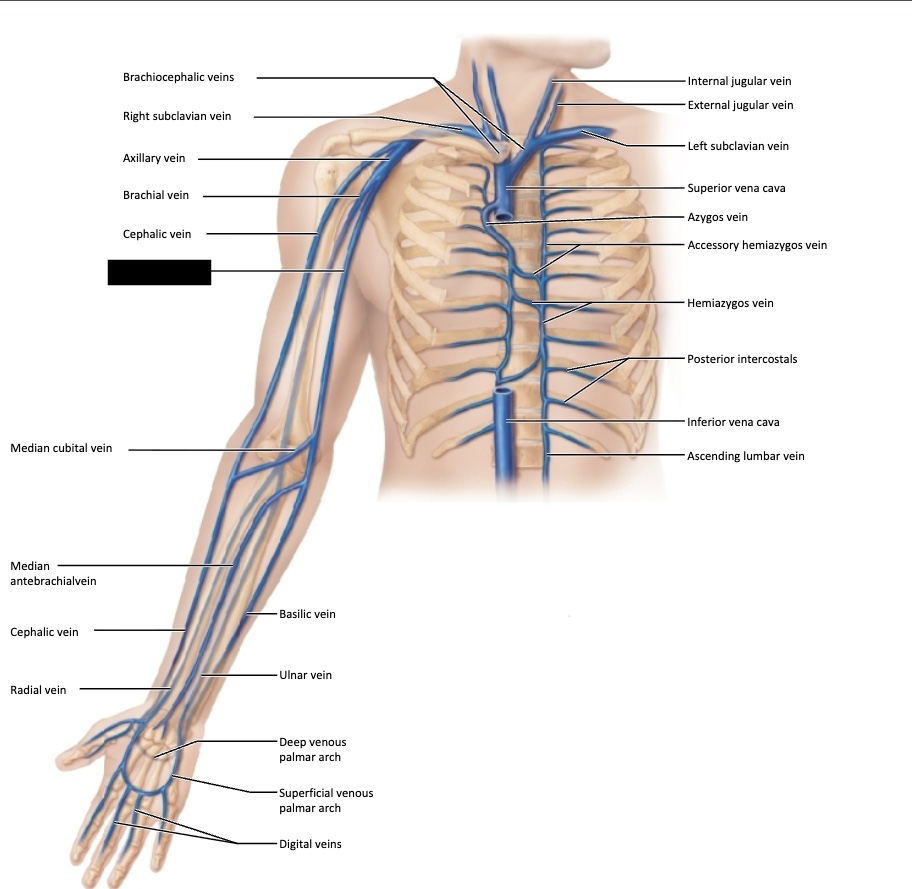
median cubital vein

radial vein

ulnar vein

azygos

intercostal vein

renal vein

suprarenal vein

gonadal (testis/ovarian) vein

hepatic vein

hepatic portal vein

splenic vein

superior mesenteric vein

inferior mesenteric vein

lumbar vein

common iliac vein

external iliac vein

internal iliac vein

femoral vein

popliteal vein

anterior tibial vein

posterior tibial vein

great saphenous vein

umbilical vein (1)
carries OXYGENATED blood from placenta to the fetus; becomes ligamentum teres

umbilical artery (2)
carries low oxygenated blood from fetus to the placenta; becomes median umbilical ligaments

ductus venosus (ligamentum venosus in newborn)

ductus arteriosus (ligamentum arteriosum in newborn)

foramen ovale (fossa ovalis in newborn)
