SAMPLING TECHNIQUES AND SURVEY DESIGN
 Call Kai
 Learn
Learn Practice Test
 Spaced Repetition
 Match
Match Flashcards
 Knowt Play
1/45

There's no tags or description
Looks like no tags are added yet.
Name | Mastery | Learn | Test | Matching | Spaced | Call with Kai | Chat |
|---|
No analytics yet
Send a link to your students to track their progress
46 Terms
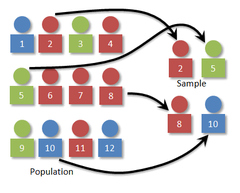
random sample or sample
- Every member of the population must have an equal chance of being selected.
- It is important because it gives us an unbiased sample.
(NOTE: If our sample is unbiased, it represents the population we are studying)
= unbiased sample = representative of the population
sampling or selection bias
nonresponse bias
response or interviewer bias
volunteer bias
4 Types of Biased Samples:
Sampling or selection bias
- some subjects are more likely to be included in a survey than others.
(NOTE: Also known as the "convenience sampling technique." They are more accessible and free)

Nonresponse bias
- Subjects who do not respond to a survey question would answer it differently than those who do respond to it.
(NOTE: Also known as the one that got away)

Response or interviewer bias
- The subject gives a different response than the respondent truly believes.

Volunteer bias
- are used since they might be more interested in the survey and answer questions or participate differently than randomly selected subjects
(NOTE: Not considered a random sample if volunteers only answer, it would cause possible bias)

Acquiescence Bias (Yea-saying)
Social Desirability Bias
Extreme Responding
Central Tendency Bias
4 Different Response Bias:
Acquiescence Bias (Yea-saying)
- Tendency to agree with statements regardless of content.
Typical Trigger: Agree/disagree Likert items; deference to authority.
Example: Respondent answers "Agree" to both "I feel happy" and "I feel sad."

Social Desirability Bias
- Overreporting "good" behaviors, underreporting "bad" ones.
Typical Trigger: Sensitive topics (health, ethics, habits).
EXAMPLE: Claiming to exercise daily when they don't.

Extreme Responding
- Favoring endpoints of a scale (always 1 or 5).
- intentionally
Typical Trigger: Personality traits,
cultural norms.
Example: Choosing "Strongly Agree" for most items.
Central Tendency Bias
- Clustering around the midpoint of scales.
(NOTE: Neutral answers or play safe, because they fear committing to an opinion)
Typical Trigger: Fear of committing to an opinion.
EXAMPLE: Always selecting "Neutral."

sample
- is used to get information about a population for several reasons:
þ It saves the researcher time and money.
þ It enables the researcher to get information that they may not be able to obtain otherwise.
þ It enables the researcher to get more detailed information about a particular subject.
(NOTE: The best thing to do is to select a sample that will be representative with respect to some characteristics, preferably those pertaining to the study. Inclusion and Exclusion Criteria.)

Simple Random Sampling
Systematic Sampling
Stratified Sampling
Cluster Sampling
4 Sampling Methods:
Simple Random Sampling
- Use methods such as random numbers, which can be generated from calculators, computers, or tables.
- For a sample size n, all possible samples of this size have an equal chance of being selected from the population.
(NOTE: One limitation: If the population is extremely large, it is time-consuming to number and select the sample elements.)
Incorrect methods:
- Ask "the person on the street."
- Ask a question by either radio or television and have listeners or viewers call the station to give their responses or opinions.
- Ask people to respond my mail or email.

Fishbowl method
- Number each element of the population and then place the numbers on cards.
- Place the cards in a hat or fishbowl, mix them, and then select the sample by drawing the cards.
(NOTE: Correct method of Simple Random Sampling, But if not mixed well, numbers chosen are placed in the bowl last.)
Random Numbers
- Each digit, 0-9, has an equal probability of occurring.
- In every sequence of 10 digits, each digit has a probability of 1/10 occurring.
- This can be generated by a computer in a table.
(NOTE: Correct method of Simple Random Sampling. Number the elements of the population sequentially and then select each person by using random numbers.)

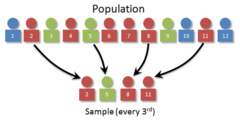
Systematic Sampling/Systematic Sample
- sample obtained by numbering each element in the population selecting some random starting point, and then selecting every kth element from the population to be included in the sample.
- But be careful on how the items are arranged on the list!
Stratified Sampling/Stratified Sample
- obtained by dividing the population into subgroups, called strata.
Example: (1) Males who smoke, (2) males who don't smoke, (3) females who smoke, and (4) females who don't smoke
(NOTE: However, it may not be representative on the basis of other characteristics.)

strata
- according to various homogeneous (similar) characteristics and then randomly selecting members from each stratum for the sample.

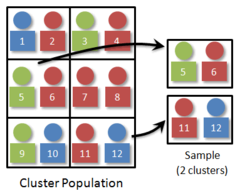
Cluster Sampling/Cluster Sample
- Obtained by selecting a pre-existing or natural group, called a cluster, and using the members in the cluster for the sample.
- We may use all units of a cluster if it is feasible, or we may select only part of the cluster to use as a sample.
- This selection is done by random methods.
Advantages:
- A ___ sample can reduce costs.
- It can simplify fieldwork.
- It is convenient.
Disadvantage:
- the elements in the ___ may not have the same variations in characteristics as elements selected individually from a population.
- The groups of people may be more homogeneous (alike) in specific ____ such as neighbourhoods or clubs.
Double Sampling
Multistage Sampling
Convenience Sampling
Snowball Sampling
4 Other types of sampling techniques:
Double Sampling
- a very large population is given a questionnaire to determine who meets the qualifications for a study (census sampling ➡ purposive sampling).
- After the questionnaires are reviewed, a second, smaller population is defined.
- Then a sample is selected from this group.

Multistage Sampling
- uses a combination of sampling methods.

Convenience Sampling
- selects subjects from the population who are available to use; not usually representative of the population = biased conclusions.

Snowball Sampling
- use of referrals

Step 1:
Steps for Conducting A Sample Survey: Decide what information is needed.

Step 2:
Steps for Conducting A Sample Survey: Determine how the data will be collected (mail survey, phone interview, etc.).

Step 3:
Steps for Conducting A Sample Survey: Select the information-gathering instrument or design the questionnaire if one is not available.

Step 4:
Steps for Conducting A Sample Survey: Set up a sampling list, if possible.

Step 5:
Steps for Conducting A Sample Survey: Select the best method for obtaining the sample (random, systematic, stratified, cluster, or other).

Step 6:
Steps for Conducting A Sample Survey: Conduct the survey and collect the data.

Step 7:
Steps for Conducting A Sample Survey: Tabulate the data.

Step 8:
Steps for Conducting A Sample Survey: Conduct the statistical analysis.

Step 9:
Steps for Conducting A Sample Survey: Report the results.

Survey
- conducted when a sample of individuals is asked to respond to questions about a particular subject.

Interviewer-administered
Self-administered
2 types of surveys:
Interviewer-administered
- requires a person to ask the questions; face-to-face in office, street, or in the mall, or via telephone.

Self-administered
- done by email, mail, or internet; or in a group setting like classroom.

Asking biased questions
Using confusing words
Asking double-barreled questions
Using double negatives in questions
Ordering questions improperly
(5) Avoid these mistakes when writing questions:
Asking biased questions
AVOID: leading on to answer a question the way researchers want to:

Using confusing words
AVOID: respondent misinterprets the meaning of the words and answers in a biased way:
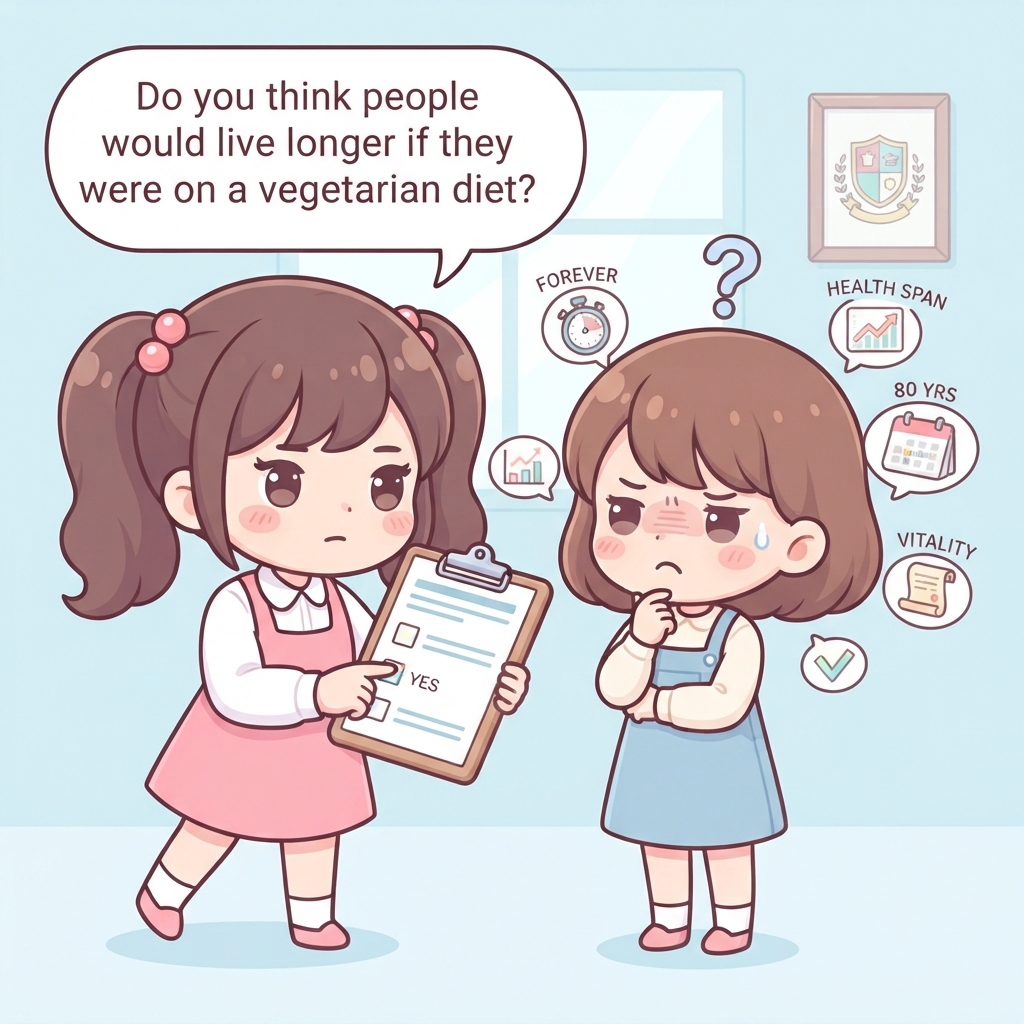
Asking double-barreled questions
- questions that contain compound sentences that require respondent to answer to two questions at the same time:

Using double negatives in questions
AVOID: "not" is used twice in a sentence.”

Ordering questions improperly
AVOID: by arranging the questions in a certain order, the researcher can lead the participant to respond in a way that the researcher may otherwise not have done.

Open-ended questions
Close-ended questions
2 Types of questions asked influence the responses:
Pilot Study
- should be done to test the design and usage of the questionnaire (i.e. validity).
- It helps researchers to pre-test the questionnaire to determine if it meets the objectives of the study.
- It also helps in rewriting questions that are misleading, ambiguous, etc.
