TEAS Chemical Solutions/ chemistry
 Call Kai
 Learn
 Practice Test
 Spaced Repetition
 Match
 Flashcards
 Knowt Play
1/64

There's no tags or description
Looks like no tags are added yet.
65 Terms
🧪 TEAS Chemistry: Solutions
1. First, what is a mixture?
Imagine you have a glass of water and you add something to it.
When you put two or more substances together WITHOUT creating a new substance through a chemical reaction, you have a mixture.
Mixture = two or more substances physically combined.
Examples:
Water + salt
Water + sugar
Cereal + milk
Sand + water
Think: You're just putting things together!
There are TWO main types of mixtures.
2. Homogeneous vs. Heterogeneous
Homogeneous = MIXED EVENLY.
Imagine putting salt into water and stirring it.
The salt dissolves.
You cannot see the individual salt anymore.
Every sip has about the same mixture.
Memory trick: HOMO = SAME.
Everything looks the same throughout.
Heterogeneous = NOT MIXED EVENLY.
Imagine putting sand into water.
The sand does not dissolve.
You can see the sand particles.
The mixture is not the same throughout.
Memory trick: HETERO = DIFFERENT.
You can see different parts
Side-by-side comparison
Homogeneous
Mixed evenly
Salt water
Sugar water
Air
Looks the same throughout.
Heterogeneous
Not mixed evenly
Sand and water
Oil and water
Salad
Different parts can be seen.
TEAS MEMORY TRICK:
Homo = SAME
Hetero = DIFFERENT
3. What is solubility?
the ability of something to dissolve in another substance.
Let's break that down.
Imagine adding salt to water.
The salt seems to disappear because it breaks apart into tiny particles and spreads throughout the water.
That means salt is soluble.
Now imagine adding sand to water.
The sand stays visible and does not dissolve.
That means sand is insoluble.
Two words to remember
Word | Super easy meaning | Example |
|---|---|---|
Soluble | CAN dissolve | Salt |
Insoluble | CANNOT dissolve | Sand |
Memory trick:
SOLUBLE = SOLVES (dissolves into the liquid).
INSOLUBLE = DOESN'T dissolve.
Important: Dissolving doesn't mean something disappears forever. The particles are still there; they're just spread throughout the liquid!
4. What is a solution?
A solution is a homogeneous mixture formed when one substance dissolves into another.
In other words:
Solution = something dissolves evenly into something else.
Example: Salt water.
When salt dissolves in water, you create a solution.
There are TWO important words you need to know:
Solute = the substance being dissolved.
Solvent = the substance doing the dissolving.
Let's use salt water.
Word | What is it? | In salt water |
|---|---|---|
Solute | Gets dissolved | Salt |
Solvent | Does the dissolving | Water |
Solution | The final mixture | Salt water |
SUPER EASY MEMORY TRICK:
SOLUTE = gets dissolved.
SOLVENT = does the dissolving.
SOLUTION = the final result.
Think of it this way:
You're making lemonade.
Sugar = solute.
Water = solvent.
Lemonade = solution.
One more important detail: Usually, the solvent makes up the greater amount of the solution.


5. What is an aqueous solution?
containing water.
An aqueous solution is simply a solution where WATER is the solvent.
Examples:
Salt dissolved in water.
Sugar dissolved in water.
Baking soda dissolved in water.
Memory trick: AQUEOUS = WATER.
If you see this word on the TEAS, think WATER!
any homogeneous mixture in which water (\(H2O\)) acts as the solvent
6. Measuring solutions (four ways)
Scientists need ways to measure how much solute is in a solution.
For example:
Imagine two glasses of water.
Glass A has 1 spoon of salt.
Glass B has 5 spoons of salt.
Glass B has more salt compared with the amount of water.
Scientists use different measurements to describe how much solute is present.
You have FOUR terms to learn.
A. Molarity
Molarity = number of moles of solute per liter of solution.
Let's break down the hard words:
Mole = a counting unit scientists use for tiny particles.
Liter = a unit used to measure liquid volume.
Solute = the substance being dissolved.
In regular language:
Molarity tells you how much dissolved substance is in 1 liter of solution.
Formula:
m= moles of solute/ liters of solution
Example:
If you have 2 moles of salt in 1 liter of solution:
m= 2/1 = 2
Your molarity is 2 M.
Memory trick: MOLARITY = MOLES / LITERS.
B. Molality
Number of moles of solute per kilogram of solvent.
Let's compare this with molarity.
The difference is ONE word!
Molarity uses LITERS of solution.
Molality uses KILOGRAMS of solvent.
Molarity | Molality |
|---|---|
Liters | Kilograms |
Solution | Solvent |
Memory trick:
MOLARITY = L for liters.
MOLALITY = kg for kilograms.
Don't mix these up!
C. Percent composition by mass
What percentage of the total solution's weight comes from the solute?
Example:
Imagine:
10 grams of salt.
90 grams of water.
100 grams total solution.
The salt makes up 10% of the total weight.
Formula:
%= mass of solute/ mass of solution x 100
Memory trick: MASS PERCENT = PART / WHOLE × 100.
D. Mole fraction
This one is about comparing MOLES.
Mole fraction = moles of one substance divided by the total moles of all substances in the solution.
Example:
Imagine:
2 moles of salt.
8 moles of water.
10 total moles.
Salt's mole fraction:
2/10= 0.2
Memory trick: MOLE FRACTION = YOUR MOLES / TOTAL MOLES.
⭐ Your TEAS all-in-one cheat sheet
Solutions
Term | Easy meaning | Remember |
|---|---|---|
Mixture | Substances physically combined | Put together |
Homogeneous | Mixed evenly | SAME |
Heterogeneous | Not mixed evenly | DIFFERENT |
Solubility | Ability to dissolve | Can it dissolve? |
Soluble | Can dissolve | Salt |
Insoluble | Cannot dissolve | Sand |
Solution | Homogeneous mixture | Final mixture |
Solute | Gets dissolved | Salt |
Solvent | Does the dissolving | Water |
Aqueous | Contains water as solvent | WATER |
Molarity | Moles per liter of solution | mol/L |
Molality | Moles per kg of solvent | mol/kg |
Percent mass | Solute mass compared with solution mass | Part / whole × 100 |
Mole fraction | Moles of one substance / total moles | Your moles / total |
🧠 The 5 things I REALLY want you to remember
Homogeneous = evenly mixed.
Heterogeneous = unevenly mixed.
Solute = gets dissolved; solvent = does the dissolving.
Aqueous = water.
Molarity uses liters; molality uses kilograms.
You mix salt into water until you cannot see the salt. What type of mixture is this?
Homogeneous
Salt water is evenly mixed, so it is homogeneous.
2. You mix sand and water. You can still see the sand. What type of mixture is this?
Heterogeneous
Sand and water are not evenly mixed, so they are heterogeneous.
3. What does soluble mean?
Can dissolve
Soluble means a substance can dissolve in another substance.
4. In salt water, what is the solute?
salt
8. Which measurement uses moles per kilogram of solvent?
Molality uses kilograms of solvent.
5. In salt water, what is the solvent?
water
Water is doing the dissolving, so it is the solvent.
6. What does aqueous mean?
Contains water as the solvent
7. Which measurement uses moles per liter of solution?
Molarity
uses moles divided by liters of solution.
🧪 1. First, what is the solubility limit?
Solute = what gets dissolved.
Solvent = what does the dissolving.
Solution = the final mixture.
Now imagine you have a glass of water and keep adding sugar.
At first, the sugar dissolves easily.
But if you keep adding more and more sugar, eventually the water reaches a point where it CANNOT dissolve any more sugar under those conditions.
That maximum amount is called the solubility limit.
SUPER EASY DEFINITION:
Solubility limit = the maximum amount of a substance that can dissolve in a certain amount of liquid at a certain temperature.
Think: WATER HAS A LIMIT!

2. The THREE types of solutions
A. Unsaturated solution
Below the limit
Unsaturated = there is STILL room for more solute to dissolve.
Imagine:
You add a little sugar to water.
All the sugar dissolves.
You can still add more sugar and it will dissolve.
That means the solution is UNSATURATED.
Memory trick:
UNSATURATED = NOT FULL YET.
More solute CAN dissolve!
B. Saturated solution
At the limit
Saturated = the solution has reached its maximum amount of dissolved solute.
Imagine:
You keep adding sugar.
More and more dissolves.
Eventually, the water reaches its limit.
Now it cannot dissolve any more sugar at that temperature.
Memory trick:
SATURATED = STUFFED FULL!
It has reached its limit.
C. Above the saturation limit
Above the limit = you've added MORE solute than the liquid can dissolve.
Imagine:
The water can dissolve a maximum of 10 grams of sugar.
You add 15 grams.
Only 10 grams dissolve.
The extra 5 grams stay undissolved.
Memory trick:
EXTRA = LEFTOVER!
The extra substance stays undissolved.

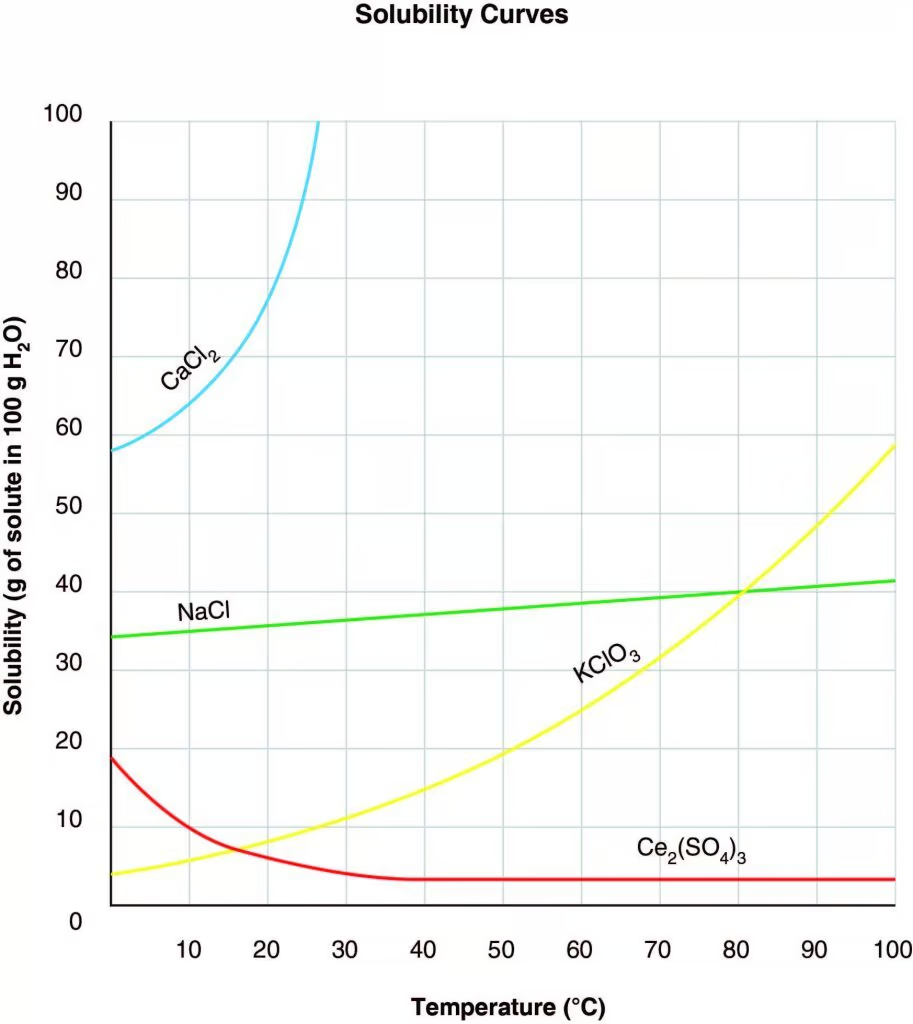
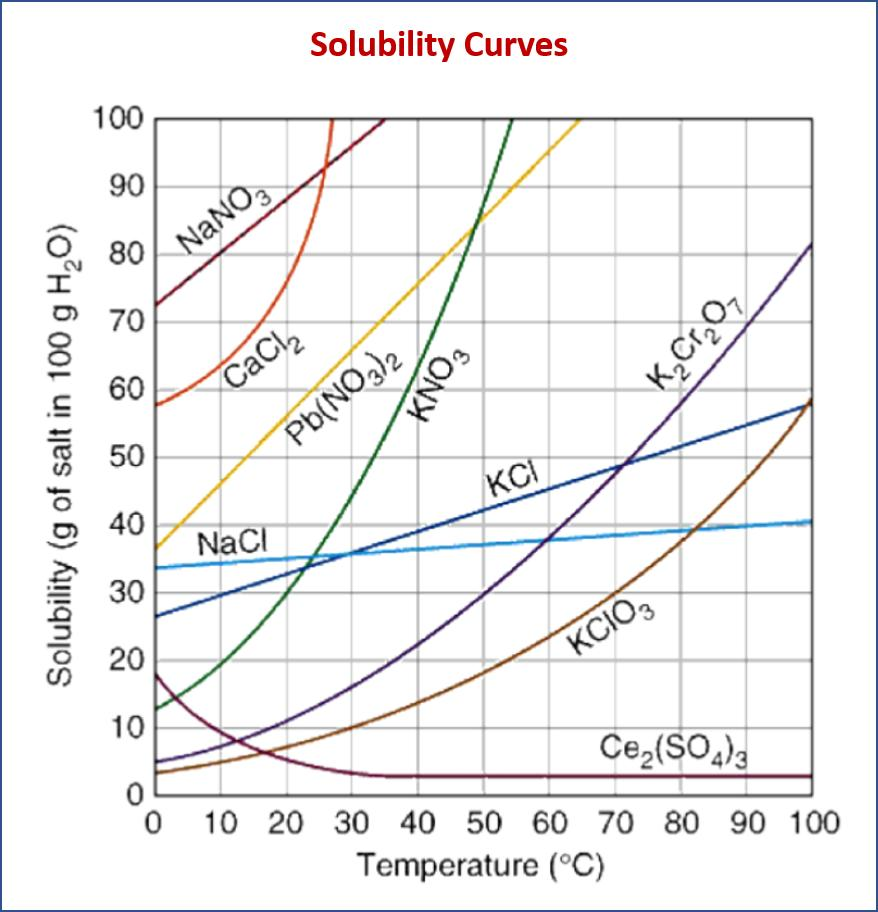
Imagine the graph shows how much sugar can dissolve in 100 grams of water.
Here's how to read it:
Where is the amount? | What does it mean? |
|---|---|
Below the line | Unsaturated |
Exactly on the line | Saturated |
Above the line | More solute than can dissolve |
THIS IS IMPORTANT FOR THE TEAS!
Remember:
BELOW = MORE CAN DISSOLVE.
ON = LIMIT REACHED.
ABOVE = EXTRA STAYS UNDISSOLVED.
4. Why does temperature matter?
Your notes mention that solubility changes at different temperatures.
This means the amount of sugar or another substance that can dissolve may change when the water gets hotter or colder.
For many solid substances, such as sugar:
Hotter water = more can usually dissolve.
Colder water = less can usually dissolve.
Think about making hot tea: sugar usually dissolves more easily in hot tea than cold tea.
Important: This is not true for every substance. Gases generally become LESS soluble in warmer liquids.
5. What does the sponge example mean?
Imagine a dry sponge.

Dry sponge = has room to absorb water.
Wet sponge = has absorbed water.
Fully soaked sponge = saturated.
Saturated always gives you the idea of FULL.
In chemistry, it means the solution has reached its dissolving limit.
In everyday life, it means something has absorbed as much as it can.

⭐ Your TEAS memory cheat sheet
The 3 S's of solubility
UNSATURATED
Below line
NOT FULL YET = MORE CAN DISSOLVE.
SATURATED
On line
FULL = MAXIMUM AMOUNT HAS DISSOLVED.
ABOVE SATURATION
Above line
TOO MUCH = EXTRA SOLUTE STAYS UNDISSOLVED.
Other important facts:
Solubility limit = maximum amount that can dissolve.
Solubility depends on temperature.
More heat usually allows more solid solute to dissolve.
Gases usually dissolve less in warmer liquids.
100 g water = the amount of water used as the reference in your textbook's graph.
An unsaturated solution can dissolve more solute, a saturated solution has reached its maximum dissolving limit, and any extra solute added above that limit remains undissolved.
The more solute (like salt or sugar) you add, the closer you get to the maximum amount the water can dissolve.
BUT here's the important part:
Different substances have DIFFERENT limits, and those limits can change depending on temperature.
A student adds sugar to water. All the sugar dissolves, and more sugar could still dissolve. What is the solution?
Unsaturated
means the solution has not reached its limit.
2. A solution has dissolved the maximum amount of solute possible at that temperature. What is it?
Saturated
means the maximum amount has dissolved.
3. On a solubility graph, what does a point BELOW the line represent?
unsaturated
Below the line means more solute can still dissolve.
4. On a solubility graph, what does a point ABOVE the line mean?
More solute was added than can dissolve
The excess solute cannot dissolve under those conditions.
5. What usually happens to the solubility of a solid like sugar when water gets hotter?
More can dissolve
For many solids, increasing temperature increases solubility.

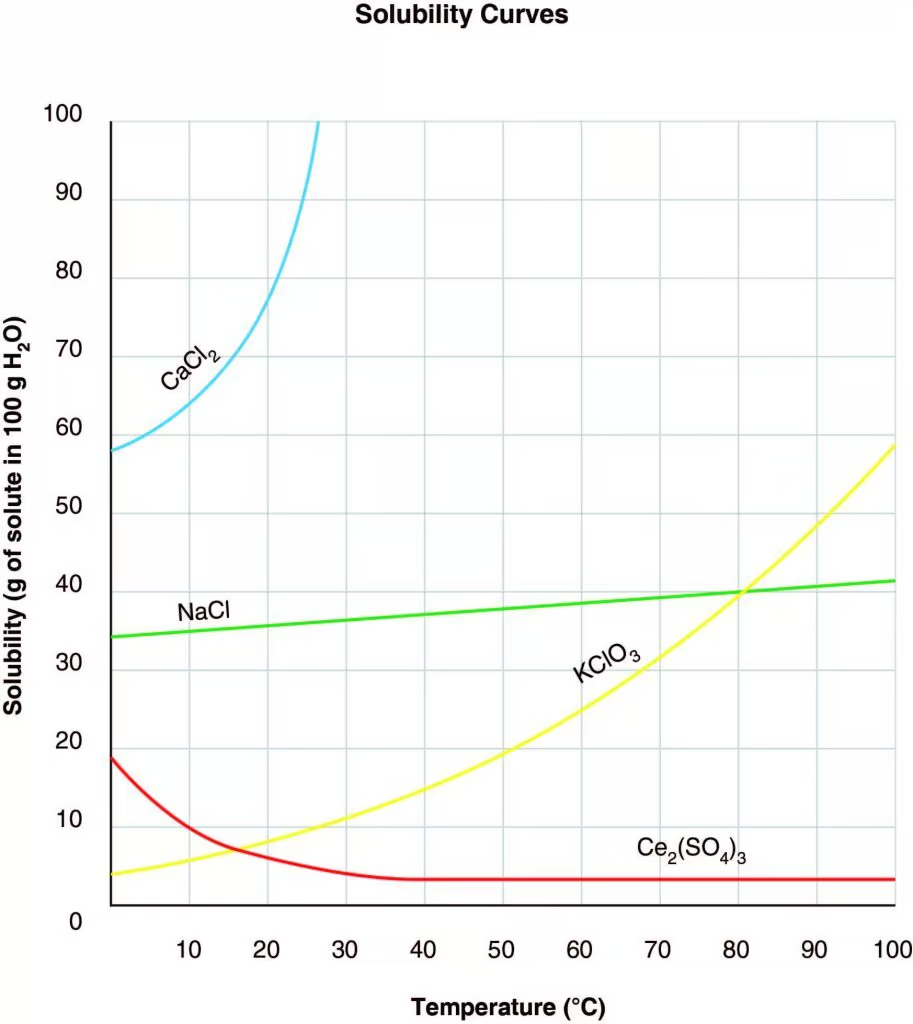
🧪 1. First, understand what you're looking at
Your graph has TWO things:
Bottom (X-axis): Temperature (°C)
This tells you how HOT or COLD the water is.
Left = colder water.
Right = hotter water.
Side (Y-axis): Solubility (g of solute in 100 g H₂O)
This tells you HOW MUCH of a substance can dissolve in 100 grams of water.
For example:
If the graph says 35, that means:
35 grams of that substance can dissolve in 100 grams of water at that temperature.
SUPER IMPORTANT: Every line represents a DIFFERENT substance with its own dissolving limit!
2. The THREE solubility situations
These are the three things you need to recognize on a solubility graph.
Let's pretend we're looking at the GREEN NaCl (salt) line at 20°C.
At 20°C, approximately 35 grams of NaCl can dissolve in 100 grams of water.
Imagine the limit is 35 grams
1. UNSATURATED
20 grams
You add 20 grams of salt.
All 20 grams dissolve.
The water could dissolve another 15 grams.
NOT FULL YET!
Below the line = Unsaturated
2. SATURATED
35 grams
You add 35 grams of salt.
All 35 grams dissolve.
The maximum amount has been reached.
FULL!
On the line = Saturated
3. ABOVE THE LIMIT
45 grams
You add 45 grams of salt.
Only 35 grams dissolve.
The extra 10 grams stay undissolved.
TOO MUCH!
Above the line = Excess solute
3. Now let's understand the DIFFERENT colored lines
Each substance behaves differently when the temperature changes.
Look at these four substances:
CaCl₂ – Blue line
As temperature increases, solubility increases A LOT.
Hotter water can dissolve much more CaCl₂.
Its line rises steeply.
Memory trick: BLUE GOES UP FAST!
NaCl – Green line
As temperature increases, solubility increases a LITTLE.
Its line barely rises.
Memory trick: GREEN = GENTLE increase.
KClO₃ – Yellow line
As temperature increases, solubility increases A LOT.
Its line curves upward.
Memory trick: YELLOW CLIMBS!
Ce₂(SO₄)₃ – Red line
As temperature increases, solubility DECREASES.
Its line goes down and then levels off.
Memory trick: RED GOES DOWN!
TEAS IMPORTANT: Don't assume every substance dissolves more when heated. This graph shows you that different substances behave differently!

4. How do I actually READ this graph?
Imagine the TEAS asks:
"At 20°C, approximately how many grams of NaCl can dissolve in 100 grams of water?"
Here's what you do:
Find 20°C on the bottom.
Move UP until you reach the green NaCl line.
Look LEFT to read the number.
The answer is approximately 35 grams.
That's it!
Another example:
"At 20°C, which substance has the highest solubility?"
Look at all four lines at 20°C.
The blue CaCl₂ line is highest.
So CaCl₂ has the highest solubility at that temperature.
⭐ 5. Your ultimate TEAS memory tricks
Memorize these:
Graph position | Meaning | Memory trick |
|---|---|---|
Below the line | Unsaturated | Room for MORE |
On the line | Saturated | FULL |
Above the line | Excess solute | TOO MUCH |
And for temperature:
Line | What happens as temperature increases? |
|---|---|
Blue CaCl₂ | Increases a lot |
Green NaCl | Increases a little |
Yellow KClO₃ | Increases a lot |
Red Ce₂(SO₄)₃ | Decreases |
One last thing to remember: The line is the LIMIT. Below it = room for more. On it = full. Above it = extra that cannot dissolve.

At 20°C, approximately how many grams of NaCl can dissolve in 100 g of water?
35g
Find 20°C, move up to the green NaCl line, and read approximately 35 g.
2. At 20°C, you add 20 g of NaCl to 100 g of water. What type of solution do you have?
Unsaturated
3. At 20°C, you add 45 g of NaCl to 100 g of water. What happens?
Only about 35 g dissolve; the extra stays undissolved

4. Which substance's solubility DECREASES as temperature increases?
Ce₂(SO₄)₃
The red line goes down as temperature increases.
5. Which substance has the highest solubility at 20°C?
The blue CaCl₂ line is highest at 20°C.
6. What does a point exactly ON a solubility curve represent?
saturated
🧪 1. First, what is a chemical reaction?
Imagine you're baking a cake.
You start with ingredients:
Flour
Eggs
Sugar
You mix them, bake them, and end up with something NEW: a cake!
A chemical reaction is similar.
Chemical reaction = substances change and form new substances.
The original substances don't just disappear. Their atoms rearrange to form something new.
Other examples:
Wood burning.
Iron rusting.
Food being digested.
Gasoline burning in a car.
Memory trick: REACTION = CHANGE!
Something happens to the starting substances, and new substances form.
2. The TWO most important words: Reactants and Products
Every chemical reaction has two sides.
Think of a cooking recipe!
REACTANTS
What you START with.
These are the original ingredients.
Chemical reaction happens!
PRODUCTS
What you END with.
These are the new substances formed.
Let's break down the words:
Reactants
Substances present at the beginning.
They undergo a chemical change.
They are on the LEFT side of the arrow.
Products
Substances formed from the reaction.
They are the result.
They are on the RIGHT side of the arrow.
Memory trick!
REACTANTS = READY TO REACT (START).
PRODUCTS = PRODUCED (END).
Remember:
LEFT = START. RIGHT = RESULT.
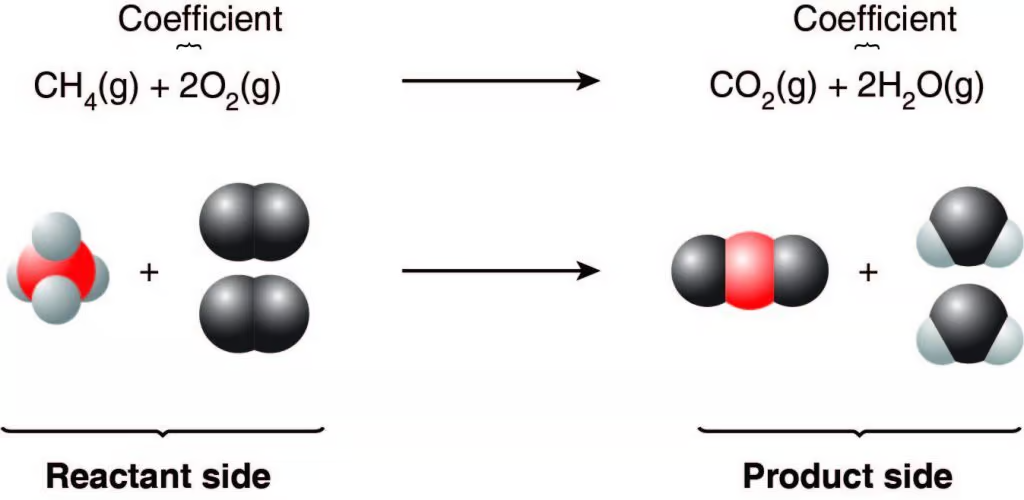

3. How to read a chemical equation
Let's translate every part into regular English.
Symbol | Meaning |
|---|---|
CH₄ | Methane |
O₂ | Oxygen |
CO₂ | Carbon dioxide |
H₂O | Water |
+ | And / reacts with |
→ | Produces / forms |
So the equation says:
Methane reacts with oxygen to produce carbon dioxide and water.
That's ALL you're reading!
What is methane?
Methane is a gas that can burn.
When methane burns in oxygen, it produces carbon dioxide and water.
This type of reaction is called combustion.
Hard word:
- Combustion = burning.
Think: Burning methane = combustion.
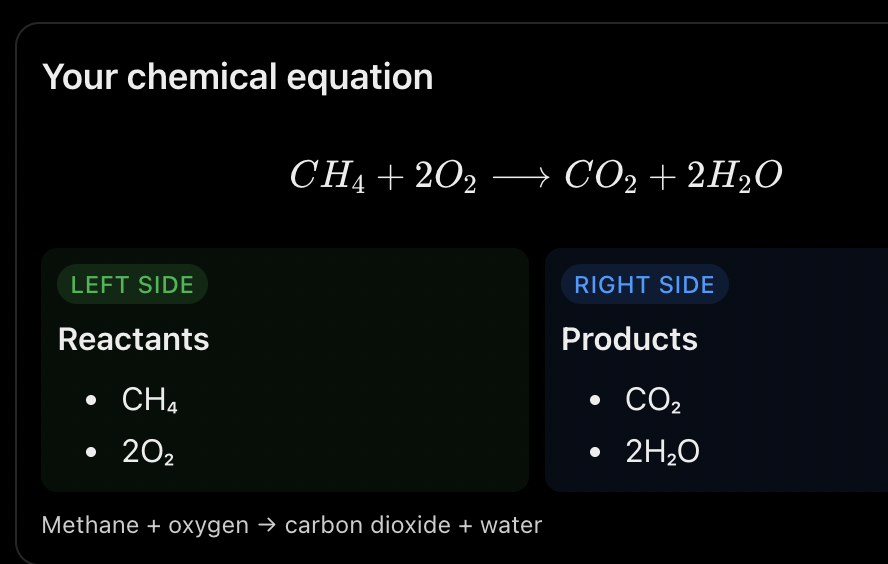

4. What does the PLUS (+) sign mean?
The plus sign separates different substances.
For example:
CH_4 + 2O_2
This means:
Methane PLUS oxygen.
And on the product side:
CO_2 + 2H_2O
This means:
Carbon dioxide PLUS water.
Memory trick: PLUS = AND.
5. What does the ARROW (→) mean?
The arrow is probably the easiest symbol!
\[ \text{Reactants} \rightarrow \text{Products} \]
It means:
Turns into.
Produces.
Forms.
Think of the arrow as saying:
START HERE → END HERE.
The arrow ALWAYS points toward the products.
6. What are those little letters in parentheses? (s), (l), (g), (aq)
Remember our previous lesson about solids, liquids, and gases?
These little letters tell you what state the substance is in during the reaction.
Symbol | Meaning | Example |
|---|---|---|
(s) | Solid | Ice / solid salt |
(l) | Liquid | Liquid water |
(g) | Gas | Oxygen gas |
(aq) | Aqueous | Dissolved in water |
Let's make these EASY to remember.
S = Solid.
L = Liquid.
G = Gas.
AQ = Aqueous (water-based solution).
VERY IMPORTANT: (aq) does NOT just mean liquid.
It means the substance is dissolved in water.
For example:
\[ NaCl(aq) \]
This means salt dissolved in water.
Compare:
NaCl(s) = solid salt.
NaCl(aq) = salt dissolved in water.
7. NOW THE IMPORTANT PART: What are coefficients?
Look at this:
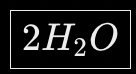
See the BIG number 2 in front?
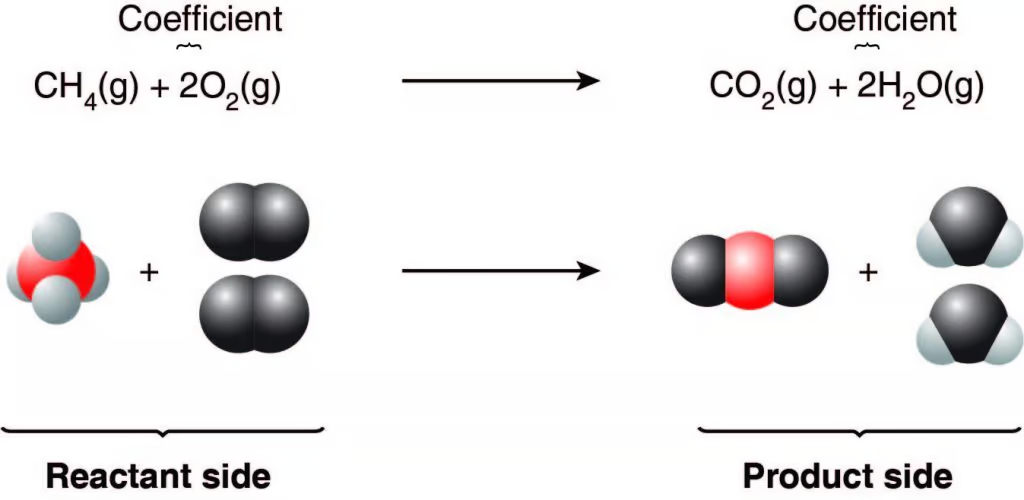
That is called a coefficient.
Coefficient = the BIG number in front of a chemical formula.
It tells you HOW MANY molecules or units of that substance are involved.
Let's break it down.
Example: 2H₂O
2
Coefficient
Two water molecules
₂
Subscript
Two hydrogen atoms per molecule
So 2H₂O means:
2 water molecules.
Each molecule has 2 hydrogen atoms.
Each molecule has 1 oxygen atom.
Total:
4 hydrogen atoms.
2 oxygen atoms.
What's a subscript?
A subscript is the SMALL number written below and to the right of an element symbol.
For example:
\[ H_2O \]
H = hydrogen.
The little 2 = two hydrogen atoms.
O = oxygen.
No little number after O = one oxygen atom.
How do you remember the difference?
COEFFICIENT vs. SUBSCRIPT
2H₂O
BIG NUMBER
Coefficient
Counts how many molecules.
SMALL NUMBER
Subscript
Counts atoms in one molecule.
Memory trick:
Coefficient = COUNTS the molecules.
Subscript = COUNTS the atoms.
Also, if there is NO coefficient written, it automatically means 1.
For example:
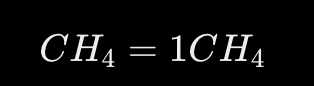
You just don't write the 1!
8. Let's understand YOUR methane equation completely!

We can count the atoms on both sides.
LEFT SIDE: Reactants
Substance | Atoms |
|---|---|
CH₄ | 1 carbon, 4 hydrogen |
2O₂ | 4 oxygen |
Total:
1 carbon
4 hydrogen
4 oxygen
RIGHT SIDE: Products
Substance | Atoms |
|---|---|
CO₂ | 1 carbon, 2 oxygen |
2H₂O | 4 hydrogen, 2 oxygen |
Total:
1 carbon
4 hydrogen
4 oxygen
Look what happened!
Element | Reactants | Products |
Carbon (C) | 1 | 1 |
Hydrogen (H) | 4 | 4 |
Oxygen (O) | 4 | 4 |
Everything matches!
This demonstrates an important chemistry rule:
Atoms are NOT created or destroyed during an ordinary chemical reaction. They are rearranged.
This is called the Law of Conservation of Mass.
Super easy meaning:
You start with certain atoms, and you end with those same atoms. They just get rearranged into different substances.
Memory trick:
SAME ATOMS, NEW ARRANGEMENT!
⭐ 9. Your TEAS cheat sheet
Word | Easy definition | Memory trick |
|---|---|---|
Chemical reaction | Substances change into new substances | CHANGE |
Reactants | Starting substances | START |
Products | Substances formed | RESULT |
Chemical equation | Written way to show a reaction | RECIPE |
+ | Separates substances | AND |
→ | Shows what is produced | BECOMES |
Coefficient | Big number in front | Counts molecules |
Subscript | Small number below | Counts atoms |
(s) | Solid | S = Solid |
(l) | Liquid | L = Liquid |
(g) | Gas | G = Gas |
(aq) | Dissolved in water | AQ = Aqueous |
Combustion | Burning reaction | FIRE |
Conservation of mass | Atoms are rearranged, not destroyed | SAME ATOMS |
1. What are reactants?
The starting substances
Reactants are the starting substances in a chemical reaction.
2. What are products?
The substances formed by a reaction
Products are what the reaction produces.
3. In a chemical equation, which side contains the reactants?
left
Reactants are on the left; products are on the right.
4. What does the arrow (→) mean?
. Produces or forms
The arrow points from reactants to products.
5. What does the coefficient in 3H₂O represent?
3 water molecules
The coefficient 3 counts three water molecules.
6. What does the subscript 2 in H₂O represent?
Two hydrogen atoms in one water molecule
The subscript tells you how many atoms of that element are in one molecule.
8. What does (g) mean in a chemical equation?
gas
9. What happens to atoms during a chemical reaction?
They are rearranged
10. What is combustion?
Burning

The 3 means you have 3 WATER MOLECULES, NOT 3 water atoms.
Think of it like having 3 separate water bottles.
Each H₂O has:
2 hydrogen atoms (H₂)
1 oxygen atom (O)
Altogether, 3H₂O has:
6 hydrogen atoms
3 oxygen atoms
9 atoms total!
Now let's compare:
Formula | What it means |
|---|---|
H₂O | 1 water molecule |
2H₂O | 2 water molecules |
3H₂O | 3 water molecules |
4H₂O | 4 water molecules |
Here's the BIG difference!
BIG 3 in front = 3 water molecules.
Little 2 below H = 2 hydrogen atoms in EACH water molecule.
Memory trick:
BIG number = HOW MANY GROUPS.
Little number = HOW MANY ATOMS inside each group.
If you see 2H₂O, how many hydrogen atoms are there TOTAL?
2 molecules × 2 hydrogen atoms each = 4 hydrogen atoms!

First, what is a chemical reaction?
A chemical reaction happens when substances change into new substances.
Think of it like cooking:
You start with ingredients.
The ingredients change or combine.
You end up with something new.
Reactants = What you START with (before the arrow).
Products = What you END with (after the arrow).

Example:
A + B = Reactants
AB = Product
Now let's learn the 5 types!
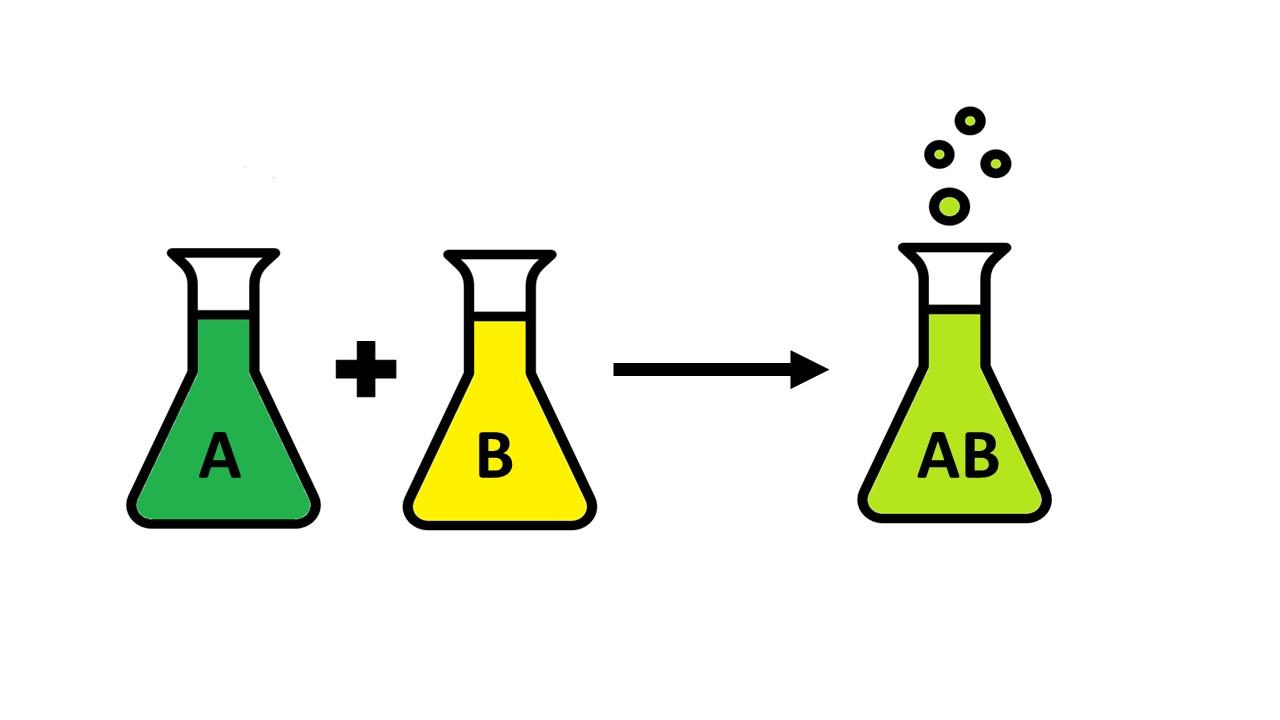
1. Synthesis Reaction
Definition: Two or more substances JOIN together to make ONE new substance.
Think: Putting two puzzle pieces together!
Pattern:
A+B→ AB
Example:

What's happening?
Hydrogen (H₂) starts by itself.
Oxygen (O₂) starts by itself.
They combine to make water (H₂O).
Memory trick: SYNTHESIS = STICK TOGETHER.
Remember: Many reactants → ONE product.
2. Decomposition Reaction
BREAK APART
Definition: ONE substance breaks apart into TWO or more smaller substances.
Think: Breaking a cookie into pieces!
Pattern:
AB→A+B
Example:
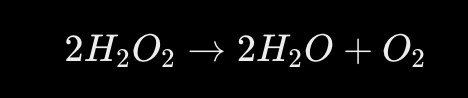
What's happening?
Hydrogen peroxide (H₂O₂) starts as ONE substance.
It breaks apart.
It produces water (H₂O) and oxygen (O₂).
Memory trick: DECOMPOSITION = DESTROY OR BREAK APART.
Remember: ONE reactant → MANY products.

3. Single-Replacement Reaction
ONE TAKES ANOTHER'S PLACE
Definition: ONE element kicks out another element and takes its place in a compound.
Think: Someone taking another person's seat!
Pattern:

4. Double-Replacement Reaction
BOTH SWITCH PARTNERS
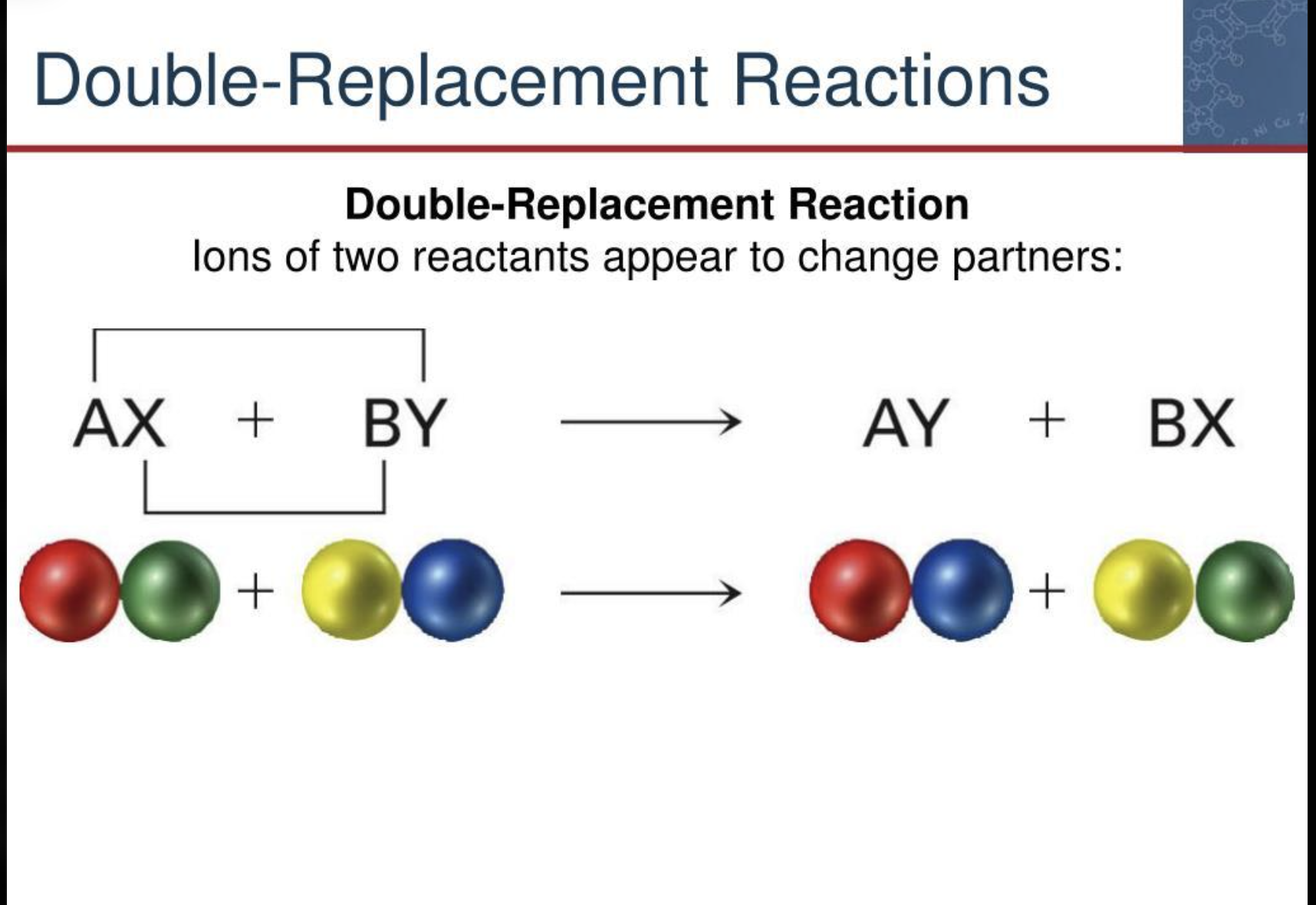
Definition: TWO compounds switch partners to make TWO new compounds.
Think: Two couples switching partners!

Let's break it down:
You start with:
AgNO₃ = Silver nitrate.
NaCl = Sodium chloride.
They switch partners:
Silver (Ag) joins chlorine (Cl).
Sodium (Na) joins nitrate (NO₃).
You end with:
AgCl = Silver chloride.
NaNO₃ = Sodium nitrate.
Memory trick: DOUBLE = TWO COMPOUNDS SWITCH PARTNERS.
Look for TWO compounds on the left and TWO compounds on the right.


5. Combustion Reaction
BURNING
Definition: A fuel reacts with oxygen and BURNS, releasing energy.
Think: A gas stove burning!
For the TEAS, remember these three important things:
Fuel (usually contains carbon and hydrogen).
Oxygen (O₂).
Produces carbon dioxide (CO₂), water (H₂O), and energy.
What's happening?
Methane (CH₄) is the fuel.
Oxygen helps it burn.
Carbon dioxide and water are produced.
Energy is released as heat and light.
Memory trick: COMBUSTION = FIRE!
Remember: FUEL + OXYGEN → CARBON DIOXIDE + WATER + ENERGY.

⭐ Your TEAS cheat sheet — memorize this!
Learn to recognize the patterns!
Reaction | What happens? | Pattern |
|---|---|---|
Synthesis | Put together | A + B → AB |
Decomposition | Break apart | AB → A + B |
Single-replacement | One switches | AB + C → AC + B |
Double-replacement | Both switch | AB + CD → AD + CB |
Combustion | Burning | Fuel + O₂ → CO₂ + H₂O + energy |
🧠 The easiest way to remember all 5
Synthesis = Stick together.
Decomposition = Break apart.
Single = One takes someone's place.
Double = Two compounds switch partners.
Combustion = Burning with oxygen.
Important words you might see on the TEAS
Word | Easy meaning |
|---|---|
Reactants | Starting substances |
Products | Substances made at the end |
Fuel | Something that can burn |
Compound | Two or more different elements chemically joined |
Element | A pure substance made of one type of atom |
Energy | The ability to do work; combustion releases it |
Replace | Take someone else's place |
Oxygen | Element needed for ordinary combustion |
Aqueous (aq) | Dissolved in water |
Solid (s) | Solid state |
Liquid (l) | Liquid state |
Gas (g) | Gas state |
One more important thing: The little numbers (subscripts) and big numbers (coefficients) are different!
H₂O: The little 2 means TWO hydrogen atoms in each water molecule.
2H₂O: The big 2 means TWO water molecules.
1. Two substances combine to make one new substance. What reaction is this?
Synthesis
combines two or more reactants into one product.
2. One compound breaks into two or more simpler substances. What reaction is this?
Decomposition
means breaking apart.
3. A + BC → AC + B. What reaction is this?
single replacement
One element replaces another element in a compound.
4. Two compounds exchange their ions or partners. What reaction is this?
Double-replacement
Double-replacement means two compounds switch partners.
A fuel reacts with oxygen and produces carbon dioxide and water. What reaction is this?
Combustion is burning fuel in oxygen.
6. Which reaction follows the pattern AB → A + B?
Decomposition
One reactant breaks into multiple products.
7. Which reaction follows A + B → AB?
synthesis
Two substances join to form one product.
8. Zinc replaces hydrogen in hydrochloric acid. What type of reaction is this?
Single-replacement
Zinc takes hydrogen's place.
9. What three things are produced in the combustion pattern taught here?
Carbon dioxide, water, and energy
Combustion produces carbon dioxide, water, and energy in the standard complete hydrocarbon combustion pattern.
10. What are reactants?
Substances at the beginning
Reactants are the starting substances, before the arrow.
🔥 1. First, what is a fuel?
A fuel is something that can burn.
Examples:
Methane = found in natural gas.
Propane = used in gas grills.
Butane = used in lighters.
Octane = found in gasoline.
These are all examples of fuels.
2. What is the chart trying to show?
Look at the first example:
CH4 + 2O2 → CO2 + 2H2O + energy

In regular words:
Methane is the fuel.
It reacts with oxygen.
It burns.
Carbon dioxide and water are produced.
Energy is released as heat and light.
That's what ALL four equations in your chart are showing!
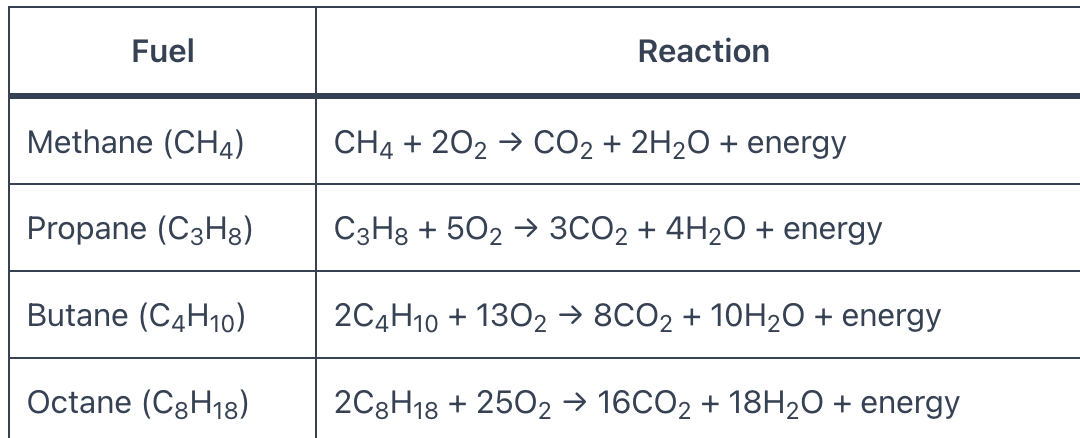
3. Why are there different numbers in each equation?
Look at these:
Methane = CH₄
Propane = C₃H₈
Butane = C₄H₁₀
Octane = C₈H₁₈
The numbers tell you how many atoms of each element are in the fuel.
For example:
CH₄
C = 1 carbon atom.
H₄ = 4 hydrogen atoms.
C₃H₈
C₃ = 3 carbon atoms.
H₈ = 8 hydrogen atoms.
C₄H₁₀
C₄ = 4 carbon atoms.
H₁₀ = 10 hydrogen atoms.
C₈H₁₈
C₈ = 8 carbon atoms.
H₁₈ = 18 hydrogen atoms.
The fuels have different amounts of carbon and hydrogen, so their equations have different numbers.
4. What are hydrocarbons?
A hydrocarbon is a compound made of ONLY two elements:
Hydrogen (H)
Carbon (C)
Break the word apart:
HYDRO = Hydrogen
CARBON = Carbon
Memory trick: HYDROCARBON = H + C.
All four fuels in your chart are hydrocarbons!

5. What are fossil fuels?
Fossil fuels are fuels that formed from the remains of ancient living organisms millions of years ago.
Examples:
Coal
Oil
Natural gas
Easy way to remember:
Fossil fuels = Energy from ancient living things.
⭐ YOUR TEAS CHEAT SHEET
Memorize these five things:
Word | What to remember |
|---|---|
Fuel | Something that burns |
Hydrocarbon | Made of carbon + hydrogen |
Oxygen | Needed for combustion |
Combustion | A burning reaction |
Fossil fuel | Fuel formed from ancient organisms |
THE BIGGEST THING TO REMEMBER FOR THE TEAS
FUEL + OXYGEN↓CO₂ + H₂O + ENERGY
All four fuels in your chart follow this same combustion pattern!
One last memory trick: If a TEAS question mentions a fuel burning in oxygen and producing carbon dioxide and water, think COMBUSTION immediately.
Step 1: Learn how to read ANY chemical equation
Look at this:
A+B→ AB
There are three things to understand:
Left side = What you START with.
Arrow (→) = Changes into.
Right side = What you END with.
Think of the arrow as saying: "This turns into that."
Step 2: Let's learn to recognize the patterns
Before worrying about the letters and numbers, look at how many separate substances are on each side.
Reaction | What you see |
|---|---|
Synthesis | Two or more → ONE |
Decomposition | ONE → Two or more |
Single-replacement | Compound + element → New compound + element |
Double-replacement | Two compounds → Two new compounds |
Combustion | Fuel + oxygen → CO₂ + H₂O |
Our secret trick: Ignore the little numbers at first. Look at the BIG picture.
Single-Replacement

First, let's translate the letters:
Na = Sodium
Zn = Zinc
Cl = Chlorine
LEFT SIDE (before):
Na = Sodium (one element).
ZnCl₂ = Zinc chloride (one compound).
RIGHT SIDE (after):
Zn = Zinc by itself.
NaCl = Sodium chloride (a new compound).
What's happening?
Sodium comes in and takes zinc's place in the compound.
Think of it like someone taking another person's seat!
Memory trick: SINGLE-REPLACEMENT = ONE ELEMENT TAKES SOMEONE ELSE'S PLACE.

Double-Replacement
First, let's translate:
AgNO₃ = Silver nitrate.
NaCl = Sodium chloride.
AgCl = Silver chloride.
NaNO₃ = Sodium nitrate.
Before the arrow:
Silver is with nitrate.
Sodium is with chlorine.
After the arrow:
Silver is with chlorine.
Sodium is with nitrate.
The two compounds SWITCH PARTNERS!
Think of two couples switching partners.
Memory trick: DOUBLE = TWO compounds switch partners.


Combustion 🔥
Let's translate:
CH₄ = Methane (fuel).
O₂ = Oxygen.
CO₂ = Carbon dioxide.
H₂O = Water.
Before the arrow:
Methane (fuel).
Oxygen.
After the arrow:
Carbon dioxide.
Water.
Energy (heat and light).
What's happening?
The methane is BURNING with oxygen!
Memory trick: COMBUSTION = BURNING!
For the TEAS, remember:
FUEL + OXYGEN → CARBON DIOXIDE + WATER + ENERGY.
Why is it combustion?
Let's translate:
CH₄ = Methane (fuel).
O₂ = Oxygen (helps the fuel burn).
CO₂ = Carbon dioxide.
H₂O = Water.
What happened?
Methane starts as the fuel.
Oxygen reacts with the fuel.
The fuel burns.
Carbon dioxide and water are produced.
Energy is released as heat and light.
That's COMBUSTION = BURNING!

Energy diagrams
Chemical reactions can either RELEASE energy or ABSORB energy.
Think of energy like heat.
Release = energy goes OUT.
Absorb = energy goes IN.
There are two types of reactions:
1. Exothermic = energy OUT
The reaction gives off energy to its surroundings.
Example: Burning wood gives off heat.
Releases energy
2. Endothermic = energy IN
The reaction takes in energy from its surroundings.
Example: An instant cold pack absorbs heat from around it.
Absorbs energy
1. Understand the words first
Exo = exit. Energy exits (leaves).
Endo = enter. Energy enters (goes in).
Reactants = what you START with.
Products = what you END with.
Activation energy = the energy needed to START the reaction.
Activated complex = the temporary, high-energy stage at the top of the hill.

2. How to read the graphs
Look at the axes:
Sideways (horizontal) = Time: the reaction is happening as time passes.
Up and down (vertical) = Energy: how much energy the substances have.
Important: Higher on the graph means MORE energy. Lower means LESS energy.
3. Exothermic graph — energy goes OUT
Follow it slowly:
Reactants: Start at a certain energy level.
Hill goes UP: The reaction needs activation energy to get started.
Top of hill: This is the activated complex (temporary high-energy stage).
Hill goes DOWN: Energy is released!
Products: End LOWER than where the reactants started.
Why lower? Because the reaction released some of its energy.
EXOTHERMIC = PRODUCTS LOWER
Memory trick: EXO = EXIT = energy exits = graph ends LOW.
4. Endothermic graph — energy goes IN
Now look at the RIGHT graph.
Follow it slowly:
Reactants: Start at a certain energy level.
Hill goes UP: The reaction needs activation energy to get started.
Top of hill: Activated complex.
Products: End HIGHER than where the reactants started.
Why higher? Because the reaction absorbed energy and gained energy.
ENDOTHERMIC = PRODUCTS HIGHER
Memory trick: ENDO = ENTER = energy enters = graph ends HIGH.


5. The MOST important thing to memorize
energy’s
Exothermic | Endothermic |
|---|---|
Energy goes OUT | Energy goes IN |
Releases energy | Absorbs energy |
Products are LOWER | Products are HIGHER |
Gives energy away | Takes energy in |
6. What about the activation energy hill?
This part is important because BOTH graphs have a hill!
Think of pushing a ball over a hill.
You need energy to push the ball UP.
Once it gets over the hill, it can move DOWN.
That first push is like activation energy.
Remember: Even if a reaction releases energy overall, it STILL needs energy to get started!
EXO = EXIT = DOWN
Energy exits. Products end lower.
ENDO = ENTER = UP
Energy enters. Products end higher.
A reaction starts with reactants at a HIGH energy level and ends with products at a LOWER energy level.
Exothermic! The products end lower because energy was released.
compare where the reactants START and where the products END. That's the easiest way to tell!
What happens to energy while the reaction is happening?
Energy can either:
Leave the reaction.
Enter the reaction.
That's where our two big words come in!
EXOTHERMIC = ENERGY EXITS
Energy leaves the reaction and goes OUT into the surroundings.
Releases energy.
Surroundings usually get warmer.
Products have LESS energy than reactants.
Think: OUT = EXO
ENDOTHERMIC = ENERGY ENTERS
Energy goes INTO the reaction from the surroundings.
Absorbs energy.
Surroundings usually get cooler.
Products have MORE energy than reactants.
Think: IN = ENDO
Memory trick:
EXO = EXIT = energy goes OUT.
ENDO = ENTER = energy goes IN.
3. Now, what is an activated complex?
This sounds complicated, but the idea is actually simple.
Imagine you're climbing a hill.
You start at the bottom, climb to the VERY TOP, and then go down the other side.
A chemical reaction does something similar!
Think about the reaction like this:
Reactants start at the beginning.
They need energy to climb uphill.
They reach the very TOP.
They pass that point and turn into products.
The activated complex is the VERY TOP of the hill!
Let's break down the vocabulary:
Hard word | Super easy meaning |
|---|---|
Activated complex | Temporary arrangement of atoms at the top of the hill |
Transition state | Another name for the activated complex |
Transition | Change from one thing to another |
Reactants | Starting substances |
Products | Ending substances |
IMPORTANT: The activated complex is temporary. It is not the final product.
Memory trick:
Activated complex = THE PEAK!

4. What is activation energy?
Now that you understand the hill, this becomes much easier.
Imagine you're trying to ride your bike up a hill.
You need energy to get yourself to the top!
Chemical reactions also need energy to get from the reactants to the activated complex.
That required energy is called ACTIVATION ENERGY.
In chemistry:
Reactants = bottom of the hill.
Activation energy = energy needed to climb UP.
Activated complex = very top of the hill.
Products = other side of the hill.
Memory trick:
Activation = ACTION needed to get started.
Activation energy = the energy needed to START the reaction.

5. Let's understand the energy diagram
Look at the diagram and learn what each part means:
Diagram part | What it tells you |
|---|---|
Left side | Reactants (START) |
Right side | Products (END) |
Bottom-to-top axis | Energy |
Highest point | Activated complex |
Reactants to highest point | Activation energy |
Reactants vs. products | Energy released or absorbed |
There are TWO things you need to know how to identify:
A. Activation energy
This is the energy difference between the reactants and the highest point.
Think: How much energy does it take to climb the hill?
B. Overall energy change
This is the energy difference between the reactants and products.
Think: Did the reaction release energy or absorb energy?

6. How to recognize exothermic vs. endothermic on a diagram
EXOTHERMIC
Products are LOWER
Products end with LESS energy than they started with.
Memory: Exo = exits. Energy goes OUT.

ENDOTHERMIC
Products are HIGHER
Products end with MORE energy than they started with.
Memory: Endo = enters. Energy goes IN.
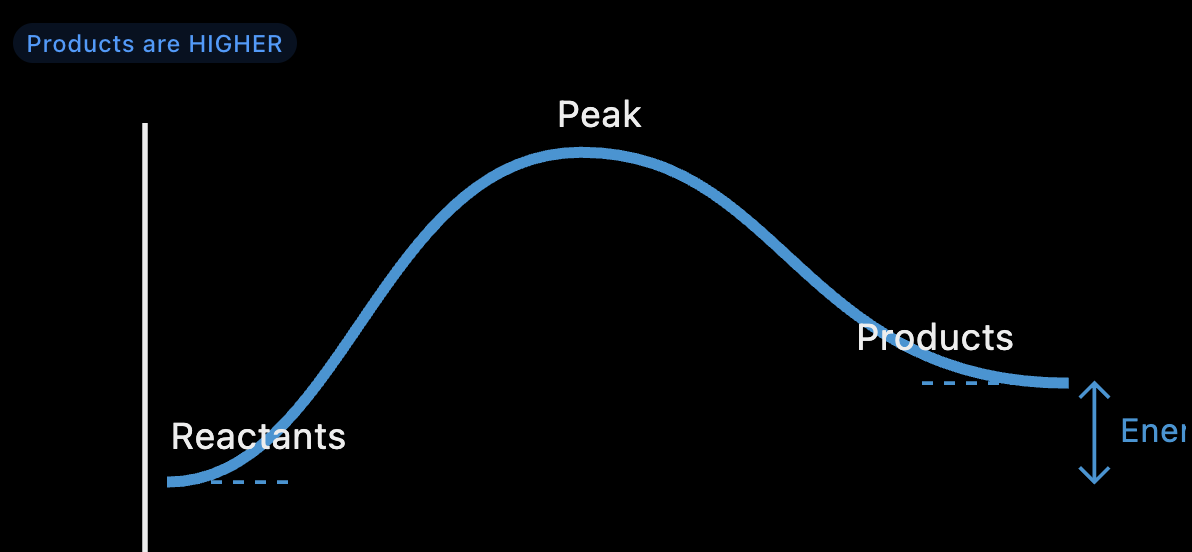
Don't get distracted by the shape of the hill!
Just compare the starting point (reactants) to the ending point (products).
Products LOWER = EXOTHERMIC.
Products HIGHER = ENDOTHERMIC.
7. Your TEAS cheat sheet
Save these definitions because these are the important words to memorize.
Term | Remember it as |
|---|---|
Exothermic | Energy OUT |
Endothermic | Energy IN |
Reactants | START |
Products | END |
Activated complex | TOP of the hill |
Transition state | Another name for the TOP |
Activation energy | Energy needed to reach the TOP |
Energy released/absorbed | Difference between START and END |
One more important detail:
Activation energy is NOT the same as energy released or absorbed.
Activation energy = reactants → peak.
Overall energy change = reactants → products.
Exo = energy exits.
Endo = energy enters.
Activated complex = top of the hill.
Activation energy = energy needed to reach the top.
1. In an exothermic reaction, what happens to energy?
Energy leaves the reaction
Exo = exits. Energy leaves the reaction.
2. What does the activated complex represent?
The highest-energy point
The activated complex is the temporary arrangement at the peak of the energy diagram.
3. What is activation energy?
Energy needed to reach the activated complex
Activation energy is the energy needed to get from the reactants to the peak.
4. Products are HIGHER in energy than reactants. What type of reaction is this?
endothermic
Higher-energy products mean energy was absorbed.
5. What is another name for the activated complex?
Activated complex and transition state are two names for the same thing.
When iron reacts with oxygen, iron (III) oxide , also known as rust, forms according to the equation below. The iron (III) oxide has less energy than the iron and oxygen. How is reaction classified, and why?
It is exothermic because energy is released.
It is exothermic because the reactants must release energy to form a product that has less energy.
1. MIXTURES: What happens when things are combined?
A mixture is when two or more substances are put together WITHOUT chemically changing into a new substance.
Think about putting cereal and raisins in a bowl.
Cereal is still cereal.
Raisins are still raisins.
They are just together!
That's a mixture.
MEMORY TRICK: MIXTURE = MIX, NOT CHANGE.
There are TWO main types of mixtures.
2. Homogeneous vs. heterogeneous
HOMOGENEOUS = EVEN
Everything is mixed evenly. You cannot easily see the different substances.
Examples:
Salt water
Sugar water
Air
Memory: HOMO = SAME throughout.
HETEROGENEOUS = UNEVEN
The substances are not evenly mixed. You can see different parts or regions.
Examples:
Oil and water
Salad
Sand and water
Memory: HETERO = DIFFERENT parts.
TEAS SECRET:
Looks the SAME throughout? → Homogeneous.
Has DIFFERENT visible parts? → Heterogeneous.
3. SOLUTIONS:
Solute vs. solvent
A solution is a homogeneous mixture where one substance dissolves into another.
Think about making lemonade!
There are TWO important words:
Word | Easy meaning | Lemonade example |
|---|---|---|
Solute | What gets dissolved | Sugar |
Solvent | What does the dissolving | Water |
Solution | The finished mixture | Lemonade |
Memory tricks:
SOLUTE = substance being dissolved.
SOLVENT = does the dissolving.
SOLUTION = finished result.
Think: Sugar goes INTO the water. The water dissolves the sugar.
4. Concentration: Unsaturated vs. saturated
First, what is concentration?
Concentration = how much solute is in a certain amount of solution.
Imagine adding sugar to a glass of water.
Now learn these two words:
UNSATURATED = NOT FULL
Can dissolve MORE
The water can still dissolve additional sugar.
SATURATED = FULL
At its dissolving limit
The water has reached the maximum amount of sugar it can dissolve under those conditions.
Extra sugar will remain undissolved.
MEMORY TRICK:
UN-saturated = NOT full.
SATURATED = FULL.
Imagine a parking lot:
Unsaturated = empty parking spaces.
Saturated = no more parking spaces!
5. LAW OF CONSERVATION OF MASS
Matter cannot be created or destroyed. It can only change forms.
Let's make that easy.
Imagine you have:
2 pieces of bread
1 slice of cheese
You make a sandwich.
You didn't magically create more food. You just rearranged what you already had!
Chemical reactions work the same way.
Atoms can rearrange, but they don't magically disappear or appear in an ordinary chemical reaction.
MEMORY TRICK: SAME ATOMS, NEW ARRANGEMENT.
Example:
If a reaction starts with:
4 hydrogen atoms
2 oxygen atoms
The products must still contain:
4 hydrogen atoms
2 oxygen atoms
Nothing disappears!
TEAS TIP: If a question asks which law says matter cannot be created or destroyed, the answer is the Law of Conservation of Mass.
6. CHEMICAL REACTIONS
A chemical reaction happens when substances change into new substances.
There are two important words:
Word | Easy meaning |
|---|---|
Reactants | Starting substances |
Products | New substances formed |
Think:
REACTANTS → PRODUCTS
The arrow means "turn into" or "produces."
Example:
Reactants → Products
Starting materials new substance
The reaction changes the starting substances into new substances.
What is a chemical equation?
A chemical equation is just a way to WRITE a chemical reaction using chemical formulas and symbols.

Let's translate it:
H₂ = hydrogen gas.
O₂ = oxygen gas.
H₂O = water.
Arrow = produces.
So hydrogen and oxygen react to make water!
7. Balancing chemical equations
Remember the law of conservation of mass?
This is WHY we balance chemical equations.
We need the SAME number of each type of atom on BOTH sides.
Let's look at the equation:
Count the atoms:
Atom | Left side | Right side |
|---|---|---|
Hydrogen (H) | 4 | 4 |
Oxygen (O) | 2 | 2 |
Everything matches!
Important: Coefficients vs. subscripts
2H₂O
Big 2 in front = coefficient. It means TWO water molecules.
Little 2 after H = subscript. It means TWO hydrogen atoms in EACH water molecule.
O has no little number, so it means ONE oxygen atom in each molecule.
Total:
4 hydrogen atoms.
2 oxygen atoms.
MEMORY TRICK:
BIG number in front = how many molecules.
LITTLE number below = how many atoms of that element.
TEAS RULE: When balancing, change the BIG numbers (coefficients), NEVER the little numbers (subscripts).

8. FIVE TYPES OF CHEMICAL REACTIONS
1. Synthesis = COMBINE
Two or more substances join together to make ONE product.
Pattern: A+b→ AB
Think: Two things become ONE.
Example: Two puzzle pieces joining together.
Memory: SYNTHESIS = PUT TOGETHER
2. Decomposition = BREAK APART
One substance breaks into TWO or more simpler substances.
Pattern: AB→ A+B
Think: One big thing breaks into smaller pieces.
Memory: DECOMPOSITION = BREAK DOWN
3. Single replacement = ONE TAKES OVER
One element replaces another element in a compound.
Pattern:
A+BC→ AC+ B
Memory: SINGLE = ONE REPLACES ONE
4. Double replacement = SWITCH PARTNERS
Two compounds exchange parts (ions).
Pattern:
AB+ CD→ AD+ BC
Think: Two couples switch partners!
Memory: DOUBLE = TWO EXCHANGE
5. Combustion = BURNING
A substance reacts with oxygen, releasing energy.
For the common TEAS pattern of hydrocarbon combustion:
hydrocarbon+02→ CO2+H20
Think: Burning fuel.
Examples:
Burning gasoline.
Burning natural gas.
Memory: COMBUSTION = BURNING + OXYGEN
The easiest comparison table EVER
Reaction | What happens? | Remember |
|---|---|---|
Synthesis | Things join | PUT TOGETHER |
Decomposition | Things split | BREAK APART |
Single replacement | One takes a place | ONE SWITCH |
Double replacement | Two exchange partners | TWO SWITCH |
Combustion | Reacts with oxygen | BURN |
9. ENERGY DIAGRAMS
show how energy changes during a chemical reaction.
Remember our two types:
Type | What happens? | Products |
|---|---|---|
Exothermic | Energy goes OUT | LOWER energy |
Endothermic | Energy goes IN | HIGHER energy |
There are three more words you need to know:
Word | Easy meaning |
|---|---|
Activation energy | Energy needed to get started |
Activated complex | Highest point of the hill |
Transition state | Another name for activated complex |
Remember the hill:
Reactants = beginning.
Peak = activated complex.
Climbing up = activation energy.
Products = ending.
TEAS SECRET: Compare the reactants and products, NOT the peak, to determine whether the reaction is endothermic or exothermic.
10. THE ONE-PAGE MASTER CHEAT SHEET
This is the part to memorize before your TEAS!
CHEMISTRY: MUST-MEMORIZE
MIXTURES
Mixture = substances physically combined.
Homogeneous = evenly mixed, same throughout.
Heterogeneous = unevenly mixed, different parts.
SOLUTIONS
Solution = solute + solvent.
Solute = gets dissolved.
Solvent = does the dissolving.
Concentration = amount of solute in a given amount of solution.
Unsaturated = can dissolve MORE.
Saturated = reached its limit.
CONSERVATION OF MASS
Matter cannot be created or destroyed.
Same atoms before and after a chemical reaction.
Atoms can rearrange.
CHEMICAL REACTIONS
Reactants = START.
Products = END.
Chemical equation = written representation of a reaction.
Balanced equation = same number of each atom on both sides.
Coefficient = big number in front.
Subscript = little number below.
FIVE REACTION TYPES
Synthesis = JOIN.
Decomposition = BREAK.
Single replacement = ONE switches.
Double replacement = TWO switch.
Combustion = BURN + oxygen.
ENERGY
Exothermic = energy OUT.
Endothermic = energy IN.
Activation energy = energy needed to start.
Activated complex = PEAK.
Transition state = another name for activated complex.
1. A mixture that is evenly mixed is called what?
Homogeneous/
homo=same
2. In lemonade, what is the sugar?
solute
3. A solution that can dissolve more solute is:
unsaturated
4. What law says matter cannot be created or destroyed?
Law of conservation of mass
5. What are the starting substances called?
Reactants = starting materials.
6. What type of reaction combines substances?
Synthesis = putting together.
7. One compound breaking apart is:
Decomposition = breaking down.
8. One element taking another's place is:
Single replacement = one element replaces another.
9. A reaction that burns a fuel with oxygen is:
combustion