Quantitative Research Designs
 Call Kai
 Learn
 Practice Test
 Spaced Repetition
 Match
 Flashcards
 Knowt Play
1/22

There's no tags or description
Looks like no tags are added yet.
23 Terms
Research designs for PICO
RCT
Cohort analytic study
Single group pre/post-test design
Case-control study
Research designs for PECO
cohort study
case control study
cross sectional study
RCT
Random assignment of participants (random allocation)
There can be continous outcomes or discrete outcome
Continous outcome RCT
Numerical variable where measurements can take any value along a continuum

Discrete outcome RCT
Refers to when there is only two possible values like outcome vs no outcome
Strengths of RCT
Random allocation
Temporality where exposure precedes outcome
Weaknesses of RCT
Costly
Time is required for follow up
Patients that agree to participate may differ from target population (generalizability)
Not always ethical or feasible
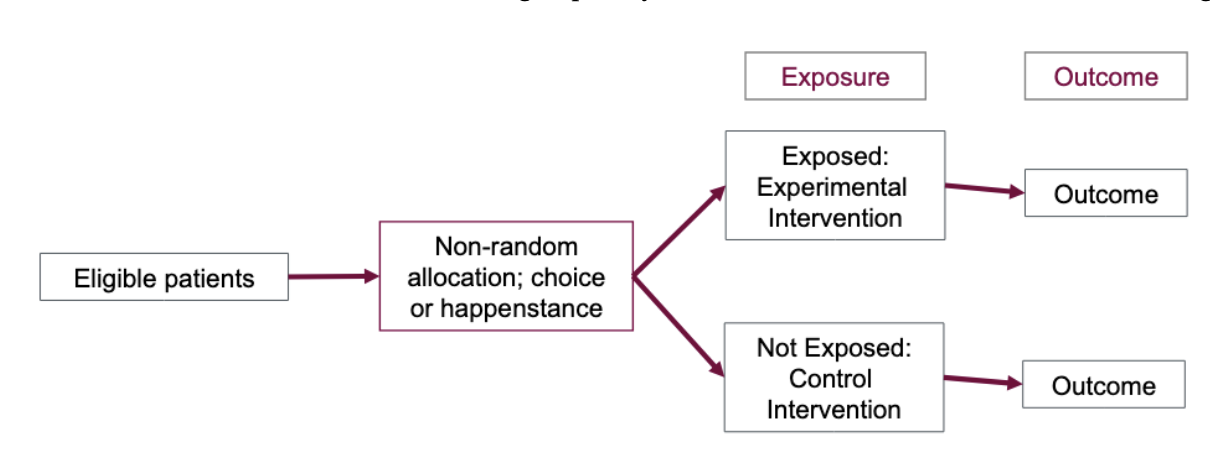
Cohort analytic study
Compares an expiremental and controul group when random allocation is not feasible or ethical
Strengths of cohort analytic study
Potentially less costly and more feasible than an RCT
Exposure precedes outcome - temporality
Weaknesses of cohort analytic study
costly
selection bias where groups may differ in ways other than exposure to the intervention
baseline differences where groups may differ in characteristics before intervention began
single group pre/post-test design
used when it is not possble to have a comparison or control group (experiemental and control group are the same)
outcomes are measured prior to and after an intervention
case control study
compares people who have a specific outcome or disease with people do not have outcome to look retrospectively at past exposures
can determine if the exposure is associated or correlated with the outcome but cannot confirm that the intervention causes the outcome
two group, post-test only design
measures outcome data (post-test) in participants following exposure to the intervention
cohort study
follows a sample forwards in time (prospectively) or backwards in time (retrospectively) to see if they are exposed to the exposure of interest and if they develop the outcome of interest
no random allocation

strengths of cohort study
good for studying rare exposures
temporality
multiple outcomes
best for evaluating risk factors
weaknesses of cohort study
lack of a control group
inefficient for studying rare outcomes
follow up takes a long time
contamination where long follow ups could mean that other factors could cause certain outcomes
case-control study
identifies participants with AND without outcome of interest and looks retrospectively to collect data about participant exposure to a certain risk factor

strengths of case-control study
quicker and more cost-efficient than cohort study
good for study of rare OUTCOMES and common EXPOSURES
includes control group
can examine multiple exposures
weaknesses of case control study
difficult to obtain temporality
difficult to obtain accurate information on exposure
cannot examine multiple outcomes
cross sectional study
follows participants throughout life at the same point in time for each participant
measures exposure and outcome data
descriptive cross sectional survey
group of people interviewed/asked to complete a survey to determine whether they have experienced an exposure of interest and an outcome of interest
strengths of descriptive cross sectional survey
cost efficient and quick
good for exploratory research phase where potential causal factors can be identified
weaknesses of descriptive cross sectional survey
no temporality
difficult to obtain exposure information
there may be no control group