Tropospheric chem
 Call Kai
 Learn
 Practice Test
 Spaced Repetition
 Match
 Flashcards
 Knowt Play
1/16

Earn XP
Description and Tags
L2
17 Terms
what are the differences of reactions that happen in the troposphere and the stratosphere?
troposphere
has active weather which mixes the air relatively fast
contains much more water vapour than stratosphere
the amount of UV radiation reaching the troposphere is much less
because much of the short wave radiation is filtered out by the ozone layer
Define photolysis/photodissociation.
a chemical reaction in which a compound in the atmosphere is broken down by light.
light with a short wavelength had more energy and so more effective at breaking down atmospheric molecules
in the troposphere, most of the photolysis reactions occur under the influence of uv light
photolysis of Ozone occurs
Photolysis of O3
reaction:
O3 + hv (λ<310 nm) → O2 + O·
O· + O2 → O3
O· + H2O(g)→ 2OH·
radicals(molecules with an unpaired electron) are normally very reactive and remain in the atmosphere for fraction of a second
How are hydroxyl radicals formed?
O3 + hv (λ<310 nm) → O2 + O·
O· + O2 → O3
some O· encounter a H2O molecule
O· + H2O(g)→ 2OH·
the OH radicals live short but can oxidise many compounds in our atmosphere.
What are the pollutants in our atmosphere that are oxidised by hydroxyl radicals?
OH· + CO → CO2 + H·
OH· + CH4 →02 H2O + CH3O2· (methylperoxy radical)
OH· + NO2 → HNO3
OH· + C5H8 (isoprene) →02 H2O + C5H7O2·
OH is the cleansing agent of our atmosphere
Why is oxidation a primary process in the atmosphere?
primary process that removes trace gases, such as CH4, CO, and VOCs
most important in troposphere where most trace gas species are emitted and undergo chemistry.
What is the short lifetime of OH determined by?
determined by the concentration (ni) and rate constants (ki) of all constituents that react with OH:
𝛕OH = 1/ ∑i kini
Photolysis of NOx.
NO2 + hv (λ<420 nm) →JNO2 NO + O·
first order chemical loss. Meaning that the removal rate of a gas depends on the amount of gas present:
JNO2[NO2] = d[NO]/dt = d[O·]/dt = -d[NO2]/dt
What 3 factors determines photolysis frequency?
the intensity of light (actinic flux)
the cross section sigma: the ability of a molecule to absorb a photon with λ
the quantum yield: the probability of a molecule breaking after absorbing a photon
photolysis stops at night because no uv photons are available
peaks at midday when the actinic flux is maximised
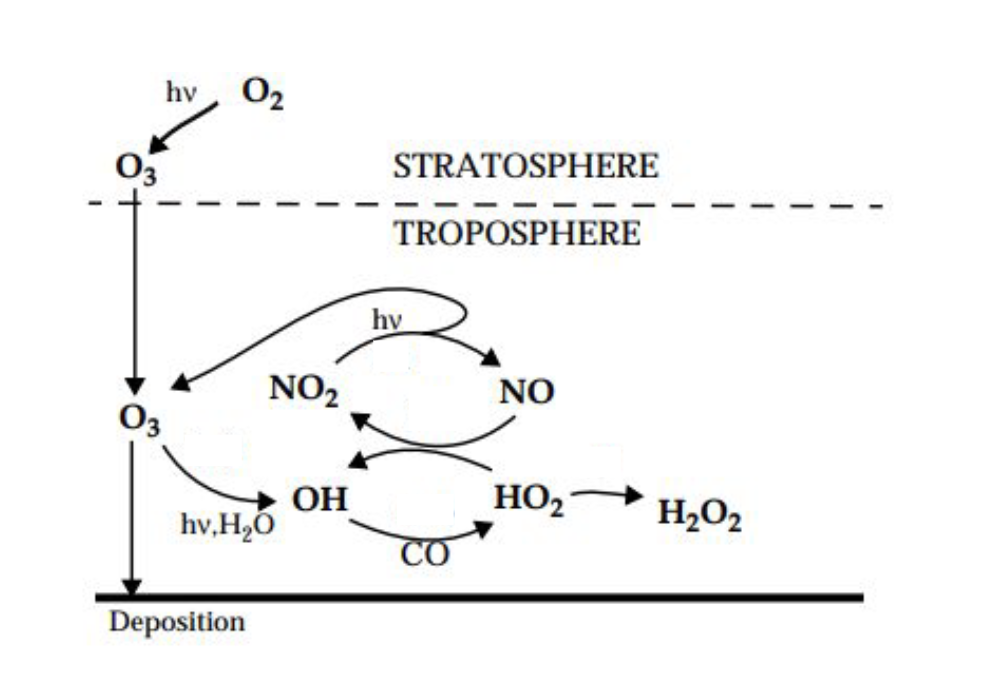
Explain the formation of ozone in the troposphere.
with NOx present:
CO + OH· → CO2 + H·
H· + O2 → HO2·
HO2· + NO → NO2 + OH·
NO2 + hv → NO + O·
O· + O2 → O3
Net: CO + 2O2 → CO2 + O3
without NOx:
CO + OH· → CO2 + H·
H· + O2 → HO2·
HO2· + O3 → 2O2 + OH·
Net: CO + O3 → CO2 + 2O2
Chemical mechanisms when the emission mixture is high VOC and low NOx.
Low NOx pathway: RO2 + HO2 becomes more likely
CH3O2 + HO2 → CH3OOH + O2 (low NOx pathway)
CH3O2 + NO → CH3O + NO2 (high NOx pathway)
less efficient formation of ozone
Chemical mechanisms when the emission mixture is medium VOC and medium NOx.
high NOx pathway: RO2/HO2 + NO2 becomes more likely:
CH3O2 + HO2 → CH3OOH + O2 (low NOx pathway)
CH3O2 + NO → CH3O + NO2 (high NOx pathway)
efficient formation of ozone
Chemical mechanisms when the emission mixture is low VOC and high NOx.
OH has to compete between NO2 and VOC
OH + VOC → RO2 + H2O
OH + NO2 → HNO3
thus: NO + O3 → HNO3 becomes dominant
Ozone titration effect

Explain this graph.
shows how ground-level (tropospheric) ozone is created when sunlight drives chemical reactions between two main precursors: VOCs and NOx
The NOx limited regime:
ozone production is strictly limited by how much NOx is available
more NOx → Ozone up. Changing VOCs has very little effect.
typically occurs in rural /remote areas with clean air
The VOC limited / NOx saturated regime
ozone production is limited by VOCs
more NOx → suppresses or titrate ozone
if reduce NOx → ozone levels temporarily increase
reduce VOC emissions → to successfully lower ozone pollution
typically occur in urban/city environemnts with heavy traffic and industry
What is photochemical smog and what are the main reactions that contribute to its formation?
a mixture of pollutants that are formed when NOx and VOCs react to sunlight, creating a brown haze over cities
often occur in summer because most sunlight
reactions:
O3 + hv (λ<310 nm) → O2 + O·
O· + O2 → O3
O· + H2O(g)→ 2OH·
OH + VOC → RO2
RO2 + NO → NO2. and reform OH
NO2 + hv → NO + O
O + O2 → O3
How can a location or weather influence the formation of photochemical smog?
topography
valley bowl causes smog
blocks the wind and restrict air movement
meteorology
during an inversion: a layer of warm air settles on top
trapping cooler air