Bild 2 Lecture 12
 Call Kai
 Learn
 Practice Test
 Spaced Repetition
 Match
 Flashcards
 Knowt Play
1/10

There's no tags or description
Looks like no tags are added yet.
11 Terms
Open Circulatory System
Hemolymph (invertebrate fluid) pumped by heart —> arteries that empty into hemocoel (invertebrate open cavity)
Fluid in hemocoel bathes cells directly
insects, crustaceans, arachnids, gastropods , bivalves
Closed Circulatory System
blood travels away from heart into arteries through capillaries
blood travels back to heart through veins
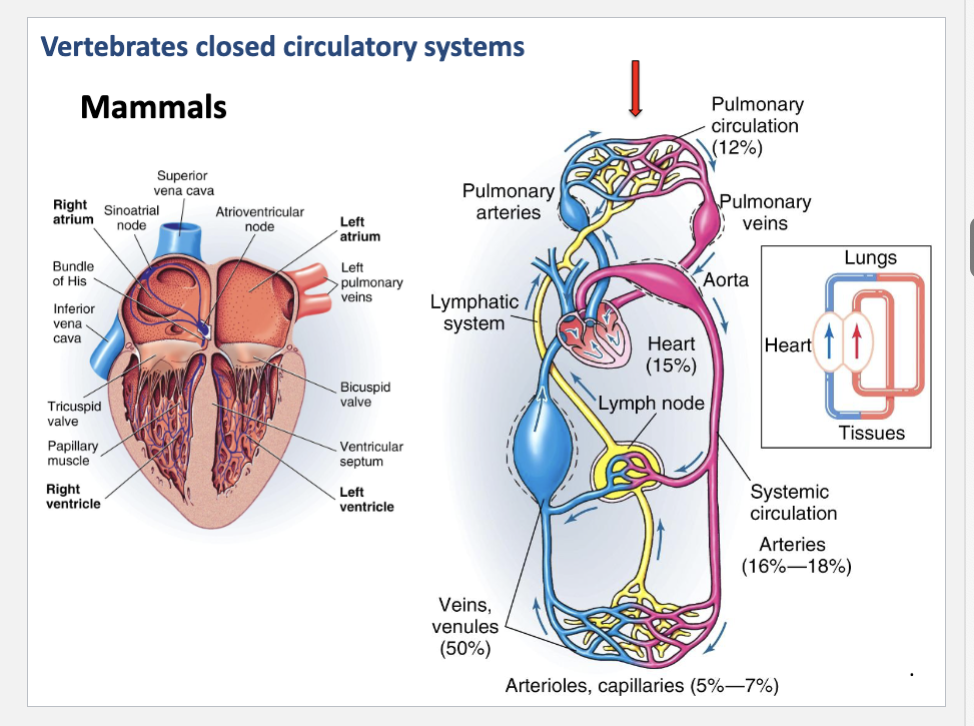
Single Circulation
Single: sends blood through the heart once per cycle
fish : Blood moves from the heart to the gills for oxygenation, then directly to body tissues before returning to the heart.
Double circulation
Pathway: Blood passes through the heart twice per complete circuit via two loops:
Pulmonary circulation: Carries deoxygenated blood from the heart to the lungs and returns oxygenated blood to the heart.
Systemic circulation: Pumps oxygenated blood from the heart to body tissues and returns deoxygenated blood to the heart.
mammals, birds, reptiles
Blood Vessels
arterial circulation: pressure reservoir
venous circulation: volume reservoir
Veins
carry blood towards heart
Arteries
carry blood away from heart (elastic)
Venules
connect veins and capillaries
Arteriorles
connect arteries and capillaries
resistance vessels

How blood moves through blood vessels
Pressure creates by contracting muscles is trasnferred to blood
Driving pressure : created by ventricles (ventricle pumps blood)
Blood flows from higher pressure to lower pressure gradient
higher pressure gradient : greater fluid flow
Cardiac Cycle (Contraction and Relaxation)
Systole: Contraction Phase
Diastole: Relaxation Phase
Electric Conduction System of the Heart
Sinoatrial Node (SA)
signal for contractiopn
sets rhythm for heart beat
Atrioventricular Node (AV)
between atria and ventricles
delay signal (slows down impulse of electrical signal coming from SA)
Bundle of His
bridges atria and ventricles
spread depolarization ( electrical wave that triggers contraction)
Purkinje Fibers
rapid depolarization
trigger coordinated ventricular contraction
Spread of Depolarization in Myocardial Cells
SA authorthymic cells spontanouelsy fire action potentials.
depolarizations of the autorhythmic cells spread rapidly to ajacent contractile cells thru gap junctions
ECG
P Wave: Atrial Depolarization
P-R segment: Delay in AV node
Qrs Complex: ventriculardepolarization
T wave: ventricular repolarization
Cardiac Output, Heart Rate, Stroke volume
Cardiac Output: volume of blood pumped into systemic circulation per minute
Heart rate: BPM
Stroke volume: amount of blood pumped in single contraction,